 By • Published on May 7, 2026 • 13 min read • 4,318 views
This article is for informational and educational purposes only and does not constitute medical advice. Always consult with a qualified healthcare professional before using symptom information to make diagnosis or treatment decisions.
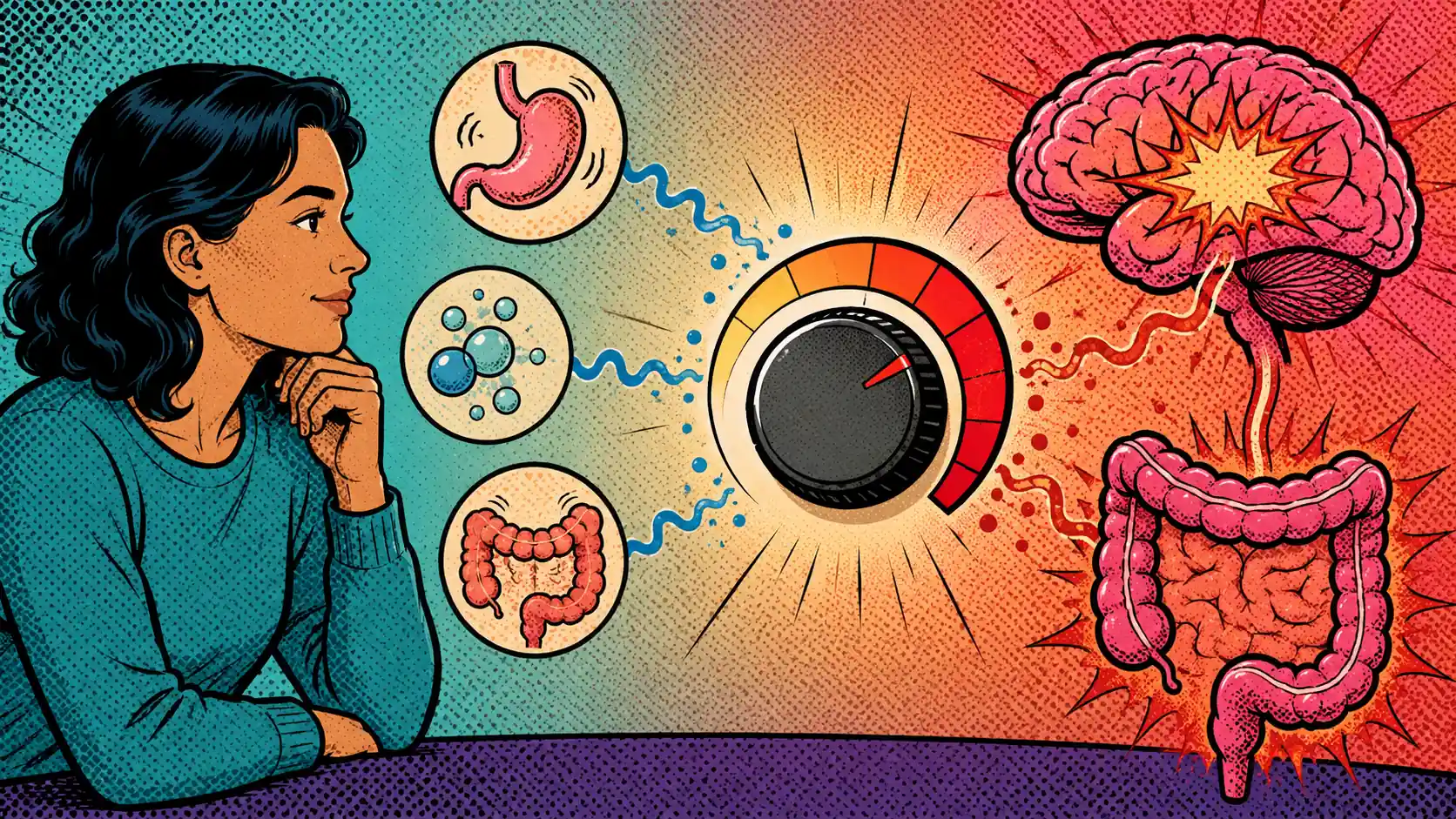
Some IBS pain feels bigger than the gut event that seemed to trigger it. A little gas moves. A bowel contraction happens. A meal sits normally in the gut. Then the pain arrives with a force that makes the body feel unsafe. That does not mean the pain is fake. It means the useful question may be what turned the signal volume up.
Visceral hypersensitivity in IBS is the name for a pattern where internal gut signals are felt as stronger, more painful, or more threatening than expected. It can help explain why normal digestion can feel painful, especially when stress, poor sleep, anticipation, prior flares, or gut-brain pain processing make the same signal feel louder.
That explanation needs a safety boundary. Visceral hypersensitivity is not a reason to ignore new, severe, progressive, or red-flag pain. If abdominal pain comes with bleeding, black stool, fever, persistent vomiting, unexplained weight loss, anemia, severe new pain, or an obstruction-like pattern, start with evaluation, not a mechanism theory.
This page sits between the broad microbiota-gut-brain axis map and the deeper pain volume pattern page. It is for the reader who needs the plain-language bridge first: how can ordinary gut signals hurt this much?
Important: This article is educational. It cannot diagnose IBS, explain every abdominal pain pattern, or replace clinician-guided care.
IBS is a disorder where repeated abdominal pain occurs with changes in bowel movements, such as diarrhea, constipation, or both. NIDDK explains that IBS symptoms occur without visible signs of damage or disease in the digestive tract on routine evaluation 1.
That last part is where many readers get stuck. If tests do not show visible damage, why does the pain still feel so physical?
Visceral hypersensitivity is one answer. "Visceral" refers to internal organs, including the gut. "Hypersensitivity" means the sensory system is responding too strongly. In plain language, gut signals that might be mild, background, or manageable for one person can register as sharp, urgent, or threatening for another.
That does not make IBS pain imaginary. Pain is produced by the nervous system, but it is still a real body experience. Reviews of IBS and visceral hypersensitivity describe the pattern as involving both local gut mechanisms and central nervous system processing 2 3.
Two terms can help, if they stay simple:
The practical question is not "Is this all sensitivity?" It is "Does my pattern look like pain amplification, and have I ruled out the reasons this pain needs evaluation first?"
Digestion is not silent. The gut stretches after meals. Gas moves. Muscles contract. Stool moves through the colon. Sensory nerves send information toward the spinal cord and brain. Most of the time, those signals stay in the background.
With visceral hypersensitivity, the same kinds of signals may feel louder.
Gas does not have to be dangerous to feel uncomfortable. A bowel contraction does not have to be abnormal to be noticed. Post-meal fullness does not have to mean the gut is damaged. These are normal signals moving through a sensory system.
The problem starts when the signal is interpreted as more intense than the event itself. That can happen at more than one level:
This is why the enterochromaffin cells and serotonin page is a useful sibling, not a replacement for this one. EC-cell serotonin signaling is one lane in the gut-pain story. It is not the whole map.
Pain is not a simple readout of tissue damage. It is an output of sensory processing. That is why two people can have similar gut events and very different pain experiences. It is also why the same person can have a tolerable meal on one day and a painful one on another.
Rome Working Team brain-imaging work describes disorders of brain-gut interaction as involving gut symptoms related to combinations of motility disturbance, visceral hypersensitivity, immune or mucosal changes, microbiota changes, and central processing 4. That kind of model does not say the pain is "mental." It says the gut, nerves, immune signals, and brain interpretation can all sit in the loop.
This distinction matters because it changes the next step. If pain is being amplified, the answer may not be another diet reset. It may be a better IBS treatment plan, a gut-brain therapy conversation, sleep and stress support, or clinician-guided discussion of pain-modulating medicines.
That is not the same as treating pain casually. It is matching the route to the mechanism.
Visceral hypersensitivity is useful only when it stays in its lane. It should not swallow every abdominal pain question.
| Pattern | What it often looks like | Better next route |
|---|---|---|
| Food intolerance | A reproducible food, dose, or FODMAP pattern | Food-tolerance or low-FODMAP troubleshooting |
| Visceral hypersensitivity | Many ordinary gut events feel painfully loud | Gut-brain pain route and IBS treatment planning |
| Functional dyspepsia overlap | Early fullness, upper-abdominal pain, burning, nausea | Functional dyspepsia |
| Red-flag lower-GI pattern | Bleeding, anemia, weight loss, major bowel change | IBS vs colorectal warning signs |
| Obstruction-like pattern | Distension, vomiting, inability to pass stool or gas | Bowel obstruction pain patterns |
If one specific food reliably causes symptoms, food tolerance still matters. If pain is lower-left and new, severe, or associated with fever, urinary symptoms, pelvic symptoms, or a changed bowel pattern, the lower-left abdominal pain comparator may be the better next page.
If pain keeps pushing you toward more and more restriction even when the pattern is not food-specific, pause. That is the point where visceral hypersensitivity becomes a useful route. The question changes from "What else should I remove?" to "Why is the pain system so sensitive, and what treatment route fits that?"
The microbiota-gut-brain axis is the broader signaling map. It includes neural, immune, endocrine, serotonin, and metabolite pathways. Visceral hypersensitivity is one practical symptom pattern inside that larger map.
Microbiome research belongs here, but with restraint. Reviews describe microbiota-neuroimmune cross-talk and stress-related gut-brain mechanisms as plausible contributors to visceral pain signaling 5. Mast-cell, permeability, and immune mediator research also offers plausible routes for sensory nerve sensitization in some IBS contexts 6.
But plausible biology is not the same as a consumer treatment map.
This article does not recommend stool testing, probiotic guessing, or a "dysbiosis" explanation as the first move. The current evidence is better used as a way to understand why the pain system might be sensitized, then choose a reasonable next clinical route.
That is also why this page does not preserve old WordPress "pain management" or "gut bacteria symphony" framing. The useful fragments are the claim lanes. The modern article role is routing.
Once safety is checked and the pattern looks like pain amplification, the next step is not one universal fix. It is a better conversation.
NIDDK describes IBS treatment as potentially including diet and lifestyle changes, medicines, probiotics, and mental health therapies, with the plan matched to the person 7. The ACG guideline also supports a structured IBS management approach rather than one mechanism explaining every treatment choice 8.
Diet still matters when there is a clear food pattern, a FODMAP dose issue, or constipation / diarrhea routing that responds to food structure. But if food rules keep expanding while pain stays loud, the diet may no longer be the main lever.
That is when the conversation should widen.
Gut-directed therapies are not a way of saying pain is psychological. They are used because gut-brain signaling and pain processing are part of the symptom loop. NCCIH notes that hypnotherapy may help IBS symptoms for some people, while also keeping the evidence bounded 9.
Use gut-directed hypnotherapy for IBS if your main question is whether a brain-gut behavioral therapy fits your pattern.
Some readers need a clinician conversation about medicines that target pain processing, bowel pattern, or both. That belongs in an individualized plan, not in a self-treatment checklist. Use IBS treatment options when you need the broader treatment map.
If the pattern is specifically stress-sensitive or persistent after stool pattern improves, the deeper route is stress, sex, and chronic visceral pain. If the pattern is urgency-heavy and diarrhea-dominant, serotonin and IBS-D may be the cleaner lane.
Download: Visceral Pain Pattern Tracker Use this one-page tracker before deciding whether the pain is mainly food-triggered, bowel-pattern related, stress-amplified, or different enough to need evaluation.
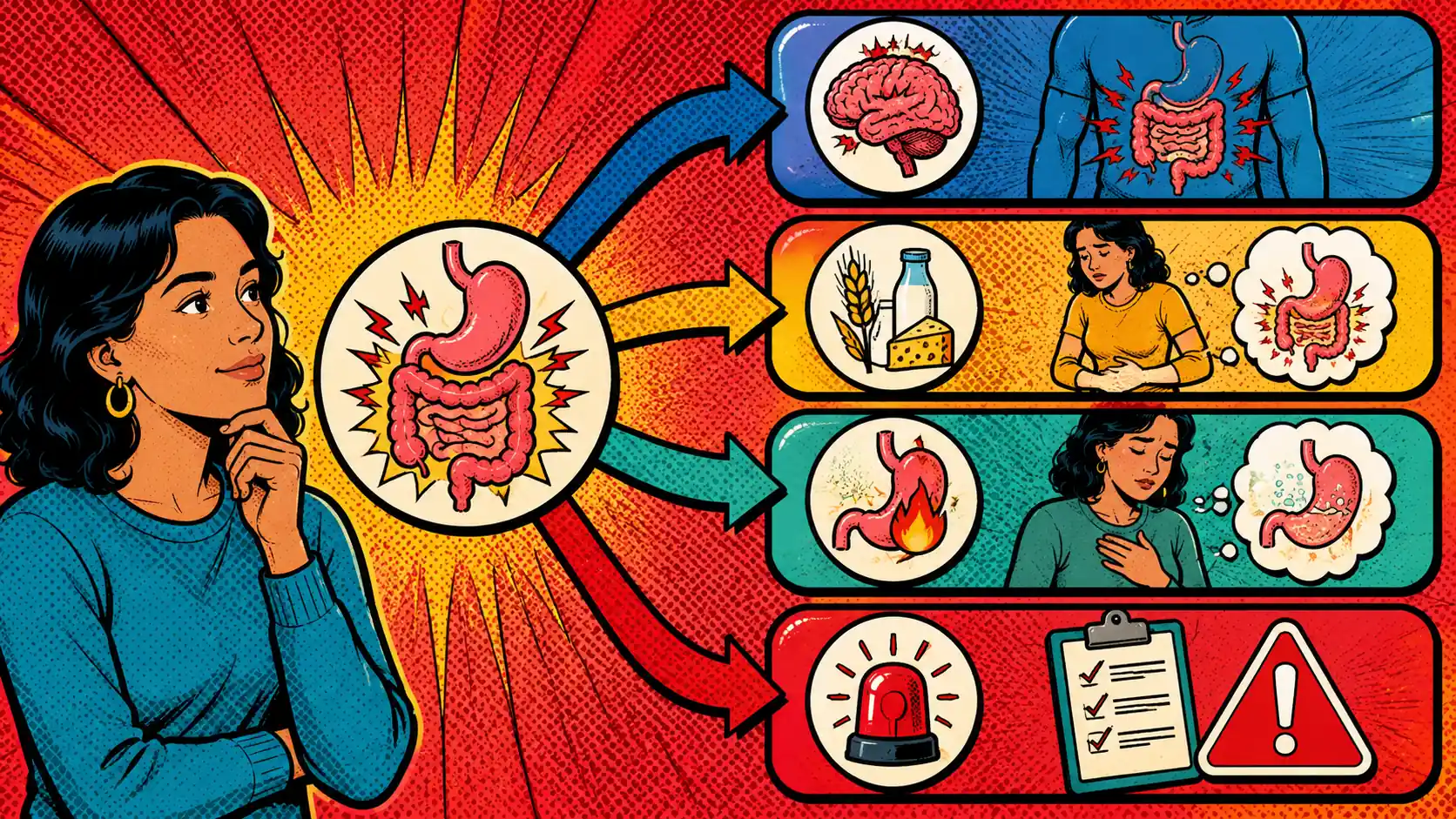
| Dominant question | Best next read | Why |
|---|---|---|
| I need the broad signaling map | Microbiota-gut-brain axis explained | It shows the neural, immune, serotonin, and metabolite lanes together |
| I want the serotonin / EC-cell lane | Enterochromaffin cells, serotonin, and gut pain signaling | It explains one cell-level bridge between gut inputs, urgency, and pain |
| Body scanning, fear predictions, and avoidance are turning up the pain or urgency loop | CBT for IBS anxiety, urgency, and gut-brain skills | It turns gut-brain insight into practical skills without saying symptoms are imaginary |
| Cramping or spasm-focused medication is the main question | Antispasmodics for IBS cramping | It separates cramping medication questions from broader pain-volume patterns |
| Stress or anticipation turns pain up | Stress, sex, and chronic visceral pain | It handles the deeper stress, hormone-context, and persistent pain layer |
| Pain volume rises during a broader midlife transition with new bowel changes | Menopause, perimenopause, and IBS symptoms | It keeps hormone context visible without letting it explain away a new pattern |
| Pain sensitivity travels with migraine, nausea, or headache patterns | Migraine and IBS overlap | It keeps gut-brain comorbidity separate from a simple food-trigger explanation |
| Upper-GI fullness or burning dominates | Functional dyspepsia | It separates upper-stomach pain and fullness from lower-GI IBS patterns |
| Urgency and diarrhea dominate | Serotonin and IBS-D | It focuses on fast-transit and urgency-heavy IBS-D routing |
| Pain is cycle-timed, pelvic, sex-related, urinary, or progressive | IBS, endometriosis, or pelvic pain | It keeps pelvic safety boundaries visible before treating pain only as sensitivity |
| Warning signs or changing symptoms dominate | IBS vs colorectal warning signs | It keeps safety evaluation ahead of gut-brain interpretation |
Download: IBS Pain Discussion Guide Use this guide to bring a clearer pain-pattern conversation to a clinician instead of arriving with only "my IBS pain is bad."
Do not route every pain flare into visceral hypersensitivity.
Get medical evaluation when pain is:
Those symptoms are not "maybe later" details. They change the route. IBS and visceral hypersensitivity are real, but they do not make warning signs safe.
When body alarm overlaps with prior difficult care, IBS and trauma-informed care can help separate real pain, consent needs, and medical evaluation.
Visceral hypersensitivity in IBS is a pain-volume idea. It helps explain why normal gut signals such as stretch, gas movement, bowel contractions, or post-meal activity can feel painful when the sensory system is sensitized. That pain can be real even when routine tests do not show visible damage.
The next move is not endless restriction.
Use the pattern this way:
If pain sensitivity is the main pattern, bring that language into care. Ask about IBS treatment options, gut-brain therapies, stress-sensitive pain loops, and whether a clinician-guided pain-modulation route makes sense.
That is the practical value of the term. Not a label to carry alone. A better route.
If poor sleep or cycle timing makes the pain-volume pattern louder, use sleep and gut symptoms in IBS or menstrual cycle and IBS symptoms as the next context-specific bridge. The cycle page is the better route when the pain surge travels with bleeding days, ovulation timing, painful bowel movements, pain with sex, urinary symptoms, or pelvic-safety questions.
If the pattern is newer in midlife and travels with sleep disruption, pelvic clues, or medication changes, use menopause, perimenopause, and IBS symptoms instead.
Xam Riche is a gut health solopreneur and founder of YourFitNature, dedicated to helping people navigate digestive wellness through evidence-based information and personal experience. After years of struggling with IBS and bloating, Xam discovered the transformative power of the low FODMAP diet and now shares practical, science-backed guidance to help others find relief. While not a medical professional, Xam combines extensive research with lived experience to create accessible, empowering resources for the gut health community. Learn more about our mission
As an affiliate, we may earn from qualifying purchases.
Choose a focused guide for what you are noticing or deciding next.