 By • Published on May 27, 2026 • 9 min read • 1,825 views
This article is for informational and educational purposes only and does not constitute medical advice, nutrition counseling, or legal advice. Talk with a qualified clinician, GI dietitian, disability office, HR contact, or school support team for decisions about diagnosis, treatment, diet changes, and accommodations.
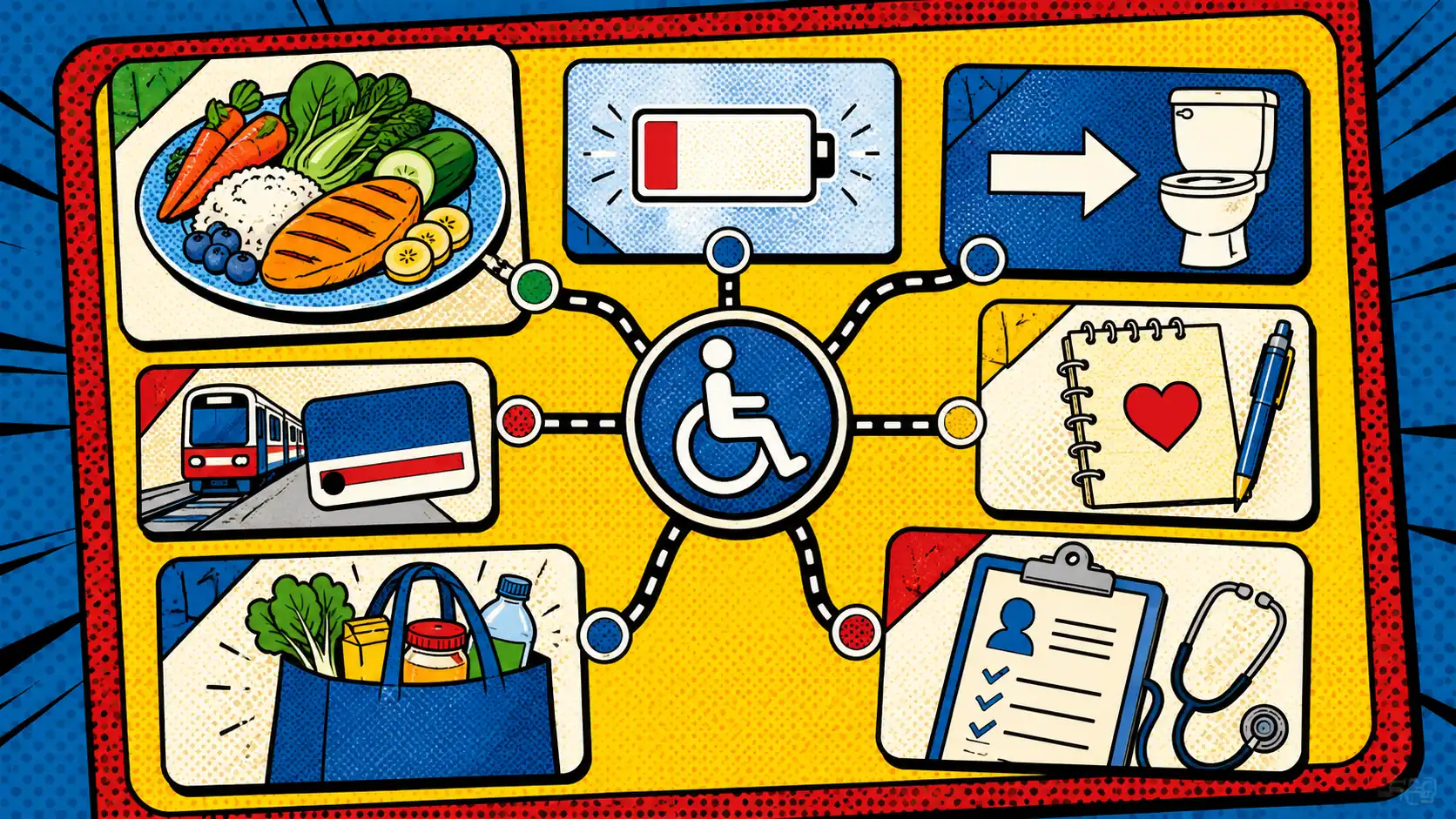
Sometimes the hardest part of IBS or low-FODMAP planning is not knowing the rules. It is having enough energy, mobility, money, kitchen access, bathroom access, transport, and support to follow them.
That changes the job. A plan that assumes a flexible schedule, a full grocery trip, a long prep session, and easy bathroom access may be technically correct and still unusable. If you live with disability, chronic pain, fatigue, mobility limits, unreliable transport, caregiver schedules, or support-worker handoffs, the question is not "How do I do low FODMAP perfectly?" The question is "What is the smallest plan that protects my gut, my access needs, and my real life?"
This page is the accessibility and disability planning layer. It does not decide whether you qualify for workplace, school, or disability support. It helps you separate food choices from access barriers so you can bring a clearer plan to a GI dietitian, clinician, caregiver, support worker, HR contact, or school support team.
IBS commonly involves repeated abdominal pain with bowel changes such as diarrhea, constipation, or both 1. That does not mean every bowel change belongs in a routine self-management plan.
Pause the food experiment and seek medical guidance if you have:
NIDDK lists dehydration risk and severe symptoms as reasons diarrhea needs medical attention, and it also flags constipation with vomiting, constant pain, or inability to pass gas or stool as concerning 2 3. If those signs are present, use doctor visit prep for IBS or urgent care guidance instead of tightening the diet.
Do not start by rewriting the entire food plan. Start by naming the constraint that most often breaks it.
| If the real bottleneck is... | Build this first | Route if it stays hard |
|---|---|---|
| Low energy or fatigue | One anchor meal, one snack, one freezer backup | Low-FODMAP meal prep |
| Mobility or pain with shopping | Delivery, pickup, shorter list, reachable storage | How to start low FODMAP |
| Bathroom access | First bathroom, backup bathroom, travel buffer | Bathroom anxiety route map |
| Work, school, or commuting logistics | Meal timing, supplies, support process | IBS at work, school, and commuting |
| Caregiver or support help | Written food list, portion notes, stop signs | Doctor visit prep |
| Active flare day | Smaller expectations, fluids, safer baseline | IBS flare plan |
CDC describes disability barriers as including physical, communication, attitudinal, programmatic, transportation, and policy barriers 4. That matters here because a diet plan can fail for reasons that are not about motivation. The store may be inaccessible. The kitchen may not be usable for standing prep. A bathroom may be too far away. A support worker may need clear instructions. A flare may make a normal plan unrealistic.
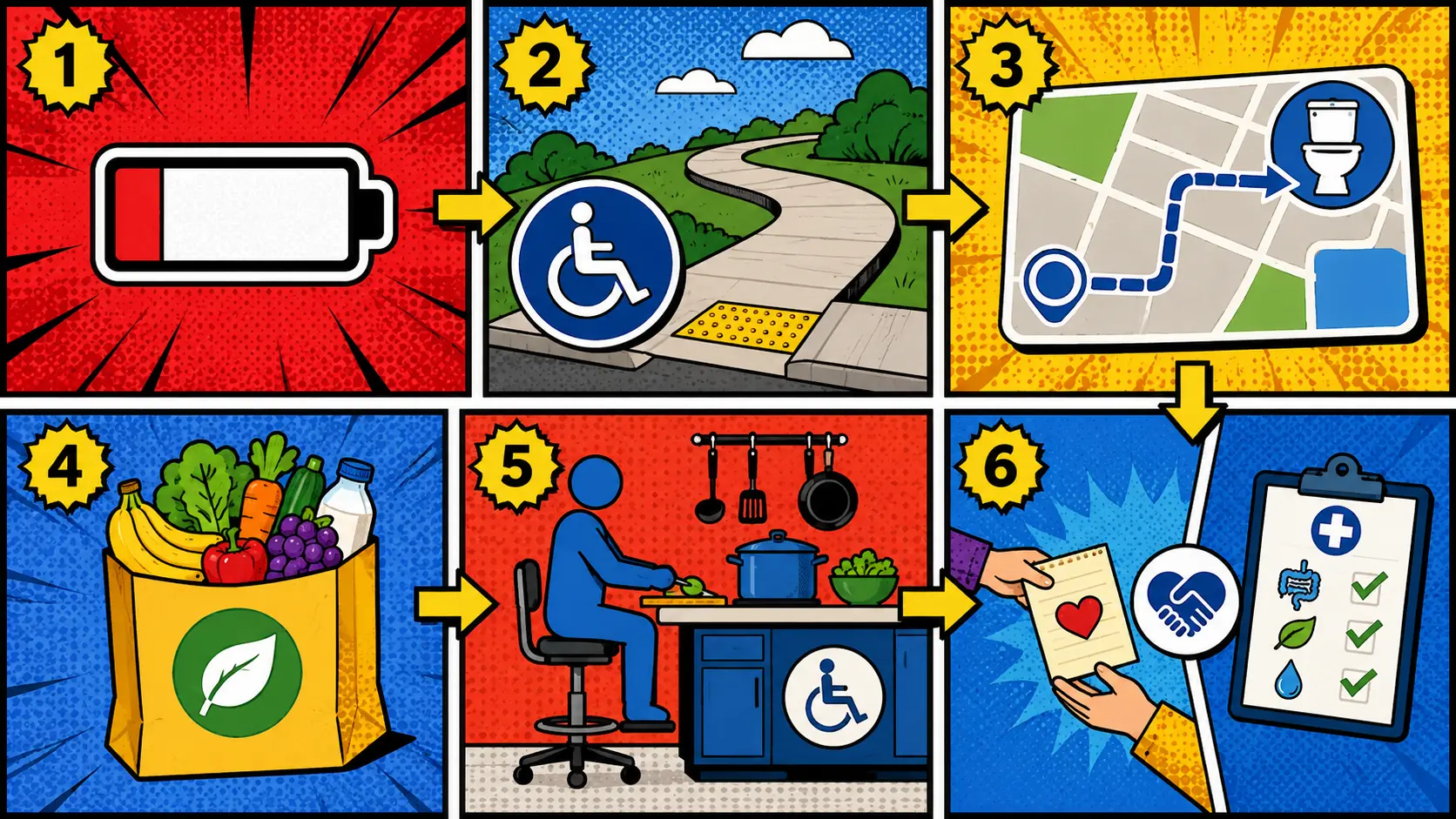
Low FODMAP is not meant to become permanent maximum restriction. Monash frames it as a three-step process: reduce high-FODMAP foods for a short period, reintroduce FODMAP groups, then personalize the diet 5. That process still needs to be possible on a low-energy week.
Start with a floor, not a perfect menu:
This might mean repeated meals. It might mean frozen rice, canned tuna, eggs, plain lactose-free yogurt, peeled carrots, microwave potatoes, tolerated frozen vegetables, or another simple pattern that fits your phase and your body. Use the Monash app or your dietitian's serving guidance for exact portions. This article is about access design, not replacing your food-list tool.
If you need the full weekly system, use low-FODMAP meal prep. If you are still learning the three-step process, start with how to start the low-FODMAP diet.
Restrictive whole-diet interventions can be challenging to deliver effectively and safely, especially when the plan is complex 6. That is why access planning matters. The right question is not "How can I make this more impressive?" It is "How can I make this easier to repeat without shrinking the diet forever?"
Try these access swaps:
If symptoms return even when the plan is realistic, use when low FODMAP does not work instead of responding with more restriction.
Bathroom access is not a character test. It is logistics.
For public days, write down:
If bathroom fear is starting to shape meals, travel, work, school, dates, or social plans, use the bathroom anxiety route map. If the issue is a day away from home, use IBS at work, school, and commuting.
Hydration belongs in this lane too. Diarrhea, heat, low intake, medication effects, or difficulty accessing fluids can make symptoms and fatigue harder to sort. If fluids and electrolytes are part of the pattern, use hydration and electrolytes.
Support is not cheating. It is part of the plan.
If someone helps you shop, cook, organize, drive, remind, or attend appointments, give them a short handoff instead of asking them to infer the whole diet.
Include:
Download: Accessibility Energy-and-Access Meal Planning Card to map the constraint, food floor, bathroom plan, and support handoff.
Some readers need more than personal planning. If IBS symptoms, disability, or fatigue repeatedly disrupt attendance, shifts, exams, commuting, shopping, appointments, or eating enough, ask what support process applies in that setting.
For employment, ADA.gov explains that the ADA protects disabled applicants and employees from discrimination in employment practices and gives examples of common accommodation types 7. For school settings, the U.S. Department of Education describes Section 504 as a federal civil-rights law that protects people with disabilities from discrimination in covered programs and activities 8.
This article cannot tell you whether you qualify or what a workplace, school, or program must provide. It can help you bring a clearer summary:
That is where doctor visit prep helps. You are not asking a clinician to solve your whole week. You are asking for a cleaner handoff and, when appropriate, documentation for the support process.
| Situation | Next read |
|---|---|
| You need the basic low-FODMAP sequence | How to start the low-FODMAP diet |
| Meal prep is the main access problem | Low-FODMAP meal prep |
| Bathroom access shapes the day | Bathroom anxiety route map |
| Work, school, or commuting is the hard part | IBS at work, school, and commuting |
| Symptoms keep breaking the plan despite effort | When low FODMAP does not work |
| You need a clinician handoff | Doctor visit prep for IBS |
Accessibility and disability planning changes the question. You are not trying to prove that you can follow the most demanding version of an IBS or low-FODMAP routine. You are trying to build a plan that fits your energy, mobility, bathroom access, food access, support needs, and care team.
Start small. Check stop signs. Pick the main constraint. Build the lowest-effort food floor. Separate bathroom access from food rules. Write a handoff note for caregivers, support workers, clinicians, or school and workplace contacts.
The strongest plan is not the strictest one. It is the one you can actually use without making access barriers invisible.
Xam Riche is a gut health solopreneur and founder of YourFitNature, dedicated to helping people navigate digestive wellness through evidence-based information and personal experience. After years of struggling with IBS and bloating, Xam discovered the transformative power of the low FODMAP diet and now shares practical, science-backed guidance to help others find relief. While not a medical professional, Xam combines extensive research with lived experience to create accessible, empowering resources for the gut health community. Learn more about our mission
As an affiliate, we may earn from qualifying purchases.