 By • Published on March 20, 2026 • 14 min read • 2,985 views
This article is for informational and educational purposes only and does not constitute medical advice. Always consult with a registered dietitian, gastroenterologist, or other qualified medical professional before making significant dietary changes.
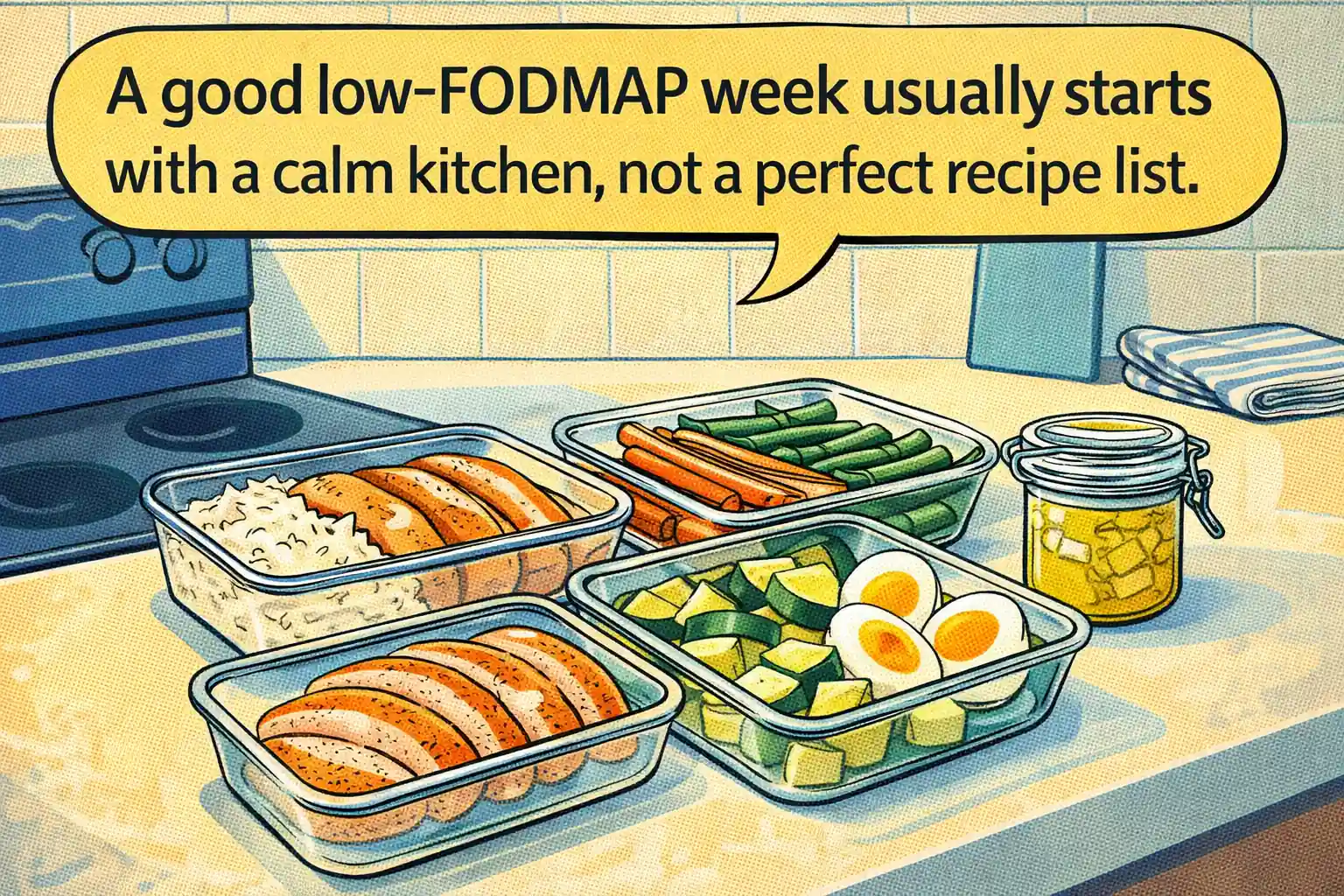
By Wednesday, low-FODMAP eating often falls apart because the diet is hard to run in real life without a system. This guide gives you one: a short weekly prep routine built around safe portions, easier storage, and less midweek food panic.
Short answer: this page is the adherence-system utility for low FODMAP. Use it to turn the elimination phase into a repeatable weekly prep routine so the plan does not fall apart by Wednesday.
This page is for you if your next question is: "How do I make this diet easier to follow across the whole week instead of deciding every meal live?"
Use a different page first if you need the meal sequence itself in 7-Day Low FODMAP Meal Plan for Bloating Relief, or if you still need the week-one shopping foundation in Low FODMAP Grocery List for Beginners. If disability, fatigue, mobility limits, caregiver help, or bathroom access is the real reason prep keeps breaking, use accessibility, disability, IBS, and low-FODMAP planning first so the plan fits the access you actually have.
You do well for a few days. Then work runs late, you are hungry, and suddenly the safest option is whatever you can grab fast.
That is not a willpower problem. It is a systems problem.
In Step 1 of the low-FODMAP diet, Monash recommends swapping high-FODMAP foods for low-FODMAP alternatives and using serving-size guidance to do it accurately 1. That sounds simple until you have to make those decisions every day under real time pressure.
There is good evidence that the low-FODMAP diet can improve IBS symptoms 2. There is also indirect evidence that adherence and routine matter, even though meal prep itself has not been studied as a stand-alone IBS treatment 3 4. So this article is not here to claim that meal prep cures IBS. It is here to make the diet easier to carry through the week.
If you already have your 7-day meal plan and your FODMAP-safe shopping list, this is the missing operational layer.
Low-FODMAP eating is not just "cook at home more." It asks you to think about ingredient swaps, portion thresholds, hidden triggers, and meal combinations at the same time. That is exactly why the diet tends to break down when life gets busy.
Meal prep helps because it reduces the number of food decisions you need to make while already hungry. It also lets you control the part that matters most in the elimination phase: consistency. Monash frames Step 1 as a structured swap process, not a loose "eat cleaner" suggestion 5.
The people who benefit most are usually:
If you are still learning the basic food rules, start with how to start the low-FODMAP diet first. If you know the rules but the week keeps beating you anyway, keep going.
Think of this like a two-touch system:
That is enough for most people. You do not need a full influencer fridge. You need a few reliable components that turn into low-noise meals.
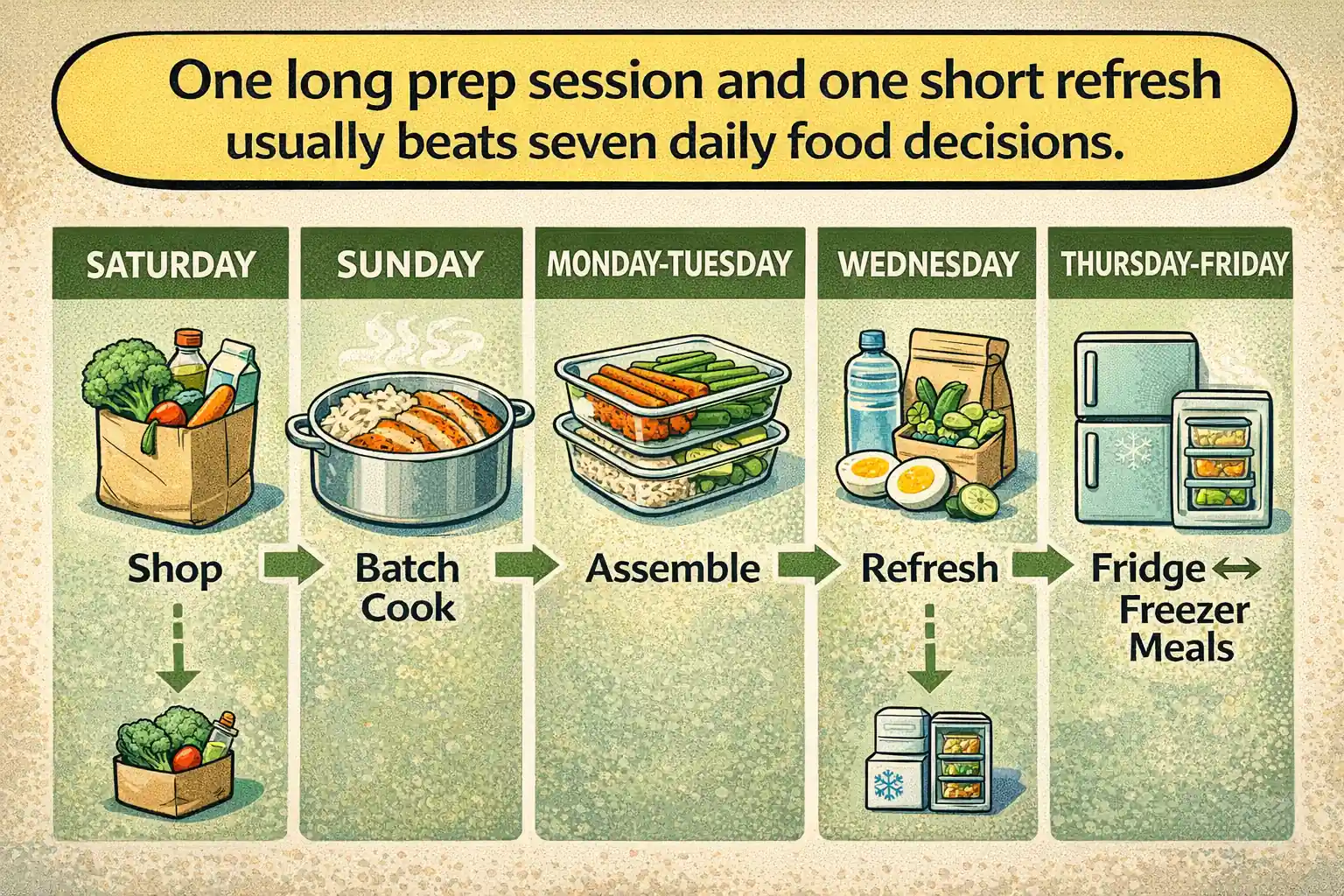
Use your 7-day meal plan as the structure for what to cook each day, then cut that down into repeatable components:
Then build the shopping list from your full grocery list.
Monash repeatedly emphasizes that serving size matters, including for foods that look green in the app at smaller amounts 6. So do your portion checking before you batch cook, not after you are already packing containers.
Start with the least complicated components:
The practical rule is simple: keep the base foods plain, then add flavor at serving time.
Monash explains that garlic fructans do not dissolve into oil, which is why garlic-infused oil is a useful low-FODMAP workaround 7 8. That makes it one of the best meal-prep ingredients you can keep on hand.
Good prep-ahead flavor options include:
If packaged sauces are where your "safe" meals go wrong, use the hidden FODMAPs label-reading guide before you add anything bottled.
Write the date on the container. Add a short note like eat first or
freeze by Wednesday. This sounds basic, but it is what keeps meal prep from
turning into fridge roulette by midweek.
[!TIP] Free Download: Low FODMAP Weekly Prep Checklist Use it as your Sunday reset so you do not have to remember every step from scratch.
The safest meal-prep foods are the ones that are easy to portion, easy to repeat, and easy to read later in the week.
| Food | Why it works | Practical note |
|---|---|---|
| Chicken thighs or breast | reheats well, easy to portion | store plain and add sauces later |
| Ground turkey or beef | flexible for bowls or lettuce wraps | cook without onion or garlic powders |
| Baked salmon | good for 2 to 3 days | better early-week than late-week |
| Hard-boiled eggs | fast breakfast or backup protein | FoodSafety.gov lists hard-cooked eggs at 1 week refrigerated 9 |
| Firm tofu | useful plant option | keep seasoning simple and portion-aware |
If you are meal-prepping without meat, use the low-FODMAP vegetarian protein guide to choose tofu, tempeh, canned legumes, and product backups without adding extra label noise to the week.
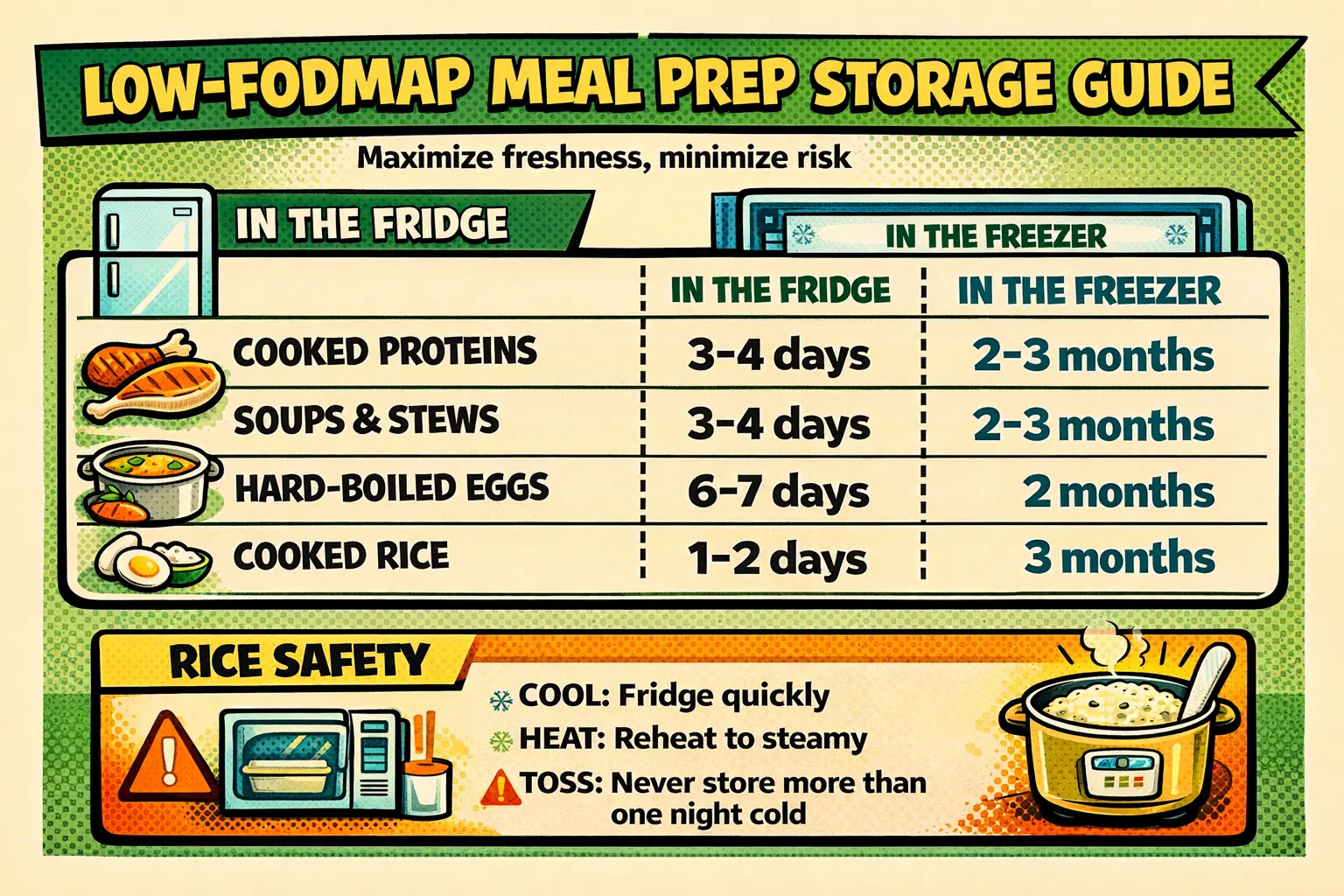
Rice, quinoa, potatoes, and simple gluten-free starches are common anchors because they turn proteins and vegetables into an actual meal quickly. The main exception is rice safety, which needs stricter handling than many people realize. NHS says cooked rice should be cooled within 1 hour, refrigerated or frozen promptly, eaten within 24 hours if refrigerated, and never reheated more than once 10.
So if rice is in your system, make it a same-day or next-day base and freeze extra portions early.
Monash publishes serving guidance for several vegetables that work well in meal prep. This is the part to keep nearby when you are portioning containers:
| Food | Published low-FODMAP serve | Source |
|---|---|---|
| Carrot | 75 g | 11 |
| Green beans | 75 g | 12 |
| Bell pepper / capsicum | 75 g | 13 14 |
| Eggplant | 75 g | 15 |
| Kale | 75 g | 16 |
| Baby spinach | 75 g | 17 |
| Zucchini | 65 g | 18 |
| Canned chickpeas | 42 g to 46 g | 19 20 |
For a broader ingredient list, use the complete low-FODMAP foods list. And keep one important rule in mind: the app can change serving details over time, so use the article for planning and the app for precision.
Think of your FODMAP threshold like a bucket. Each ingredient adds a little water. A meal-prep container that already includes several moderate foods can fill the bucket before you even add a snack.
Monash explicitly warns that foods with a green overall rating can still move into amber or red territory at larger serves, and it uses mixed-meal examples to show why stacking matters 21 22.
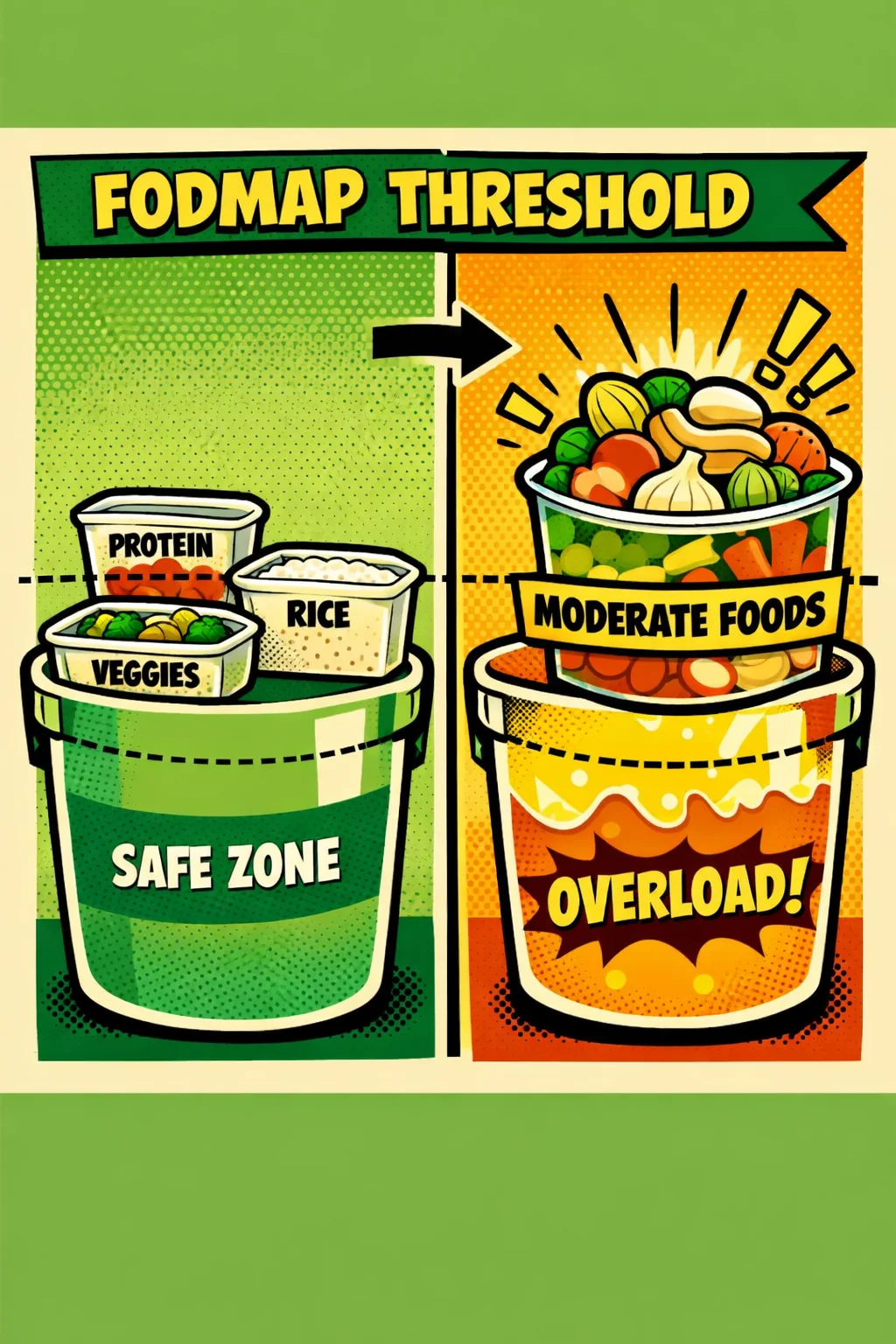
That is why this matters at prep time, not just at mealtime.
A few examples:
The simplest way to reduce stacking is to keep moderate items separate. Store protein in one container, vegetables in another, and add the final portions at serving time. If this section is the part that keeps tripping you up, read the full article on why safe foods can still trigger symptoms.
Meal prep works best when the fridge is trustworthy. That means food safety first, aesthetics second.
FoodSafety.gov lists cooked meat or poultry leftovers and soups or stews at 3 to 4 days in the refrigerator, and it also recommends cooling leftovers quickly in shallow containers and using them within 4 days 23 24.
Use this as your simple working guide:
| Food type | Fridge | Freezer |
|---|---|---|
| Cooked meat, poultry, fish leftovers | 3 to 4 days | up to 2 to 6 months 25 |
| Soups and stews | 3 to 4 days | about 2 to 3 months 26 |
| Hard-boiled eggs | up to 1 week | not ideal to freeze 27 |
| Cooked rice | use within 24 hours if refrigerated | freeze quickly after cooling 28 |
For cooked vegetables, quinoa, and mixed bowls, the safest mindset is not "how long can I push this?" but "when should I freeze the extras?" If you will not eat it inside the short fridge window, freeze it early.
Good containers help, but simple habits matter more:
Breakfast is usually where meal prep quietly pays for itself.
If mornings are rushed, prep one or two of these instead of trying to create variety for variety's sake:
| Breakfast | Prep idea | Timing note |
|---|---|---|
| Overnight oats | make 2 to 3 jars | best early in the week |
| Hard-boiled eggs | batch once | easy protein backup |
| Egg muffins | bake a tray | useful if you need grab-and-go food |
| Lactose-free yogurt pots | portion with tolerated fruit | keep fruit portions clear |
| Freezer-friendly muffins | freeze individually | good for late-week backup |
If you need more portable options that double as breakfast, use these low-FODMAP snacks you can prep ahead.
If you want the full breakfast-specific version of this section, use these low-FODMAP breakfast ideas to build one hot anchor, one cold anchor, and one portable backup.
Low-FODMAP meal prep does not need to be elaborate. One batch-cook session, one midweek refresh, and a few clearly portioned staples can remove a lot of the decision fatigue that makes the diet harder than it needs to be.
Start small. Prep a protein, a starch, a vegetable, and one breakfast base. Label the containers. Freeze the extras. Use the app when portions get fuzzy.
That is enough to turn "What can I eat today?" into "Lunch is already handled."
And if you want to carry that same structure into shared meals and celebrations, use this low-FODMAP holiday survival guide to plan buffets, family dishes, and leftovers with less guesswork.
[!TIP] Download the checklist: Low FODMAP Weekly Prep Checklist Keep it nearby for your Sunday reset, then use the 7-day meal plan for what to cook and the reintroduction guide when you are ready to widen your diet again.
Across: cookbook fit Use the low-FODMAP cookbook comparison guide if recipe structure is the missing tool and you need to choose between a recipe-first and protocol-first book.
Up: execution plan Return to 7-Day Low FODMAP Meal Plan for Bloating Relief if you want the exact meal sequence that this prep system is meant to support.
Across: budget support Use Low FODMAP on a Budget if the weekly prep system needs to get cheaper before it can become repeatable.
Across: shared household dinners Use Low FODMAP Family Meals Without Separate Cooking if the hard part is serving one shared dinner without making two complete meals.
Across: limited kitchen space Use Small Apartment Low-FODMAP Meal Prep if the real constraint is one fridge shelf, limited freezer space, shared equipment, or a tiny prep surface.
Down: equipment only after the workflow is clear If storage is the missing job, inspect the current Rubbermaid glass-container details. If repeatable portion measurement is the missing job, inspect the current OXO kitchen-scale details.
Across: night-shift execution Use Night Shift Low-FODMAP Meals and Flares if the hard part is packing meals around nights, rotating schedules, caffeine, sleep, and flare days.
Across: diabetes and blood-sugar planning Use Low-FODMAP With Diabetes, Blood Sugar, and Gut Symptoms if meal prep also needs to account for glucose monitoring, medicines, appetite, fiber, and carbohydrate awareness.
Down: next step after a stable routine Use Low FODMAP Reintroduction: How to Test Foods Without Trigger Chaos once your prep system gave you a stable enough baseline to start testing foods.
Xam Riche is a gut health solopreneur and founder of YourFitNature, dedicated to helping people navigate digestive wellness through evidence-based information and personal experience. After years of struggling with IBS and bloating, Xam discovered the transformative power of the low FODMAP diet and now shares practical, science-backed guidance to help others find relief. While not a medical professional, Xam combines extensive research with lived experience to create accessible, empowering resources for the gut health community. Learn more about our mission
As an affiliate, we may earn from qualifying purchases.