 By • Published on April 2, 2026 • 11 min read • 3,583 views
This article is for informational and educational purposes only and does not constitute medical advice. Always consult with a registered dietitian, gastroenterologist, or other qualified medical professional before making significant dietary changes.

Breakfast can look healthy and still leave you bloated, hungry, or second-guessing every ingredient before noon. This guide shows you how to build a lower-noise low-FODMAP breakfast that is simple enough to repeat and practical enough to survive a workweek.
Short answer: low-FODMAP breakfast gets easier when you stop improvising and build a few repeatable morning templates that reduce bloating noise before the day gets busy.
This page is for you if breakfast is still where your low-FODMAP day falls apart, even when lunch and dinner feel more manageable.
Use a different page first if you need a full first-week plan or a grocery reset before solving breakfast. Start with 7-day-low-fodmap-meal-plan-for-bloating-relief or low-fodmap-grocery-list-for-beginners.
You start the day with the breakfast you were told should help. Maybe it is a yogurt bowl. Maybe a smoothie. Maybe a bran cereal, a breakfast bar, or toast with whatever looked safe enough in the pantry.
Then your gut starts talking back before lunch.
Here is the truth: breakfast problems are often less about finding the perfect food and more about reducing the number of things your gut has to process at once. The good news is that low FODMAP can help create that reset, but it works best as a structured trial, not a forever breakfast identity 1 2.
This article is the breakfast-specific companion to your broader 7-day low-FODMAP meal plan and your grocery list for beginners. The goal is simple: calmer mornings, clearer signal, and less guessing.
This page explains a morning execution utility:
This page is not mainly explaining:
Breakfast is where a lot of "healthy" habits turn into symptom noise.
The fruit-and-yogurt bowl can stack dairy, fruit, granola, and seeds in one sitting. The smoothie can become fruit plus chia plus sweetener plus speed. The bran cereal can push fiber faster than your gut wants to handle. And the protein bar can hide sweeteners, added fibers, or ingredients you would never choose if you were not already late.
That is one reason breakfast often feels confusing even after you learn the basic low-FODMAP rules. NIDDK notes that some people with IBS do better with soluble fiber than insoluble fiber and that adding fiber too quickly can worsen gas and bloating 3. Monash also emphasizes that low-FODMAP foods can still add up across one meal, which is exactly what happens when a breakfast bowl gets too ambitious 4.
Bottom line: breakfast usually works better when it becomes easier to read.
That means:
If your bigger pattern is "healthy foods still make me feel worse," the next useful layer after this article is broader troubleshooting around food patterns that still cause bloating.
Start here: build breakfast from three parts.
That is enough for most mornings.
Your base might be oats, tolerated toast, lactose-free yogurt, rice cakes, or even savory leftovers. Your staying-power element might be eggs, lactose-free yogurt, peanut butter, or another simple tolerated protein. Your add-on might be kiwi, berries, cinnamon, or a small seed topping if you already know it sits well.
Monash's current meal-planning examples support a wider breakfast range than most people think, including omelettes, oat-based breakfasts, overnight oats, granola with lactose-free yoghurt, and chia pudding 5. The part that matters more than variety, though, is meal simplicity. If every breakfast contains four toppings, two fruits, and one "healthy" extra, you lose the signal.
The Monash app matters here because breakfast foods that look obviously "safe" can still be portion-sensitive, and app entries are updated over time 6.
Not every morning needs the same breakfast.
Warm breakfasts usually win when your gut feels touchy or you are trying to avoid a cold, dairy-heavy start. Oats or porridge are the obvious first lane. They are easy to control, easy to repeat, and easy to simplify. Eggs with tolerated toast are another strong option when you want something warm but do not want a sweeter breakfast.
If constipation is part of the picture, this is also where breakfast can become more strategic. Monash notes that kiwifruit may help constipation symptoms and describes green kiwi as low FODMAP at 2 fruits, which makes oats plus kiwi one reasonable breakfast test for IBS-C style patterns 7. If that is your lane, also review the broader IBS-C and low-FODMAP adjustments.
Cold breakfasts work best when they stay simple. Lactose-free yogurt plus one fruit is clearer than a giant yogurt bowl with granola, seeds, nut butter, and two fruits. Overnight oats are useful because they give you some make-ahead structure without forcing you into packaged bars or a cafe scramble. Monash still uses overnight oats as a current breakfast format 8.
This is one of the most underused fixes. If sweet breakfasts keep leading to pressure, hunger, or weird symptom noise, stop trying to force them. Eggs with spinach, eggs with tolerated toast, a rice-and-egg bowl, or even leftovers can be a cleaner way to start the day.
Savory breakfasts often lower the fruit, sweetener, and topping load without making breakfast more restrictive. They simply change the kind of noise you are removing.
Portable does not have to mean a bar. A yogurt jar, overnight oats jar, hard-boiled eggs, or egg muffins usually hold up better than random packaged breakfasts. If you need more cross-over ideas that work as snack-plus-breakfast backup, use the guide to portable low-FODMAP snacks.
Use this list as a rotation, not a challenge to make all ten this week.
The thread running through all ten is the same: lower the number of variables. Monash's meal-planning content supports breakfast variety, but variety works best after you have a few dependable defaults 9.
Breakfast gets easier when you prepare one hot option, one cold option, and one portable backup.
That could be:
Food safety matters here too. FoodSafety.gov says hard-cooked eggs can be kept refrigerated for up to 1 week 10. So if eggs are part of your backup system, they are practical as well as low friction.
What you should leave flexible is the part most likely to create stacking: fruit amount, seed add-ons, toast choice, and whatever you keep telling yourself is "just a small extra."
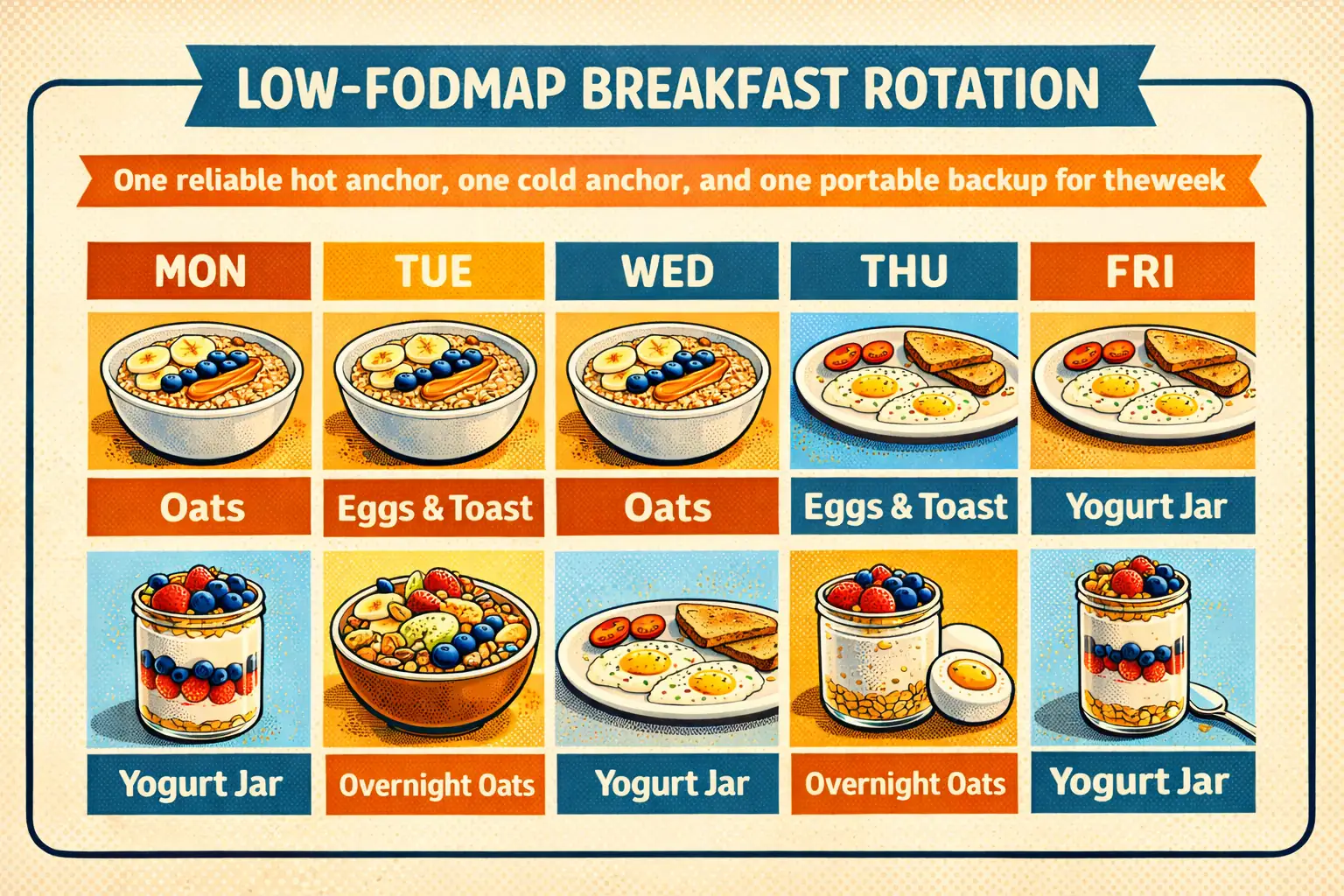
[!TIP] Download: Week of Breakfast Rotation Use it to plan one hot breakfast, one cold breakfast, and one portable backup before Monday starts.
If you want the broader weekly systems layer, the next step is low-FODMAP meal prep for the week.
The biggest mistakes are usually not dramatic. They are repetitive.
Mistake 1: assuming gluten-free means low FODMAP. Many gluten-free breakfast foods still contain high-FODMAP ingredients or are just poor symptom fits in practice. That is why the breakfast grocery lane still matters 11.
Mistake 2: trying to fix everything with more fiber. NIDDK specifically advises adding fiber gradually because too much at once can increase gas and bloating 12.
Mistake 3: stacking several moderate items in one bowl or smoothie. This is the breakfast version of the broader FODMAP stacking problem.
Mistake 4: relying on bars, powders, or convenience foods every busy morning. Even when the ingredient list looks close enough, breakfast gets harder to read when every rushed morning runs through processed defaults.
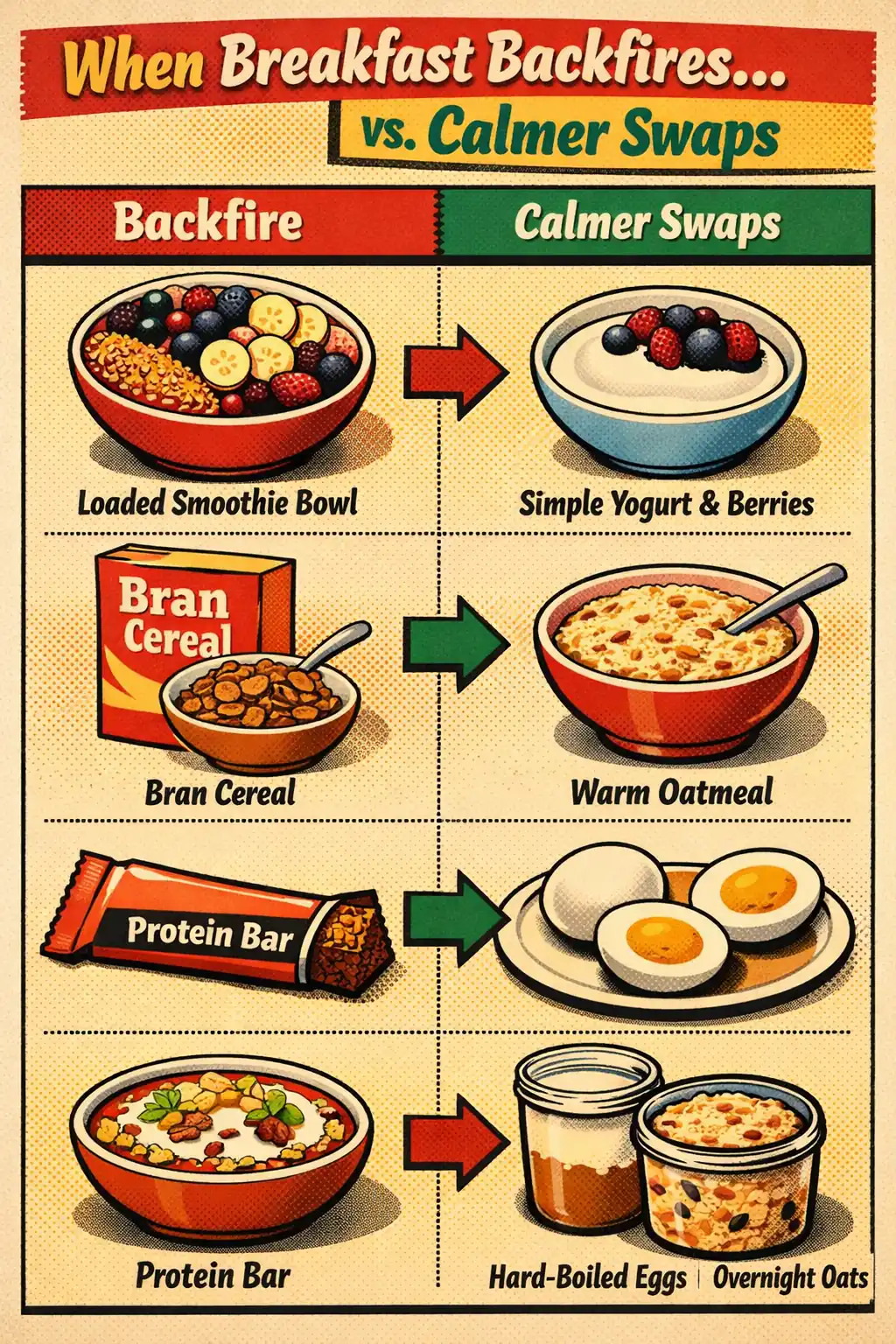
Mistake 5: repeating a breakfast that keeps backfiring because it has a health halo. If yogurt bowls, smoothies, or bran cereals reliably leave you worse, treat that pattern as data.
[!TIP] Download: Breakfast Trigger Swap Matrix Keep it nearby if breakfast keeps looking healthy on paper but noisy in your body.
Breakfast can help. It cannot explain everything.
If symptoms happen after many meals, not just in the morning, zoom out. If low FODMAP helps only partly, the next step may be reintroduction and personalization, not collecting more "safe" breakfasts. If breakfast changes do not move the needle at all, broader troubleshooting may matter more than breakfast strategy alone, especially if stress, constipation, or diagnostic mismatch is part of the story.
That is where a broader article like when low FODMAP does not work helps more than another smoothie recipe ever will.
Low-FODMAP breakfast usually gets easier when you stop trying to be creative and start trying to be clear.
Use one base, one protein or staying-power element, and one low-noise add-on. Keep sweet breakfasts simpler. Switch to savory if sweet breakfasts keep failing. Prep one hot breakfast, one cold breakfast, and one portable backup so your mornings do not depend on whatever is easiest to grab.
Start here:
Breakfast is not supposed to solve all of IBS. But it can absolutely stop being the part of the day that starts the spiral.
Xam Riche is a gut health solopreneur and founder of YourFitNature, dedicated to helping people navigate digestive wellness through evidence-based information and personal experience. After years of struggling with IBS and bloating, Xam discovered the transformative power of the low FODMAP diet and now shares practical, science-backed guidance to help others find relief. While not a medical professional, Xam combines extensive research with lived experience to create accessible, empowering resources for the gut health community. Learn more about our mission
As an affiliate, we may earn from qualifying purchases.