 By • Published on March 19, 2026 • 13 min read • 4,770 views
This article is for informational and educational purposes only and does not constitute medical advice. Always consult with a registered dietitian, gastroenterologist, or other qualified medical professional before making significant dietary changes.
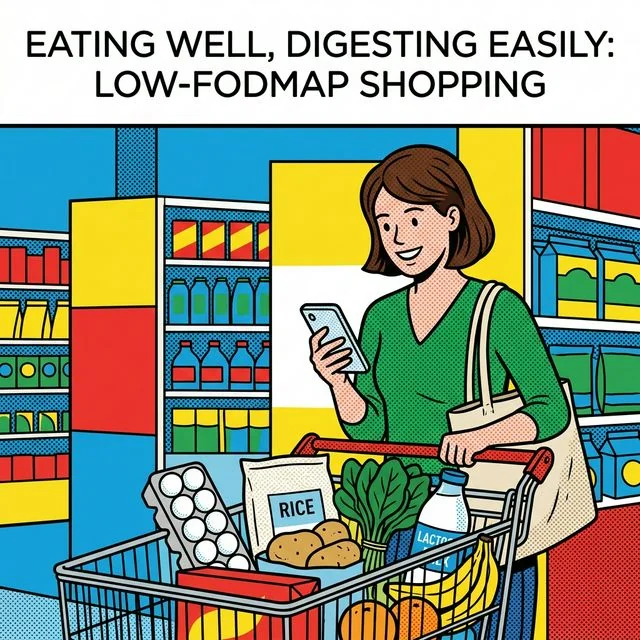
Your first low-FODMAP grocery trip should not feel like a two-hour scavenger hunt. This guide shows you what to buy first, what to skip, and how to build a calmer week of meals without drowning in conflicting food lists.
Short answer: your first low-FODMAP cart should stay small and repeatable: plain proteins, easy starches, a short produce list, simple dairy options, and packaged foods with obvious trigger ingredients left behind.
This page is for you if you already accepted the low-FODMAP trial and now need to answer the week-one shopping question: "What do I actually buy?"
Use a different page first if you still need the full starter framework in Low FODMAP Diet for Beginners: How to Start, or if you need the bigger safe-food reference in Low FODMAP Foods to Eat for Bloating Relief.
The first time you try to shop low FODMAP, the store can feel hostile.
Foods you used to buy without thinking suddenly look suspicious. Apples, yogurt, granola bars, wraps, pasta sauce, broth, protein bars. Even the gluten-free shelf starts to feel like a trick.
If that sounds familiar, take a breath. You do not need a perfect cart. You need a low FODMAP grocery list that helps you get through week one with less guesswork.
Start here: this article is for the person who is just learning how to start the low-FODMAP diet and wants the grocery-store version of the plan. We will keep it practical, show you what to buy first, explain what to skip, and help you turn your cart into simple meals you can actually repeat.
This is a beginner grocery list for the elimination phase. It is not a forever-food list. It is not a promise that you will never eat broadly again.
The low-FODMAP approach works best as a three-stage process: restriction, reintroduction, and personalization 1. That means your first shopping trip should be built for clarity, not perfection. You are trying to lower food noise, calm symptoms, and create a stable baseline for the start of the elimination phase.
That is also why conflicting lists feel so frustrating. A 2023 review found that 22.6% of foods were classified differently across available FODMAP lists, which helps explain why online grocery advice can feel inconsistent 2. The best way through that confusion is to use a simple article like this as a starting point, then check the Monash app for current food ratings and serving details when you need precision 3 4.
Bottom line: your first trip should feel smaller than you think it needs to.
Start with foods you can build multiple meals around. Monash beginner materials repeatedly come back to the same categories: plain proteins, reliable starches, simple produce, lactose-free dairy options, and a few clean pantry basics 5 6.
Here is the week-one version:
| Category | Beginner Staples |
|---|---|
| Proteins | eggs, chicken, fish, firm tofu |
| Starches | rice, oats, potatoes, quinoa |
| Vegetables | carrots, cucumbers, spinach, zucchini |
| Fruits | kiwi, grapes, strawberries, oranges |
| Dairy / alternatives | lactose-free milk, lactose-free yogurt, hard cheese |
| Pantry | olive oil, garlic-infused oil, tamari, mustard, canned tomatoes without onion or garlic |
| Snacks | rice cakes, popcorn, plain crackers, small serves of tolerated nuts |
If snacks are the part that keeps getting repetitive, use our guide to portable low FODMAP snacks for workdays, travel, and emergency backup options.
Why this works:
If you want to turn the cart directly into breakfasts, lunches, and dinners, use it alongside our 7-day plan to build your first week of meals.
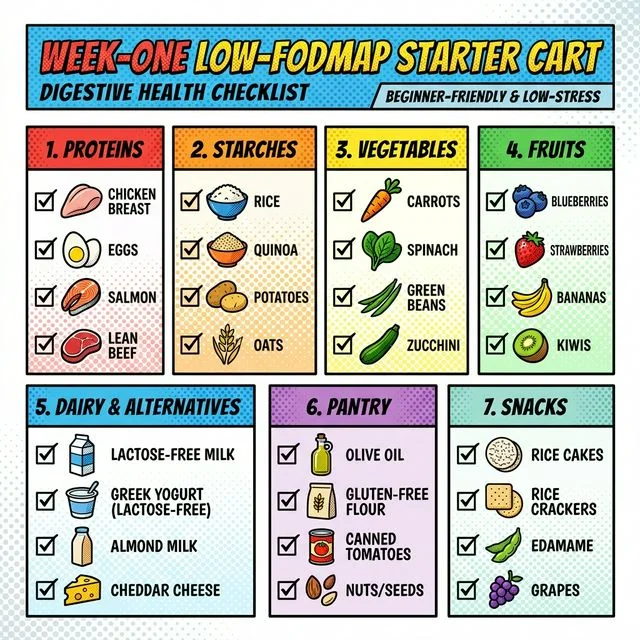
[!TIP] Free Download: Week-One Low FODMAP Grocery Checklist Keep it on your phone so you can shop faster and second-guess less.
The easiest way to grocery shop low FODMAP is to move through the store by aisle, not by panic.
Good default buys include carrots, cucumbers, spinach, lettuce, zucchini, potatoes, oranges, kiwi, and berries 7 8. They are simple, flexible, and easy to pair with proteins and starches.
Common beginner traps include apples, pears, cauliflower, onions, and garlic. If you need a fuller explanation of what belongs on the "leave it here" side of the cart, review the high-FODMAP foods to leave off the list.
Plain eggs, meat, fish, and firm tofu are strong first-week choices because they keep meals satisfying without adding unnecessary ingredient complexity 9.
This is also where labels start to matter. Pre-marinated chicken, flavored sausage, deli meat, or ready-made tofu products often bring onion, garlic, wheat, or sweeteners along for the ride. If you want the broader safe-food library, use our more complete low-FODMAP food examples after you have the basics covered.
If you are shopping vegetarian, use the low-FODMAP vegetarian protein guide to decide how tofu, tempeh, soy-protein milk, canned legumes, and protein products fit without overcomplicating week one.
Rice, oats, quinoa, potatoes, and simple rice-based or corn-based products are usually the least stressful starting point 10.
One of the biggest beginner mistakes happens here: assuming gluten-free automatically means low FODMAP. It does not. Monash specifically warns that gluten-free products can still contain high-FODMAP ingredients such as onion, honey, soy flour, or lupin flour 11 12.
Use a simple rule: week one is not the time to buy the most "wellness" version of a packaged food. Choose the plainer version.
This is where many people lose confidence.
Label reading matters, but it also has limits. Monash says it can help identify suitable foods, while also warning that ingredients alone do not always reveal the full FODMAP picture because processing and serving size matter too 13 14.
That means your goal is not to become a food detective who can decode every package on earth. Your goal is to scan for the most obvious triggers and move on.
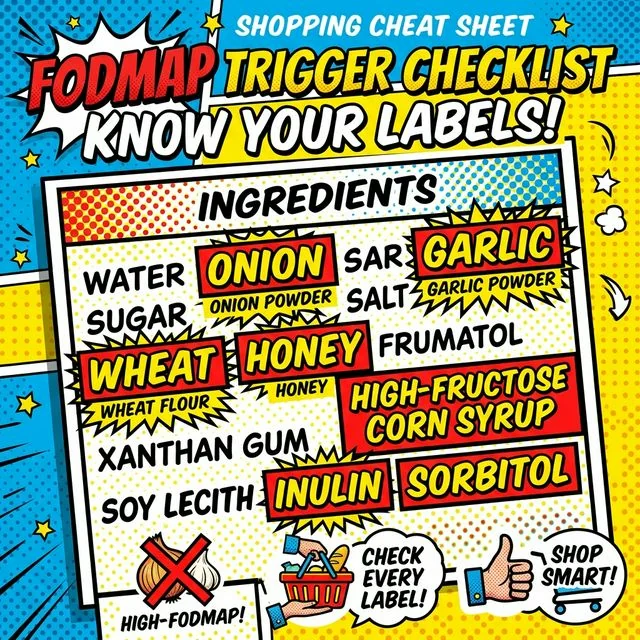
Start here:
Monash label-reading guidance repeatedly flags these explicit ingredients, especially in pasta sauces, tomato pastes, stocks, dips, dressings, and snack foods 15 16.
When the problem is not the grocery cart alone, move to our deeper guide to hidden FODMAPs, which also covers supplements and medications.
Use this decision tree when a packaged food feels borderline:
If packaged foods are still confusing, remember that hidden ingredients can sabotage progress even when your meals look compliant on paper.
If the package is part of a meal kit, grocery delivery kit, or ready-to-heat meal, use meal delivery kits and low-FODMAP labels for the semi-prepared-meal decision route.
You do not need more discipline here. You need fewer moving parts.
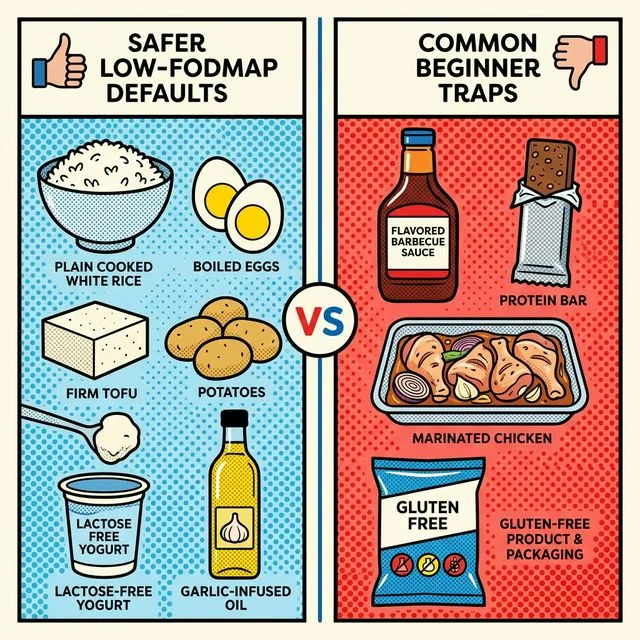
Mistake 1: Buying too many specialty products.
Low-FODMAP cookies, bars, crackers, cereals, baking mixes, sauces, wraps, and flours can turn one trip into a mental tax. Start with foods you recognize.
Mistake 2: Assuming every healthy food is safe.
Apples, cauliflower, onions, garlic, and many "high-fiber" packaged foods can still be rough on a sensitive gut.
Mistake 3: Assuming every gluten-free product is safe.
Again, gluten-free is not the same as low FODMAP 17 18.
Mistake 4: Ignoring portion size.
Some foods look fine until the serving gets too big. That is one reason portion sizes and stacking still matter, even when the ingredient list looks clean.
Mistake 5: Building a cart full of snacks instead of meals.
Snacks are fine. But your first trip should mainly help you cook breakfast, lunch, and dinner without stress.
Mistake 6: Trying to outsmart the app with random lists online.
The Monash app remains the strongest reference for current food ratings and serving changes 19.
Bottom line: the simplest cart usually wins.
This is the point of the whole article. The cart should become food you can eat this week.
Use formula meals, not complicated recipes:
| Meal | Example |
|---|---|
| Breakfast | oatmeal + lactose-free milk + blueberries |
| Breakfast | eggs + spinach + simple gluten-free toast |
| Lunch | rice + chicken + carrots + zucchini |
| Dinner | baked potato + tuna + side salad |
| Snack | lactose-free yogurt + kiwi |
Repeating meals in week one is not failure. It is strategy.
You are trying to reduce food noise, lower decision fatigue, and notice what your gut does when meals stay simple. Once things calm down, you can expand from there with the full foods-to-eat guide and later move into structured reintroduction.
If breakfast is the first place you want more variety without more chaos, use these low-FODMAP breakfast ideas to turn the starter cart into calmer repeat mornings.
If you want to turn this cart into a week of ready lunches and dinners, use this low FODMAP meal prep system.
Taking a trip soon? Here is what to buy for a low-FODMAP hotel stay or travel day when your normal kitchen setup disappears.
[!IMPORTANT] Next Resource: Week-One Cart-to-Meal Map Use it when you want your grocery list and meal plan on one page.
Use the printable checklist when you want speed.
Use the Monash app when a food, serving size, or packaged product feels unclear 20.
Use dietitian support when the process still feels contradictory, overly restrictive, or hard to implement in real life. In one real-world study, adherence to phase 1 was 96% with dietitian guidance versus 71% without, and therapeutic intake targets were reached much more often with professional support 21. NICE also recommends that exclusion diets such as low FODMAP be delivered by a healthcare professional with expertise in dietary management 22.
If you are shopping carefully and still not improving, it may be time to step back and read what to do if low FODMAP is not helping rather than shrinking your food list even further.
Here is the truth: your first low-FODMAP grocery trip does not need to impress anyone.
It needs to make the next seven days easier.
Start with versatile staples. Shop by aisle. Read labels for the obvious triggers. Keep meals simple. Use the app when the serving details matter. That is enough to begin.
If you want a simple next-step plan:
The good news is that this gets easier fast. Once the first week stops feeling chaotic, the whole diet starts to feel more manageable.
Across: cookbook support Use the low-FODMAP cookbook comparison guide if the shopping list is clear but you still need to choose between recipe inspiration and a protocol-first guide.
Up: setup context Return to Low FODMAP Diet for Beginners: How to Start if you want the grocery trip placed inside the full first-week setup.
Across: diabetes and blood-sugar planning Use Low-FODMAP With Diabetes, Blood Sugar, and Gut Symptoms if your cart also needs to fit glucose monitoring, medication questions, fiber, and carbohydrate awareness.
Across: access and disability planning Use Accessibility, Disability, IBS, and Low-FODMAP Planning if fatigue, mobility, sensory load, caregiver help, or food access changes what a realistic grocery plan can look like.
Across: campus grocery constraints Use College Dorm Low-FODMAP and IBS Flare Plan if the grocery list has to work around dining halls, mini-fridges, shared bathrooms, class timing, and campus health.
Across: safe-food reference Use Low FODMAP Foods to Eat for Bloating Relief if you need a wider safe-food library while you shop.
Across: current pantry-product examples After the label scan, inspect the current Fody pasta-sauce details or current Gourmend broth details as product examples, not proof of personal tolerance.
Constraint route: budget Use Low FODMAP on a Budget if the cart is technically clear but the cost of specialty swaps is what keeps breaking the plan.
Xam Riche is a gut health solopreneur and founder of YourFitNature, dedicated to helping people navigate digestive wellness through evidence-based information and personal experience. After years of struggling with IBS and bloating, Xam discovered the transformative power of the low FODMAP diet and now shares practical, science-backed guidance to help others find relief. While not a medical professional, Xam combines extensive research with lived experience to create accessible, empowering resources for the gut health community. Learn more about our mission
As an affiliate, we may earn from qualifying purchases.