 By • Published on March 24, 2026 • 15 min read • 3,295 views
This article is for informational and educational purposes only and does not constitute medical advice. Always consult with a registered dietitian, gastroenterologist, or other qualified medical professional before making significant dietary changes.
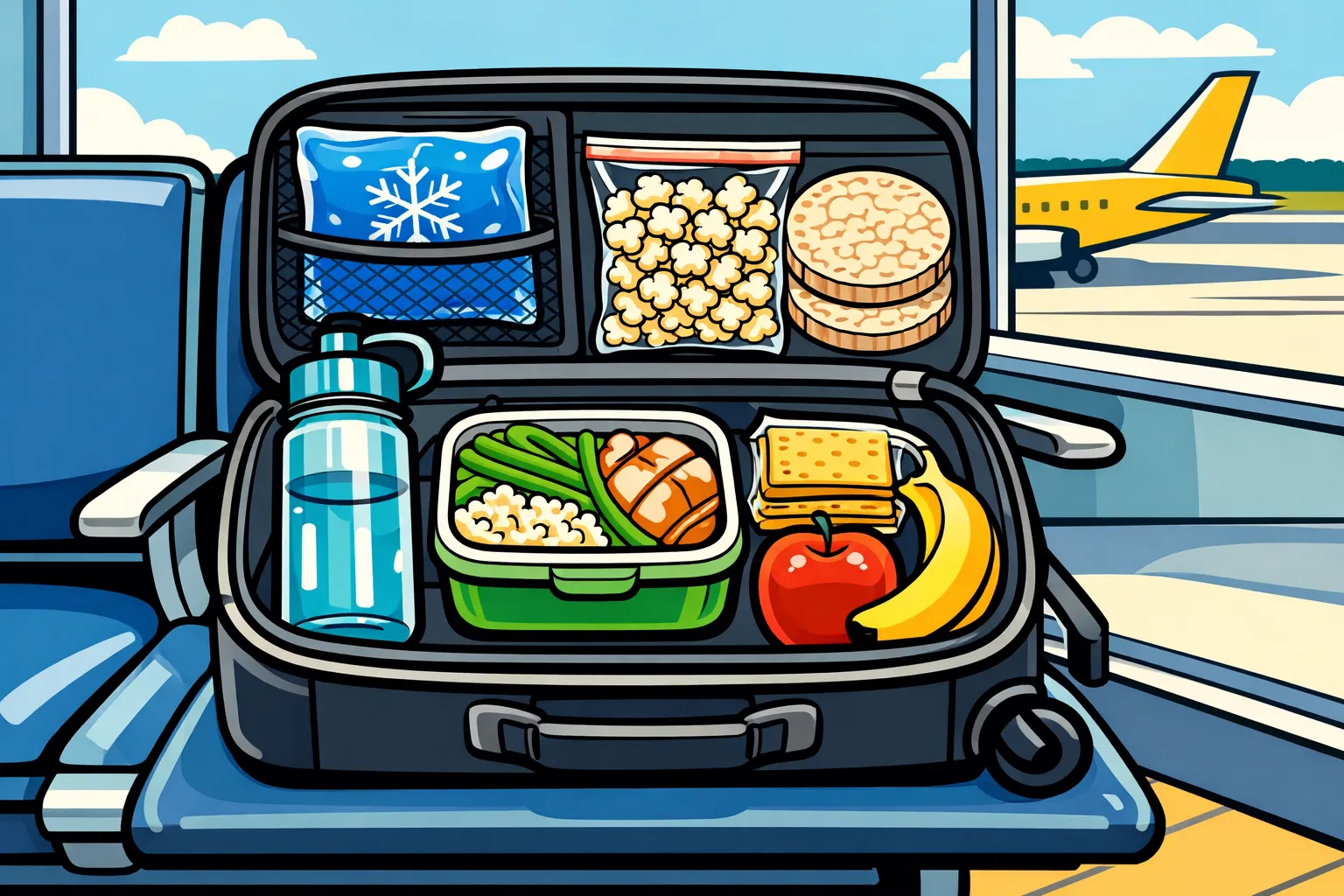
Travel days can break a low-FODMAP routine faster than a restaurant meal ever does. This guide gives you a calmer system for airports, hotel rooms, and long drives so you are not forced into your hardest food decision when you are already hungry, delayed, and out of routine.
Short answer: low-FODMAP travel works best when you match the plan to your current phase, pack one real meal plus one backup layer, and decide your hotel or road-trip food system before hunger forces random choices.
This page is for you if airports, hotels, long drives, or schedule disruption keep knocking you out of a routine that works better at home.
Use a different page first if your main issue is a single restaurant meal, not travel logistics. Start with low-fodmap-eating-out. If your problem is getting started with low FODMAP at all, go to low-fodmap-diet-for-beginners-how-to-start. If travel mainly causes constipation, diarrhea, dehydration worries, or bathroom-access planning, use the travel constipation and diarrhea prep kit alongside this food-logistics guide.
You leave home with a plan.
Then the trip happens.
Security takes longer than expected. The airport food looks random. The hotel breakfast is mostly pastries. The gas station has a wall of bars you do not trust. By the time you are actually hungry, you are no longer choosing from your plan. You are choosing from whatever is left.
That is why a low FODMAP travel guide needs to be more than a snack list. It needs to be a system.
Monash notes that a well-structured low-FODMAP meal plan can save time, reduce decision fatigue, and help you stay organized and confident in your food choices 1. Travel strips away exactly that structure. The answer is not perfection. The answer is one layer of control before you leave home.
If you need the portable-food version first, start with portable low-FODMAP snacks. If the harder part comes after you arrive, keep restaurant strategies ready for destination meals. This article covers the stretch in between.
This page explains how to keep a low-FODMAP routine functional when airports, hotel breakfasts, road stops, and timing changes remove your usual food setup.
It is not the main page for restaurant ordering, holiday shared-table strategy, or general beginner education. Use low-fodmap-eating-out for restaurant scripts, low-fodmap-holiday-survival-guide for buffets and family meals, and low-fodmap-diet-for-beginners-how-to-start for the core setup.
Travel is not just "eating away from home." It is a pileup of smaller problems: less routine, fewer trusted foods, more time pressure, and longer gaps between meals.
That matters because low FODMAP works best when the background pattern is stable enough to read. Monash frames Step 1 around swapping high-FODMAP foods for low-FODMAP alternatives and using the app's serving guidance accurately 2. That is much harder to do when you are hungry in an airport queue or trying to decode a hotel pantry label late at night.
Travel days also compress more food decisions into one longer window. You might eat a bag snack, then a delayed airport meal, then a plane snack, then a late dinner. Even when each choice looks reasonable on its own, the day can still get noisy. If that pattern feels familiar, it is worth understanding FODMAP stacking instead of assuming every individual food was the whole problem.
The goal of travel food planning is not to create a perfect travel diet. It is to make the lowest-risk option easier to reach when the day goes sideways.
Not every trip needs the same kind of plan.
If you are in Step 1, keep the trip boring on purpose. Monash says Step 1 is built around switching to low-FODMAP alternatives and using serving-size guidance carefully 3. This is not the time to chase variety just because you are traveling. Repeat foods are a feature, not a failure.
If you are in Step 2, travel is usually a bad moment to start a fresh challenge. Monash describes reintroduction as continuing a low-FODMAP background diet while challenging one FODMAP group across 3 days and tracking symptoms 4. That structure depends on fewer moving parts than travel usually gives you. Short version: if the trip is messy, pause the challenge and pick it up later. Use the full reintroduction guide when you have a steadier window.
If you are in Step 3, the plan can get lighter. Monash says this stage is about building a personalized long-term diet with as much variety as you can tolerate 5. That means your travel kit can be built around foods you already know work, instead of acting like every trip is a brand-new elimination phase.
If the whole structure still feels fuzzy, step back to the 3 phases of low FODMAP before you over-pack for the wrong stage.
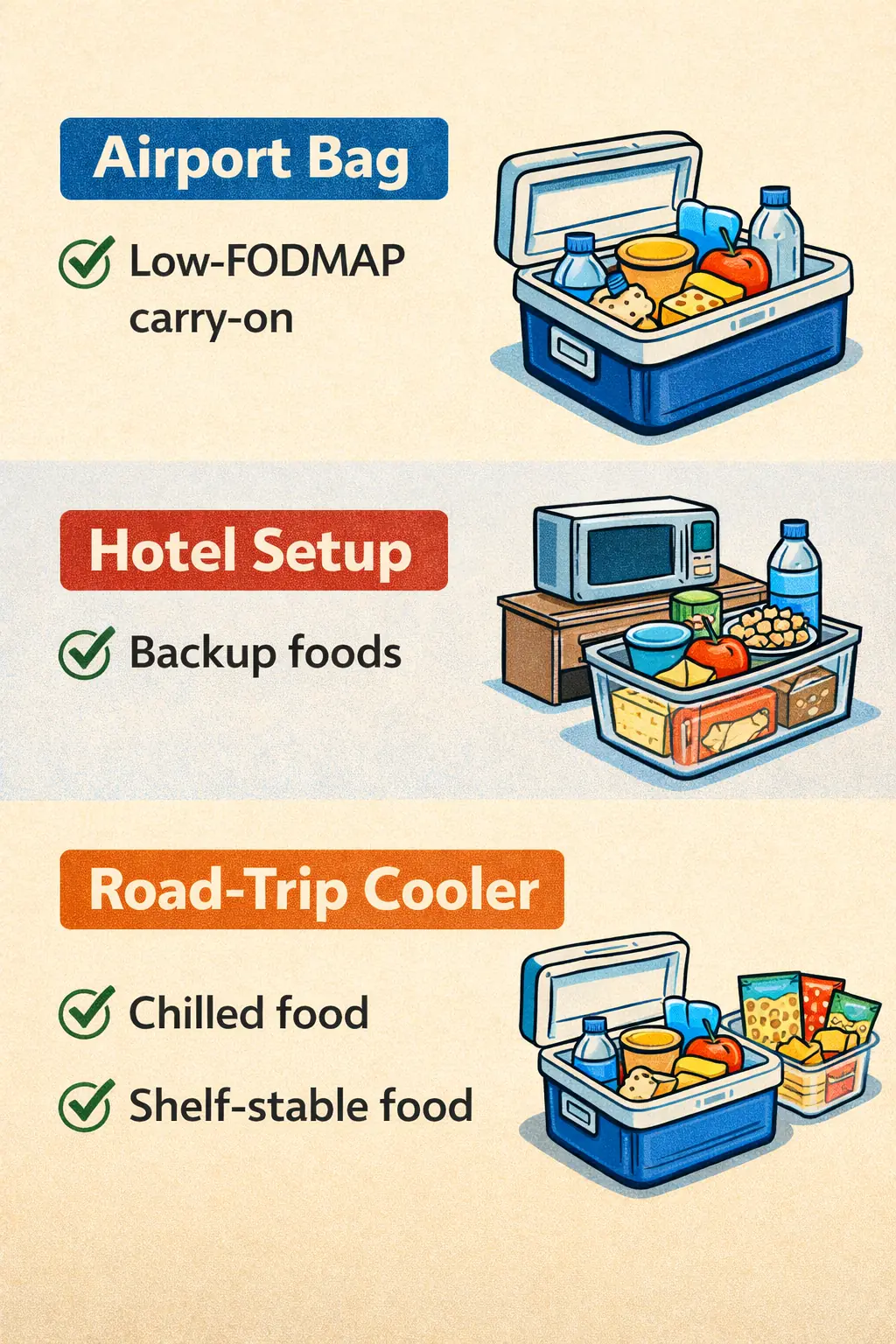
The simplest airport rule is this: pack one real meal, one planned snack, and one emergency backup.
Under U.S. TSA rules, solid food items can go in carry-on or checked bags, but liquid or gel foods over 3.4 ounces cannot go through the checkpoint in a carry-on 6. TSA also treats yogurt like a liquid or gel, so larger portions usually belong in checked baggage instead 7.
Use that to your advantage. Solid foods are the least complicated layer.
| Pack type | Good examples | Why it works |
|---|---|---|
| Real meal | simple sandwich, rice bowl without liquid sauce, plain protein + starch combo | keeps the trip from starting with hunger |
| Planned snack | rice crackers, plain popcorn, fruit, hard cheese | buys time without guesswork |
| Emergency backup | one certified bar, plain pretzels, rice cakes | covers delays, gate changes, and missed meals |
If you are carrying chilled food, TSA says frozen gel packs are allowed only if they are frozen solid at screening. If they are slushy or partially melted, they need to meet liquid rules unless they qualify as medically necessary 8.
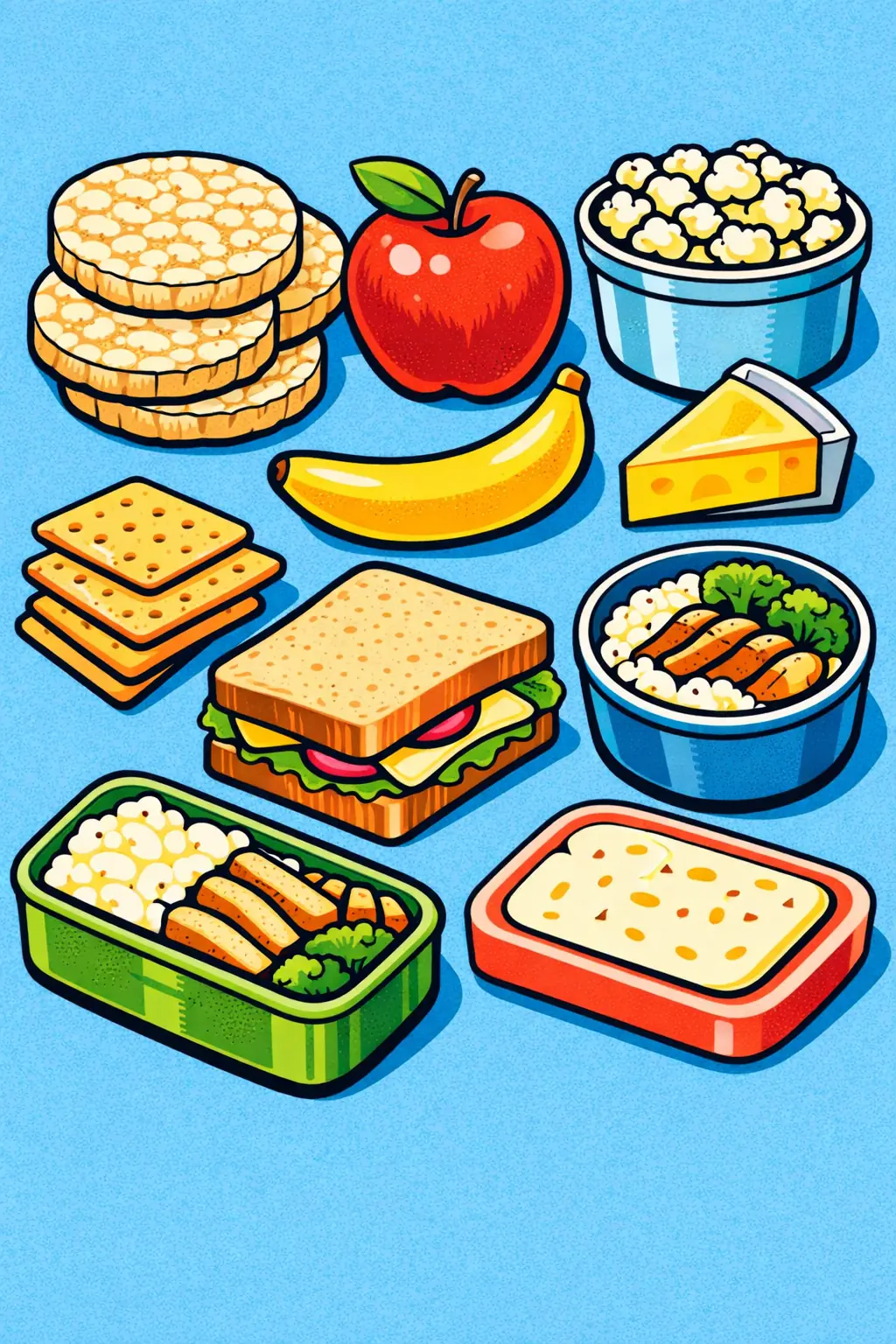
Bring an empty bottle and fill it after security. And if you are relying on packaged snacks, remember that Monash's updated label-reading guidance specifically calls out onion, garlic, inulin, FOS, and GOS as ingredients that deserve extra caution even in smaller amounts 9.
[!TIP] Download: Low FODMAP Travel-Day Packing Checklist Use it the night before a flight, hotel stay, or long drive so your backup food is already chosen.
If you could not pack enough food, the next best move is not to hunt for a "special" airport meal. It is to look for grocery-style foods with the fewest moving parts.
That usually means simple fruit, crackers, chips with short ingredient lists, plain oatmeal, cheese, or a basic rice-or-potato-based meal with sauce on the side. A plain option with fewer ingredients is usually easier to trust than a "healthy" snack bar with five sweeteners and three fibers.
Monash also warns that ingredients alone do not reliably predict FODMAP status, because processing and serving size can change the result 10. So if a packaged product still feels noisy, the practical answer is usually to buy the plainer alternative, not to overthink the label.
If packaged-food uncertainty keeps tripping you up, widen the lens with what to do when low FODMAP is not helping instead of trying to solve every airport meal by instinct alone.
Do not board already hungry if you can avoid it.
Treat the airport meal as the real meal when the flight meal feels unpredictable. Then use plane food as a backup only if it fits the plan. This keeps you from stacking random snacks just because there is nothing else to reach for.
Monash advises people starting low FODMAP to prioritize foods with green traffic-light ratings and green serving sizes 11. That matters even more on a long travel day, when several "small" snacks can quietly add up.
The best hotel food plan depends less on the hotel brand and more on the room setup.
| Room type | What it supports | Best first move |
|---|---|---|
| No fridge | shelf-stable only | buy one-night basics and avoid risky leftovers |
| Fridge only | breakfast, snacks, simple cold meals | stock 24 to 48 hours of repeat foods |
| Fridge + microwave | breakfasts plus easy reheats | add rice cups, oats, leftovers, or simple prepared foods |
| Kitchenette | full control | build two or three repeat meals, not a gourmet travel menu |
Monash's snack guidance explicitly recommends having food handy when you are on the move 12, and its shopping-list guidance recommends planning and using a list instead of guessing 13. A hotel arrival grocery stop is just the travel version of that same idea.
When you arrive, build a mini food base:
That might look like yogurt, fruit, crackers, cheese, oats, nut butter packets, or a simple microwaveable starch if the room allows it. The goal is not variety. It is that tomorrow morning's first meal is already solved.
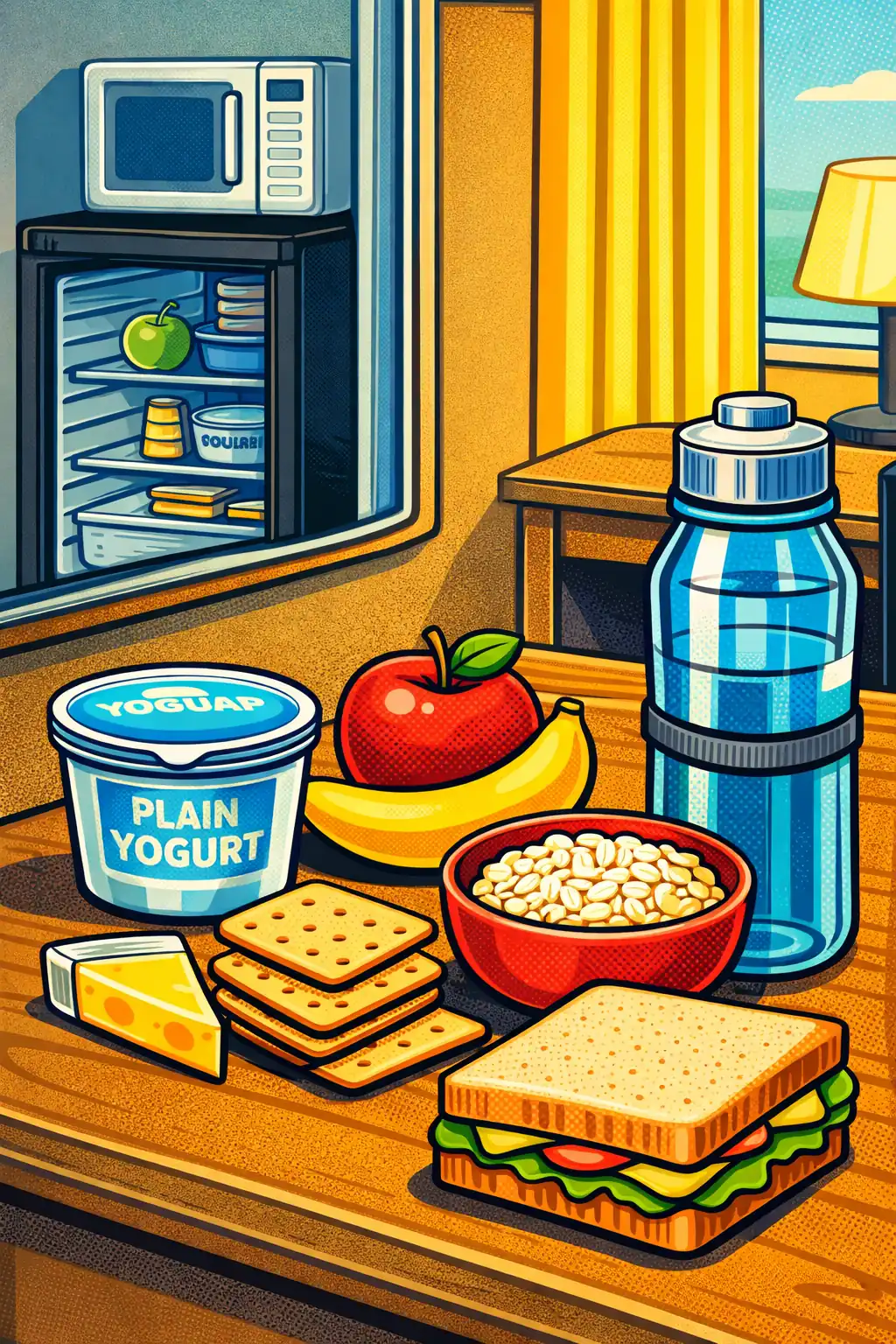
If you need help deciding what to buy based on room type, start with the beginner grocery list and strip it down to the room's actual storage limits.
[!IMPORTANT] Next Resource: Hotel Room Food Upgrade Matrix Use it when you know your room setup but are not sure what kind of food plan it can realistically support.
Do not think "What is the perfect low-FODMAP breakfast here?" Think "What is the plainest breakfast I can identify quickly?"
Plain eggs, fruit you can peel yourself, simple oats, or yogurt you can verify are usually easier to reason through than scrambled dishes with add-ins, smoothies, dressed fruit, pastries, or buffet potatoes with seasoning blends.
In higher-risk travel settings, CDC says fully cooked foods served hot are generally the safest choice, and travelers should be cautious with ice and questionable water 14. That makes "plain and hot" a better travel default than "healthy-looking but hard to verify."
Road trips work best with a two-zone system:
FoodSafety.gov says perishable foods should stay at 40 F or below, and most should not sit out for more than 2 hours, or more than 1 hour when temperatures go above 90 F 15. It also recommends using ice, gel packs, or frozen water bottles and keeping drinks separate if possible because beverage coolers are opened more often 16.
That is why the two-zone system matters. The dry foods stay easy to reach, and the cooler stays colder longer.
| Cooler lane | Shelf-stable lane |
|---|---|
| yogurt | rice crackers |
| hard cheese | plain popcorn |
| eggs | pretzels |
| simple rice bowl | tolerated nut packs |
| fruit | certified bar |
| cut vegetables | oats |
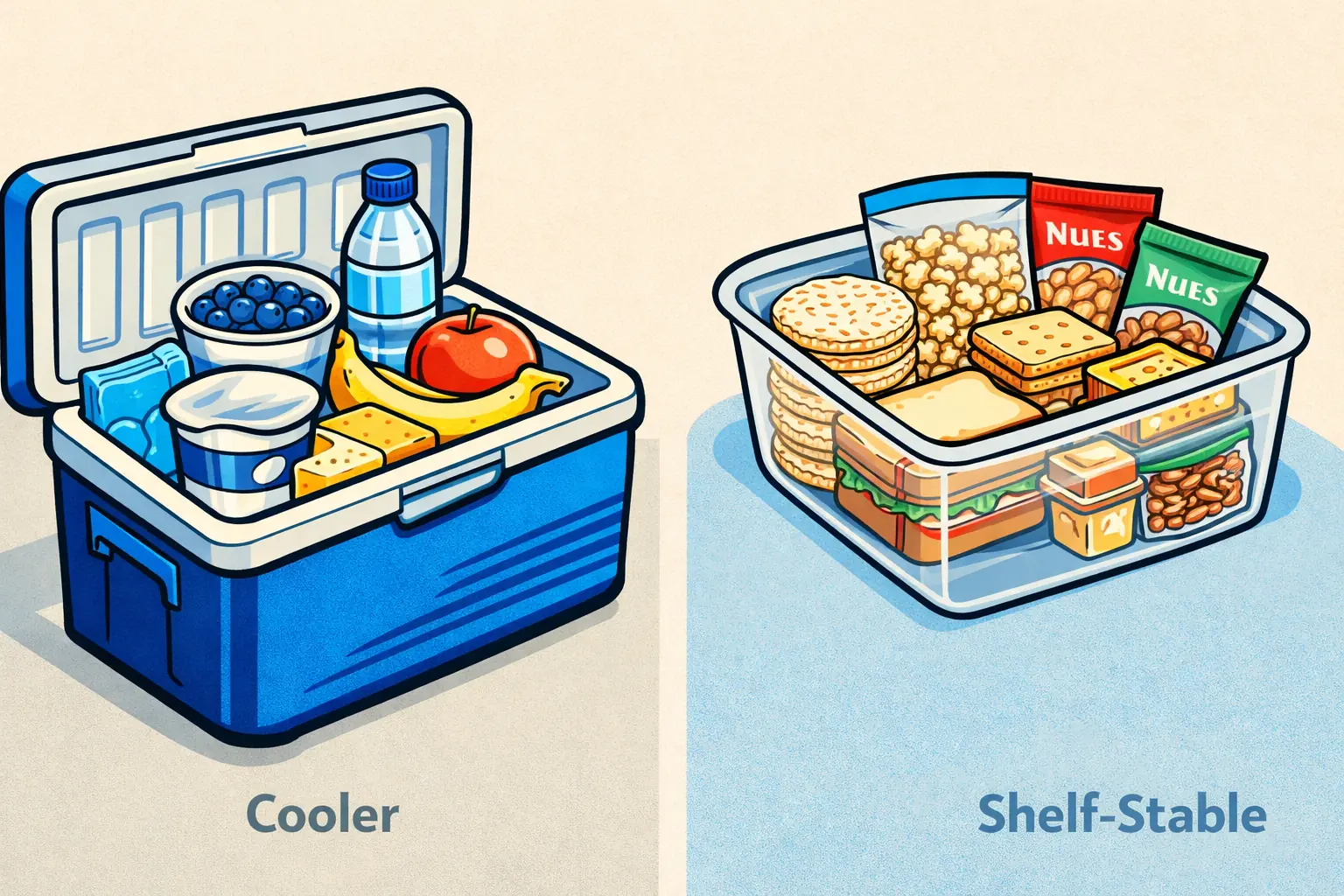
For leftover safety, FoodSafety.gov's cold storage chart lists many cooked leftovers at 3 to 4 days refrigerated 17, and its consumer guidance says leftovers should be chilled within 2 hours, used within 4 days, and reheated to 165 F 18. On a hot road trip, that does not mean "probably fine in the car for a while." It means be honest about time and temperature.
At the gas station, start with the plainest option. If you are choosing between a basic cracker and a fiber-loaded "wellness" bar, the basic cracker is often the more readable travel choice.
If the plan failed, work the rescue ladder in this order:
Monash's label-reading update is useful here because it keeps the screen short: be especially careful with onion, garlic, inulin, FOS, and GOS 19. That is often enough to rule a product in or out quickly.
If a restaurant meal is the only realistic option, fall back to the restaurant guide: simple protein, starch, plain vegetable, sauce on the side, and fewer hidden ingredients.
The goal on a bad travel-food day is not elegance. It is the lowest-risk option you can reasonably control.
This section matters most when water safety or sanitation is uncertain.
CDC says fully cooked foods served hot are generally the safest choice in these settings 20. It also says to avoid ice unless you know it was made with safe water 21. CDC Travelers' Health adds that iced drinks and fountain drinks can be risky in places where the water supply is uncertain 22.
That means:
One more boundary: U.S. TSA rules do not automatically cover customs or destination-country import rules. If the trip crosses borders, check local screening and customs guidance separately.
Most bad travel-food days come from systems mistakes, not one dramatic mistake.
The common ones:
If your reactions are especially driven by mixed snacks across long days, return to FODMAP stacking. If the bigger problem is that the diet still feels impossible to execute in real life, revisit how to start low FODMAP rather than tightening the rules even more.
The hardest part of travel is rarely one perfect or imperfect food. It is the moment when you have no plan left and hunger is making the decision for you.
That is why this system works:
If you want the easiest next step, download the travel-day checklist, build one hotel-room fallback plan, and keep the destination restaurant guide ready for the meals you cannot pack.
If the trip also includes family meals or party food, add this low-FODMAP holiday survival guide so the shared-table part of the trip has a plan too.
Xam Riche is a gut health solopreneur and founder of YourFitNature, dedicated to helping people navigate digestive wellness through evidence-based information and personal experience. After years of struggling with IBS and bloating, Xam discovered the transformative power of the low FODMAP diet and now shares practical, science-backed guidance to help others find relief. While not a medical professional, Xam combines extensive research with lived experience to create accessible, empowering resources for the gut health community. Learn more about our mission
As an affiliate, we may earn from qualifying purchases.
Choose a focused guide for what you are noticing or deciding next.