 By • Published on November 27, 2025 • 12 min read • 3,288 views
This article is for informational and educational purposes only and does not constitute medical advice, diagnosis, or individualized nutrition counseling. Work with a registered dietitian, gastroenterologist, or other qualified healthcare professional before starting, extending, or intensifying a low-FODMAP elimination diet, especially if symptoms are severe, weight is changing, food restriction is increasing, or you have a medical condition.
Follow this 7-part series to learn everything you need to know to successfully start and complete the low-FODMAP diet for bloating relief.
You're reading: The 3 Phases Low FODMAP Diet Plan for Busy People
Your gut is telling you something. Bloating hits at 2 PM, right when you're in that Slack call. You skip lunch because the afternoon feels like carrying a weight. This isn't willpower—it's biology. Your digestive system is rebelling against something you're eating.
The 3 phases low FODMAP diet plan for busy people works. It works so well that gastroenterologists recommend it for IBS (Irritable Bowel Syndrome) and SIBO (Small Intestinal Bacterial Overgrowth) 1 2. But here's the problem: everything you read about it assumes you have time. Meal prep Sunday. Track every ingredient. Follow a 2-6 week elimination phase like you're running a science experiment.
You're not. You're running a business. You have meetings. You have deadlines. You need a system that fits reality, not the other way around.
If you're new to this approach, start with understanding the basics of the Low FODMAP diet before diving into the 3-phase protocol.
This is how you apply the low FODMAP 3-step process without burning out, losing productivity, or spending three hours planning meals.
Short answer: this article is the older reference version of the 3-phase low-FODMAP workflow. It is still useful, but the newer pillar pages now do a better job of routing readers by intent.
This page is for you if you want the legacy protocol view of elimination, reintroduction, and personalization in one place.
Use a different page first if you want the newer protocol pillar or the orientation page. Start with low-fodmap-diet-bloating-how-it-helps-3-phases or what-is-the-low-fodmap-diet-for-bloating-understanding-the-basics.
This page explains a legacy protocol bridge:
This page is not mainly explaining:
Use this page when you already know the low-FODMAP diet is the right lane and you want the full elimination, reintroduction, and personalization sequence. Use the beginner explainer if you are still asking what the diet is, and use the bloating-specific phase guide if bloating is the main search intent.
| Reader stage | Better page |
|---|---|
| Still deciding what low FODMAP means | What is the low FODMAP diet for bloating? |
| Ready for the bloating-specific phase explainer | Low FODMAP diet for bloating and the 3 phases |
| Ready to test foods after improvement | Low FODMAP reintroduction guide |
| Step 3 is noisy or too restrictive | Low-FODMAP personalization mistakes |
| Gluten or wheat is the confusing trigger | Gluten, celiac, or IBS symptoms |
Most Low FODMAP guides treat it like a full-time job. They overwhelm you with lists of forbidden foods, then expect you to memorize which carrots are safe and which aren't.
This is backwards.
The real leverage isn't in perfection. It's in clarity + constraints + simple decision rules.
When your decisions are complex, you'll default to what's easy—and what's easy is often high-FODMAP. Pizza, garlic bread, that apple at your desk. When your decisions are simple, you stick to the system. Simple wins.
Here's how the Low FODMAP diet actually works, and how to make it work for you.
The Low FODMAP diet is a low FODMAP 3-step process designed to manage symptoms of IBS (including IBS-D and IBS-C subtypes) and SIBO. FODMAP stands for Fermentable Oligosaccharides, Disaccharides, Monosaccharides, and Polyols—types of carbohydrates that can trigger digestive symptoms in sensitive individuals.
Think of Low FODMAP as a journey with three distinct objectives 3. Each phase has one job.
Phase 1: Elimination. Remove the triggers. See what happens.
Phase 2: Reintroduction. Find your actual limits. Not everyone reacts the same.
Phase 3: Personalization. Expand to the widest diet you can tolerate. This is permanent life.
Most people fail because they treat all three phases the same way. They don't. Each one requires different thinking 4. This protocol is recognized by gastroenterologists following the Rome IV criteria for IBS diagnosis 5.
To understand how the Low FODMAP diet helps with bloating specifically, see our detailed guide on the mechanisms behind symptom relief.
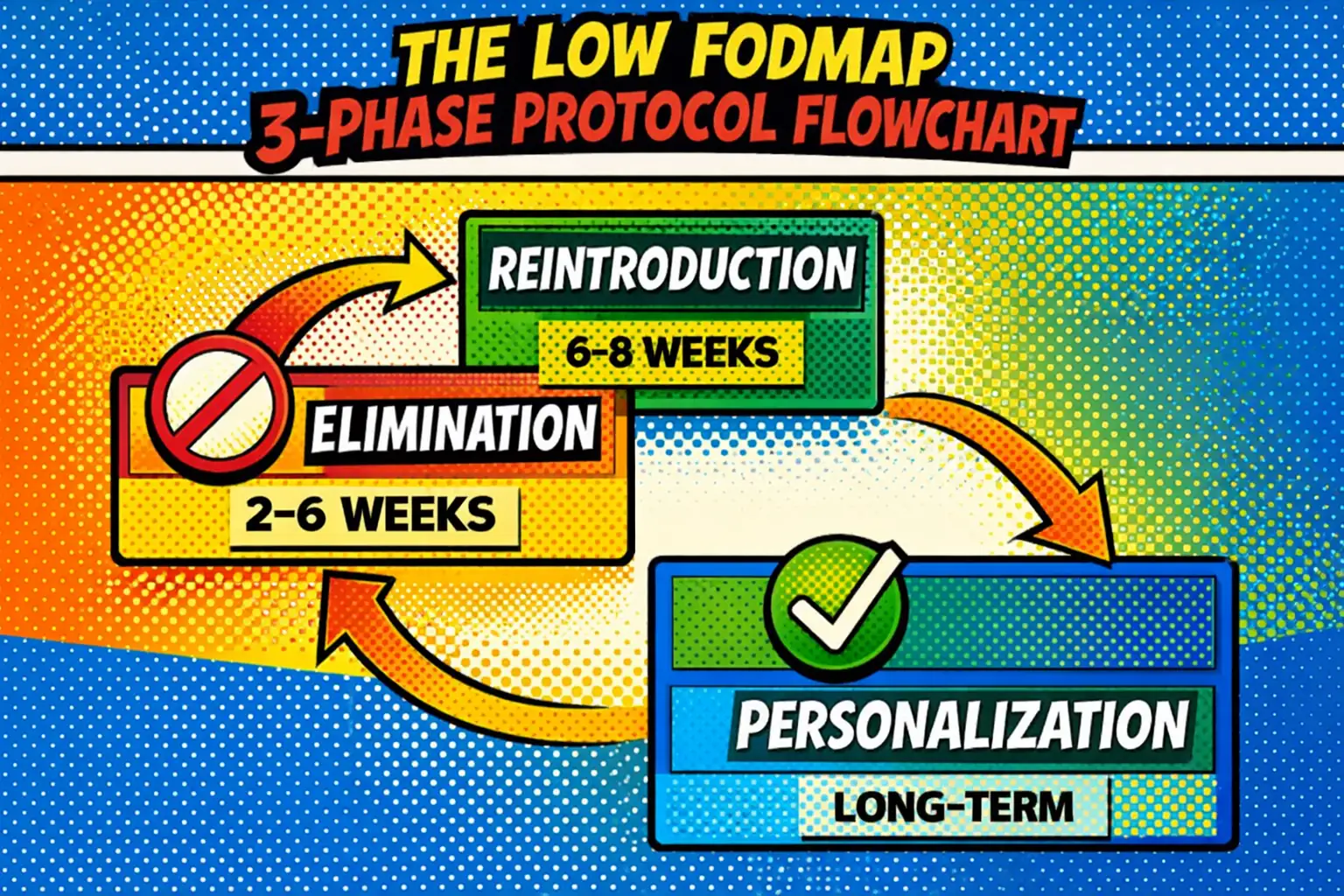
What it is: The elimination phase duration is 2-6 weeks where you eat only low-FODMAP foods. High-FODMAP foods (including fructans, lactose, sorbitol, and GOS) trigger fermentation in your gut. Fermentation creates gas. Gas creates bloating, pain, and brain fog 6.
Eliminate FODMAPs, eliminate the trigger. It's that simple 7.
Why it matters: Most people notice symptom relief by week 1 or 2. Real relief. Not marginal. Not "I feel slightly better." People say "I forgot what it felt like to not be bloated." 8
The busy professional's approach:
Stop thinking "diet." Start thinking "constraints." Constraints simplify everything.
Your constraint: Eat from a pre-approved list only.
Not on the list? Don't eat it. That's the rule.
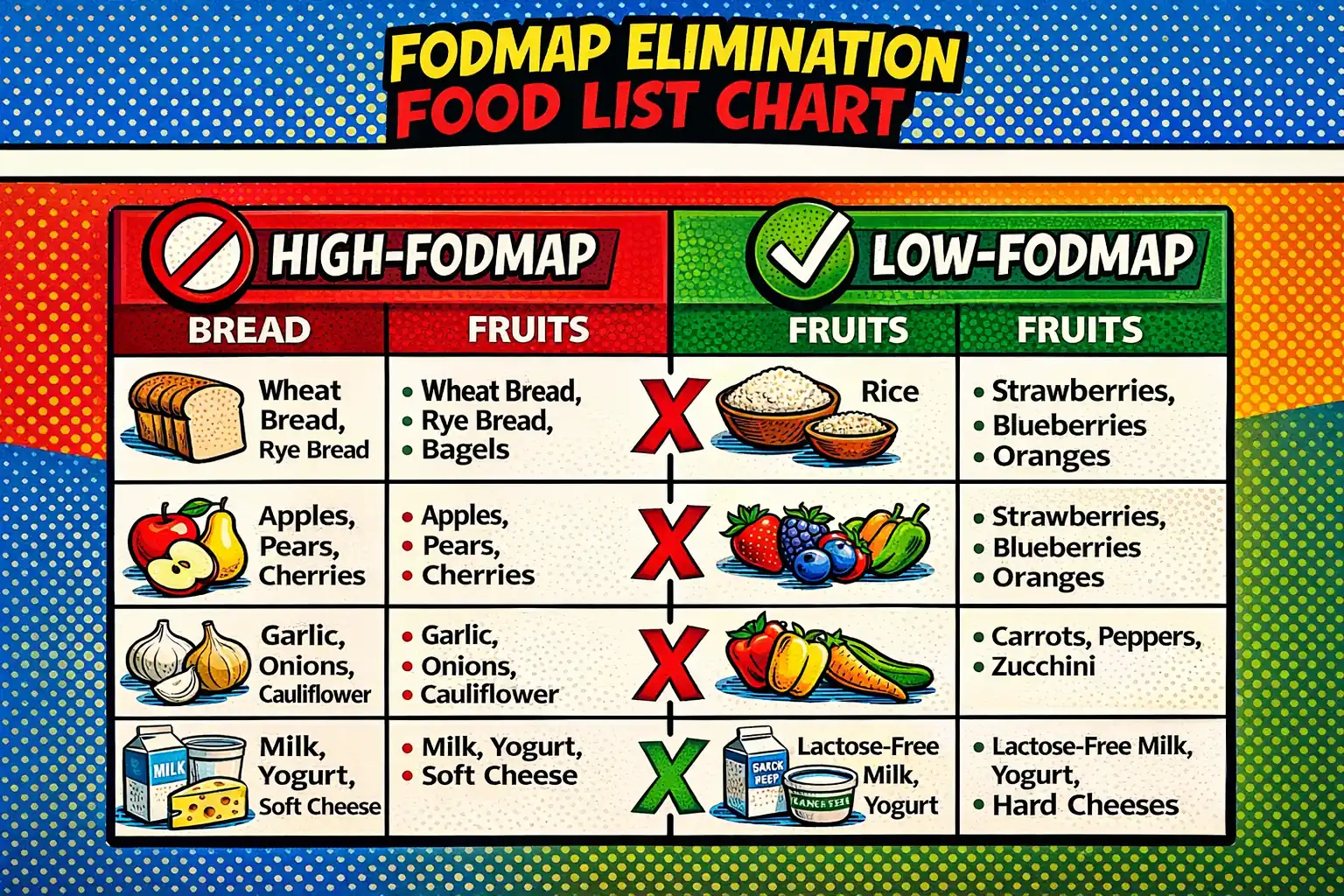
This eliminates decision fatigue. You're not questioning whether something is safe. You're checking a list.
Before you start, use this guide to what to buy on your first low-FODMAP grocery trip.
If you need to travel during this phase, use this low-FODMAP travel guide to keep the diet more stable on the move.
Your elimination phase meal structure:
Breakfast: Eggs + toast (regular bread, not wheat) + blueberries
Lunch: Grilled chicken + rice + steamed carrots
Dinner: Ground turkey + pasta + tomato sauce (made without garlic/onions)
Snacks: Rice cakes, strawberries, cheddar cheese, nuts
Notice what's gone: garlic, onions, wheat (in most foods), high-fructose corn syrup, most processed foods. These are your high-FODMAP culprits.
The mindset shift: You're not depriving yourself for 6 weeks. You're running an experiment. "If I eliminate these foods, will my symptoms disappear?" The answer is usually yes. That certainty is worth 6 weeks.
How to track it: Keep a simple symptom log. Rate your bloating 1-10 each day, note your energy, mark your bowel movements. By week 3, the pattern emerges. Your body talks. Listen.
Critical rule: Don't cheat. Even small amounts of high-FODMAP foods accumulate. Your goal is a clean baseline so you know exactly what triggered you later.
Timeline: Aim for a clean short trial rather than rushing the data. Monash FODMAP describes the low-FODMAP process as a staged approach that starts with reducing high-FODMAP foods, then tests tolerance and personalizes the diet 9.
What it is: You've been feeling great for a month. Now the fun part: figuring out which specific foods you can actually eat through the FODMAP reintroduction challenge steps.
Not everyone reacts to the same FODMAPs. One person fine with milk but can't touch wheat. Another handles wheat fine but reacts to apples 10.
This phase identifies your specific triggers.
If you want the full walkthrough for challenge timing, washouts, symptom tracking, and what to do when a test gets messy, read our detailed low FODMAP reintroduction guide.
If a challenge goes badly, use our guide on troubleshooting bad reintroduction weeks before assuming the whole process failed.
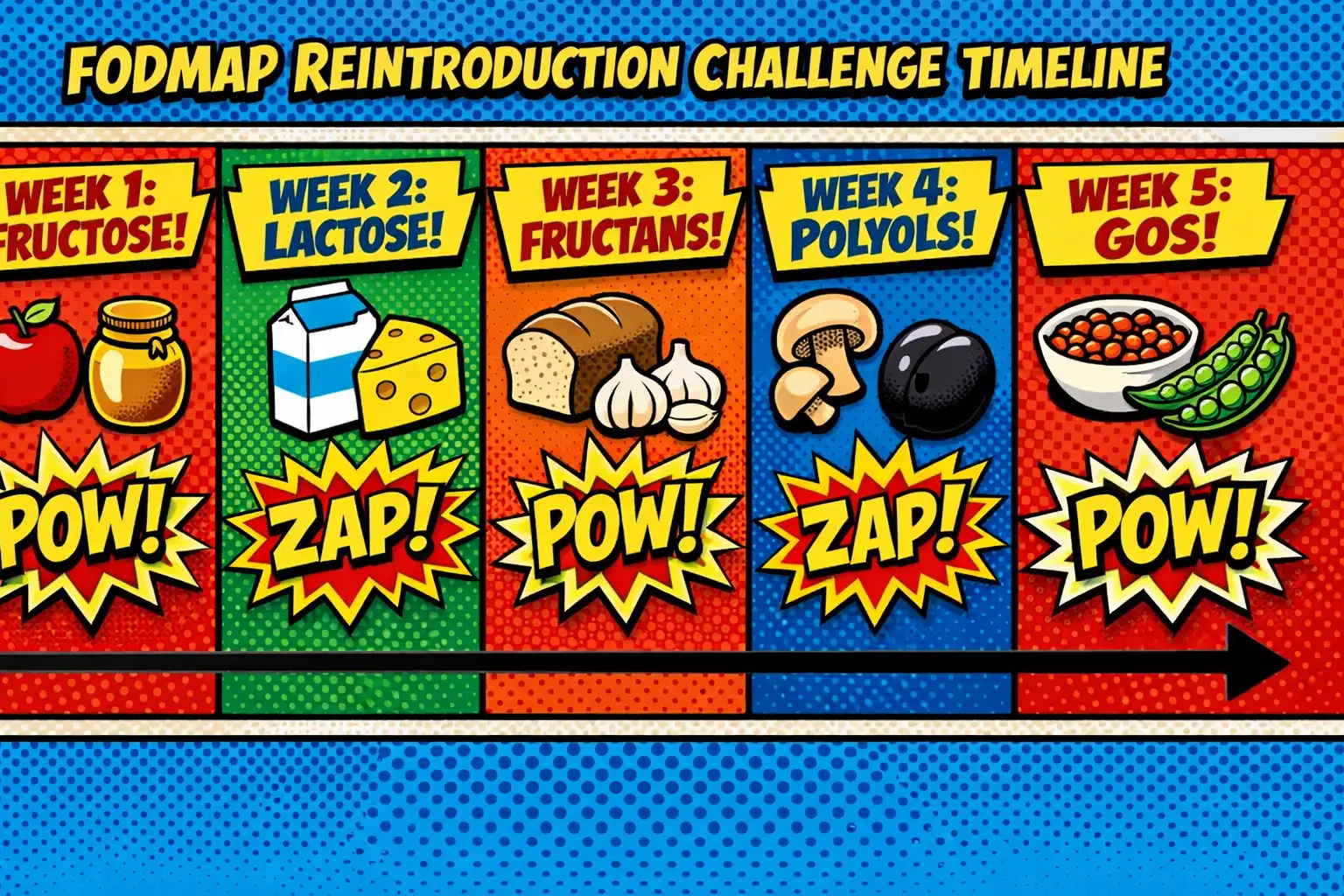
How it works: The 3-Day Protocol
Use our interactive tracker to systematically test FODMAP groups and log your symptoms:
Timeline: 6-8 weeks covers all FODMAP groups if you test one per week with a 3-4 day washout between 11.
What it is: You've done the work. You know your triggers. Now you expand to the widest personalized low FODMAP diet you can tolerate while remaining symptom-free. 12
This is your forever diet.
The principle: You're not trying to be perfect. You're trying to be functional. Functional means living normally, eating socially, traveling—without constant bloating 13.
Build your personal food system:
From Phase 2, you have data. Use it to create three categories using our interactive tool:
For the office worker: Weekly meal-prep system
Sunday evening, 30 minutes:
Monday-Friday, you grab a container. Decision made. Zero cognitive load.
Breakfast rule: Eggs + toast + fruit. Same thing. Boring is good.
Dinner flexibility: Use your Green list. Salmon with rice and broccoli. Turkey with quinoa and carrots. Variety without complexity.
Social eating: You're not perfect. You don't need to be. You go to dinner with friends, you make a choice. You've already expanded to Yellow foods in controlled amounts. You decide what's worth it and what isn't.
Track your progress through all three phases:
Here's what separates people who succeed with Low FODMAP from people who quit:
People who quit try to optimize everything. "What about this vegetable?" "Can I have this at night?" "What if I combine two foods?" The complexity makes them quit.
People who succeed accept constraints. "These are my Green foods. I eat them. End of story."
Constraints aren't limiting. They're liberating 14. They remove decisions. Fewer decisions = more energy for your actual work.
Your attention is a limited resource. Stop spending it on food logistics. Spend it on what matters.
[!WARNING] The Low FODMAP diet is a temporary, restrictive elimination protocol designed to identify food triggers. It should never be followed long-term without professional supervision.
The restrictive nature of Phase 1 (elimination) carries known nutritional risks. Patients following the Low FODMAP diet without professional guidance may experience reduced intake of:
These deficiencies can impact energy levels, bone health, immune function, and overall wellbeing. This is why the elimination phase should be limited to 2-6 weeks maximum.
Research indicates that strict, long-term FODMAP restriction can adversely affect gut bacteria diversity. Studies show that prolonged elimination phases may reduce levels of beneficial bacteria, including Bifidobacteria 16.
This is why Phase 2 (Reintroduction) is not optional—it's essential for restoring dietary variety and supporting a healthy microbiome.
The complexity of the Low FODMAP protocol and its nutritional risks make professional supervision critical:
Do not self-diagnose or self-treat digestive symptoms. Consult a healthcare provider before beginning this protocol.
If you are still unsure whether your symptoms fit IBS, SIBO, or a more specific food intolerance pattern, compare them in this SIBO vs IBS guide before assuming the diet alone is the answer.
This page is the protocol reference, not the only low-FODMAP starting point. Use it when you need the full elimination, reintroduction, and personalization sequence in one place.
Download: Low FODMAP Protocol Route Checklist
You don't follow Low FODMAP to suffer. You follow it to work without digestive distraction.
Imagine Tuesday at 2 PM. Your 3 PM presentation is queued up. You're not bloated. Your energy isn't tanked. You're thinking clearly because your gut isn't fighting you.
That's the actual win.
The 3 phases low FODMAP diet plan for busy people isn't punishment. It's a protocol that costs you 12 weeks upfront to give you clarity for life 18. You'll know your body. You'll know your triggers. You'll know exactly what you can eat, when, and how much.
Most people never get that information. They just feel bad and don't know why 19.
You will. And you'll organize your eating system around it.
Start Phase 1 this week. Choose your Green list foods today. Do your first Sunday prep. Track your symptoms. The data will tell you whether the low FODMAP 3-step process is your answer. And after 12 weeks, you'll have a personalized low FODMAP diet that actually works for your life, not against it.
Remember: Consult with a specialized Low FODMAP dietitian before starting this protocol to ensure nutritional adequacy and proper diagnosis.
The system is simple: reduce high-FODMAP foods briefly, test tolerance, and personalize the diet from the data 20.
Xam Riche is a gut health solopreneur and founder of YourFitNature, dedicated to helping people navigate digestive wellness through evidence-based information and personal experience. After years of struggling with IBS and bloating, Xam discovered the transformative power of the low FODMAP diet and now shares practical, science-backed guidance to help others find relief. While not a medical professional, Xam combines extensive research with lived experience to create accessible, empowering resources for the gut health community. Learn more about our mission
As an affiliate, we may earn from qualifying purchases.
Choose a focused guide for what you are noticing or deciding next.