By Xam Riche • Published on December 1, 2025 • 9 min read • 4,818 views
This article is for informational and educational purposes only and does not constitute medical advice. Always consult with a qualified healthcare professional before using diet or symptom information to make diagnosis or treatment decisions.
Affiliate Disclosure: This post contains affiliate links. If you click and make a purchase, we may earn a commission at no extra cost to you.Medical Disclaimer: This article is for informational and educational purposes only and does not constitute medical advice. Always consult with a qualified healthcare professional before using diet or symptom information to make diagnosis or treatment decisions.
Last updated on October 25, 2026
The Ultimate Guide to the Low-FODMAP Diet for Bloating
A Step-by-Step Guide to the Low-FODMAP Diet
Follow this 7-part series to learn everything you need to know to successfully start and complete the low-FODMAP diet for bloating relief.
You're reading: High FODMAP Foods to Avoid for Bloating
Your stomach swells. Your waistband cuts in. You shift in your seat, praying no one notices.
You replay the meal: wholegrain toast, "gut-friendly" yogurt, an apple, chickpea salad with onions. All the things you've been told are healthy.
Three hours later, you're bloated, foggy, and loosening your belt in the bathroom, wondering: "What did I do wrong this time?"
Short answer: this page helps you identify the highest-yield high-FODMAP
foods to remove first during elimination and explains why those trigger
patterns keep showing up in "healthy" meals.
This page is for you if your next question is: "Which foods should I stop
first, and why do these specific categories keep hitting me?"
The inconsistency wears you down. One day you tolerate avocado. The next day, the same amount doubles you over. The rules keep changing.
So you start saying "no" to dinners out. You avoid travel. You see food as a threat, not nourishment.
Here's the shift:
What if it's not random? What if the bloating, the gas, the 3 p.m. crash—all of it—is a pattern your gut has been showing you for years?
Before diving into high FODMAP foods, you may want to understand what the low FODMAP diet is and how it works as a science-backed approach to identifying your triggers.
Bloating Isn't Random: The FODMAP Pattern Hiding in Plain Sight
Most people get vague answers:
"Sensitive stomach."
"Stress."
"Maybe gluten."
So you cut things randomly. Dairy one week. Bread the next. Then all fruit. Symptoms improve, then return. It feels like guesswork because it is.
Here's what changes everything:
Your bloating isn't a character flaw. It's chemistry 1.
Specific carbohydrates (FODMAPs) behave predictably in your gut. When you understand how they behave, your symptoms make sense.
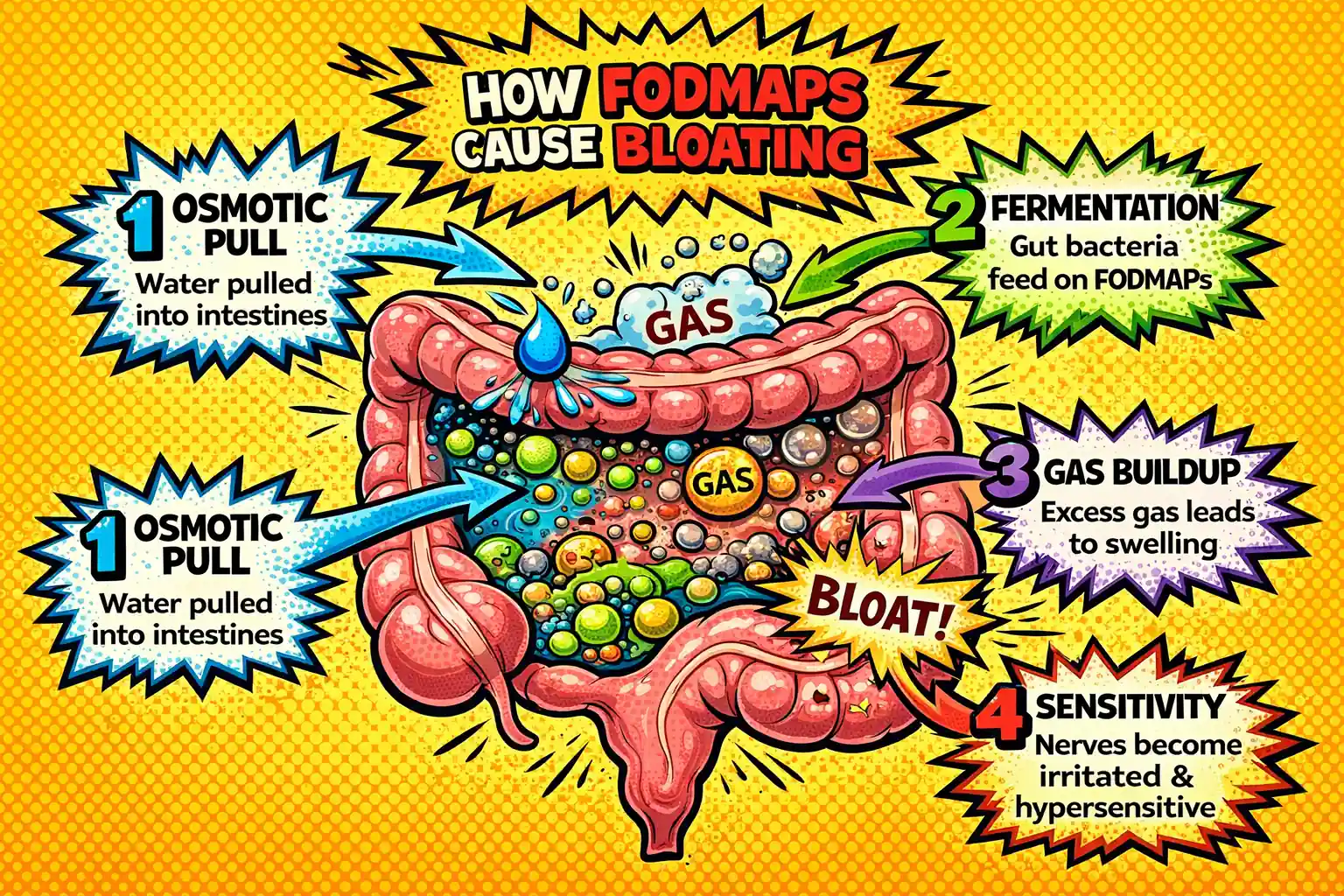
FODMAPs are short-chain carbs your small intestine can't fully absorb 2. They reach your colon and trigger four mechanisms: poor absorption, bacterial fermentation, water pull, and gut sensitivity.
The science behind FODMAP-induced bloating and gas
Why This Perspective Gives You an Edge
Most approaches hand you a list: "Avoid these foods. Good luck."
That's like getting a spreadsheet with thousands of numbers and no context.
Understanding mechanisms changes everything:
Knowledge = Control
You stop fearing "mystery foods." You know which carb type triggers you: fructans, lactose, GOS, excess fructose, or polyols.
Patterns = Predictability
Garlic and onions trigger the same mechanism as wheat. Apples, mangoes, and honey share a pattern. Beans have their own 3. You see clusters, not chaos.
Awareness = Freedom
You make strategic swaps: garlic-infused oil instead of garlic. Gluten-free grains instead of wheat. Lactose-free milk instead of regular. You navigate menus with confidence, not avoidance.
For the complete 3-phase low FODMAP protocol with meal planning and reintroduction strategies, see our guide.
The shift: From emotional reaction to informed decision.
Now let's meet the five FODMAP "villains" driving your bloating.
The Five FODMAP Villains Driving Your Bloating
Understanding the five FODMAP types helps you identify patterns in your symptoms and make strategic food swaps. Each "villain" triggers bloating through specific mechanisms—once you know how they work, you gain control.
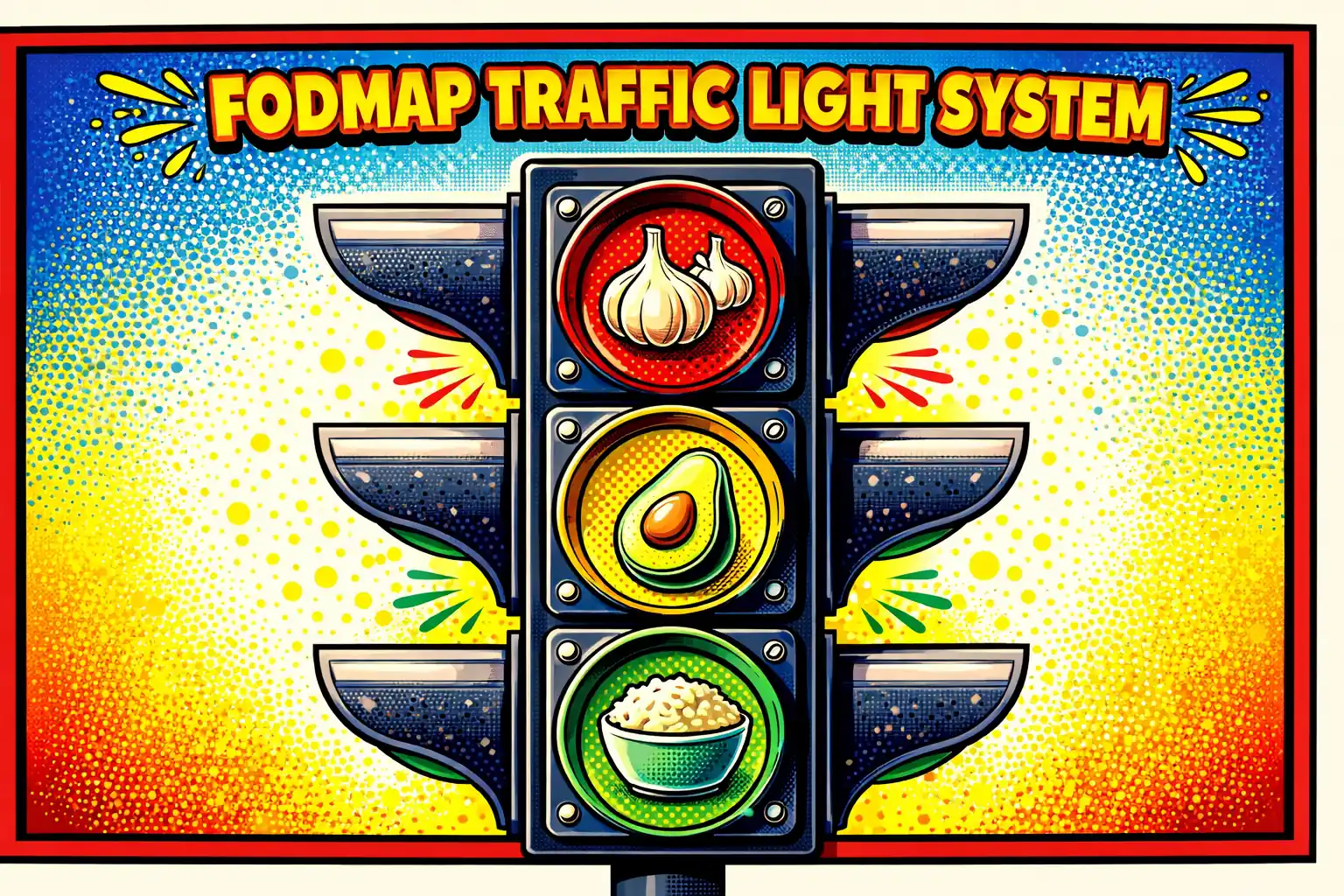
Quick Reference: FODMAP Traffic Light System
Navigating FODMAP foods becomes simple with a traffic light system: 🔴 Red (avoid during elimination), 🟡 Yellow (small portions only), and 🟢 Green (safe in normal portions). Use our interactive food database to search, filter, and build your personalized meal plans with confidence.
Visual guide to high, moderate, and low FODMAP foods
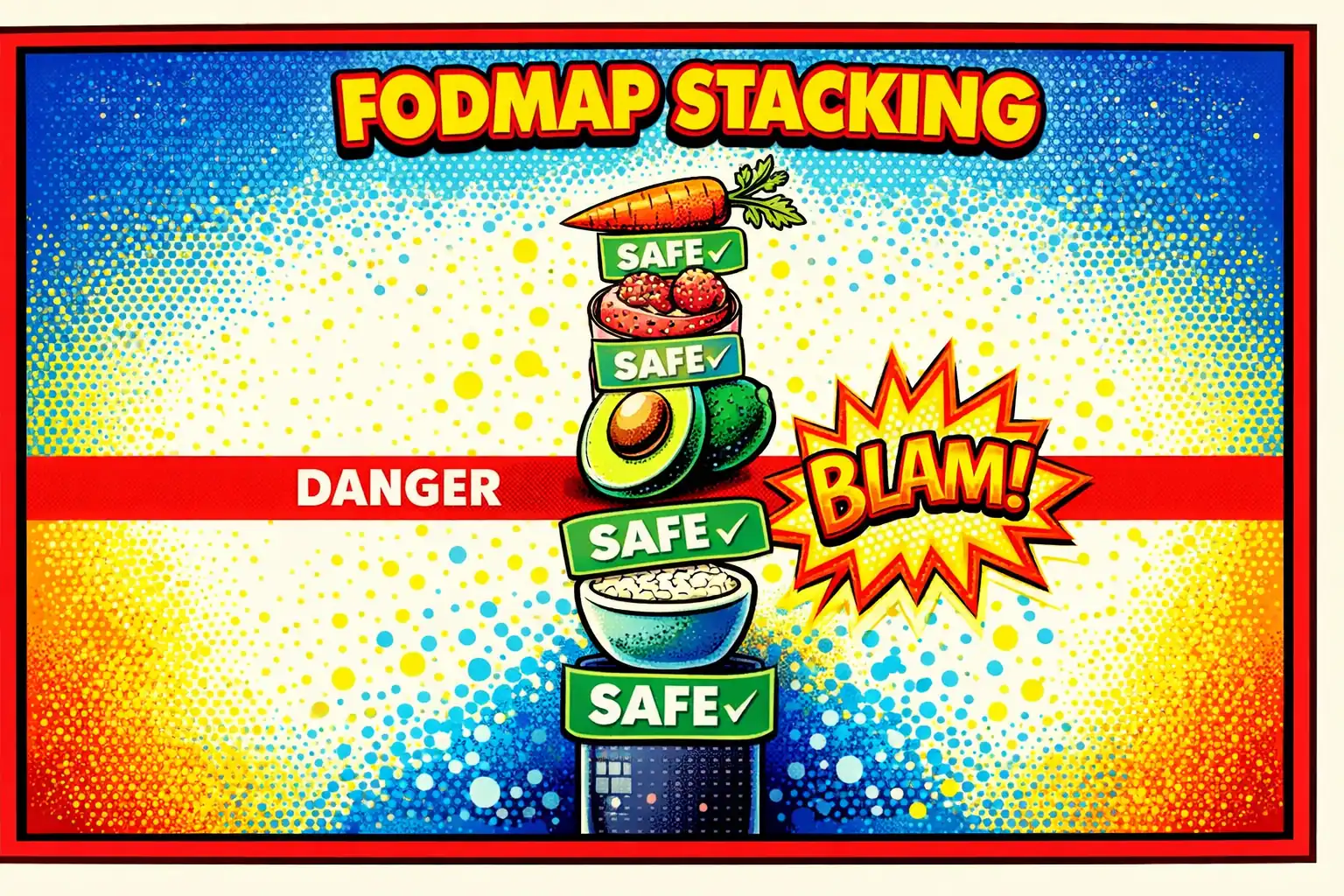
The Hidden Danger: FODMAP Stacking Explained
You've been following the low FODMAP diet religiously for two weeks. You check every label, avoid all the obvious triggers, and stick to "green light" foods. Yet some meals still leave you bloated and uncomfortable.
You review your food diary:
Breakfast: Gluten-free toast (low FODMAP ✓) with a small serving of avocado (1/8, low FODMAP ✓)
Snack: Lactose-free yogurt (low FODMAP ✓) with a handful of blueberries (low FODMAP ✓)
Lunch: Rice bowl with firm tofu (low FODMAP ✓), bok choy (low FODMAP ✓), and a small portion of canned chickpeas (1/4 cup, low FODMAP ✓)
Every single item is technically "safe." So why do you feel like you've swallowed a balloon?
Welcome to FODMAP stacking.
How FODMAP stacking causes symptoms even with safe foods
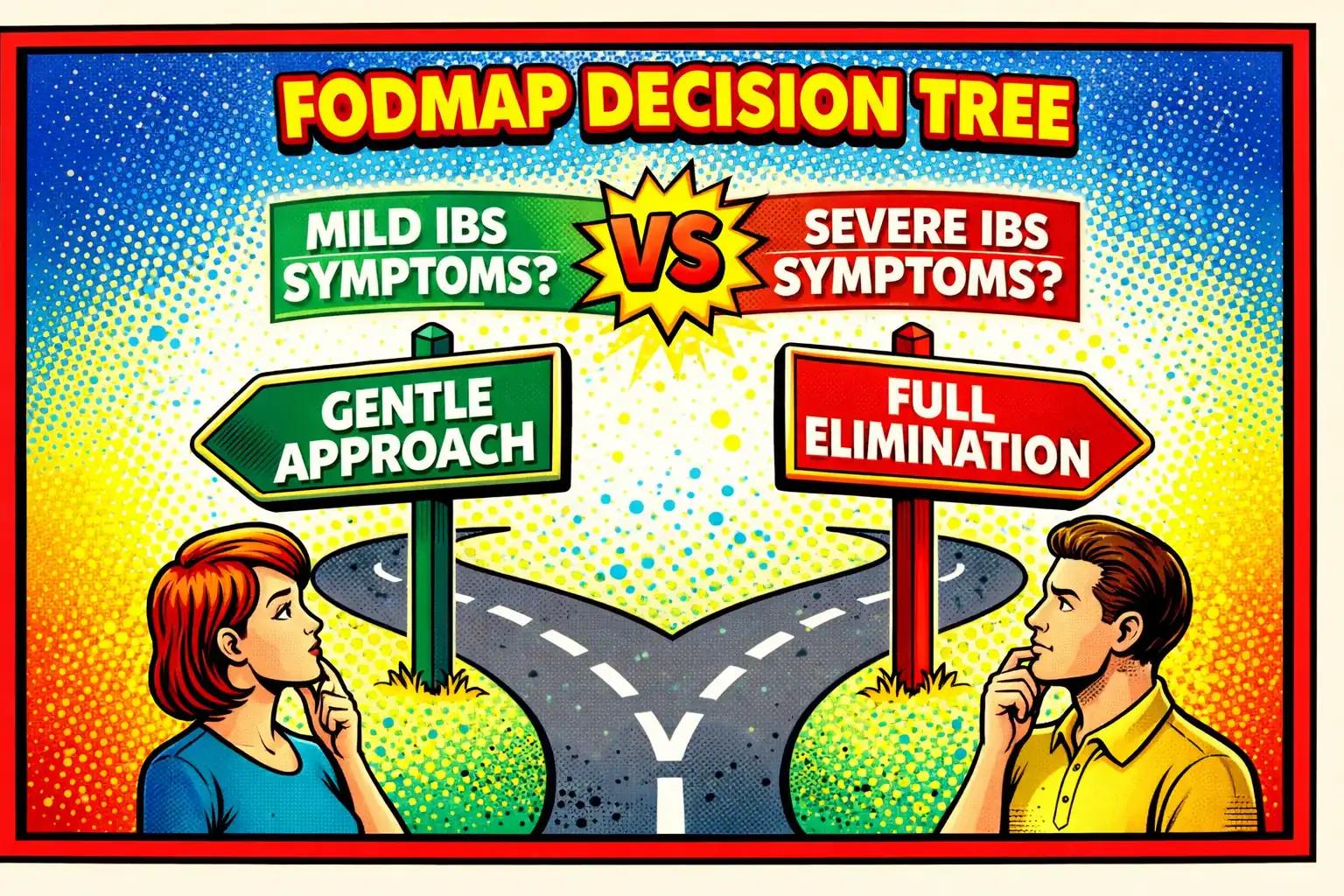
Not Everyone Needs Strict Elimination: The FODMAP Gentle Approach
The standard low FODMAP diet is often presented as an all-or-nothing protocol: eliminate all high-FODMAP foods for 2-6 weeks, then systematically reintroduce them one by one.
For many people with moderate to severe IBS, this strict approach is necessary and life-changing.
But what if your symptoms are mild? What if you're elderly and already dealing with nutritional restrictions? What if you have a history of disordered eating and the idea of another restrictive diet feels triggering?
Enter the FODMAP Gentle approach.
Choosing between gentle FODMAP approach and full elimination
The Missing Piece: Why Stress Makes Your Bloating Worse
You've followed the low FODMAP diet perfectly for two weeks. Eliminated all triggers. Tracked every meal.
Then you have a stressful day. Deadline looms. Terse email from your boss. Nightmare traffic.
By evening, your stomach is distended—even though you ate the exact same low-FODMAP meals.
What happened?
The gut-brain axis—your brain and digestive system communicate directly. Stress triggers IBS symptoms as powerfully as high-FODMAP foods through five mechanisms:
Altered gut motility - Stress hormones speed up or slow down digestion
Increased sensitivity - Normal gut sensations feel more painful when stressed
Leaky gut - Toxins enter the bloodstream, triggering inflammation
Disrupted microbiome - Stress alters bacteria, increasing fermentation and gas
Reduced enzymes - Poor FODMAP breakdown leads to more fermentation
This creates a vicious cycle: bloating → anxiety → worse gut sensitivity → more symptoms → more anxiety.
The truth: You can't out-diet your stress. Perfect FODMAP adherence won't eliminate symptoms if chronic stress is triggering the gut-brain axis.
For how stress triggers bloating through the gut-brain axis, including 6 evidence-based strategies (gut-directed hypnotherapy, vagus nerve stimulation, CBT for IBS, mindful eating, exercise, sleep optimization), see our guide.
The 7-Day FODMAP Detective Challenge
Now that you understand the mechanisms, it's time to run an experiment on your own body—like a scientist, not a victim.
The 7-Day FODMAP Detective Challenge helps you identify your personal triggers through systematic observation.
Track your progress, log symptoms, and build your personalized trigger map using our interactive tracker.
You're Not Broken — You're Learning the System
Bloating makes you feel betrayed by your body. It shrinks your social life, drains your energy, and turns food into anxiety.
Here's the truth:
Your gut has been remarkably consistent. Fructans, GOS, lactose, excess fructose, and polyols follow clear rules. They create water pull. They ferment. They produce gas. Your gut amplifies those signals.
That doesn't mean you're fragile. It means you're highly responsive—and responsiveness becomes strength once you understand the system.
The low FODMAP approach isn't a life sentence. It's a temporary investigation that shows you which foods, in which portions, at which times, work with your body 25.
Your next step:
Start the 7-Day FODMAP Detective Challenge. Observe. Journal. Notice patterns. Build your trigger map.
Your gut isn't your enemy. It's a feedback system. Now you have the framework to decode its signals and move from survival mode to informed control.
Your job is no longer to fear every bite. Your job is to listen, experiment, and design a way of eating that finally fits you.
Some people also find relief by combining the low FODMAP diet with digestive enzymes for bloating, especially for specific trigger foods like dairy or beans.
Bottom Line
High-FODMAP food lists are most useful as temporary investigation tools, not
permanent fear lists. Use this page to identify the highest-yield categories,
then move into safe-food swaps, a beginner setup, or structured reintroduction
instead of staying in avoid-everything mode.
Xam Riche is a gut health solopreneur and founder of YourFitNature, dedicated to helping people navigate digestive wellness through evidence-based information and personal experience. After years of struggling with IBS and bloating, Xam discovered the transformative power of the low FODMAP diet and now shares practical, science-backed guidance to help others find relief. While not a medical professional, Xam combines extensive research with lived experience to create accessible, empowering resources for the gut health community. Learn more about our mission
Xam Riche - Gut Health Solopreneur & IBS Advocate. Xam Riche is a gut health solopreneur and founder of YourFitNature, dedicated to helping people navigate digestive wellness through evidence-based information and personal experience. After years of struggling with IBS and bloating, Xam discovered the transformative power of the low FODMAP diet and now shares practical, science-backed guidance to help others find relief. While not a medical professional, Xam combines extensive research with lived experience to create accessible, empowering resources for the gut health community.
Recommended Products
As an affiliate, we may earn from qualifying purchases.
 By • Published on December 1, 2025 • 9 min read • 4,818 views