 By • Published on May 25, 2026 • 11 min read • 4,746 views
This article is for informational and educational purposes only and does not constitute medical advice. Use individualized guidance from a qualified healthcare professional for persistent, severe, new, or concerning symptoms.
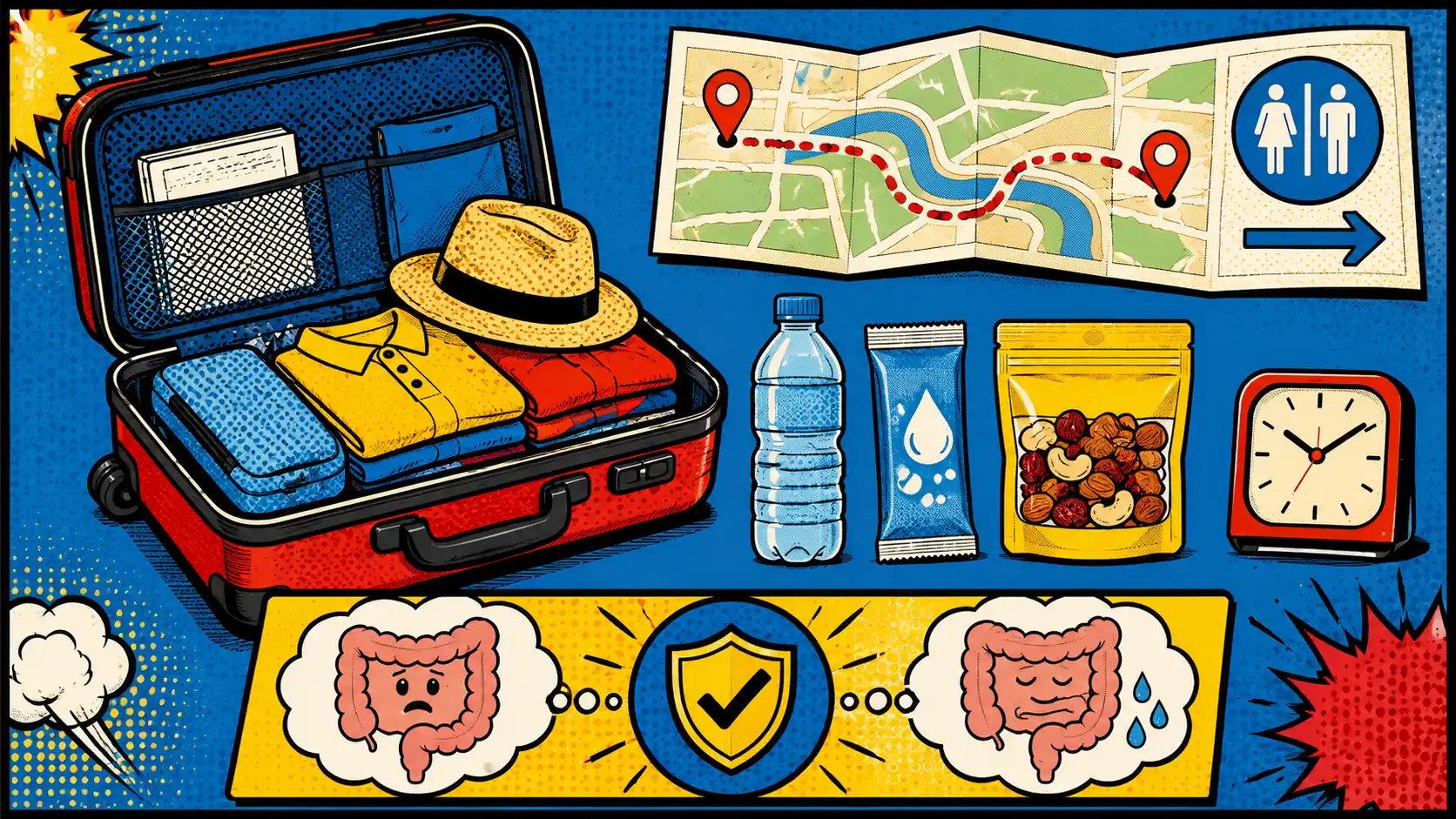
Travel can make a stable gut feel unpredictable.
At home, you may know your usual IBS rhythm. On a trip, the rhythm gets scrambled by early flights, long drives, delayed meals, unfamiliar bathrooms, hotel breakfasts, heat, dehydration, coffee timing, restaurant choices, and sleep changes. One trip may lean constipated. Another may become diarrhea-heavy. Some trips do both.
This page is not a replacement for the full low-FODMAP travel guide. Use that article when the main question is what to pack, buy, or eat in airports, hotels, or road trips. Use this page when the harder question is: "What do I do if travel flips my bowel pattern, and when is it no longer routine IBS?"
IBS can involve abdominal pain with constipation, diarrhea, or alternating bowel changes, and the pattern is often multifactorial rather than one single trigger 1. A travel prep kit is really a routing system: constipation layer, diarrhea and hydration layer, food layer, bathroom-access layer, and stop-sign layer.
Before packing more products, name the pattern you are planning for.
| Travel pattern | First question | Better next route |
|---|---|---|
| Constipation-leaning | Will routine, fluids, meals, movement, and bathroom timing be disrupted? | Constipation and bloating |
| Diarrhea-leaning | Is this your usual IBS-D pattern, possible food/water exposure, heat, or illness? | Oral rehydration for diarrhea and flares |
| Mixed | Are you overcorrecting one symptom and triggering the other? | IBS flare plan |
| Food logistics only | Do you mainly need airport, hotel, or road-trip food structure? | Low-FODMAP travel guide |
| New or concerning | Is there blood, fever, severe pain, dehydration, black stool, or persistent change? | IBS warning signs |
The travel mistake is treating every trip as a food problem. Food matters, but so do bathroom access, hydration, timing, movement, stress, sleep, medications, and whether the pattern is different from your baseline.
Pack for the pattern you already recognize, not every digestive problem you can imagine. A smaller kit is easier to understand if symptoms change during the trip.
| Your established travel pattern | Add to the kit | Keep out of the “just in case” pile |
|---|---|---|
| Constipation-leaning | Familiar breakfast support, water plan, movement breaks, and only constipation medicine already agreed with your clinician | A new high-dose fiber, magnesium, or laxative experiment on departure day |
| Diarrhea-leaning | ORS packets when fluid loss is a realistic risk, bathroom route, spare clothes, and only clinician-approved medicine used as directed | Multiple untested anti-diarrhea products or very sugary hydration drinks |
| Mixed or unpredictable | One-page symptom log and a written rule for when to stop correcting one direction | Simultaneous constipation and diarrhea products without a clear plan |
| Food-logistics only | Checked meal, snack, backup food, and hotel or destination restock list | A large supplement stack that makes the symptom signal harder to read |
If you want a compact preassembled cleanup option rather than building that layer from separate items, compare the public restroom travel kit by contents, portability, and disposal needs. It is a logistics tool, not a treatment for urgency, diarrhea, constipation, or IBS.
If water cleansing is the missing part, use the portable-bidet travel-fit guide to compare manual, larger-capacity, and electric options by grip, refill route, and drying needs.
Save or print this section as the packing list. For airport, hotel, road-trip, and destination food choices, use the low-FODMAP travel guide rather than expanding this kit with more “safe” foods or products.
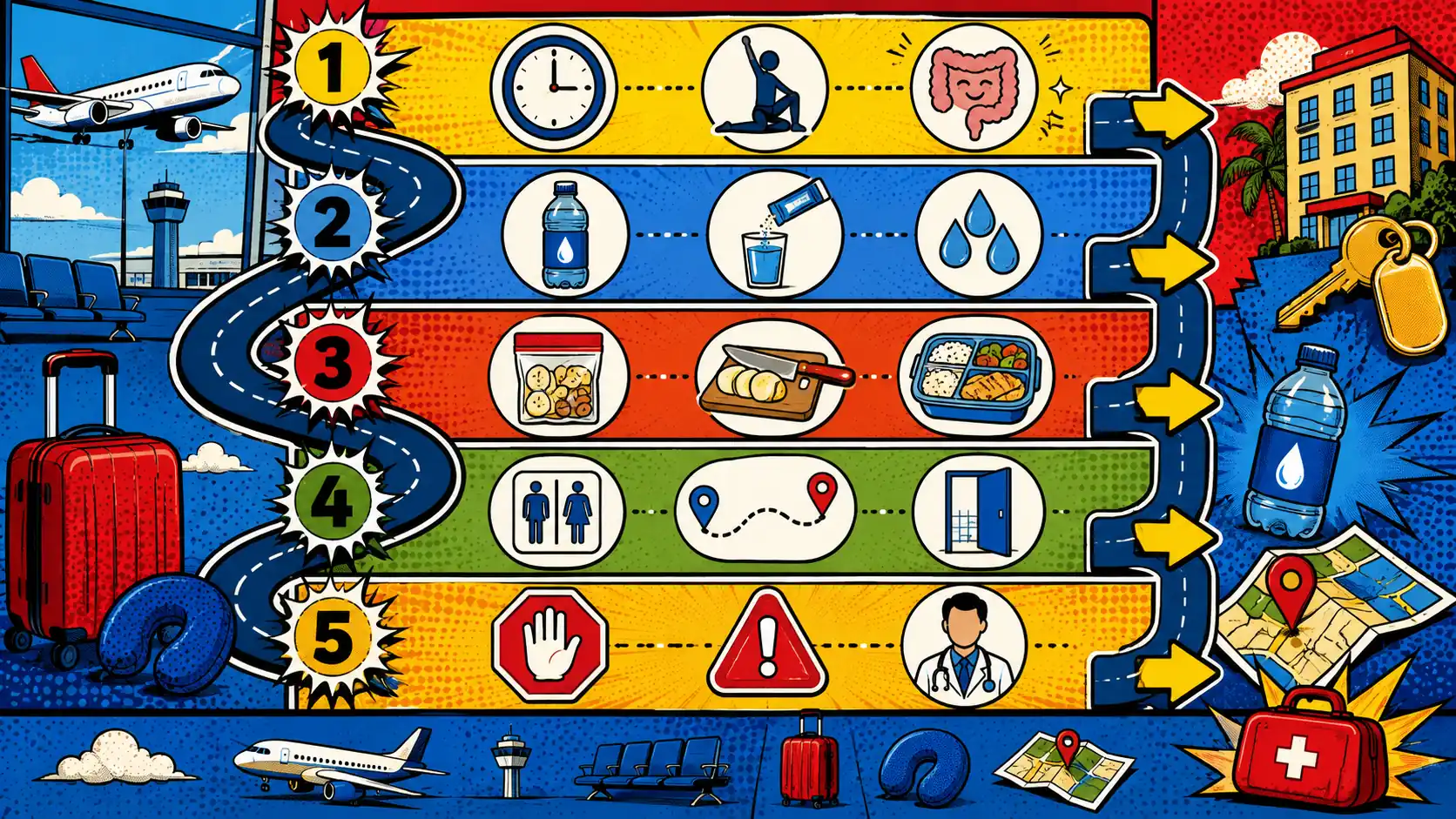
Travel constipation often starts before the trip does.
You wake up earlier than usual, skip breakfast, sit for hours, drink less water, avoid public bathrooms, delay the urge to go, and eat differently. By the time you arrive, the problem may be routine disruption more than one specific food.
Build a constipation layer around what you already tolerate:
NIDDK frames constipation care around diet and drink changes, physical activity, gradual fiber changes, and medication review when medicines may contribute 2. That "gradual" part matters. A travel day is usually a bad time to test a huge new fiber dose, magnesium product, or laxative strategy you have never used.
If constipation and bloating are already a recurring pair, use constipation and bloating before the trip to build the routine. If symptoms are severe, progressive, or paired with vomiting or inability to pass stool or gas, do not treat that as normal travel constipation.
Diarrhea while traveling needs a different kind of caution.
Sometimes it is your familiar IBS-D pattern under stress. Sometimes it is a restaurant, alcohol, caffeine, heat, poor sleep, or timing stack. Sometimes it may be traveler's diarrhea or another illness. The prep kit should not pretend those are all the same.
Pack the basics:
CDC Yellow Book guidance says severe fluid loss from travelers' diarrhea is best replaced with oral rehydration solution prepared from packaged oral rehydration salts, while overly sweet drinks can worsen osmotic diarrhea if used in quantity 3.
That does not mean every loose stool needs ORS. It means repeated watery stool, vomiting, heat, sweating, dizziness, very dark urine, or trouble keeping up with fluids deserves a hydration route, not just another food rule.
Use oral rehydration for diarrhea and IBS flares when the travel pattern is diarrhea-heavy. Use hydration and electrolytes when the question is broader fluid balance, sweat, constipation, dizziness, or electrolyte-product confusion.
Food still matters. It just should not carry the entire explanation.
For most IBS travel days, the food layer works best when it is boring and repeatable:
If you are in the elimination phase of low FODMAP, your food layer may need to be tighter. If you are in personalization, the goal is usually a stable travel base plus a few known flexible choices. If you are not doing low FODMAP, the same idea still applies: choose reliability before novelty on the hardest travel days.
For detailed airport, hotel, and road-trip food planning, use the low-FODMAP travel guide. For restaurant-specific choices, use low-FODMAP eating out. If travel follows a diarrhea flare, use what to eat after a diarrhea flare instead of jumping straight into a wide restaurant test.
Bathroom access is not a minor detail. It can change the whole symptom day.
For constipation, access matters because some readers delay the urge to go until the schedule is "easier." For diarrhea and urgency, access matters because fear can make meals, hydration, and movement feel risky even before symptoms start.
Plan the obvious pieces:
This is not saying symptoms are psychological. It is saying logistics can make real symptoms easier or harder to handle. If urgency fear is becoming the main constraint, route to IBS at work, school, and commuting for access planning and to doctor visit prep if symptoms are escalating.
The stop-sign layer is the most important part of the prep kit.
NIDDK lists diarrhea warning signs that include dehydration, blood or pus in stool, black stool, fever, severe abdominal pain, and diarrhea that persists 4. During travel, also take new, severe, nighttime, or clearly unusual symptoms seriously.
Get medical help promptly for:
If you are traveling internationally, immunocompromised, pregnant, older, or managing other medical conditions, ask a clinician or travel-medicine provider before the trip what to do if diarrhea, dehydration, or severe constipation appears.
| Your situation | Read next |
|---|---|
| You need airport, hotel, and road-trip food logistics | Low-FODMAP travel guide |
| Diarrhea, heat, vomiting, or dizziness is involved | Oral rehydration for diarrhea and IBS flares |
| Constipation and bloating dominate the trip | Constipation and bloating connection |
| You need same-day symptom triage | IBS flare plan |
| Symptoms include blood, fever, severe pain, dehydration, or persistent change | IBS warning signs |
| You need help explaining the pattern to a clinician | Doctor visit prep |
An IBS travel prep kit is not just a bag of snacks.
Build it in layers: constipation routine, diarrhea and hydration support, food reliability, bathroom access, and stop signs. That way you are not trying to solve every travel symptom with one more restriction or one more product.
If the pattern feels familiar and mild, use the route guide to make the next small decision. If symptoms are new, severe, dehydrating, bloody, feverish, persistent, or different from your baseline, stop treating it as routine IBS and get medical support.
Xam Riche is a gut health solopreneur and founder of YourFitNature, dedicated to helping people navigate digestive wellness through evidence-based information and personal experience. After years of struggling with IBS and bloating, Xam discovered the transformative power of the low FODMAP diet and now shares practical, science-backed guidance to help others find relief. While not a medical professional, Xam combines extensive research with lived experience to create accessible, empowering resources for the gut health community. Learn more about our mission
As an affiliate, we may earn from qualifying purchases.