 By • Published on April 30, 2026 • 16 min read • 4,124 views
This article is for informational and educational purposes only and does not constitute medical advice. Blood in stool, unexplained weight loss, anemia, severe weakness, or rapidly worsening bowel symptoms need medical evaluation.
A symptom-sorting sequence for bloating, constipation, urgency, IBS lookalikes, testing questions, and warning signs.
You're reading: IBS vs Colorectal Warning Signs: What Should Never Be Written Off as "Just IBS"

Most recurring bowel symptoms are not colorectal cancer. That is the reassuring part. The important part is not normalizing the symptoms that stop fitting a routine IBS story: bleeding, unexplained weight loss, anemia, or a bowel change that keeps pushing in the wrong direction.
Short answer: IBS usually means recurrent abdominal pain plus bowel habit change without visible digestive-tract damage, while colorectal warning signs include features such as rectal bleeding, blood in stool or dark stool, iron-deficiency anemia, unexplained weight loss, and persistent bowel changes that deserve medical evaluation 1 2.
This page is for you if you are trying to sort whether a lower-GI symptom pattern still looks broadly IBS-like or has crossed into a red-flag lane that should not be self-managed casually.
Use a different page first if your main question is broader symptom overlap without obvious red flags. For that, start with SIBO vs IBS vs food intolerance or the wider bloating symptom map.
If the worry is specifically lower-left abdominal pain, use the location-based lower-left abdominal pain comparator to separate familiar IBS-style pain from patterns that point toward diverticular, urinary, pelvic, or obstruction-like evaluation.
Use this page when the worry is colorectal-style warning signs. Use a different safety page when the symptom cluster points somewhere else.
| If the main worry is... | Start here | Why |
|---|---|---|
| Rectal bleeding, black stool, anemia, unexplained weight loss, or a persistent bowel-habit change | This page | It owns the colorectal-warning lane and keeps these signs from being dismissed as routine IBS. |
| Severe or worsening pain plus vomiting, distension, constipation, or inability to pass gas or stool | Possible gut obstruction signs | That page owns the obstruction-like symptom-cluster lane. |
| Wave-like pain, cramping waves, or pain that is becoming steady and severe | Bowel obstruction pain patterns | That page explains obstruction-like pain patterns, then routes back to urgent evaluation when the cluster is concerning. |
| Food reactions, bloating, diarrhea, or constipation without warning signs | SIBO vs IBS vs food intolerance | Routine symptom comparison belongs after red flags are absent or medically addressed. |
IBS is common, messy, and easy to over-apply as a label.
NIDDK describes IBS as a group of symptoms that occur together, including repeated abdominal pain and changes in bowel movements, which may be diarrhea, constipation, or both, without visible signs of damage or disease in the digestive tract 3.
That usual IBS frame often includes:
Those symptoms are real. They can be disruptive. They also overlap with many other gut problems.
That is why this article is not asking, "Can IBS feel bad?" It can. The question is whether the symptom story still behaves like a familiar IBS-style pattern, or whether new warning signs mean the next step should be medical evaluation instead of more self-sorting.
If your question is still more about benign-pattern differentiation than warning signs, the best companion page is SIBO vs IBS vs food intolerance.
American Cancer Society guidance is useful here because it stays practical.
Common colorectal warning signs include:
ACS also notes that chronic blood loss can lead to anemia and that sometimes the first clue is a blood test showing low red blood cell counts 5.
That matters because pain and bowel change can overlap with IBS, but bleeding, anemia, and unexplained weight loss should raise the bar.
NICE's current suspected-cancer pathway guidance gives the same red-flag logic more concrete referral language. It recommends FIT-led referral pathways for adults with change in bowel habit, iron-deficiency anemia, age-specific combinations of rectal bleeding, abdominal pain, and weight loss, and it says a rectal mass does not need FIT before referral is considered 6.
The practical takeaway is simple:
One warning sign matters. A cluster matters more. The goal is not to diagnose yourself from a table. The goal is to notice when the next step changes from symptom management to medical evaluation.
| Symptom cluster | Why it should not be filed under "just IBS" | Better next move |
|---|---|---|
| Rectal bleeding, visible blood, or dark stool | Bleeding is not part of the usual IBS definition, even when hemorrhoids or fissures are possible. | Prompt clinician review; urgent care if bleeding is heavy, black or tar-like, or paired with weakness. |
| Iron-deficiency anemia, low red blood cells, fatigue, or unexplained weakness | Colorectal bleeding may be hidden, and anemia can be the first clue. | Medical workup rather than diet troubleshooting. |
| Unexplained weight loss plus bowel change or abdominal pain | Weight loss changes the risk category of a bowel-symptom story. | Prompt appointment and testing discussion. |
| Persistent new bowel change | IBS can fluctuate, but a new pattern that keeps pushing away from baseline deserves a higher bar. | Clinician review, especially with bleeding, pain, anemia, or age/risk context. |
| Severe pain, vomiting, swelling, inability to pass gas or stool | This can point away from a colorectal-warning-sign sorter and toward obstruction-like evaluation. | Urgent evaluation; use possible gut obstruction signs as the safety route. |
This section belongs before food troubleshooting on purpose. If red flags are present, the next question is not "what should I eat?" It is "what needs to be ruled out?"
Some overlap is real. The next step is what changes.
| Pattern | More consistent with a common IBS-style story | More concerning for colorectal warning signs |
|---|---|---|
| Core symptom frame | recurrent abdominal pain plus bowel habit change | bowel symptoms plus bleeding, anemia, weight loss, or a persistent change |
| Bleeding | not part of the usual IBS definition | rectal bleeding, visible blood, or dark stool needs evaluation |
| Blood tests | often normal unless another issue is present | low hemoglobin or iron-deficiency anemia raises concern |
| Weight change | may fluctuate with diet or stress, but not unexplained loss as a core feature | unexplained weight loss belongs in the warning-sign lane |
| Bowel change | chronic instability can happen in IBS | a new or persistent bowel change, especially with other red flags, needs more caution |
| Next step | symptom-based IBS workup and management | clinician review, possible FIT, blood work, colonoscopy, or referral |
Use that table as a direction finder, not as a home diagnosis tool.
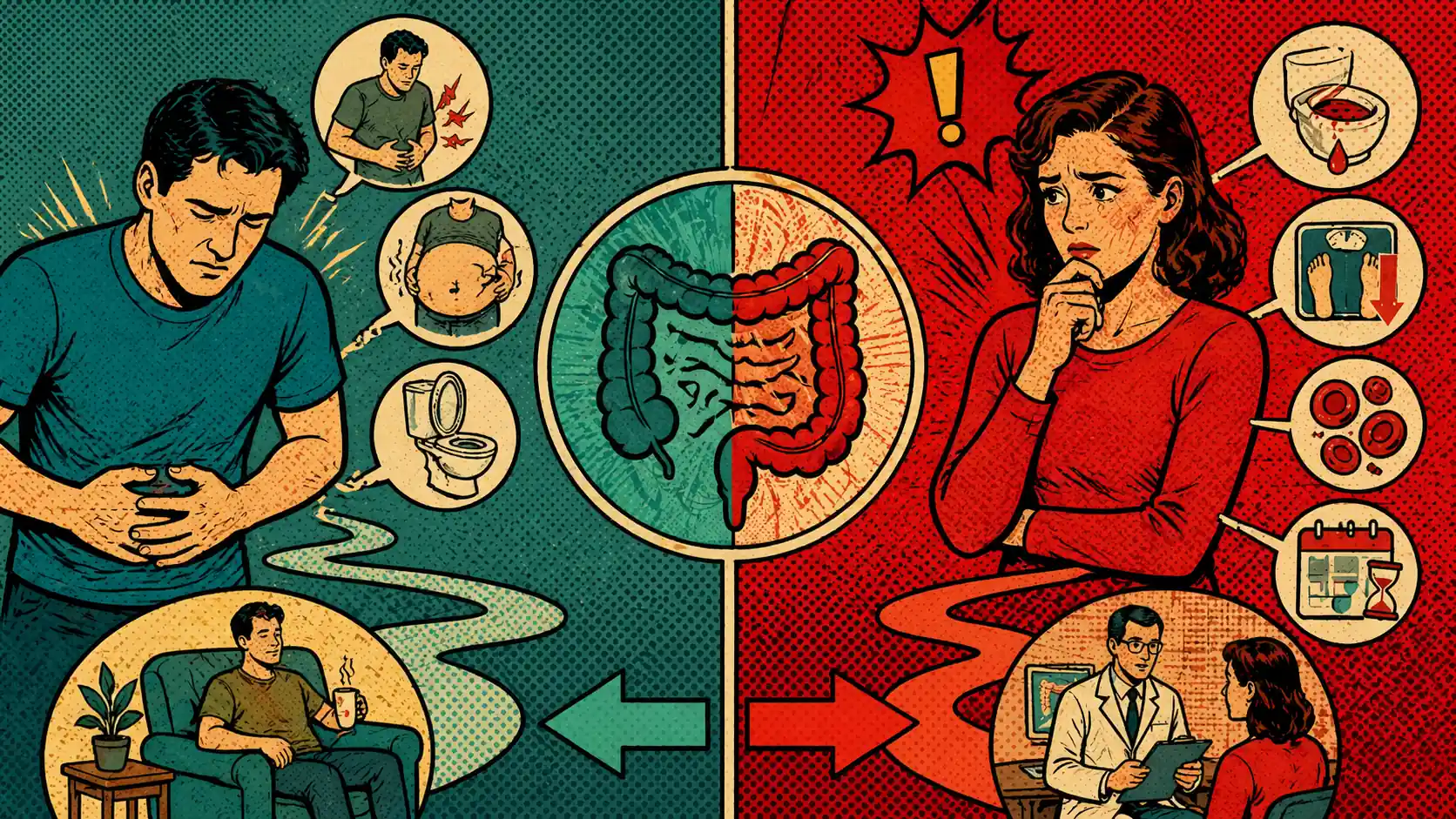
This is where people get misled.
In the United States, USPSTF recommends offering average-risk colorectal cancer screening starting at age 45 7.
That does not mean symptoms before age 45 are irrelevant.
NCI highlighted four warning signs seen before diagnosis in younger adults:
The same NCI summary noted that one sign was linked with roughly twice the likelihood of diagnosis in the study population, while three or more signs were linked with about six times the likelihood 9.
So the practical rule is:
Do not wait for a birthday if the symptom pattern has already crossed into a red-flag lane. Do not let microbiome or probiotic headlines blur that boundary either; this colorectal cancer microbiome-claim explainer is for interpreting research claims, not for replacing warning-sign workup.
Not every warning sign means the ER. But some patterns should move fast.
That last cluster deserves special caution because it can overlap with obstruction-like symptoms rather than a simple IBS flare. If that sounds closer to your pattern, go straight to possible gut obstruction signs.
Location can help route the next read, but it should not weaken the escalation standard. A lower-left pain article, an obstruction article, and a colorectal warning-sign article are asking different safety questions.
| If this is the main clue | Use this route | Why |
|---|---|---|
| Lower-left abdominal pain with fever, tenderness, urinary clues, pelvic clues, or possible diverticulitis pattern | Lower-left abdominal pain | It sorts location-specific causes before food advice. |
| Cramping waves, progressive distention, vomiting, or inability to pass gas or stool | Bowel obstruction pain patterns or possible gut obstruction signs | These are obstruction-like safety questions, not routine IBS comparisons. |
| You found the phrase "obstructive bowel disorders" while researching abdominal pain | Obstructive bowel disorders and abdominal pain | It separates a broad label from the urgent symptom clusters that matter. |
| Rectal bleeding, dark stool, anemia, unexplained weight loss, or persistent bowel change | Stay on this page and prepare a medical review | These are colorectal warning-sign routes even when IBS is already on your chart. |
The overlap can be confusing. A person can have IBS and still need evaluation for bleeding. A person can have constipation and still need urgent care if vomiting, distention, and inability to pass gas enter the picture. The label is less important than the cluster.
ACS is explicit that many of these symptoms may be caused by things other than colorectal cancer, including hemorrhoids, infection, or IBS, but it still says they should be checked so the cause can be found and treated if needed 10.
That is the tone to keep:
Doctors do not diagnose this from one symptom in isolation.
Depending on the pattern, the workup may include:
NICE guidance is particularly clear that FIT can be part of referral logic for many lower-GI warning-sign patterns, while a rectal mass should bypass the "wait for FIT first" step 11.
This is also where it helps to keep screening and symptom evaluation separate in your mind.
Screening asks:
Symptom evaluation asks:
Those are different questions, even if colonoscopy or stool-based testing may eventually appear in both pathways.
The evidence on this page is guideline and patient-safety oriented. NIDDK helps define the usual IBS symptom frame, ACS and NCI identify warning signs that should not be normalized, and NICE shows how symptom patterns can move into formal referral or FIT-led pathways.
That evidence supports a sorting rule: bleeding, anemia, unexplained weight loss, persistent bowel-habit change, black stool, severe weakness, or obstruction-like symptoms should raise the bar for medical review. It does not prove that any one reader has colorectal cancer, hemorrhoids, inflammatory bowel disease, infection, or routine IBS. The action translation is to bring a clear timeline and warning-sign list to a clinician instead of using diet changes to test a safety question.
Bring a short script like this rather than a conclusion:
"I have IBS or IBS-like symptoms, but this part feels different: [bleeding, black stool, anemia result, weight loss, persistent bowel change, severe weakness, or pain pattern]. It started on [date] and has happened [frequency]. What needs to be ruled out, and do I need blood work, FIT, colonoscopy, urgent care, or referral?"
Also ask:
[!TIP] Download: IBS vs Colorectal Warning Signs Checklist Use this to separate familiar IBS-style features from bleeding, anemia, weight-loss, or bowel-change clues worth escalating.
If you are booking an appointment now rather than only trying to sort the pattern, bring the Bowel Symptom Doctor Visit Guide so you can document bleeding timing, bowel-pattern change, weight trends, and anemia questions in one place.
If you live with IBS, it is understandable to blame a lot on IBS. That is exactly why this comparator matters.
Bottom line:
Use this page to raise your sorting standard, not to diagnose yourself.
This page can help you decide whether a bowel-symptom story still belongs in a routine IBS-management lane or whether bleeding, anemia, weight loss, persistent bowel change, black stool, severe weakness, or obstruction-like symptoms should move medical evaluation higher.
It cannot rule out colorectal cancer, inflammatory bowel disease, infection, hemorrhoids, fissures, or another cause of bleeding. If a warning sign is present, the next step is not stricter diet troubleshooting; it is the right level of clinical review.
Once urgent and prompt-evaluation flags are ruled out by the right clinician, the next read should match the remaining pattern.
| Route type | Remaining pattern | Better next read | Why |
|---|---|---|---|
| Prompt clinician route | You need to ask which tests fit after red flags are reviewed | IBS tests, celiac, SIBO, calprotectin, and colonoscopy | It keeps testing questions clinician-guided instead of fear-driven. |
| Prompt clinician route | You are booking the next appointment and need a concise summary | Doctor visit prep for IBS next steps | It turns symptom notes into a cleaner medical handoff. |
| Safety route | Severe pain, vomiting, swelling, constipation, or inability to pass gas or stool is the main concern | Possible gut obstruction signs | It routes obstruction-like clusters separately from colorectal warning signs. |
| Routine route after warning signs are absent | Symptoms changed around a medicine, supplement, dose, or timing change | Medication side effects vs IBS symptoms | It keeps medication-adjacent questions in the clinician-pharmacist lane before more food restriction. |
| Routine route after warning signs are absent | A bowel-pattern change is happening in an older adult or caregiver context | IBS in older adults: medication, constipation, and diarrhea | It keeps age, medication, constipation, diarrhea, and safety review in the same route. |
| Routine route after warning signs are absent | Constipation and bloating are the main recurring issue | Constipation and bloating connection | It keeps stool backup upstream of food restriction. |
| Routine route after warning signs are absent | Lower-left discomfort is mild, familiar, and bowel-linked | Lower-left abdominal pain | It keeps location-aware tracking without assuming danger or food causality. |
| Routine route after warning signs are absent | Bloating, diarrhea, constipation, or food reactions remain hard to separate | SIBO vs IBS vs food intolerance | It compares common non-red-flag explanations. |
| Routine route after warning signs are absent | Symptoms fit IBS and you need treatment options | IBS treatment options | It moves from safety sorting into clinician-guided management. |
| Routine route after warning signs are absent | Gluten or wheat is the suspected trigger | Gluten, celiac, or IBS symptoms | It keeps testing questions ahead of long-term elimination. |
Do this sequence in order. Red flags first, then diagnosis and evaluation, then symptom strategy. Food troubleshooting belongs after the safety question is settled.
Start here:
When a caregiver is trying to decide whether an older adult bowel-pattern change is routine or concerning, caregiver guide for IBS in older adults helps collect the timeline without minimizing warning signs.
Xam Riche is a gut health solopreneur and founder of YourFitNature, dedicated to helping people navigate digestive wellness through evidence-based information and personal experience. After years of struggling with IBS and bloating, Xam discovered the transformative power of the low FODMAP diet and now shares practical, science-backed guidance to help others find relief. While not a medical professional, Xam combines extensive research with lived experience to create accessible, empowering resources for the gut health community. Learn more about our mission
As an affiliate, we may earn from qualifying purchases.