 By • Published on April 30, 2026 • 13 min read • 4,199 views
This article is for informational and educational purposes only and does not constitute medical advice. Suspected bowel obstruction can be an emergency and needs prompt medical evaluation.
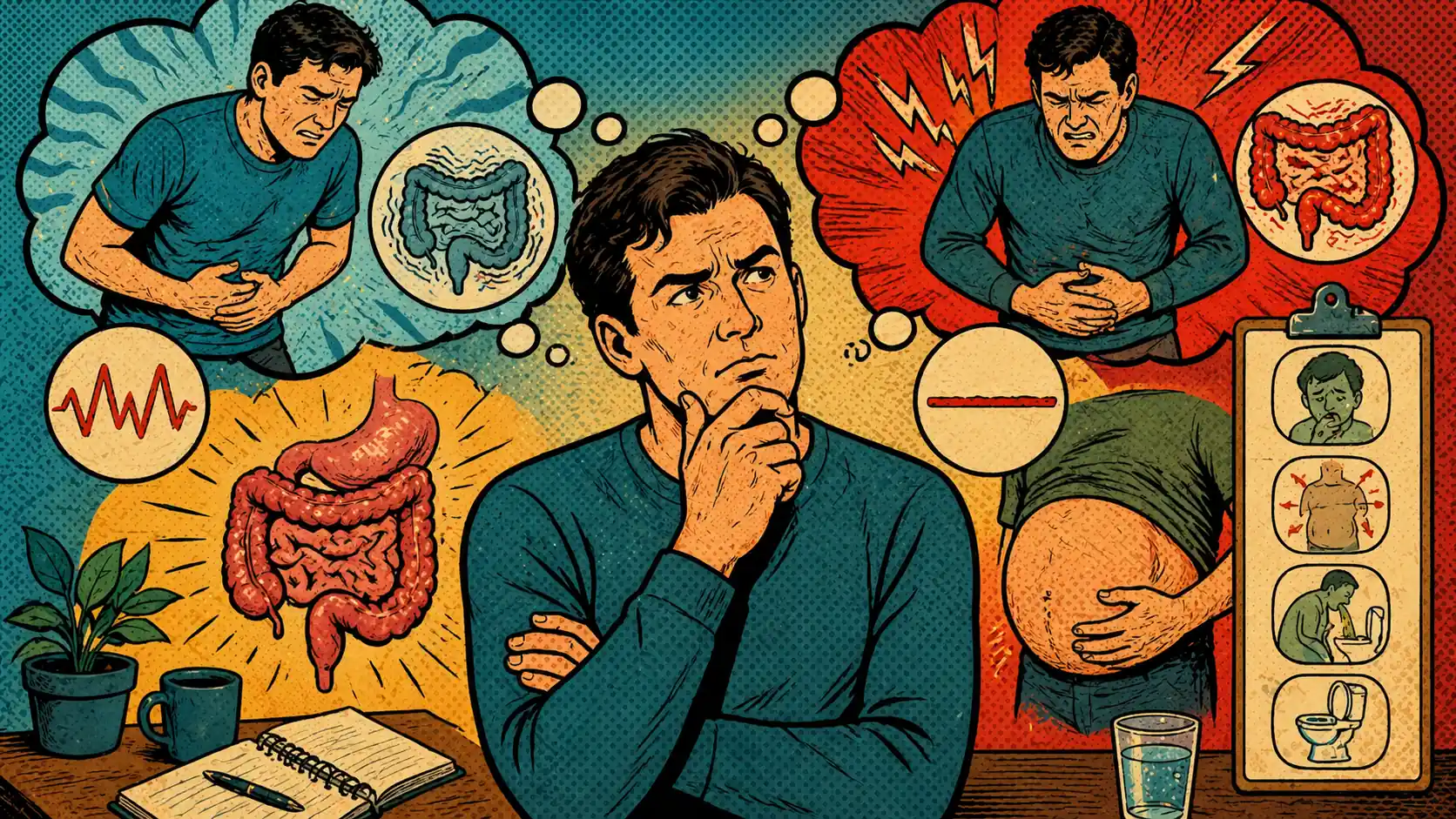
Obstruction pain is not one perfectly recognizable feeling. It may start as cramping that comes in waves, sit inside a swollen or distended abdomen, and then change character if the situation worsens. The useful question is not "Can I name the exact type?" It is "Does this pattern still belong in ordinary self-management?"
Short answer: bowel obstruction pain often feels crampy or wave-like at first, especially when bloating, vomiting, abdominal distension, constipation, or inability to pass gas are part of the same picture. If the pain becomes severe and steady, or the whole pattern keeps worsening, the concern rises and the safer next step is urgent medical evaluation 1 2 3.
Use this page if the big question in your head is what obstruction pain often feels like and whether the pain pattern itself has crossed into more serious territory.
Use the parent page first if you need the broader symptom sorter for possible gut obstruction signs, not just the pain explanation: possible gut obstruction signs.
For one-sided lower-left pain that is not clearly obstruction-like, use the lower-left abdominal pain comparator to compare IBS, constipation, diverticulitis-like, urinary, and pelvic clues before deciding whether food changes are relevant.
If you are trying to connect the broader phrase "obstructive bowel disorders" with abdominal pain, lower-left location, pseudo-obstruction language, and the right next route, use the obstructive bowel disorders and abdominal pain sorting guide as the bridge.
Pain pattern is supportive context, not a way to self-rule out obstruction. Use this selector before you read the pain details.
| If the main worry is... | Start here | Why |
|---|---|---|
| Severe or worsening pain plus vomiting, distension, constipation, or inability to pass gas or stool | Possible gut obstruction signs | That page owns the full obstruction-like symptom-cluster lane. |
| Rectal bleeding, black stool, anemia, unexplained weight loss, or a persistent bowel-habit change | IBS vs colorectal warning signs | That page owns the colorectal-warning lane. |
| Wave-like pain, cramping waves, or pain that is becoming steady and severe | This page | It explains the pain-pattern clue, but urgent evaluation still comes first when the whole cluster is concerning. |
| Mild, familiar constipation pressure without vomiting, progressive swelling, or inability to pass gas/stool | Constipation and bloating connection | Routine stool-backup troubleshooting belongs after emergency red flags are absent. |
Three pages in this cluster sound close, but they should not do the same job.
| Page | Main job | Use it when |
|---|---|---|
| Possible gut obstruction signs | Broad warning-sign sorter | You need to know whether bloating, vomiting, swelling, constipation, and inability to pass gas should move toward urgent evaluation. |
| This page | Pain-pattern explainer | The main question is what obstruction pain can feel like, why it may come in waves, and why steady severe pain changes the urgency. |
| Obstructive bowel disorders and abdominal pain | Route map for a broad search phrase | You are trying to connect obstruction-like pain, pseudo-obstruction, lower-left pain, and medical evaluation without treating "OBD" as one diagnosis. |
That ownership matters because suspected obstruction is not a content rabbit hole. If the whole cluster is severe or worsening, the safer next step is medical evaluation, not reading three more articles.
The broad symptom cluster stays the same. MedlinePlus lists severe abdominal pain or cramping, vomiting, bloating, abdominal swelling, inability to pass gas, and constipation among the common symptoms of intestinal obstruction 4.
What this page adds is the pattern layer.
Merck's consumer guidance says obstruction pain usually includes cramping abdominal pain with bloating and loss of appetite, and that the pain tends to come in waves before eventually becoming continuous 5.
That means readers often describe it in ways such as:
Pain alone still does not settle the diagnosis. A crampy pattern matters more when it appears with vomiting, progressive swelling, constipation, or inability to pass gas.
This is where the pattern becomes useful.
The 2018 Frontiers review on abdominal pain in obstructive bowel disorders says acute obstruction pain in the first 12 to 24 hours is usually colicky, meaning cramping and intermittent, and links that pattern to clustered contractions and pressure above the blockage 6.
That fits Merck's reader-facing language that pain may come in waves at first 7.
But Merck's professional guidance also says severe, steady pain suggests strangulation, meaning blood flow to the bowel may be compromised 8.
So the shift that matters is not subtle.
If the pain:
the pattern has moved out of casual home-troubleshooting territory.
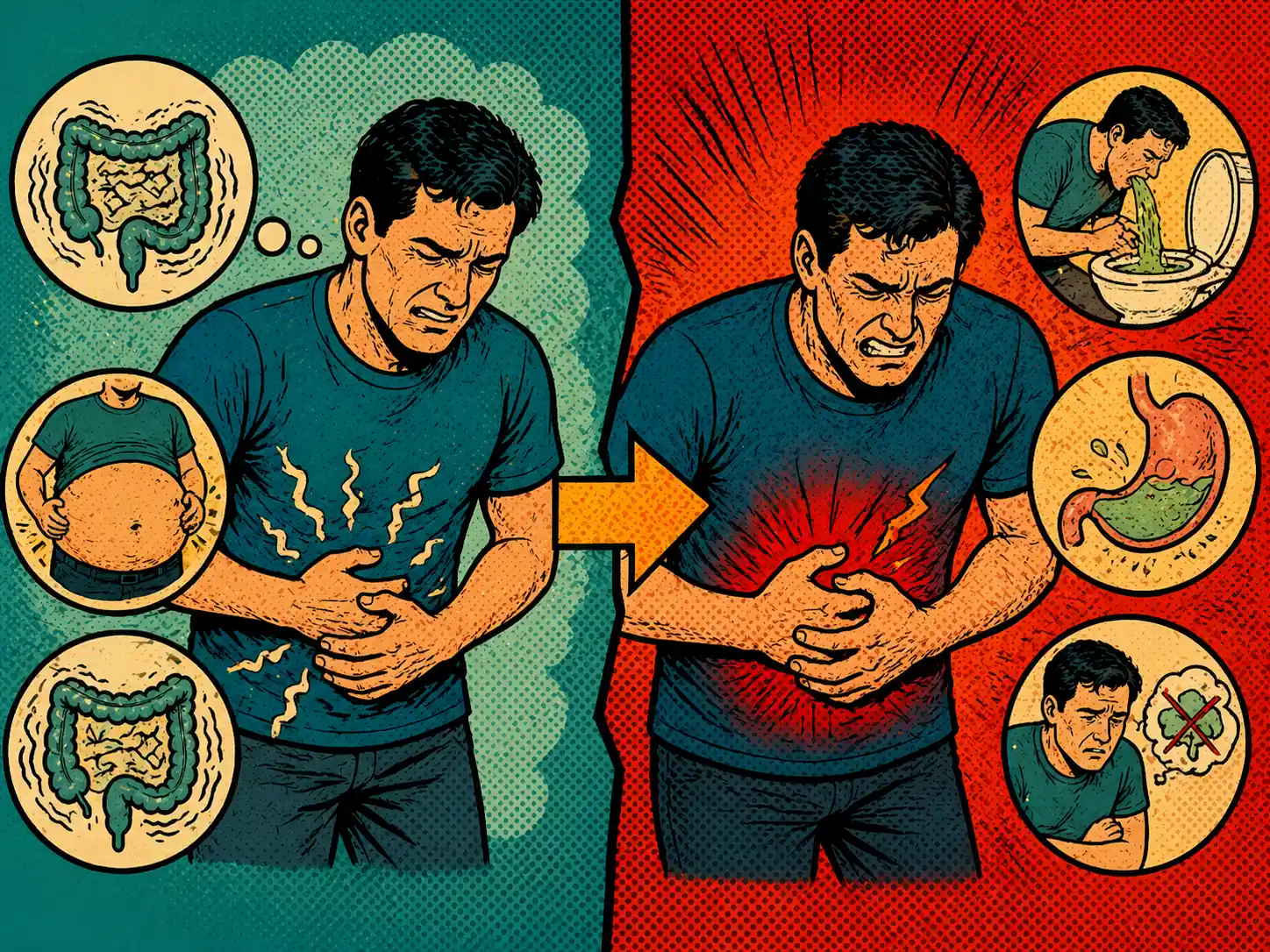
This distinction can help readers describe what is happening, but it is not a DIY diagnosis tool.
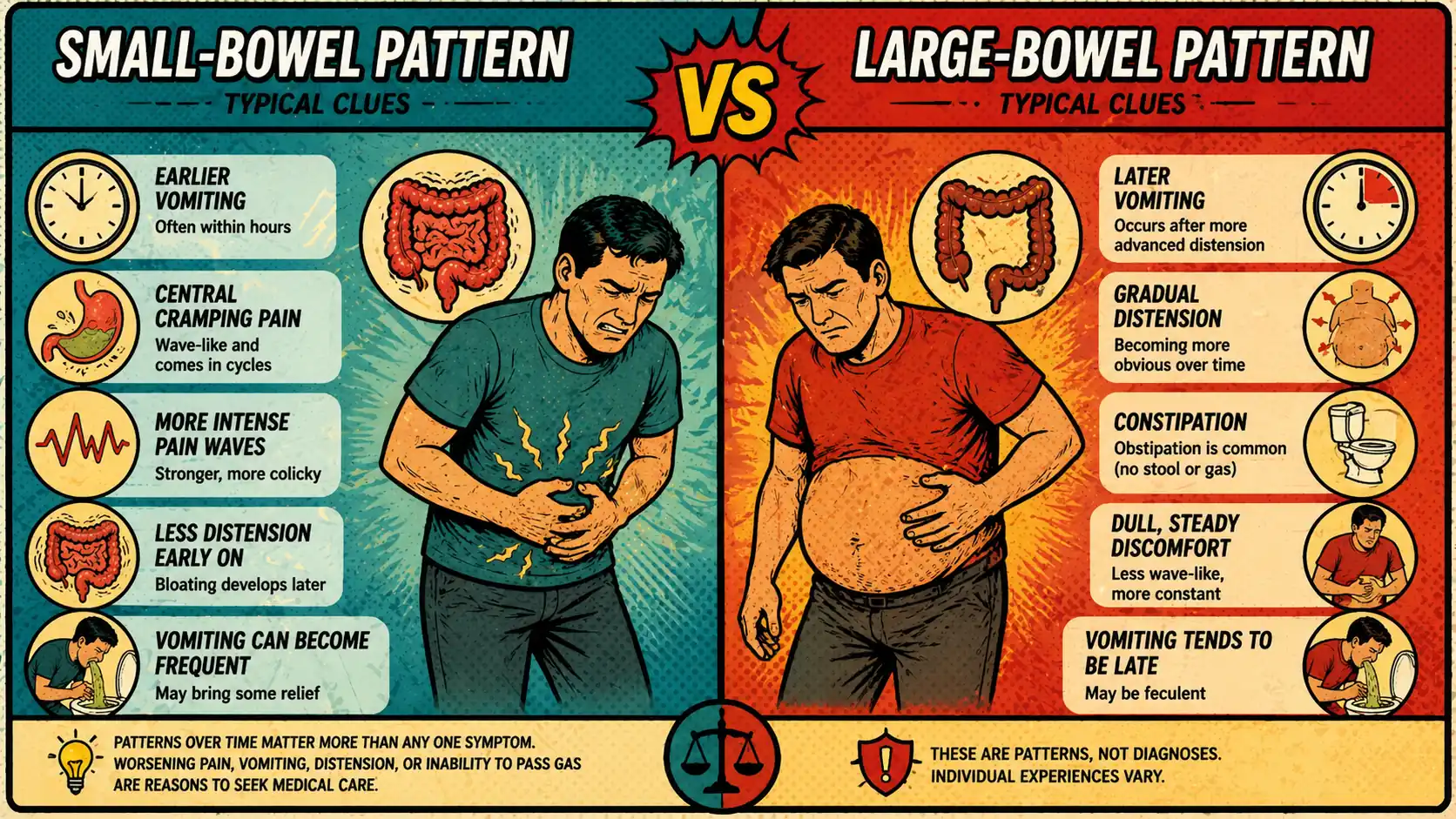
Merck says small-bowel obstruction often causes symptoms shortly after onset, with central or upper abdominal cramps, vomiting, and obstipation in complete obstruction. Large-bowel obstruction often develops more gradually, with increasing constipation, abdominal distention, lower abdominal cramps, and vomiting that may arrive later 9.
| Pattern | Small-bowel obstruction often looks more like | Large-bowel obstruction often looks more like |
|---|---|---|
| Onset | symptoms begin sooner | symptoms build more gradually |
| Pain area | central or upper abdominal cramps are common | lower abdominal cramps are more common |
| Vomiting | often earlier | often later or less prominent at first |
| Distension / constipation | may be present with rapid escalation | abdominal distension and constipation often become more obvious over time |
| Caveat | complete obstruction may bring obstipation | severe distension still needs prompt evaluation |
The value of this table is not certainty. It is helping you describe a pattern more clearly when you speak to a clinician.
Use this table to describe the pain pattern, not to diagnose the cause.
| Pain pattern | Why it matters | Safer route |
|---|---|---|
| Familiar constipation pressure or bloating | Discomfort can be real but may still fit a chronic stool-backup pattern if gas and stool continue to pass and there is no vomiting or progressive distension. | Constipation and bloating connection after red flags are absent. |
| Cramping waves with swelling | Wave-like pain can fit obstruction physiology, especially when distension, vomiting, constipation, or inability to pass gas are part of the same story. | Review possible gut obstruction signs and move toward urgent evaluation if the cluster is strong. |
| Severe steady pain | Merck notes severe steady pain can suggest strangulation, a higher-risk shift. | Urgent medical evaluation. |
| Lower-left pain with fever, urinary, pelvic, or diverticulitis-like clues | Location changes the comparator, especially when the pain is not clearly obstruction-like. | Lower-left abdominal pain. |
| Pain plus rectal bleeding, dark stool, anemia, weight loss, or persistent bowel change | This is not primarily an obstruction-pain question. | IBS vs colorectal warning signs. |
The practical split is simple: pain pattern helps you explain what is happening, but the escalation decision depends on the full cluster.
People often try to talk themselves down with the idea that "maybe it is only partial."
That is not a safe home conclusion.
MedlinePlus defines intestinal obstruction as either complete or partial 10. NIDDK's abdominal adhesions document says complete obstruction usually needs immediate surgery, while most partial obstructions can be managed without surgery 11.
But that management distinction belongs to clinicians, not to self-triage.
Merck also notes that partial small-bowel obstruction may still cause diarrhea 12.
That matters because people sometimes assume:
Neither assumption is safe on its own.
Pseudo-obstruction adds another reason not to over-interpret symptoms. NIDDK says pseudo-obstruction causes symptoms of intestinal obstruction even when doctors cannot find a physical blockage, and symptoms can include abdominal pain, bloating, nausea and vomiting, constipation, diarrhea, and sometimes inability to pass stool or gas 13.
If what you need is the broader safety sorter, return to possible gut obstruction signs.
The pain pattern matters even more when the background risk is higher.
Merck lists common adult causes of mechanical obstruction as adhesions, hernias, and tumors 14.
NIDDK's abdominal adhesions document adds that adhesions can kink, twist, or pull the intestines out of place and cause an obstruction 15.
So the pain pattern deserves more caution if you also have:
NIDDK also says acute colonic pseudo-obstruction is more common in people who have a severe illness or injury or who recently had surgery 16.
These clues still do not diagnose the cause. They just lower the threshold for taking the symptom pattern seriously.
This is the decision point most readers actually need.
Stop trying to self-sort the problem if you have:
MedlinePlus states that complete intestinal obstruction is a medical emergency 17. Merck says strangulating obstruction can progress quickly and that severe steady pain raises concern for that shift 18.
If the pain has become abrupt and continuous, Merck also notes that volvulus often starts abruptly and may cause continuous pain with superimposed colicky waves 19.
This is where home reasoning runs out.
NIDDK's abdominal adhesions material says abdominal x-rays, lower GI series, and CT scans can diagnose intestinal obstructions 20.
NIDDK's pseudo-obstruction diagnosis page says doctors review symptoms, medical history, family history, perform a physical exam, and order tests to rule out a physical obstruction and check for causes 21.
That matters because clinicians may need to sort:
Printable support: Bowel Obstruction Pain Pattern Checklist helps you summarize timing, distension, vomiting, bowel-movement changes, and risk clues before evaluation.
Bowel obstruction pain is not one clean signature. It often starts as cramping or wave-like pain with distension, bloating, vomiting, constipation, or trouble passing gas. If it becomes severe and steady, or the whole picture keeps worsening, the concern rises.
The safest use of this article is not to decide exactly what kind of obstruction you have. It is to recognize when the pain pattern no longer belongs inside routine self-management.
If severe pain, repeated vomiting, progressive distension, inability to pass gas or stool, black stool, heavy bleeding, faintness, or rapidly worsening symptoms are present, do not use next reads as a substitute for care.
After emergency red flags are absent or have been medically addressed, choose by the remaining pattern:
| Route type | Remaining pattern | Better next read | Why |
|---|---|---|---|
| Urgent safety route | You need the broader obstruction warning-sign checklist | Possible gut obstruction signs | It owns the full symptom-cluster sorter. |
| Prompt clinician route | Bleeding, anemia, unexplained weight loss, or persistent bowel change is the worry | IBS vs colorectal warning signs | It routes colorectal warning signs separately from obstruction pain. |
| Prompt clinician route | Symptoms have been checked or are not emergency-level, and you need a concise appointment summary | Doctor visit prep for IBS next steps | It turns the pain timeline, bowel pattern, medicines, and questions into a cleaner handoff. |
| Route-map support | You are trying to understand a broad OBD search phrase | Obstructive bowel disorders and abdominal pain | It separates route-map language from diagnosis. |
| Routine route after emergency red flags are absent | Pain is mainly lower left and not clearly obstruction-like | Lower-left abdominal pain | It compares IBS, constipation, diverticulitis-like, urinary, pelvic, and obstruction-like clues. |
| Routine route after emergency red flags are absent | Slow stool backup and routine pressure remain the main issue | Constipation and bloating connection | It keeps constipation-first basics upstream of food restriction. |
This article is for informational purposes only and is not intended as medical advice. Please consult a qualified healthcare provider for diagnosis and treatment of any health condition.
Xam Riche is a gut health solopreneur and founder of YourFitNature, dedicated to helping people navigate digestive wellness through evidence-based information and personal experience. After years of struggling with IBS and bloating, Xam discovered the transformative power of the low FODMAP diet and now shares practical, science-backed guidance to help others find relief. While not a medical professional, Xam combines extensive research with lived experience to create accessible, empowering resources for the gut health community. Learn more about our mission
As an affiliate, we may earn from qualifying purchases.