 By • Published on April 24, 2026 • 13 min read • 3,562 views
This article is for informational and educational purposes only and does not constitute medical advice. A suspected bowel obstruction can be an emergency. Seek urgent medical evaluation for severe or worsening symptoms.
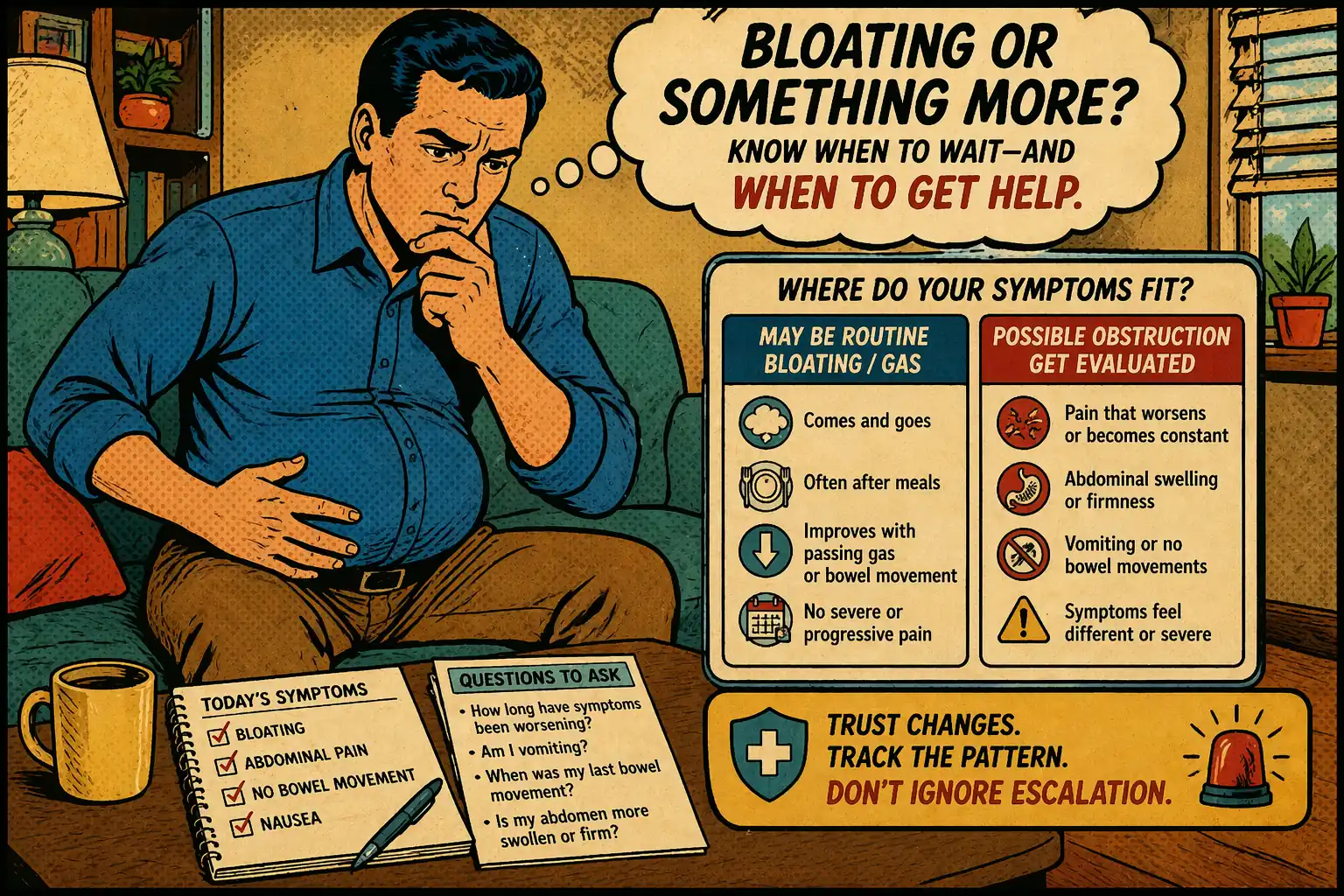
Most bloating is not a bowel obstruction. That is the reassuring part. The important part is not missing the times when the pattern stops being ordinary: severe cramping, vomiting, a swollen abdomen that is not settling, and trouble passing gas or stool together in the same story.
Short answer: possible gut obstruction signs include severe abdominal pain or cramping, vomiting, bloating, abdominal swelling, inability to pass gas, and constipation. A complete bowel obstruction is a medical emergency, and obstruction-like symptoms should not be treated as a casual home-remedy problem when they are severe or not going away 1 2.
This page is for you if you are trying to sort whether severe bloating, distention, vomiting, constipation, or inability to pass gas may have crossed out of routine symptom territory.
Use a different page first if the pattern is still more like food-trigger bloating, lower-GI troubleshooting, or upper-GI burning after meals. Those fit how to reduce bloating, when low FODMAP does not work, or reflux-like symptoms better.
Use this cluster as the first fork before you read deeper.
| If the main worry is... | Start here | Why |
|---|---|---|
| Severe or worsening pain plus vomiting, distension, constipation, or inability to pass gas or stool | This page | It owns the obstruction-like symptom-cluster lane. |
| Rectal bleeding, black stool, anemia, unexplained weight loss, or a persistent bowel-habit change | IBS vs colorectal warning signs | That page owns the colorectal-warning lane. |
| Wave-like pain, cramping waves, or pain that is becoming steady and severe | Bowel obstruction pain patterns | That page explains pain-pattern clues, but it should not replace urgent evaluation when the whole cluster is concerning. |
| Mild, familiar bloating or constipation without warning signs | Constipation and bloating connection | Routine stool-backup troubleshooting belongs after obstruction-like warning signs are absent. |
The old version of this topic drifted into "how to clear a blocked gut" style advice. That is not a safe framing for a suspected obstruction question.
MedlinePlus describes intestinal obstruction as a partial or complete blockage of the bowel and lists symptoms such as severe abdominal pain or cramping, vomiting, bloating, abdominal swelling, inability to pass gas, and constipation. It also states that a complete intestinal obstruction is a medical emergency 3.
NIDDK's abdominal adhesions material says complete intestinal obstruction is life-threatening and requires immediate medical attention and often surgery 4.
So the right reader job for this page is not "fix it yourself." It is:
recognize when symptoms might need urgent evaluation instead of more casual self-management.
Official patient-facing sources are fairly consistent on the main obstruction pattern. The symptoms worth taking seriously together are:
One symptom alone is not always enough to sort the picture. The concern rises when several of them cluster or intensify together.
That is especially true when the abdomen looks or feels more distended than usual, vomiting keeps happening, or gas and stool seem to stop moving through the usual way.
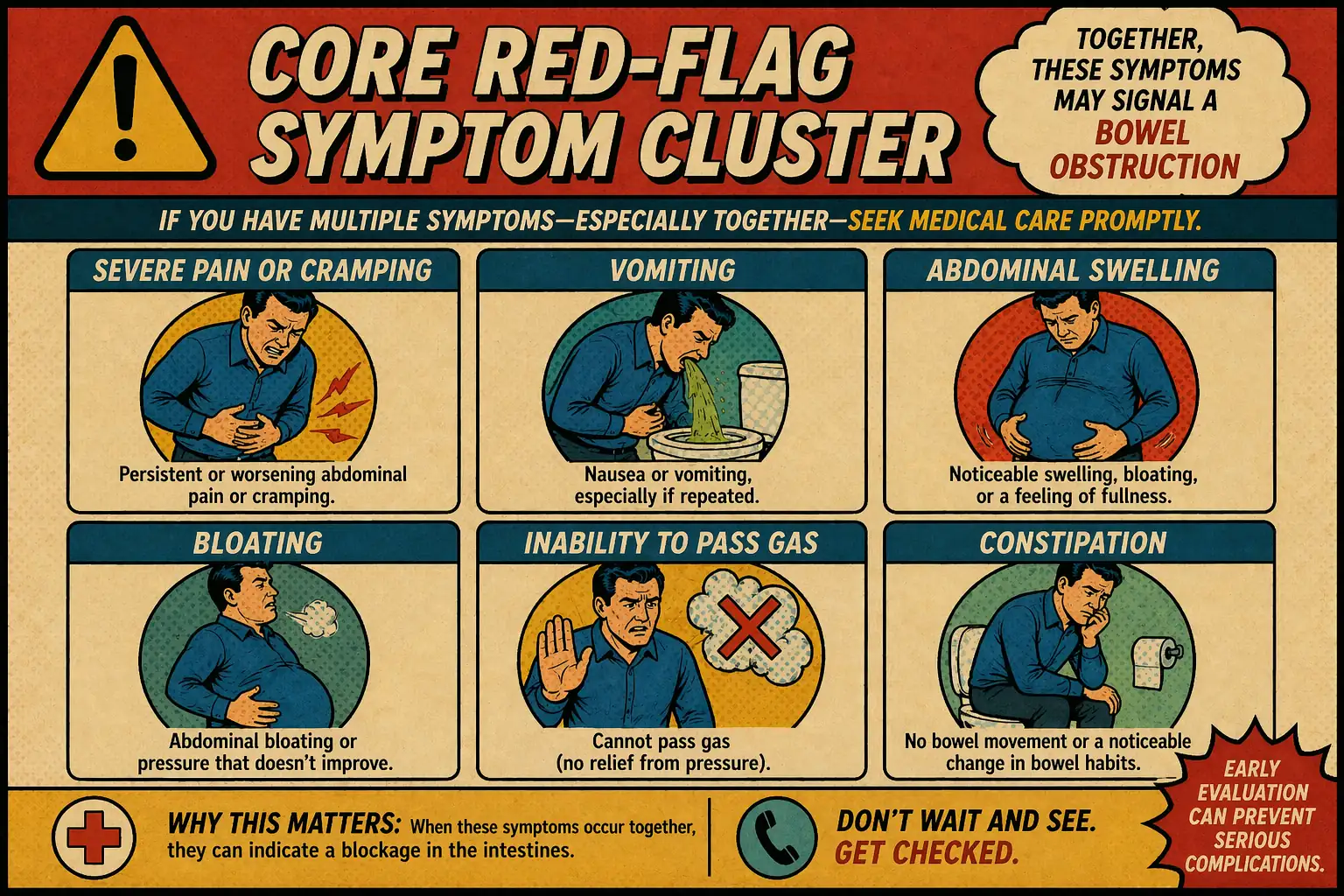
This is where people often get tripped up.
Routine constipation can be common and still miserable. But NIDDK says you should see a doctor right away if constipation comes with:
If the bigger concern is not obstruction-like symptoms but lower-GI warning signs such as bleeding, anemia, or unexplained weight loss, use IBS vs colorectal warning signs as the next comparator.
MedlinePlus similarly says to contact a provider if you cannot pass stool or gas, have a swollen abdomen that does not go away, keep vomiting, or have unexplained abdominal pain that does not go away 9.
That gives you a practical difference:
| Pattern | More consistent with routine constipation or common bloating | More concerning for obstruction-like symptoms |
|---|---|---|
| Symptom intensity | uncomfortable but still familiar | severe, escalating, or clearly different |
| Gas and stool | still moving, even if slowly | inability to pass gas or stool becomes part of the picture |
| Vomiting | absent or occasional for another reason | recurring vomiting enters the same symptom cluster |
| Abdominal shape | feels full but settles | swelling or distention does not go away |
| Best next move | symptom tracking and routine follow-up | urgent evaluation becomes much more reasonable |
That table is a safety sorter, not a diagnosis.
If the pattern still sounds more like chronic constipation than an obstruction question, step back to constipation and bloating connection.
If the bigger question is what obstruction pain often feels like when it comes in waves or later becomes more constant, use our guide to bowel obstruction pain patterns.
If you found the term "obstructive bowel disorders" while trying to connect abdominal pain, lower-left location, vomiting, swelling, and constipation clues, use the obstructive bowel disorders and abdominal pain route map before turning the symptom into a new diagnosis label.
The safest comparison starts with urgency, not labels. Obstruction, pseudo-obstruction, constipation, and IBS can all involve abdominal discomfort, bloating, and bowel changes, but they do not point to the same next step.
| Pattern | What makes it different | Better next route |
|---|---|---|
| Possible obstruction | Severe cramping or pain, vomiting, distention, and inability to pass gas or stool cluster together or worsen. | Urgent medical evaluation; use bowel obstruction pain patterns only as a pain-pattern explainer. |
| Possible pseudo-obstruction | Symptoms can look obstruction-like even when no physical blockage is found, so imaging and clinical sorting matter. | Medical evaluation, not home diagnosis; use this page as the safety bridge. |
| Constipation with bloating | Stool is backed up, but gas or stool still passes and vomiting or severe distention is not driving the picture. | Constipation and bloating connection. |
| IBS-style pattern | Pain relates to bowel changes over time, but the pattern is familiar, recurrent, and not paired with obstruction red flags. | IBS troubleshooting or IBS vs colorectal warning signs if bleeding, anemia, weight loss, or bowel-habit change is the concern. |
| Lower-left abdominal pain | Location is the main clue, especially if fever, tenderness, urinary, pelvic, or diverticulitis clues are present. | Lower-left abdominal pain. |
This table is deliberately conservative. If the pattern includes severe pain, repeated vomiting, a swollen abdomen, and inability to pass gas or stool, do not stay in comparison mode. Move toward urgent evaluation.
Food changes can help ordinary bloating, IBS flares, and chronic constipation patterns. They are the wrong first move when the symptom cluster is asking a safety question.
Do not make the first plan more fiber, more restriction, a cleanse, or a new supplement when these are present together:
In that situation, the useful food question comes later. The first question is whether a clinician needs to rule out obstruction, pseudo-obstruction, severe constipation complications, diverticulitis, or another urgent cause.
You do not need to diagnose the cause yourself, but it helps to know what makes clinicians take obstruction symptoms seriously.
MedlinePlus lists common adult causes such as:
NIDDK's abdominal adhesions material also says surgery is the most frequent cause of abdominal adhesions, and that adhesions can kink, twist, or pull the intestines out of place and cause obstruction 12.
So mention it early if you have:
Those details do not confirm obstruction, but they make the red-flag context more important.
Sometimes symptoms can look like obstruction even when there is no physical blockage.
NIDDK says intestinal pseudo-obstruction can cause abdominal pain, bloating, nausea and vomiting, constipation, diarrhea, and, in acute colonic pseudo-obstruction, inability to pass stool or gas. It also says people with these symptoms should see a doctor right away, because the symptoms could reflect either intestinal obstruction or pseudo-obstruction, and either can lead to life-threatening complications without treatment 13.
That matters because the symptom lesson is the same:
do not assume severe obstruction-like symptoms are just another bloating or constipation day.
This is another place where restraint matters. The page should not turn into a DIY workup guide.
NIDDK's abdominal adhesions publication notes that abdominal x-rays, lower GI series, and CT scans can diagnose intestinal obstructions 14.
NIDDK's pseudo-obstruction diagnosis guidance says doctors may review symptoms, history, the physical exam, and order tests to rule out a physical obstruction and check for causes 15.
The practical point is simple:
That is why this is not a "wait and see forever" question when the symptom cluster is strong.
The evidence on this page is mainly urgent-safety and patient-education evidence. MedlinePlus and NIDDK describe obstruction and pseudo-obstruction symptom clusters, explain why complete obstruction can be dangerous, and note that clinicians may need examination and imaging to sort the cause.
That evidence supports one practical boundary: severe pain, repeated vomiting, distention, and inability to pass gas or stool should not be treated like routine bloating or constipation. It does not let this page diagnose a bowel obstruction, pseudo-obstruction, impacted stool, diverticulitis, hernia, cancer, or medication complication. The action translation is to stop self-managing when the cluster is strong and bring the symptom timeline to urgent evaluation.
Use a plain handoff if you call a nurse line, urgent care, or emergency service:
"I am worried about an obstruction-like pattern. I have [severe pain or cramping], [vomiting], [swelling or distention], and [not passing gas or stool]. It started [when], is [getting worse/not improving], and I have these risk clues: [prior surgery, hernia, opioid use, IBD, cancer history, recent hospitalization, or none known]. Do I need urgent evaluation now?"
Bring or mention:
If the question in your head is "should I try more fiber, more fluids, or a laxative first?" this page is the pause button.
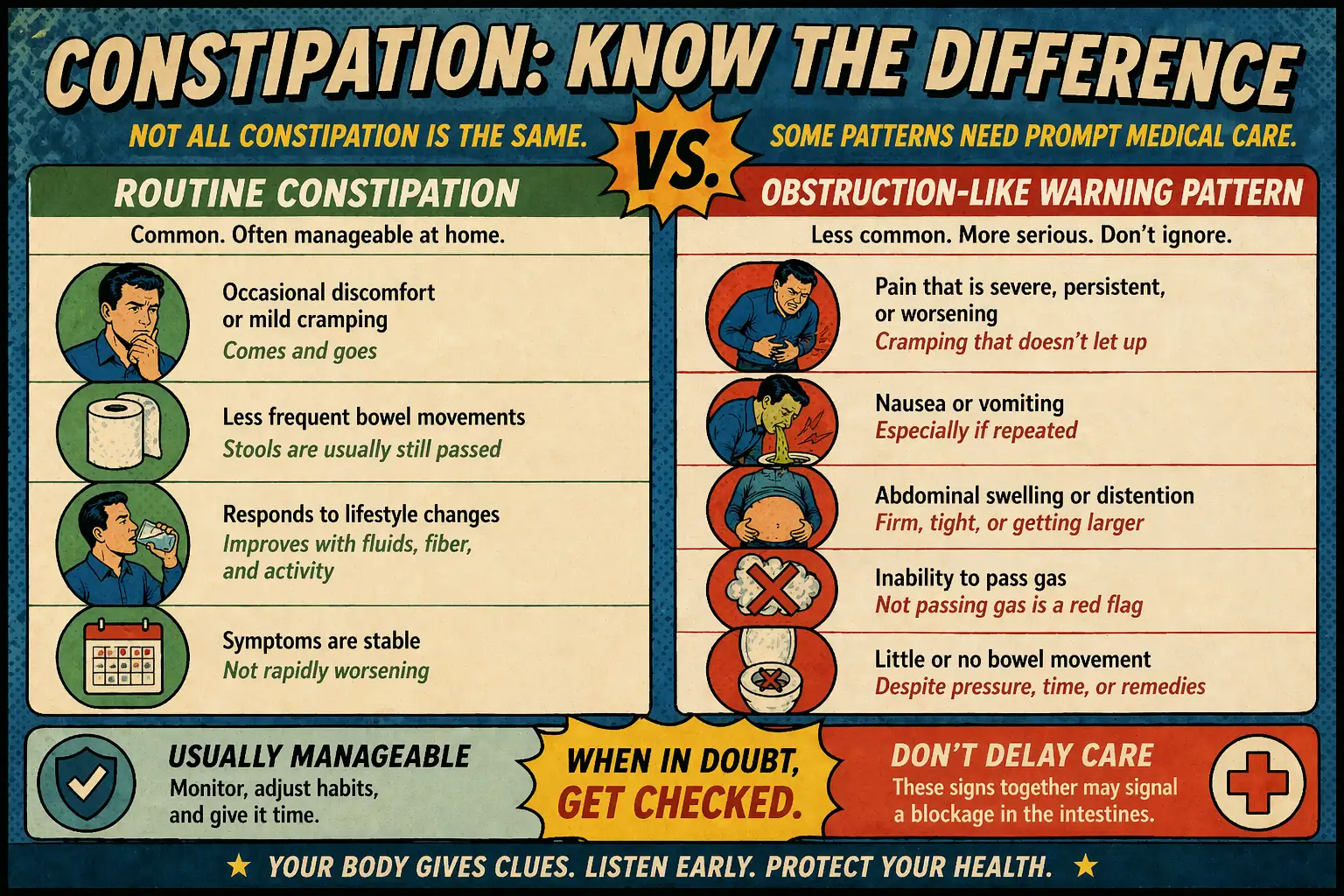
Move toward urgent medical evaluation if you have:
This does not mean every bloating flare is an obstruction.
It means there is a point where the safer move is evaluation rather than trying to push through with more self-treatment.
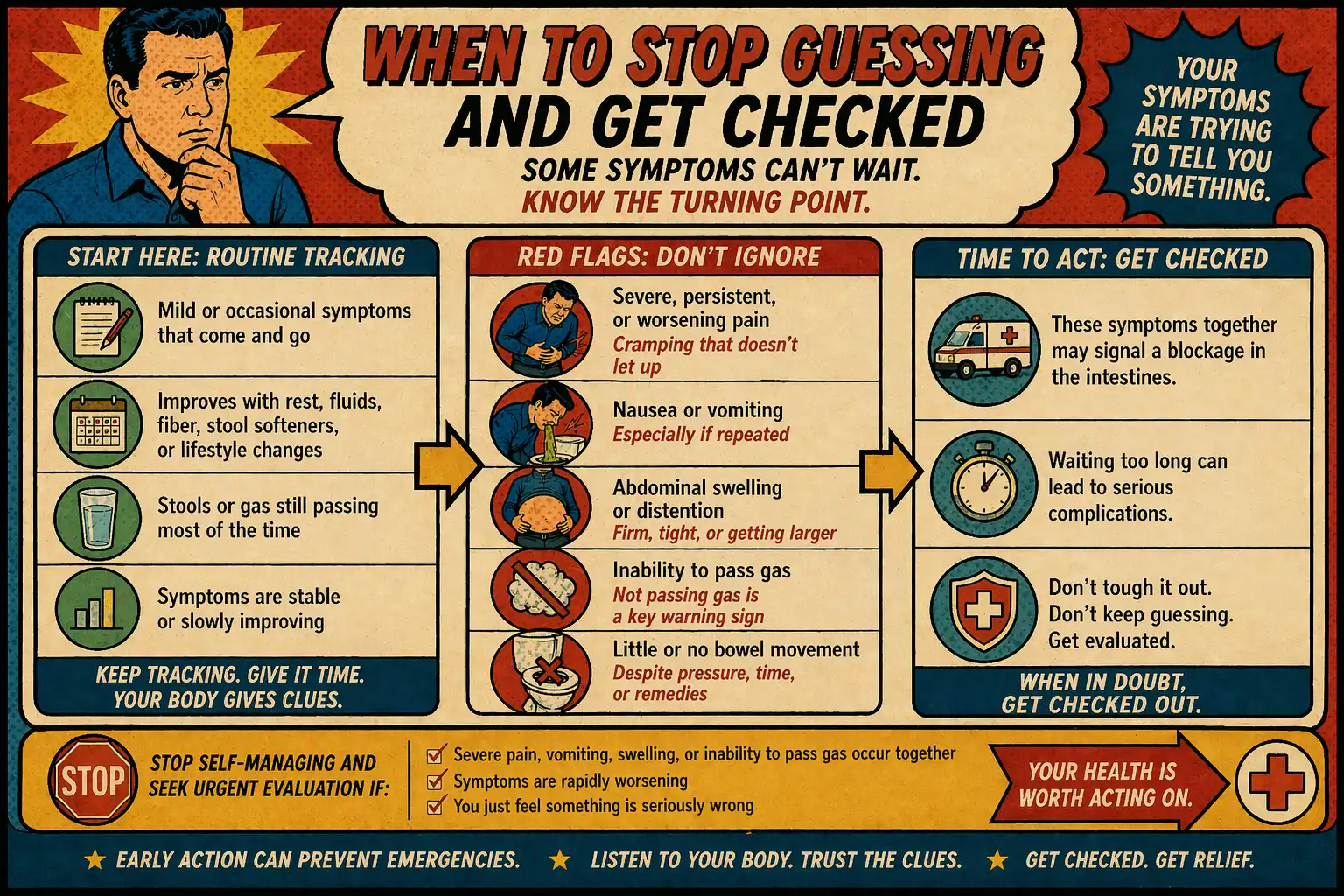
Possible gut obstruction signs matter less as isolated buzzwords and more as a pattern:
That is the pattern this page exists to flag.
If your symptoms are milder and clearly fit ordinary bloating, constipation, or upper-GI discomfort, narrower pages are more useful. But if the symptom cluster looks like obstruction or pseudo-obstruction could be on the table, the next step is medical evaluation, not another round of guessing.
Choose the next page by urgency first, then by the remaining pattern.
| Route type | Situation | Best next read | Why |
|---|---|---|---|
| Urgent safety route | You need the pain-pattern detail for cramping waves, worsening distension, or pain that is becoming steady and severe | Bowel obstruction pain patterns | It explains the pain pattern, but urgent care still comes first when the cluster is severe or escalating. |
| Prompt clinician route | Your concern is bleeding, anemia, weight loss, or colorectal warning signs | IBS vs colorectal warning signs | That page owns the colorectal-warning lane. |
| Route-map support | You need the broader obstructive-disorder route map | Obstructive bowel disorders and abdominal pain | It separates a broad search phrase from the warning-sign cluster that needs care. |
| Location comparator | The pain is mainly lower left and you need a comparator | Lower-left abdominal pain | It compares IBS, constipation, urinary, pelvic, diverticulitis-like, and obstruction-like clues. |
| Routine route after warning signs are absent | The pattern is chronic constipation and stool backup without a strong obstruction-style cluster | Constipation and bloating connection | It keeps stool backup upstream of food restriction. |
| Routine route after warning signs are absent | Constipation still needs fiber, PEG, magnesium, prescription, or pelvic-floor sorting | IBS-C constipation medications and fiber options | It keeps routine constipation treatment separate from obstruction-like escalation. |
| Routine route after warning signs are absent | Incomplete evacuation, straining, pelvic discomfort, or poor response to more fiber stands out | Pelvic-floor dyssynergia and IBS-C constipation | It routes toward outlet-constipation clues instead of more restriction. |
Xam Riche is a gut health solopreneur and founder of YourFitNature, dedicated to helping people navigate digestive wellness through evidence-based information and personal experience. After years of struggling with IBS and bloating, Xam discovered the transformative power of the low FODMAP diet and now shares practical, science-backed guidance to help others find relief. While not a medical professional, Xam combines extensive research with lived experience to create accessible, empowering resources for the gut health community. Learn more about our mission
As an affiliate, we may earn from qualifying purchases.