 By • Published on May 5, 2026 • 8 min read • 1,624 views
This article is for informational and educational purposes only and does not constitute medical advice. Severe, worsening, obstruction-like, or unexplained abdominal pain should be evaluated by a qualified health professional.

The phrase "obstructive bowel disorders" can sound like a diagnosis you are supposed to recognize. That is not the safest way to use it.
If you are reading because abdominal pain feels different, more swollen, more crampy, more stuck, or more serious than your usual gut symptoms, the practical question is simpler: does this pattern still belong in routine symptom management, or does it need medical evaluation?
Short answer: obstruction-like abdominal pain is most concerning when it appears as a cluster: cramping or wave-like pain, repeated vomiting, bloating or abdominal swelling, constipation, inability to pass gas, or pain that becomes severe and steady. MedlinePlus lists severe abdominal pain or cramping, vomiting, bloating, abdominal swelling, inability to pass gas, and constipation among intestinal obstruction symptoms 1. Merck also notes that obstruction pain may come in waves and later become continuous, and that severe steady pain is more concerning 2.
Use this page as a route map. If you need the broad warning-sign parent page, start with possible gut obstruction signs. If the main question is what obstruction pain often feels like, use bowel obstruction pain patterns. If the pain is mainly lower-left and not clearly obstruction-like, use the lower-left abdominal pain comparator.
In a medical setting, obstruction-related language can point to several different problems. A bowel obstruction may be partial or complete. It may involve the small bowel or large bowel. It may be mechanical, such as from adhesions, hernia, tumor, inflammatory narrowing, volvulus, or impacted stool. It may also be a look-alike pattern such as pseudo-obstruction, where symptoms resemble a blockage but doctors do not find a physical blockage 3 4.
That list is exactly why this should not become a self-diagnosis page. Those causes are sorted by history, exam, labs, imaging, and clinical context. The useful reader-level job is to notice whether the pattern has crossed out of "familiar digestive flare" and into "needs medical eyes."
Think of the phrase this way:
One symptom by itself is often hard to interpret. Pain can come from gas, constipation, IBS, diverticulitis, urinary problems, pelvic causes, infection, inflammation, or many other issues.
The concern rises when the story starts to cluster.
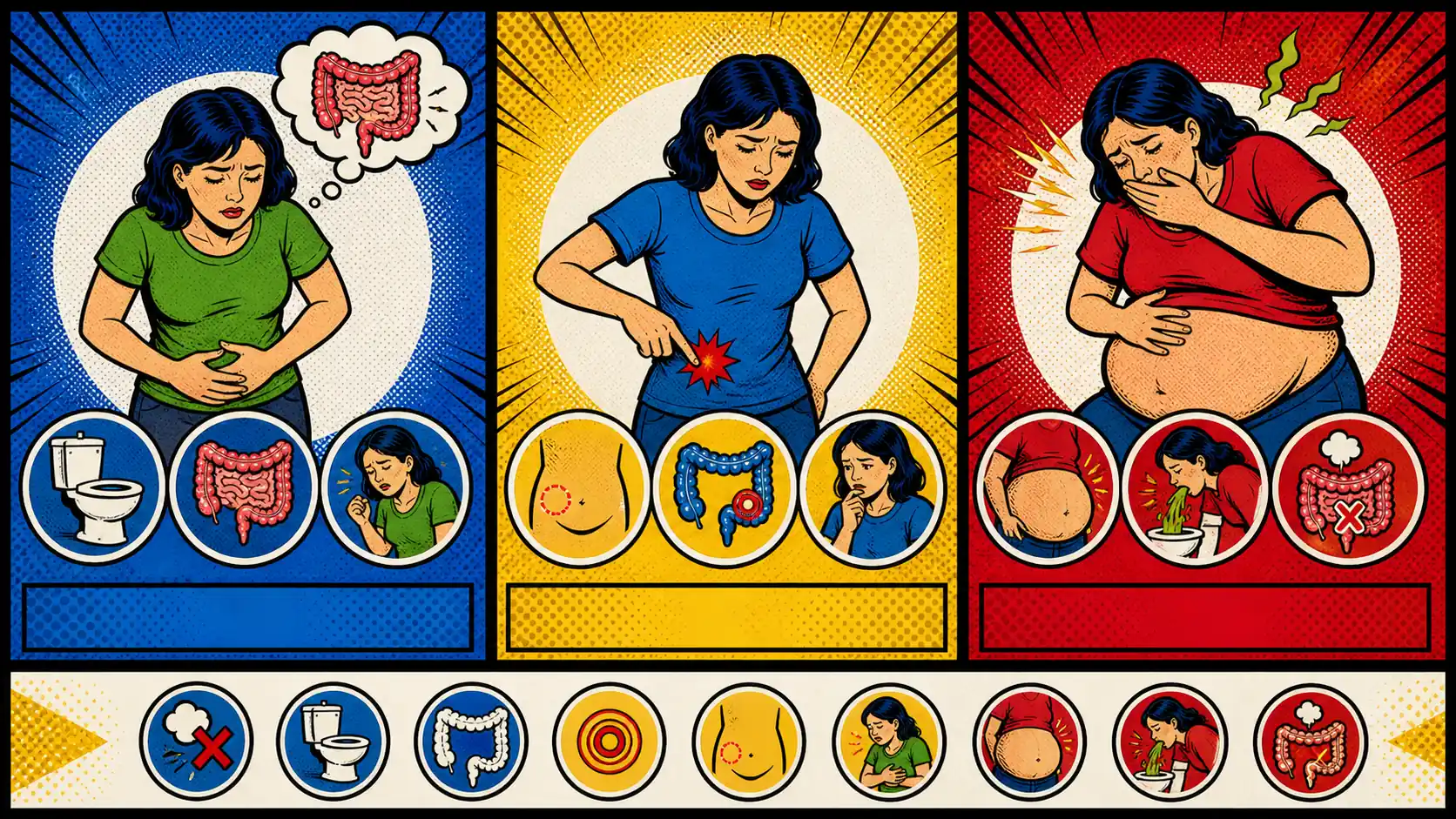
| Pattern | More routine route | Higher-concern route |
|---|---|---|
| Familiar IBS-style pain | recurrent, bowel-linked, similar to prior flares | new severe pain, progressive worsening, or warning signs |
| Constipation pressure | stool still moving slowly, gas still passing, no repeated vomiting | inability to pass gas or stool plus swelling, vomiting, or constant pain |
| Lower-left pain | mild, familiar, bowel-linked, no fever or vomiting | fever, worsening tenderness, vomiting, blood, urinary or pelvic clues |
| Obstruction-like cluster | not the main fit | cramping waves or severe steady pain with vomiting, distension, constipation, or inability to pass gas |
The obstruction-like cluster is not a diagnosis. It is a reason to stop treating the problem as a casual food or bloating experiment.
The Frontiers review on abdominal pain in obstructive bowel disorders describes acute obstruction pain as usually colicky during the first 12 to 24 hours, while more severe conditions may involve ischemia and inflammatory mechanisms 5. In plain language, wave-like pain can matter, but the safer signal is the whole pattern and whether it is getting worse.
Lower-left abdominal pain deserves its own sorter because people often search by location before they know the cause. That location can fit an IBS-style flare, constipation, gas, diverticulitis-like symptoms, urinary symptoms, pelvic causes, or an obstruction-like pattern.
NIDDK says diverticulitis may cause abdominal pain most often in the lower-left abdomen, along with constipation or diarrhea, fever and chills, nausea, or vomiting 6. That is one reason a lower-left pain page should be safety-first.
But location does not override the obstruction-like cluster. If the lower-left pain is paired with repeated vomiting, progressive distension, severe steady pain, inability to pass gas, or inability to pass stool, the more urgent route is not "what foods help lower-left pain?" It is obstruction-style evaluation.
Use the lower-left comparator when location is the central question and the pain is not clearly obstruction-like. Use the obstruction pain guide when the story is about cramping waves, constant severe pain, vomiting, distension, or gas and stool stopping.
IBS and constipation can be painful. They can also be familiar. That familiarity matters.
A known IBS pattern might involve abdominal pain with bowel habit changes that returns in recognizable ways. Constipation can cause pressure, cramping, bloating, and a stuck feeling. Those experiences are real, but they are not the same as a new severe pattern with repeated vomiting and a swollen, worsening abdomen.
The practical divider is not whether the symptom is uncomfortable. It is whether the symptom pattern is familiar, stable, and still moving through the usual bowel rhythm.
Step back to constipation and bloating connection when the story is familiar constipation pressure without vomiting, severe steady pain, or inability to pass gas. Use IBS vs colorectal warning signs when the concern is bleeding, anemia, unexplained weight loss, nighttime symptoms, or a lower-GI warning pattern rather than obstruction-like symptoms.
Move toward medical evaluation when the pattern is new, severe, escalating, or clustered with vomiting, abdominal swelling, constipation, and inability to pass gas.
This is where home reasoning runs out.
Clinicians may ask about prior abdominal or pelvic surgery, hernias, inflammatory bowel disease, cancer history, medicines, recent illness, bowel movements, gas, vomiting, fever, and whether the abdomen is distended or tender.
They may also need testing. NIDDK's pseudo-obstruction diagnosis page notes that doctors may order tests to rule out a physical obstruction and diagnose pseudo-obstruction 7. AAFP's review of intestinal obstruction reports that the American College of Radiology recommends CT as the initial imaging modality when clinical suspicion is high 8.
That does not mean every abdominal pain needs the same test. It means the right next step depends on the clinical picture. Your job is to bring a clean symptom story and get help when the warning-sign cluster is present.
Mayo Clinic's abdominal pain symptom checker advises emergency medical care for abdominal pain with signs such as black or bloody stool, blood in urine, a swollen tender abdomen, persistent nausea or vomiting, vomiting blood, chest, neck, or shoulder pain, shortness of breath, or dizziness 9.
For this specific route, take the obstruction-like pattern seriously when you notice:
Printable support: Obstruction-Like Pain Route Checklist and Abdominal Pain Visit Notes can help you summarize the pattern before evaluation.
"Obstructive bowel disorders and abdominal pain" is useful only if it helps you route safely.
If the pain is familiar, mild, bowel-linked, and not worsening, the next route may be routine constipation or IBS support. If the pain is mainly lower-left and not obstruction-like, use a lower-left pain comparator before turning it into a food question.
If pain clusters with vomiting, progressive distension, constipation, inability to pass gas, or severe steady pain, stop self-sorting. The safest next step is medical evaluation, not another round of guessing.
Xam Riche is a gut health solopreneur and founder of YourFitNature, dedicated to helping people navigate digestive wellness through evidence-based information and personal experience. After years of struggling with IBS and bloating, Xam discovered the transformative power of the low FODMAP diet and now shares practical, science-backed guidance to help others find relief. While not a medical professional, Xam combines extensive research with lived experience to create accessible, empowering resources for the gut health community. Learn more about our mission
As an affiliate, we may earn from qualifying purchases.