
BloatingRoadmap
YourFitNatureplusdescription Logo
CommunityWorkshopBuild Your Stack
Mobile Menu Background
Top Picks
Blog
BloatingRoadmapCommunityWorkshop
Build Your Stack
YourFitNatureplusdescription Logo
Find Your Custom Stack

Heal Your Gut. Reclaim Your Energy.

Science-backed tools to rebalance your microbiome
and fuel your clarity from the inside out.

ShopBlogGut Bloating ResourcesBloating ToolkitCommunity Challenge
Hiipa Compliance
About YourFitNature
BloatingRoadmap
YourFitNatureplusdescription Logo
CommunityWorkshopBuild Your Stack
Mobile Menu Background
Top Picks
Blog
BloatingRoadmapCommunityWorkshop
Build Your Stack
IBS Symptom Tracker Template for Food, Stool, Stress, and Sleep
Discover the secrets to a healthier gut!Learn more

IBS Symptom Tracker Template for Food, Stool, Stress, and Sleep

By Xam Riche on May 29, 2026 • 5 min read

This article is for informational and educational purposes only and does not constitute medical advice, diagnosis, or nutrition counseling. Use symptom tracking as a care-conversation aid, and seek qualified medical support for severe, new, persistent, progressive, or concerning symptoms.

Affiliate Disclosure: This post contains affiliate links. If you click and make a purchase, we may earn a commission at no extra cost to you.Medical Disclaimer: This article is for informational and educational purposes only and does not constitute medical advice, diagnosis, or nutrition counseling. Use symptom tracking as a care-conversation aid, and seek qualified medical support for severe, new, persistent, progressive, or concerning symptoms.
Last updated on May 29, 2026
  1. Home
  2. Blog
  3. Ibs Symptom Tracker Template Food Stool Stress Sleep
IBS, Bloating & Gut Symptoms
2,232 views

An IBS symptom tracker should make the pattern easier to see. It should not turn every meal into a trial, every sensation into a failure, or every food into a suspect.

The best tracker is short enough to use on a bad day and clear enough to help you, a clinician, or a dietitian answer a real question: Is this mostly stool backup? Meal timing? A flare after poor sleep? A medication or supplement change? A food test that was too noisy? A red flag that should not be managed at home?

IBS is commonly defined by recurrent abdominal pain with changes in stool form or frequency 1. That makes stool pattern useful, but stool is only one part of the picture.
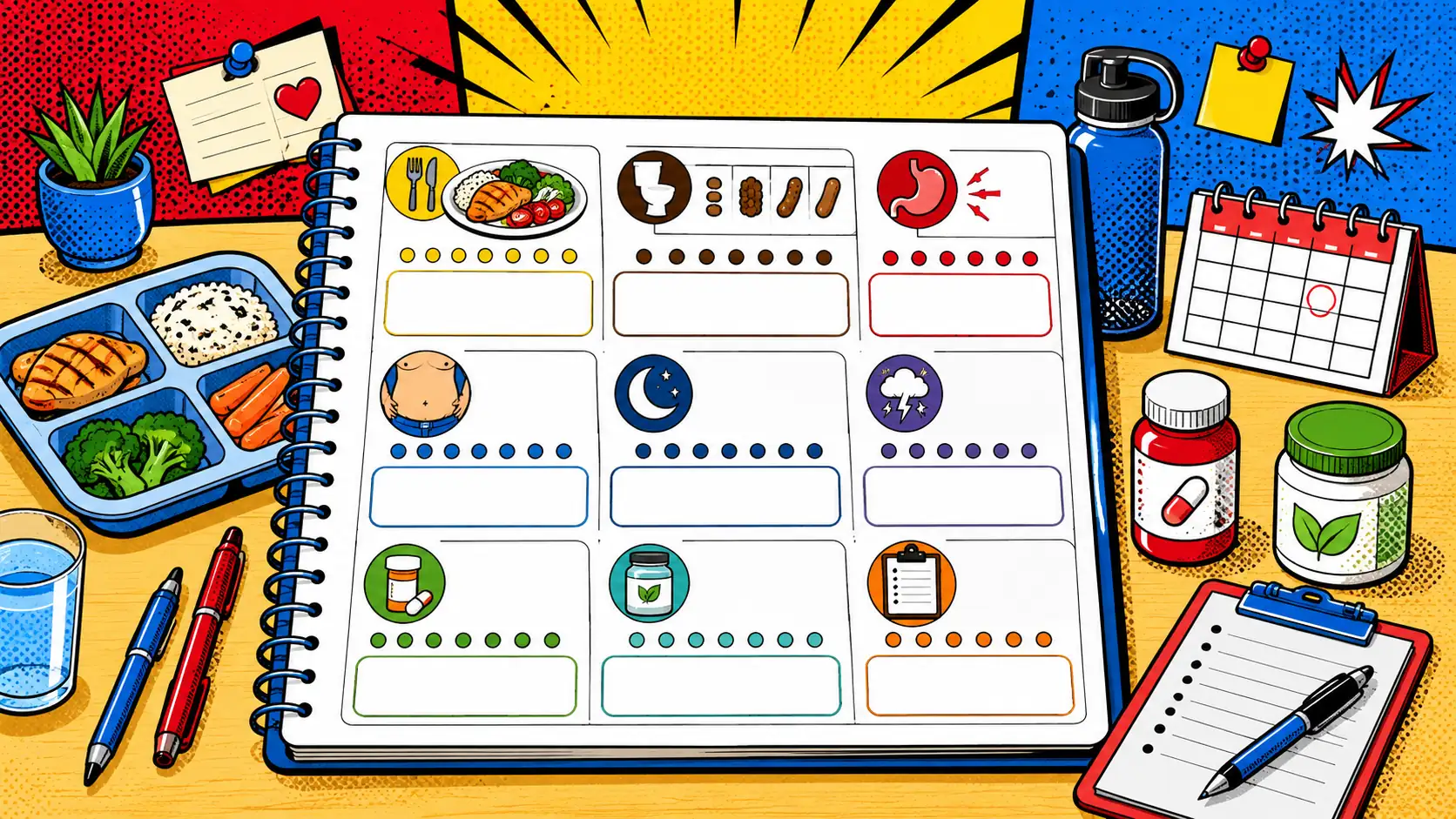
Pop art style hero image showing an IBS symptom tracker worksheet with icons for meals, stool pattern, pain, bloating, sleep, stress, medication, supplements, and appointment notes.
Track enough to see the pattern, not enough to fear every meal.

Start With the Stop Signs

A tracker is not a substitute for medical care. Stop self-managing and seek medical guidance for blood or black stool, fever, dehydration, repeated vomiting, severe or worsening pain, unexplained weight loss, symptoms that wake you from sleep or feel outside baseline, or constipation with swelling, vomiting, or inability to pass gas or stool 2 3.

If you are preparing for care now, use doctor visit prep for IBS next steps.

The Daily Tracker Fields

Use the smallest set that can change a decision.

Field What to write
Meal timing Time, meal size, unusual ingredients, alcohol, caffeine, sweeteners, or rich foods
Stool pattern Frequency, urgency, and stool form
Pain or cramps Location, timing, intensity, and relation to bowel movements
Bloating or fullness Timing, visible distension, pressure, or early fullness
Sleep Short, interrupted, late, shift-work, or normal
Stress or routine change Exam, travel, conflict, schedule change, or rushed eating
Medications and supplements New, stopped, missed, dose change, or timing change
Context Period/cycle timing, infection, heat, exercise, dining out, or flare recovery

The Cleveland Clinic patient explainer describes the Bristol Stool Chart as a way to classify stool into seven types for communication about bowel patterns 4. You do not need to obsess over the number. Use it as a shared language.

Track Flares Differently

On a flare day, the goal is not detailed food detective work. The goal is safety and recovery.

Write:

  1. What changed in the last 48 hours?
  2. What is the main symptom: urgency, constipation, pain, bloating, nausea, reflux, or appetite loss?
  3. Any stop signs?
  4. Fluids and food you can tolerate today.
  5. Whether you need work, school, travel, or caregiver support.

Use IBS flare plan: what to do today for a same-day decision path. If appetite is low, use IBS-safe foods when appetite is low.
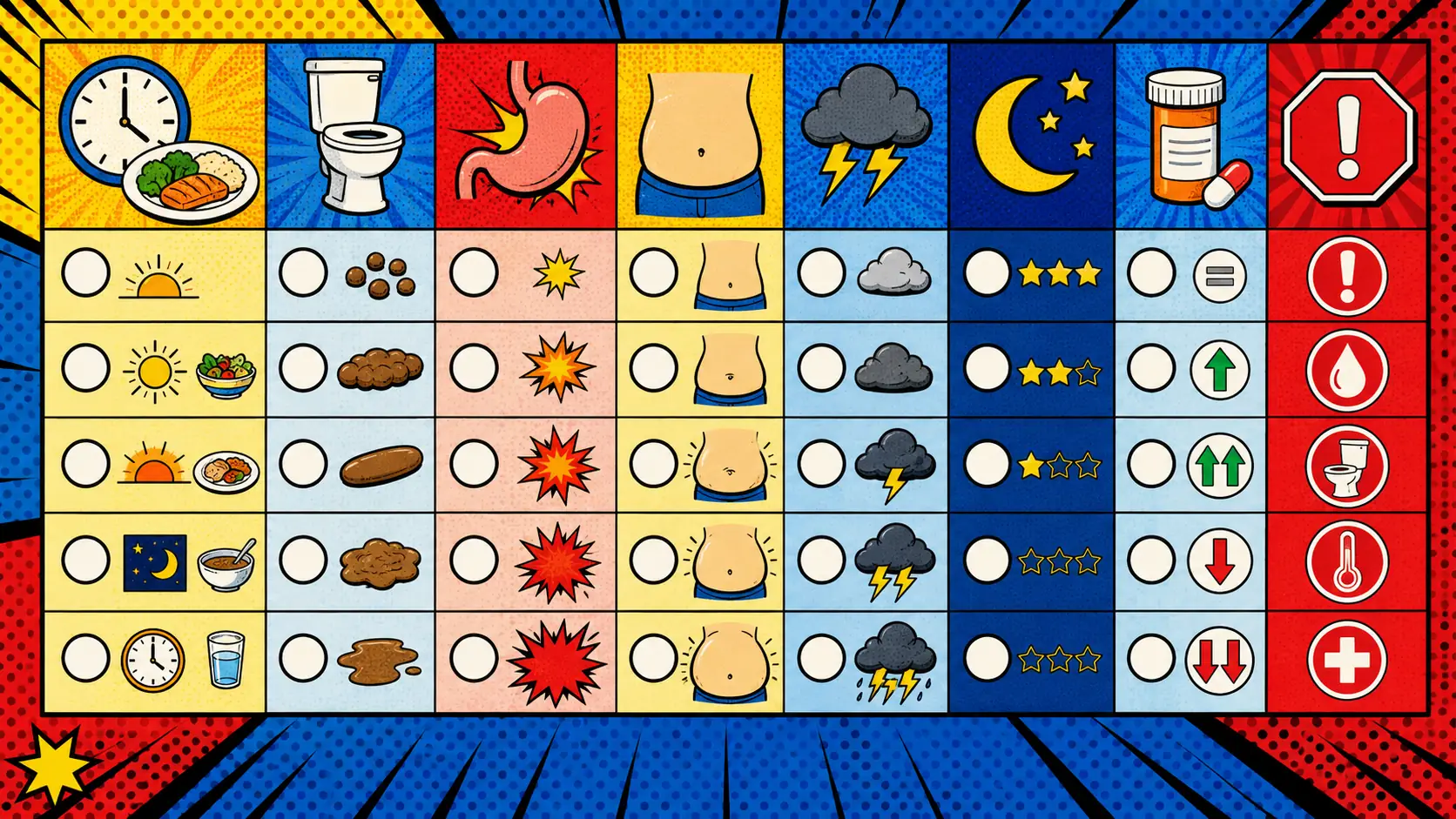
Pop art style route card showing seven tracker lanes: food timing, stool pattern, pain, bloating, stress, sleep, medication changes, plus a red stop-sign column.
A useful tracker separates food from the rest of the context.

Read Patterns Without Blaming Every Food

One bad evening after one meal does not prove that meal is a trigger. Symptoms can stack from food, constipation, poor sleep, stress, timing, caffeine, alcohol, menstrual-cycle changes, travel, infection, or medication changes.

Before removing a food, ask:

  • Did the same food cause the same pattern more than once?
  • Was the baseline stable?
  • Was the portion similar?
  • Were sleep, stress, stool backup, alcohol, caffeine, or timing different?
  • Did symptoms fit the likely timing?

If you are in low-FODMAP reintroduction or personalization, use low-FODMAP personalization mistakes before deciding that every unclear test means "never again."

Bring a One-Page Summary to Care

Clinicians do not need every line of your diary. They need the pattern.

Summarize:

  • usual stool pattern
  • worst symptom and when it happens
  • red flags if any
  • foods or contexts tested more than once
  • constipation, diarrhea, or mixed pattern
  • sleep and stress pattern
  • medications and supplements
  • what you already tried

If food is the main question, a GI dietitian can often use a concise tracker better than a long, anxious list. If non-food factors keep showing up, use the non-food IBS triggers decision guide.

Download: IBS Symptom Tracker: Food, Stool, Stress, and Sleep

Best Next Read by Situation

Situation Go next
You are preparing for an appointment Doctor visit prep for IBS next steps
Food is not the only pattern Non-food IBS triggers decision guide
Low-FODMAP Step 3 is confusing Low-FODMAP personalization mistakes
You are in an active flare IBS flare plan: what to do today

Bottom Line

Track enough to make the next decision clearer. Do not track so much that the tracker becomes another symptom burden. Food matters for many people with IBS, but stool pattern, sleep, stress, timing, medications, supplements, cycle changes, travel, and red flags can matter too. A good tracker keeps all of those lanes visible.

X

Xam Riche

Gut Health Solopreneur & IBS Advocate

Xam Riche is a gut health solopreneur and founder of YourFitNature, dedicated to helping people navigate digestive wellness through evidence-based information and personal experience. After years of struggling with IBS and bloating, Xam discovered the transformative power of the low FODMAP diet and now shares practical, science-backed guidance to help others find relief. While not a medical professional, Xam combines extensive research with lived experience to create accessible, empowering resources for the gut health community. Learn more about our mission

Xam Riche - Gut Health Solopreneur & IBS Advocate. Xam Riche is a gut health solopreneur and founder of YourFitNature, dedicated to helping people navigate digestive wellness through evidence-based information and personal experience. After years of struggling with IBS and bloating, Xam discovered the transformative power of the low FODMAP diet and now shares practical, science-backed guidance to help others find relief. While not a medical professional, Xam combines extensive research with lived experience to create accessible, empowering resources for the gut health community.
Recommended Products

As an affiliate, we may earn from qualifying purchases.

Related Questions

College Dorm Low-FODMAP and IBS Flare Plan

LOW FODMAP DIET

A practical college IBS and low-FODMAP plan for dorm meals, dining halls, shared bathrooms, class timing, flare days, and campus health handoffs.

Cultural Foods and Low FODMAP Without Losing Tradition

LOW FODMAP DIET

A respectful guide to adapting low-FODMAP and IBS planning around cultural foods, family meals, staple dishes, tradition, and diet diversity.

IBS Symptom Tracker Template for Food, Stool, Stress, and Sleep

IBS, BLOATING & GUT SYMPTOMS

A practical IBS symptom tracker template for food, stool pattern, pain, bloating, stress, sleep, medications, supplements, and clinician visits.

IBS Dietitian Visit Prep and Care-Team Roles

IBS, BLOATING & GUT SYMPTOMS

A practical IBS dietitian visit prep guide for symptom summaries, food history, medication lists, care-team roles, and safer next-step questions.

Ramadan Fasting, Meal Timing, and IBS Symptoms

IBS, BLOATING & GUT SYMPTOMS

A respectful Ramadan fasting and IBS planning guide for meal timing, hydration, constipation, diarrhea, reflux, caffeine, and care-team questions.

Low-FODMAP With Diabetes, Blood Sugar, and Gut Symptoms

LOW FODMAP DIET

A careful low-FODMAP and diabetes planning guide for blood sugar, fiber, meal timing, appetite, medications, and gut-symptom tracking.

Caregiver Guide: IBS in Older Adults at Home

IBS, BLOATING & GUT SYMPTOMS

A caregiver guide for IBS-like bowel changes in older adults at home, including hydration, medicines, constipation, diarrhea, appetite, red flags, and appointment prep.

CBT for IBS Anxiety, Urgency, and Gut-Brain Skills

GUT-BRAIN & WHOLE-BODY HEALTH

A practical guide to CBT for IBS anxiety, urgency, bathroom fear, and gut-brain skills, with clear boundaries so symptoms are not dismissed as just anxiety.

IBS and Trauma-Informed Care for Gut Symptoms

GUT-BRAIN & WHOLE-BODY HEALTH

A trauma-informed IBS care guide for exams, urgency, pain, pelvic symptoms, bathroom fear, consent, pacing, and clinician conversations.

Neurodivergent IBS Routines, Sensory Foods, and Bathroom Planning

GUT-BRAIN & WHOLE-BODY HEALTH

A respectful planning guide for neurodivergent IBS routines, sensory food limits, bathroom access, meal timing, low-effort meals, and clinician handoff.

Showing 10 of 152

Stay Updated!

Subscribe to our newsletter for the latest articles and updates.

YourFitNatureplusdescription Logo
Find Your Custom Stack

Heal Your Gut. Reclaim Your Energy.

Science-backed tools to rebalance your microbiome
and fuel your clarity from the inside out.

ShopBlogGut Bloating ResourcesBloating ToolkitCommunity Challenge
Hiipa Compliance
About YourFitNature