 By • Published on July 27, 2026 • 11 min read • 4,925 views
This article is for informational and educational purposes only and does not constitute medical advice, diagnosis, allergy testing, or nutrition counseling. Seek qualified medical support for urgent, severe, new, persistent, or concerning symptoms and for individualized testing decisions.
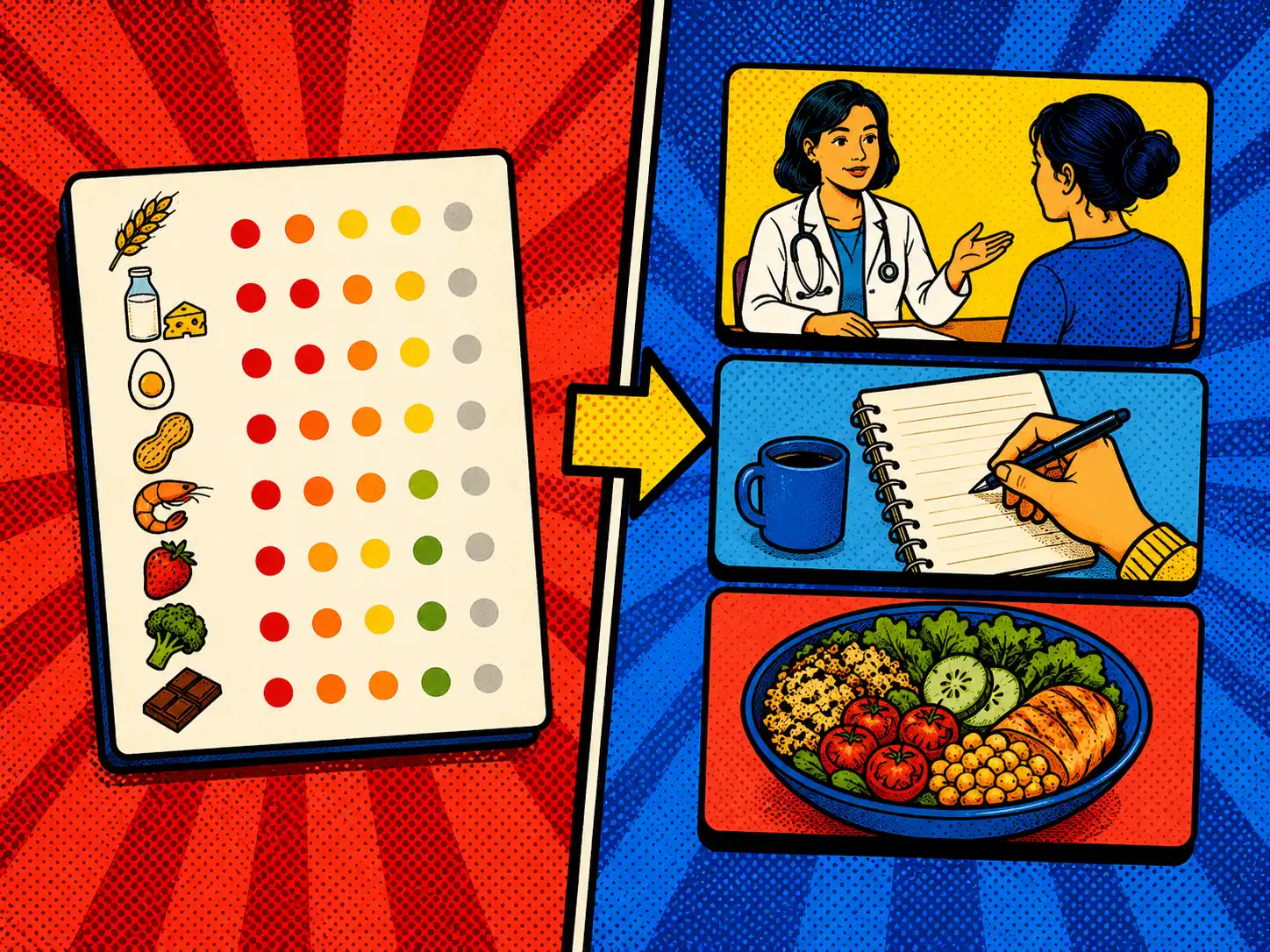
A food-sensitivity panel can look like the answer you have been waiting for. You send a blood sample, receive a long color-coded list, and suddenly the foods behind your bloating, pain, diarrhea, constipation, or “everything bothers me” feeling seem to be right there on the page.
That promise is especially tempting when IBS has made eating feel unpredictable. You may be tired of tracking meals, tired of being told to notice patterns, or worried that you are missing one hidden food that would make the whole picture click.
For most people with IBS, a broad food-sensitivity or IgG panel is not the first useful next step. The result may give you a longer food list, but it does not diagnose food allergy, prove a food intolerance, or identify every IBS trigger. The more useful question is: what decision would this result actually change?
If the answer is “I need to know whether this is an allergy,” “I should not go gluten-free before testing,” “one food seems repeatable,” or “my food list is getting smaller,” the best next move is different in each case. This guide helps you choose that route before you spend more money or remove more foods.

Broad food IgG panels are often sold as a shortcut from symptoms to an avoid list. That is not the same thing as a reliable diagnosis. AAAAI says the common food IgG panels have not been scientifically shown to deliver the diagnostic claims made for food allergy, intolerance, or sensitivity, and notes that IgG can reflect food exposure 1.
That does not mean your symptoms are imagined or that food can never matter in IBS. Foods can aggravate symptoms for some people. It means a report alone cannot tell you why a reaction happened, whether the reaction is repeatable, whether another condition needs attention, or whether cutting the food will improve your health.
Before buying a panel, use this quick filter:
| If you hope the test will answer… | Start with this question instead |
|---|---|
| “Am I allergic to this food?” | Did I have an immediate or concerning reaction that needs an allergist-led evaluation? |
| “Should I stop eating gluten?” | Could celiac testing be needed before I remove gluten? |
| “Which food is causing my bloating?” | Is there one repeatable, dose-related pattern, or is the IBS pattern broader? |
| “Why do I still feel unwell after cutting foods?” | Has restriction made the picture clearer - or only made my food list smaller? |
If your core question is whether your symptoms fit a broader syndrome, a specific intolerance pattern, or a SIBO-style question, start with IBS, SIBO, and food intolerance before treating a panel as the final answer.
The words allergy, intolerance, and sensitivity are often used interchangeably online. They should not lead to the same next step.
| Question | What it is trying to sort | Better next move |
|---|---|---|
| Possible food allergy | A potentially serious immune reaction that needs clinical interpretation | Seek appropriate allergy assessment; do not use an at-home panel to decide whether a food is safe to challenge. |
| Food intolerance | A narrower digestive pattern where amount, timing, and repeatability may matter | Track the pattern and discuss a targeted testing or structured food-trial route. |
| IBS food pattern | A broader gut-brain condition where meals, bowel pattern, stress, sleep, medicines, and routine can all affect symptoms | Use a symptom and context view instead of blaming every meal. |
| Marketed “food sensitivity” | A consumer label that can cover many different test methods and claims | Ask what the test measures and whether it is validated for the decision you need to make. |
ACAAI explains that food-allergy diagnosis relies on clinical history and appropriately interpreted testing; even a clinician-ordered positive result needs context, and a supervised food challenge may be used when needed 2. Hives, swelling, breathing trouble, faintness, or a rapidly escalating reaction belong in that safety lane - not in a home elimination or reintroduction experiment.
The medical-testing lane is different too. NIDDK notes that IBS is assessed from symptoms, medical and family history, and examination, with tests used when needed to check for other conditions 3. If you have blood in stool, black stool, unexplained weight loss, anemia concern, fever, severe or worsening pain, or a clearly changed bowel pattern, use IBS versus colorectal warning signs rather than trying to explain the change with a food panel.
If wheat or gluten is the worry, do not let a consumer result decide the sequence. NIDDK advises against starting a gluten-free diet before celiac diagnostic testing because it can affect the results 4. Use gluten, celiac, or IBS symptoms to protect that testing-first step.
Many at-home food-sensitivity panels measure immunoglobulin G, usually called IgG, to a large number of foods. A long list can feel persuasive because it looks specific. But specificity on a report is not the same as proof that each food is causing symptoms.
AAAI notes that the presence of food IgG may be a normal response to exposure and that higher IgG4 may be associated with tolerance 5. ACAAI similarly notes that many at-home panels measure IgG, which reflects exposure rather than food allergy, and warns that results can lead to unnecessary avoidance, nutrition problems, and confusion 6.
That gives a practical boundary:
The report may still be useful as a prompt to notice what you eat, what you have already removed, and what question you want to ask next. Keep it in that role: a conversation starter, not a verdict.
For a similar boundary around consumer gut reports, see what stool and microbiome tests can and cannot tell you for IBS. The test type is different, but the key question is the same: does this report answer a validated clinical question, or does it only produce a more complicated story?
There is an important nuance here. A 2025 multicenter, randomized, double-blind, sham-controlled study evaluated an elimination diet based on one IBS-specific 18-food IgG ELISA 7. It is a more relevant research signal than broad marketing claims about testing hundreds of foods.
But the study does not make all online panels interchangeable with the assay it evaluated. It does not establish that a generic panel can diagnose food allergy or food intolerance. And it does not tell you that a result should override your symptom history, medical testing sequence, nutrition needs, or care team.
That distinction matters because “there is a study about an IgG-guided diet” can quickly turn into “every IgG result is medically meaningful.” Those are not the same claim. Until a test matches the studied approach and the result can change a sensible next step, treat a broad panel as information that needs context - not as proof.
Use this map to decide what comes before another test or another restriction.
| If this sounds like you | Better next step | Why the panel is not the first answer |
|---|---|---|
| A food caused hives, swelling, breathing trouble, faintness, or a fast escalating reaction | Seek appropriate allergy or urgent assessment. | A home panel cannot establish whether it is safe to retry the food. |
| You have warning signs, possible celiac clues, or a major change from your usual symptoms | See which medical tests may fit before further restriction. | The priority is ruling out or evaluating the question that could change care. |
| One food or food group seems repeatable and amount appears to matter | Track timing, amount, and repeatability; then consider a targeted discussion or a structured food trial. | A symptom pattern explains more than a single antibody score. |
| Symptoms are broad, vary with the week, or do not improve despite repeated food cuts | Review the broader IBS pattern, routine, stress, sleep, medicines, and clinical context. | IBS does not always behave like one hidden-food problem. |
| Your safe-food list keeps shrinking or eating feels increasingly fearful | Check your food list before removing more foods and consider GI-dietitian support. | More avoidance can create nutrition and quality-of-life costs without producing a clearer signal. |
For some people with IBS, a structured low-FODMAP process can help identify tolerance patterns. ACG describes that work as time-limited elimination, reintroduction, and personalization - not permanent broad restriction - and notes that restrictive approaches may not fit people at risk of malnutrition, with eating-disorder history, or with complex medical histories 8. If you have a calm enough baseline and the safety questions are already settled, use structured reintroduction to test tolerance rather than turning a panel-derived food list into a lifelong rule.
Free Download: Food Test Next-Step Card
Use the five-lane route map to turn a test result or food worry into one focused question for your next step.
You do not need to throw the report away. Bring it into the wider context instead.
Write down the report name and date, the foods it flagged, and which foods you had already removed before testing. Then add the details a panel cannot capture on its own: how much you ate, when symptoms started, whether the reaction repeated, what your bowel pattern was doing that week, and whether sleep, stress, travel, medicines, supplements, infection, or cycle timing changed at the same time.
The goal is not to prove that every symptom has one cause. It is to make the next conversation more useful. Track the pattern without blaming every food if your notes are scattered, and prepare a clearer testing conversation if you need to bring the report to a clinician.
If a report has expanded your avoid list, ask one practical question: What would make it safe to restore variety? A GI dietitian can help separate food structure from food fear, while a clinician can decide whether the symptom pattern needs a different testing or treatment conversation. IBS dietitian visit prep and care-team roles can help you match the question to the right person.
| Situation | Best next read |
|---|---|
| You need to know which clinician-led tests may fit before you restrict more food | IBS tests, celiac, SIBO, calprotectin, and colonoscopy |
| You are trying to separate a narrow food reaction from broader IBS or SIBO uncertainty | SIBO versus IBS versus food intolerance |
| You need a bounded way to learn food tolerance after the safety questions are settled | Low-FODMAP reintroduction |
| A growing avoid list is making meals harder rather than clearer | Nutrient gaps on a restrictive gut diet |
| You need to turn a report into an appointment question | Doctor visit prep for IBS next steps |
Food sensitivity tests for IBS can sound like a shortcut through a frustrating problem. Broad direct-to-consumer IgG panels are not a reliable way to diagnose food allergy, food intolerance, or every IBS trigger. One newer IBS-specific study is worth knowing about, but it does not make every panel equivalent or turn a result into a diagnosis.
Start with the decision that actually needs an answer. Put possible allergy, red flags, and celiac testing first. Use a structured food-pattern route when it fits. Protect variety when restriction is expanding. The best next step is not the longest food list - it is the one that makes your situation clearer without making your life smaller.
Xam Riche is a gut health solopreneur and founder of YourFitNature, dedicated to helping people navigate digestive wellness through evidence-based information and personal experience. After years of struggling with IBS and bloating, Xam discovered the transformative power of the low FODMAP diet and now shares practical, science-backed guidance to help others find relief. While not a medical professional, Xam combines extensive research with lived experience to create accessible, empowering resources for the gut health community. Learn more about our mission
As an affiliate, we may earn from qualifying purchases.