 By • Published on March 26, 2026 • 13 min read • 3,214 views
This article is for informational and educational purposes only and does not constitute medical advice. Always consult with a registered dietitian, gastroenterologist, or other qualified medical professional before making significant dietary changes or trying new supplements.
A commerce-safe path for deciding when enzymes, peppermint oil, fiber, supplement audits, hidden-product checks, or symptom trackers fit.
You're reading: Peppermint Oil for IBS: Does It Actually Help?

Peppermint oil is one of the few IBS remedies that actually has trial data behind it. But that does not make it a blanket fix for every IBS problem. It works best when you know what symptom you are trying to calm, what form matters, and when another lever should come first.
Short answer: peppermint oil can help IBS pain, cramping, and bloating in the right context, but it is a symptom tool, not a diagnosis substitute or a complete treatment strategy.
This page is for you if you want to know whether peppermint capsules are a reasonable fit for your IBS pattern before buying another supplement.
Use a different page first if your main problem is broader troubleshooting or a gut-brain treatment decision. Start with when-low-fodmap-doesnt-work-next-steps or gut-directed-hypnotherapy-for-ibs.
If you have IBS, you have probably seen peppermint oil recommended so many times that it starts to blur into the rest of the gut-health noise.
It gets mentioned next to low FODMAP, probiotics, digestive enzymes, herbal teas, stress support, and every other “natural” thing people suggest when your belly is unpredictable. At some point the real question becomes less what is peppermint oil? and more does this one actually deserve a place in my plan?
That is a fair question.
Here is the short answer: peppermint oil does have real evidence behind it for IBS symptom relief, especially for abdominal pain, cramping, bloating, and overall symptom burden 1 2. But it is not a cure, not a replacement for diagnosis, and not equally useful for every IBS pattern.
So this article is not here to sell you a supplement. It is here to help you decide whether peppermint is a smart fit, a secondary fit, or the wrong next question entirely. If you need the wider symptom picture first, start with our broader bloating relief plan.
This page explains a symptom-tool decision:
This page is not mainly explaining:
Yes, in the right context.
The American College of Gastroenterology says peppermint oil relaxes smooth muscle, helps overall IBS symptoms, and may improve belly pain and bloating. It also notes that ACG suggests peppermint oil for overall symptom improvement in IBS 3.
That already puts peppermint in a different category from many IBS remedies that mostly survive on anecdote. It is not just a comfort ritual. There are randomized trials, pooled analyses, and guideline-level summaries behind it.
But the cleanest way to understand peppermint is this: it is a symptom tool, not a full IBS strategy. It may reduce symptom intensity. It does not tell you why your IBS is happening, and it does not replace the bigger work of figuring out food triggers, bowel-pattern issues, stress amplification, or whether the diagnosis still fits. If that bigger picture is still messy, read not every IBS problem is solved by one tool.
If your main question is “what does peppermint actually help?”, the best answer is pain-heavy IBS.
Peppermint makes the most sense when symptoms feel spasm-like: belly pain, cramping, tightness, post-meal discomfort, or bloating that comes with a tense, “knotted” feeling rather than only stool-pattern frustration 4.
That means peppermint may fit naturally into an IBS-D or IBS-M pattern when urgency travels with pain. It may also help some IBS-C readers if pain and bloating are prominent. But it is not a constipation treatment by itself, which is why readers whose main problem is backed-up stool usually need IBS-C support more than a mint-based add-on.
Use this quick filter:
| Pattern | Peppermint Fit | Why |
|---|---|---|
| Cramping, spasms, belly pain, bloating | strong fit | This is where the evidence is most relevant |
| IBS-D or IBS-M with pain-heavy flares | moderate-to-strong fit | Can be a useful symptom tool beside broader management |
| IBS-C with constipation as the main issue | weak-to-moderate fit | May help pain or bloating, but not the core constipation problem |
| Diagnostic uncertainty or worsening symptoms | poor fit as a solo move | Needs broader review before symptom-targeted supplements |
[!TIP] Download: Peppermint Oil for IBS Quick Check Use it before you treat peppermint like the next automatic purchase.
If your pattern leans diarrhea-predominant and the pain piece is strong, this often pairs best with broader IBS-D support, not with peppermint alone.
This is the part that matters if you are trying to separate a legitimate IBS tool from supplement marketing.
A 2022 systematic review and meta-analysis looked at 10 randomized controlled trials with 1,030 patients and found peppermint oil was better than placebo for both global IBS symptoms and abdominal pain 5. That same paper also found adverse events were more common with peppermint oil and rated the overall quality of evidence as very low 6.
That is exactly the kind of nuance readers need. The evidence is real, but it is not clean enough to justify miracle language.
A 2020 network meta-analysis went even further and ranked peppermint oil first for efficacy when the endpoint was failure to improve global IBS symptoms over 4 to 12 weeks 7. But the authors also stressed that only a small number of trials were at low risk of bias 8.
A 2019 pooled meta-analysis of enteric-coated peppermint oil also found benefit for global symptoms and abdominal pain, with numbers needed to treat of 3 and 4 respectively 9.
So the defensible summary looks like this:
| Source | What Improved | Main Caution |
|---|---|---|
| 2022 meta-analysis | global IBS symptoms and abdominal pain | adverse events were more common; evidence quality was very low |
| 2020 network meta-analysis | strongest ranking for global symptom efficacy | trial quality limitations |
| 2019 pooled meta-analysis | global symptoms and abdominal pain | formulation-specific evidence, not a universal peppermint claim |
That is enough to say peppermint is worth considering. It is not enough to say it works for everyone, or that it should outrank every other IBS lever you have.
This is where consumer advice gets sloppy.
The strongest IBS evidence is mainly for oral peppermint oil preparations, especially enteric-coated or targeted-release capsules 10 11. That does not mean peppermint tea is useless. It can still feel soothing. But it is not the same thing as the intervention studied in the IBS trials.
That distinction matters because “peppermint” can mean at least three different things in casual conversation:
If you want the form that actually maps onto the research, capsules are the relevant category.
ACG also notes that enteric coating may reduce side effects 12, which is part of why this detail keeps showing up in IBS discussions.
Peppermint tea still has a place. It may be a light comfort tool after meals or when eating out, especially if you already use it as part of your peppermint tea backup routine. But tea should be treated as a soothing ritual, not as evidence-equivalent to capsule trials.
If your question is more nausea or upper-GI comfort than IBS cramping, compare ginger tea vs ginger supplements separately instead of treating every herbal option as the same decision.
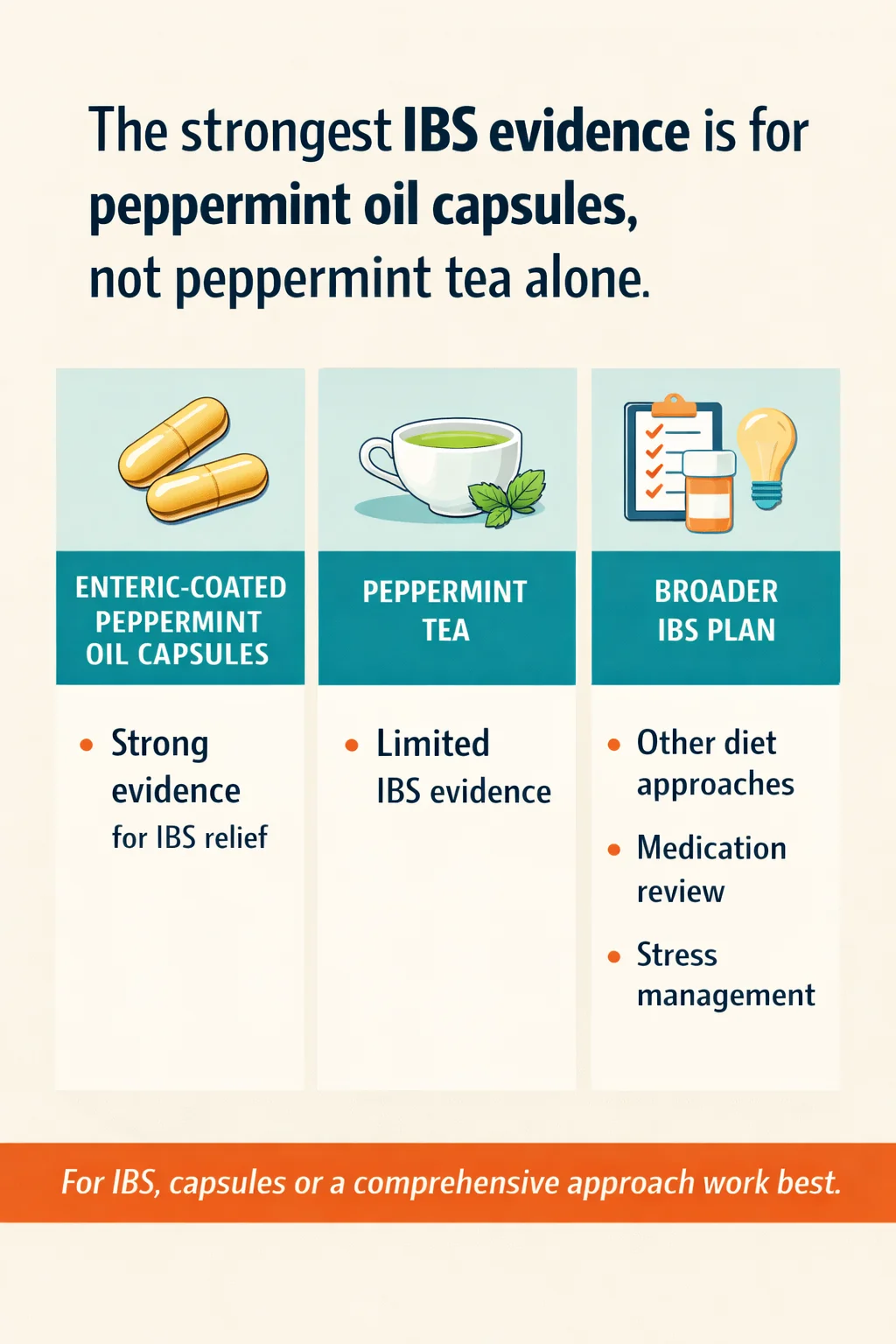
One more nuance: some sources suggest certain peppermint oil formulations may start helping quickly. ACG says benefit may appear within 24 hours, and a 2015 trial also found greater symptom-score reduction at 24 hours and again at 4 weeks 13 14. That is useful, but it still makes more sense to judge response over several days to weeks rather than treating one early result as the whole story.
This is where “natural” can mislead people.
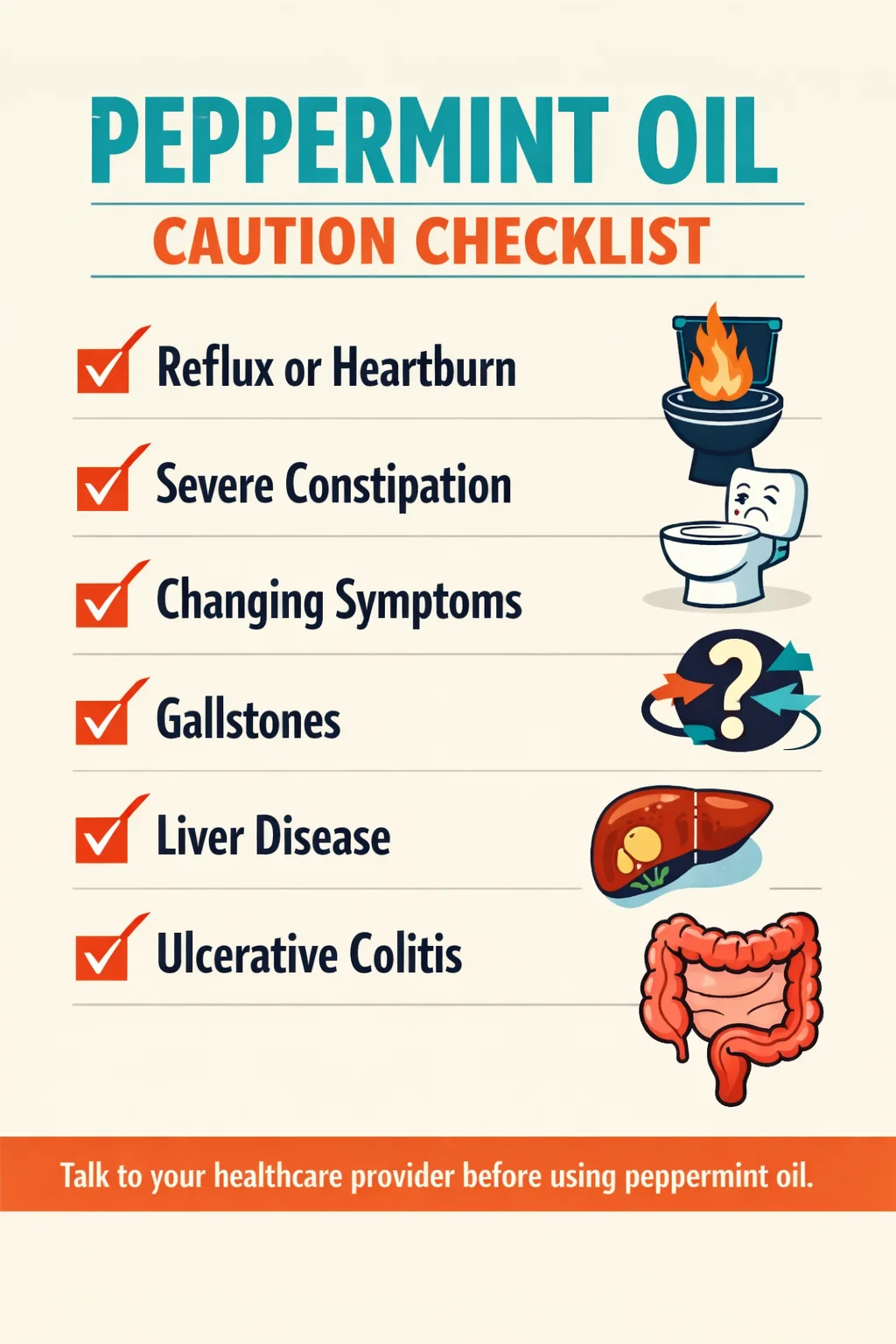
Peppermint is not a high-drama supplement, but it is also not neutral for everyone. ACG says heartburn and anal burning can happen depending on the preparation 15. NHS adds a practical list of people who should be more careful before using peppermint capsules, including people with reflux disease, severe constipation, ulcerative colitis, gallstones, liver disease, or changing gastrointestinal symptoms such as bleeding or unexplained weight loss 16.
That makes the screening question pretty simple:
If the answer is yes, peppermint becomes a much weaker self-start choice. In that situation, a bigger review is usually smarter than adding another symptom tool. If you are no longer sure the pattern even still fits IBS, step back into changing symptoms.
This is the most useful mental model.
Peppermint belongs beside the rest of your IBS plan, not above it.
If food triggers are still driving most of the picture, the bigger lever is still diet. If constipation is dominating, the bigger lever is usually fiber, fluids, routine, and escalation when needed. If stress is amplifying symptoms, the gut-brain piece may still be the part that is keeping everything loud.
That is why ACG places peppermint in a broader treatment list rather than as a standalone IBS solution 17.
Use it like this:
If you are comparing symptom tools with gut-brain therapies, see gut-directed hypnotherapy for IBS for the evidence-first treatment breakdown.
[!TIP] Download: Peppermint Oil for IBS Fit Guide Keep this as a quick reminder of when peppermint fits and when it really does not.
Peppermint is the wrong question when the bigger problem is uncertainty.
If symptoms are worsening, changing, or no longer behaving like the IBS pattern you thought you understood, symptom-relief tools should not become a way to delay the next level of evaluation.
The same applies if you keep stacking tool after tool without enough clarity. Low FODMAP. Enzymes. Probiotics. Peppermint. Ginger. Supplements can look like momentum while the real issue stays unnamed.
That does not mean peppermint has no place. It means it should stay in its lane.
If the lane you actually need is broader troubleshooting, use next steps. If the question is still “why do I feel this bad despite doing the obvious things?”, peppermint is not the only answer and often not the first one.
If you want the shortest possible summary, it is this:
That is what makes peppermint useful without turning it into hype.
If your IBS is more subtype-driven, move next into IBS-C support or IBS-D support. If you need a wider relief map, start with the broader bloating relief plan. And if symptoms still feel more confusing than clarifying, skip the supplement spiral and use next steps.
Peppermint deserves a place in IBS care. It just deserves the right-sized one.
Xam Riche is a gut health solopreneur and founder of YourFitNature, dedicated to helping people navigate digestive wellness through evidence-based information and personal experience. After years of struggling with IBS and bloating, Xam discovered the transformative power of the low FODMAP diet and now shares practical, science-backed guidance to help others find relief. While not a medical professional, Xam combines extensive research with lived experience to create accessible, empowering resources for the gut health community. Learn more about our mission
As an affiliate, we may earn from qualifying purchases.