 By • Published on March 28, 2026 • 12 min read • 4,338 views
This article is for informational and educational purposes only and does not constitute medical advice. Always consult with a registered dietitian, gastroenterologist, or other qualified medical professional before changing your treatment plan or starting a new therapy.
Gut-directed hypnotherapy is one of the few gut-brain therapies in IBS care that has both guideline support and trial data behind it. But that does not mean it is a magic answer, or that every IBS reader should jump straight into it before checking whether the pattern, timing, and access all make sense.
Short answer: gut-directed hypnotherapy can be a legitimate IBS treatment when the brain-gut loop is staying loud, but it is not a replacement for diagnosis, food structure, or broader treatment planning.
This page is for you if you suspect stress reactivity, symptom amplification, or anticipatory pain is keeping IBS active even when diet work is already in motion.
Use a different page first if your main question is simpler symptom relief or broad troubleshooting. Start with stress-bloating-through-gut-brain-axis or when-low-fodmap-doesnt-work-next-steps.
If you have IBS, sooner or later someone says the same thing: maybe the missing piece is the gut-brain axis.
Sometimes that lands as relief. Sometimes it lands as irritation, because after enough bloating, pain, urgency, and failed diet experiments, anything that sounds vaguely psychological can feel like a polite way of saying this is all in your head.
Here is the truth: that is not what gut-directed hypnotherapy means.
This is not stage hypnosis. It is not entertainment. It is not a claim that food no longer matters. It is a structured IBS-focused therapy designed to calm the gut-brain loop that can keep pain, urgency, bloating, and symptom fear louder than the food alone would explain.
And yes, there is real evidence behind it 1 2.
So this guide is here to answer the practical question: does gut-directed hypnotherapy actually work for IBS, and when is it a smarter next step than just repeating the same diet logic again? If you need the big-picture mechanism first, start with the gut-brain axis.
This page explains a gut-brain intervention decision:
This page is not mainly explaining:
Yes, but the honest answer needs some structure.
The 2021 American College of Gastroenterology guideline suggests gut-directed psychotherapy for global IBS symptoms 3. That matters because it puts this therapy inside serious IBS care rather than outside it.
But guideline support is not the same as saying the evidence is perfect. NCCIH notes that there is some evidence gut-directed hypnotherapy can improve IBS symptoms and health-related quality of life, while also making clear that the recommendation is conditional and based on very low-quality evidence 4.
That is exactly the tone readers need. The evidence is real. The confidence is qualified. It is stronger than a lot of wellness advice, but still not the kind of evidence base that justifies miracle language.
Bottom line: gut-directed hypnotherapy is a legitimate IBS option, especially when the pattern looks clearly IBS-like and the gut-brain piece is loud. But it belongs inside a bigger plan, not above it. If that bigger picture still feels messy, remember that diet is not the whole story.
This distinction matters because the word hypnosis carries baggage.
Gut-directed hypnotherapy is usually delivered through IBS-specific scripts, guided relaxation, focused attention, and repeated imagery that aim to lower symptom amplification and help the brain-gut loop stop reacting as if every signal is an emergency. In plain language, it is a way of training the system to interpret gut sensations less catastrophically and respond to them with less physiologic escalation.
That is why it sits naturally beside the broader gut-brain axis framework. The therapy is trying to change the signal, not deny that the signal exists.
It is also why this article should not be read as "food does not matter." If your symptoms still map tightly to specific meal triggers, the food side of the equation may still deserve more attention. Hypnotherapy is not an argument against diet. It is a recognition that IBS often runs on more than one channel.
This is where the therapy earns its place.
A 2025 systematic review and meta-analysis covering 12 studies and 1,158 patients found that gut-directed hypnotherapy improved pain more than comparator groups and showed a favorable signal for global IBS symptoms, although heterogeneity was high for the global-symptom outcome 5.
That same meta-analysis also found a significant subgroup result for group-delivered gut-directed hypnotherapy 6, which matters because access and cost are often the biggest real-world barriers.
A 2024 network meta-analysis of brain-gut behavioral treatments found face-to-face gut-directed hypnotherapy associated with abdominal-pain improvement, but did not show that it was clearly superior to every other behavioral therapy in the category 7. That is a useful corrective: the therapy is credible, but it is not the only gut-brain option that can help.
The British Society of Gastroenterology guideline goes even further in practical language, describing gut-directed hypnotherapy as one of the psychological therapies in IBS with one of the largest randomized-trial evidence bases for short-term and long-term efficacy 8.
Use the evidence like this:
| Source | What It Supports | Main Caution |
|---|---|---|
| 2021 ACG guideline | legitimate IBS treatment category | conditional recommendation |
| 2025 meta-analysis | pain improvement and favorable overall symptom signal | heterogeneity remains |
| 2024 network meta-analysis | abdominal-pain benefit | not clearly superior to every other therapy |
| BSG guideline | strong long-term and short-term evidence base | access in practice is still limited |
That is enough to treat gut-directed hypnotherapy as serious. It is not enough to pretend the evidence is simple.
This is the comparison readers usually want most.
A 2016 randomized clinical trial found that gut-directed hypnotherapy, low-FODMAP diet, and the combination of both produced similar improvement in overall gastrointestinal symptoms at six weeks 9.
That result is important, but easy to misread.
It does not mean food no longer matters. It does not mean everyone should swap a dietitian for a therapist. It means the study supports the idea that IBS can improve meaningfully when you target either food-trigger load or gut-brain amplification well enough.
The same trial also found stronger improvement on some psychological indices with hypnotherapy and no clear additive benefit from combining both treatments in that design 10.
The cleanest framing is this:
So the real question is not "which side wins?" It is "which lever matches my pattern best right now?"
If your symptoms still look strongly meal-triggered, keep the low-FODMAP strategy front and center. If you need the foundational diet map first, revisit who diet fits best.
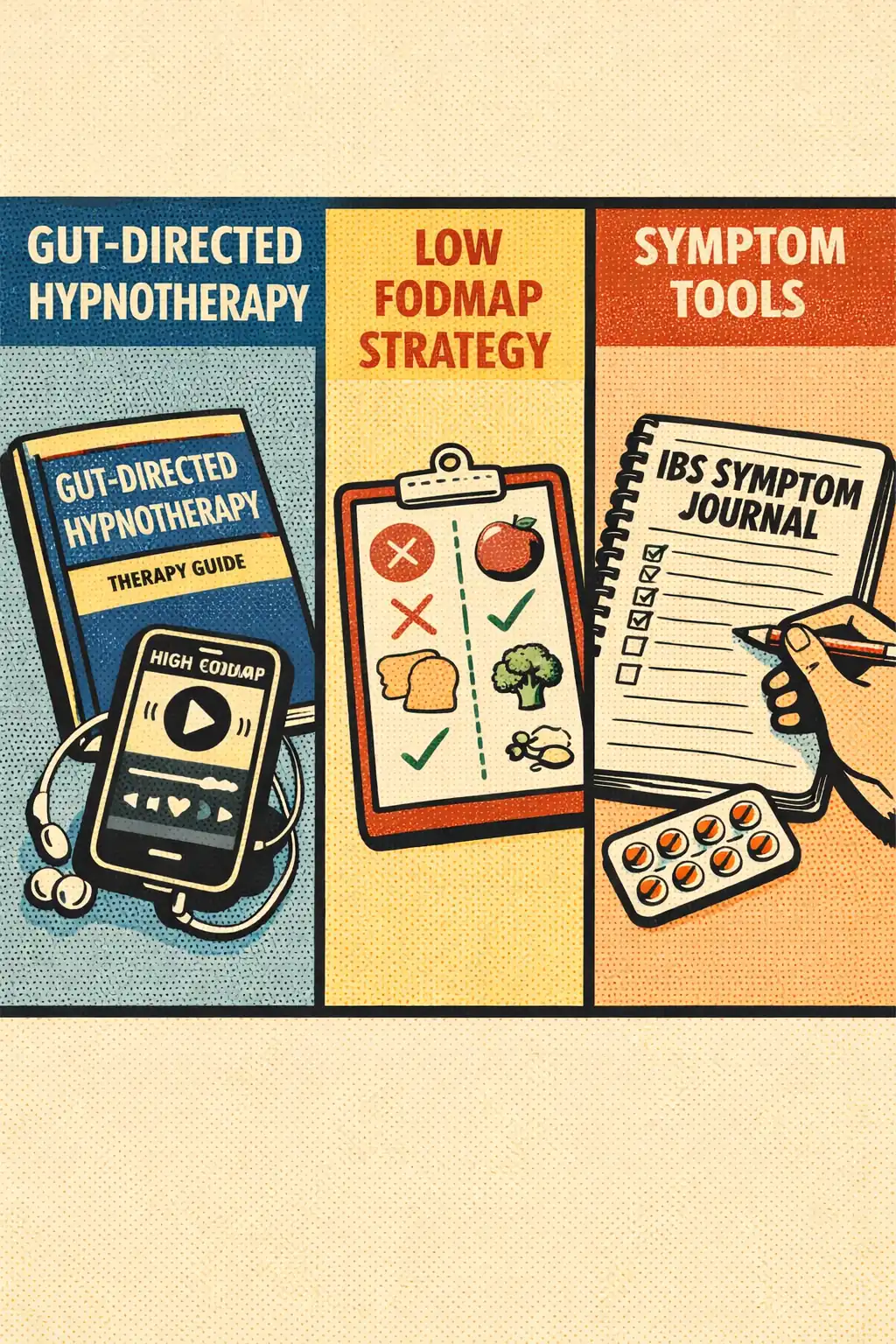
This is where the therapy becomes practical instead of abstract.
Gut-directed hypnotherapy is usually a stronger fit when:
It is a weaker first move when:
That is why the next-step choice still depends on your pattern. If the main frame is urgency-heavy, start with IBS-D pattern. If the bigger issue is stool backup and bloating, start with IBS-C pattern. If the whole diagnosis feels shaky, pull back into diagnostic uncertainty.
[!TIP] Download: Gut-Directed Hypnotherapy for IBS Quick Check Use it to decide whether this therapy is a logical next lever or just the next shiny idea.
Efficacy is only part of the story.
The BSG guideline notes that gut-directed hypnotherapy has traditionally been delivered in about 6 to 12 weekly face-to-face sessions using IBS-specific protocols 11. That alone explains why many readers hear about the therapy long before they ever have a realistic chance to try it.
Access also explains why group delivery and digital delivery matter so much now.
The 2025 meta-analysis found significant improvement in the group-delivery subgroup 12, which supports the idea that lower-cost formats can still be legitimate.
Digital programs look promising too, but the evidence is not identical across every trial. A 2025 randomized trial found a digitally delivered gut-directed hypnotherapy program beat active control on the primary endpoint, pain response, and quality-of-life measures 13. But a 2023 randomized trial against digital muscle relaxation did not show a significant difference on its primary endpoint, even though later pain-response and stool outcomes favored gut-directed hypnotherapy 14.
That means the digital takeaway should stay balanced:
NCCIH also says gut-directed hypnosis is generally considered safe and tolerable when led by trained professionals 15, which is reassuring without pretending the therapy replaces diagnosis or care quality.
This is the mental model that keeps the therapy useful.
Gut-directed hypnotherapy is not the only answer. It is one answer that can be very relevant when symptom amplification, anticipation, pain, or stress-sensitive flares are keeping the whole system louder than the food alone would predict.
It should sit beside the rest of the plan:
That is why this article pairs naturally with stress-sensitive IBS instead of replacing it.
[!TIP] Download: Gut-Directed Hypnotherapy for IBS Readiness Guide Keep this nearby if you are comparing therapist-led care, group care, and digital options.
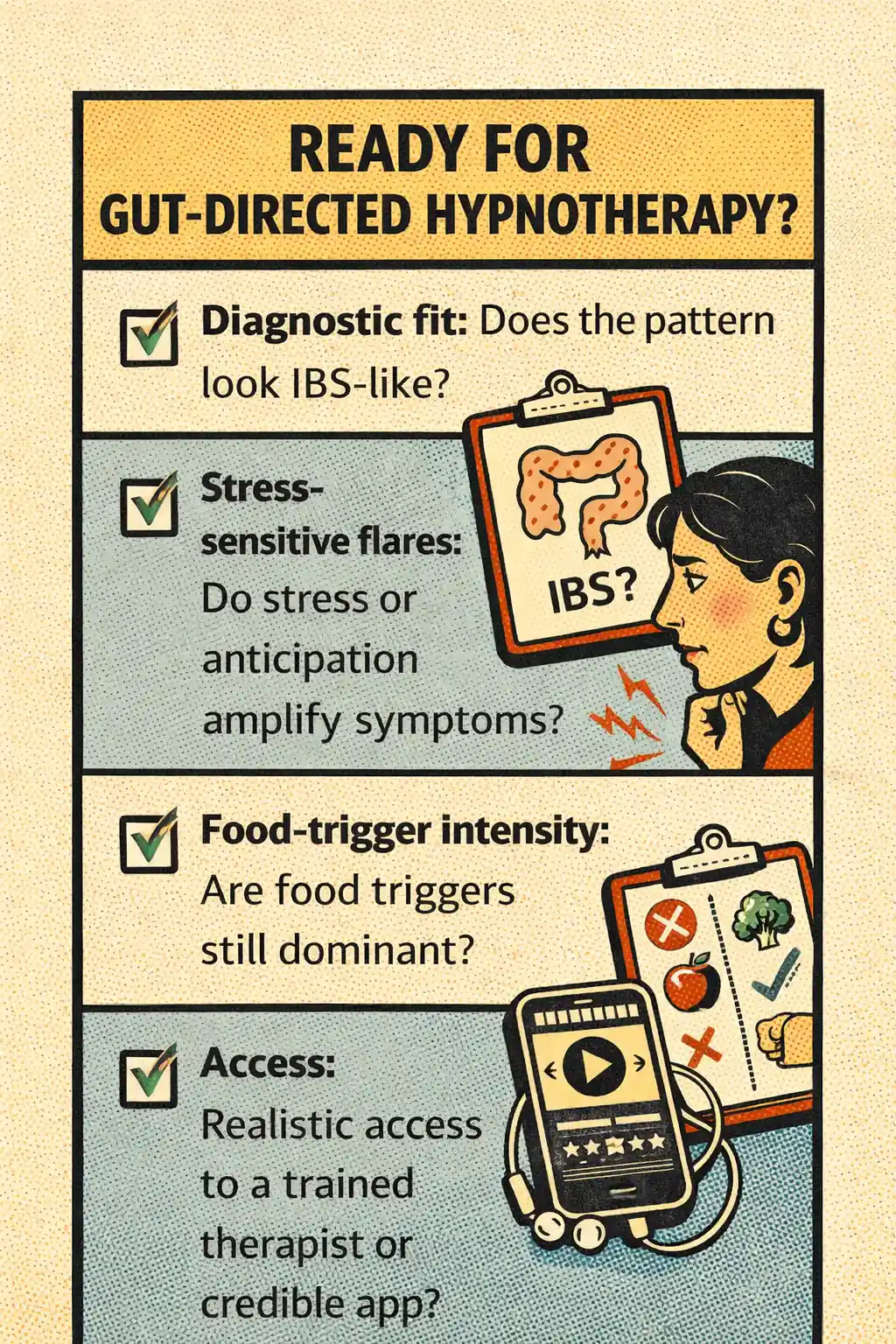
If you want the shortest version, it is this:
So if the pattern clearly looks IBS-like and the gut-brain loop is staying loud, this therapy deserves more respect than many readers initially give it.
If you need the broader symptom map first, go back to the gut-brain axis. If the bigger lever still looks food-related, go back to low-FODMAP strategy. And if symptoms remain more confusing than clarifying, move into next structured option instead of stacking tools without a map.
If you want the more explicit skills-based gut-brain route, CBT for IBS anxiety, urgency, and gut-brain skills compares thought loops, exposure, bathroom planning, and clinician support without dismissing symptoms.
If gut-brain therapy sounds useful but past experiences make therapy or exams feel loaded, IBS and trauma-informed care helps define consent, choice, and safety boundaries first.
Xam Riche is a gut health solopreneur and founder of YourFitNature, dedicated to helping people navigate digestive wellness through evidence-based information and personal experience. After years of struggling with IBS and bloating, Xam discovered the transformative power of the low FODMAP diet and now shares practical, science-backed guidance to help others find relief. While not a medical professional, Xam combines extensive research with lived experience to create accessible, empowering resources for the gut health community. Learn more about our mission
As an affiliate, we may earn from qualifying purchases.