 By • Published on March 24, 2026 • 13 min read • 2,890 views
This article is for informational and educational purposes only and does not constitute medical advice. Always consult with a registered dietitian, gastroenterologist, or other qualified medical professional before making significant dietary changes.
Low FODMAP can absolutely be part of an IBS-D plan. But if urgency is your main issue, the answer is usually not "cut more foods." It is to make the plan cleaner, calmer, and more targeted to the things that still keep your gut on high alert.
Short answer: IBS-D usually needs a cleaner version of low FODMAP, not a smaller one. The plan often works better when you audit caffeine, sorbitol, hidden ingredients, meal rhythm, and symptom-targeted supports instead of just cutting more foods.
This page is for you if you already know low FODMAP can help, but your main question is how to adapt it when urgency or loose stools still dominate the picture.
Use a different page first if you still need the basic setup in Low FODMAP Diet for Beginners: How to Start, or if the overall plan never gave you a readable signal in When Low FODMAP Does Not Work: Next Steps.
If you started IBS-D low FODMAP hoping it would finally let you leave the house without scanning for the nearest bathroom, you are not alone if urgency still feels like the symptom making most of your decisions.
Maybe the bloating eased a little. Maybe some meals feel safer. But your gut still feels reactive, your stools are still too loose too often, and now the diet is starting to look smaller, blander, and more stressful than you wanted.
That is a real problem. And it does not mean you failed.
Here is the truth: low FODMAP can help IBS-D, but urgency often needs more than food restriction alone. It often needs a cleaner trigger audit, better meal rhythm, less caffeine or sorbitol exposure, and sometimes symptom-targeted support or broader evaluation 1 2.
Start here if you need the big-picture version first: this builds on starting low FODMAP, but with the IBS-D-specific adjustments many readers never get told about.
Yes, but the expectation needs to be realistic.
The American College of Gastroenterology notes that low FODMAP can improve pain, bloating, and flatulence, and to a lesser degree diarrhea 3. Monash also says the diet can improve bowel habit, including diarrhea, with benefits often showing up within 2 to 6 weeks 4.
That matters because many people hear "try low FODMAP" and assume the diet should shut down every loose stool, every post-meal rush, and every bad day. For IBS-D, that expectation often sets people up for confusion. If pain, bloating, or gas improve but urgency still runs the day, the diet may still be doing something useful. It just may not be the whole answer.
This is also why the diet should stay inside the full 3-step process, not become a forever list of "safe" foods. Monash frames low FODMAP as a short restriction phase followed by reintroduction and personalization, not lifelong elimination 5.
Bottom line: low FODMAP can reduce symptom noise in IBS-D, but urgency often needs a more targeted version of the plan.
This is where many IBS-D readers get stuck.
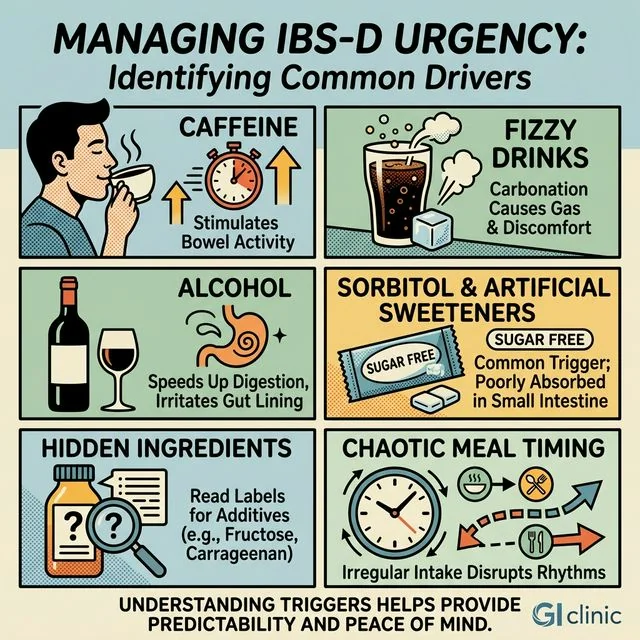
They remove the obvious food triggers, but the pattern is still noisy. Coffee is still carrying the morning. Sugar-free gum, mints, or drinks still sneak in. Fizzy drinks or alcohol are still in the week. Meals are still chaotic, with long gaps followed by oversized plates. Or the problem is not just food at all.
NICE specifically advises regular meals, avoiding long gaps between eating, restricting tea and coffee to 3 cups a day, reducing alcohol and fizzy drinks, limiting resistant starch, and avoiding sorbitol in people with diarrhea 6. That is a strong reminder that "low FODMAP" and "low urgency" are not automatically the same thing.
This is also where hidden ingredients and noisy meal timing can keep the whole pattern hard to interpret. If packaged foods, supplements, restaurant meals, or gum still show up often, review hidden ingredients. If reactions seem to follow mixed meals, frequent snacking, or a messy eating rhythm, use stacking as a troubleshooting lens before you blame every single ingredient.
Use this reset lens:
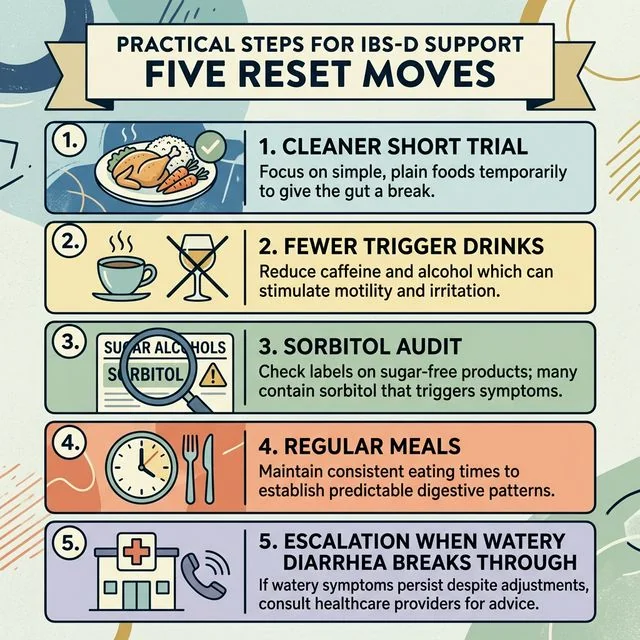
| If This Is Happening | Change This First | Why |
|---|---|---|
| Coffee, energy drinks, or fizzy drinks show up most days | Cut back trigger drinks first | They can keep bowel speed and urgency high even when food looks compliant |
| Sugar-free products are common | Audit sorbitol and other polyols | IBS-D often reacts badly to these |
| You graze all day or eat huge late meals | Move to calmer regular meals | Meal rhythm makes urgency easier to read |
| The diet is getting smaller every week | Rebuild enough variety and stop fear-based cutting | Over-restriction is not the same as control |
| Watery diarrhea is still breaking through | Widen the lens and discuss next-step support | Food is not the only tool in IBS-D |
[!TIP] Download: Urgency-Friendly Low-FODMAP Reset Checklist Use it before you tighten the diet any further.
Start with the highest-yield levers, not the harshest diet.
For many IBS-D readers, the first win is not another elimination. It is a cleaner day. Less caffeine. Less sorbitol. Fewer fizzy drinks. Fewer long gaps. Less all-day grazing followed by a large late meal. More clearly readable meals.
That is why NICE's advice matters so much here. It is not glamorous, but it is useful: regular meals, fewer long gaps, less caffeine, less alcohol, fewer fizzy drinks, and less sorbitol exposure can all reduce the background noise that keeps urgency active 7.
If coffee still starts the day, or fizzy drinks and alcohol are still common, you may be keeping urgency switched on even while following low FODMAP reasonably well. That does not mean you need a perfect life or zero pleasure. It means these are high-yield places to look first.
Sorbitol is one of the clearest examples because NICE specifically flags it for people with diarrhea-predominant IBS 8. If urgency still feels strangely unpredictable, review gum, mints, sugar-free products, supplements, and medications before assuming another whole food group needs to go.
If urgency clusters after rich meals, sugar-free products, protein bars, or app-approved meals that still feel noisy, use fat, sugar alcohols, and post-meal symptoms before cutting more staples. If the urgent bathroom run after eating is the main question, use urgency after meals for a narrower sorter.
If your pattern is "under-eat, push through, then eat a large meal when you get home," the food list is not the only problem. A calmer meal rhythm can make the whole system easier to read.
If you need a calmer food base after the audit, rebuild from the low-FODMAP foods guide. If your anxiety spikes most when you eat away from home, use the eating out guide to lower the social friction around IBS-D.
If you want a printable version of the audit, use the IBS-D Urgency Trigger Audit as a quick weekly check.
This is the trap worth avoiding.
When urgency stays active, many readers respond by shrinking the diet more and more. Meals become plain chicken and rice. Social eating gets cut. Variety starts to feel dangerous. The plan may look "cleaner," but life gets smaller and food fear gets bigger.
That is not the goal.
Low FODMAP works best as a short, structured tool, not an identity. Monash is clear that the diet is meant to move from short restriction into reintroduction and personalization 9. The goal is not to prove you can tolerate the smallest diet. The goal is to build the calmest one you can actually live with.
That means:
In practice, "safe enough" usually beats "perfect." A small set of familiar meals, clear drinks, and fewer confounders gives you a better signal than constantly changing foods out of fear.
This is where many IBS-D readers need permission.
If urgency is still running the day, symptom-targeted support is not cheating. It is part of IBS care.
NICE states that loperamide should be the first-choice antimotility agent for diarrhea in people with IBS 10. That does not mean everyone should self-medicate blindly. It means you are allowed to stop treating diet as the only respectable answer.
Peppermint oil is another useful example when urgency comes with cramping or belly pain. ACG suggests peppermint oil for overall symptom improvement in IBS 11.
And if bowel speed and pain remain major problems, ACG also notes that tricyclic antidepressants can slow gut transit and improve diarrhea symptoms in IBS 12.
Use that information the right way: not as a shopping list, but as proof that food is not the only legitimate lever.
| Situation | Best Next Move |
|---|---|
| Low FODMAP helped somewhat, but urgency still spikes | tighten the trigger audit and calm the meal pattern |
| Urgency comes with cramping and daily disruption | discuss symptom-targeted tools such as loperamide or peppermint |
| Watery diarrhea keeps pushing through a clean trial | widen the evaluation rather than cutting more foods |
If you are also exploring supplements, use the IBS-D probiotic strains guide as a separate adjunctive layer, not as a replacement for a cleaner food pattern. If the question is whether plant-derived probiotic products or IBS-D probiotic evidence actually match your situation, use probiotics and plant-derived products for IBS-D before buying another product.
Sometimes IBS-D is not just "more sensitive to FODMAPs." Sometimes the pattern is telling you to widen the lens.
If watery diarrhea keeps happening despite a clean short trial, if urgency is especially bad after fatty meals, or if low FODMAP never helped enough in the first place, it is worth looking beyond more food restriction.
A systematic review found moderate bile acid malabsorption in about 32% of patients with IBS-D-type symptoms and severe bile acid malabsorption in 10% 13. ACG also notes that bile acid binders can be helpful in treating diarrhea, even though they are not framed as overall IBS-D treatment 14.
That does not mean every IBS-D reader should jump straight to a bile acid diagnosis. It means persistent watery diarrhea deserves respect. You do not need to stay in stricter and stricter elimination just because the symptom is still loud. If that is the narrower question now, use bile-acid diarrhea vs IBS-D.
This is the right point to use the broader low FODMAP not working guide or the side-by-side SIBO vs IBS vs food intolerance comparison if the picture still feels unclear.
If you want the short version, start here:
The good news is that you do not need a harsher version of low FODMAP. You need a version that actually matches the symptom you are living with.
If your next best move is practical, keep the foods guide close, use reintroduction to stop the plan from staying too small, and go straight to troubleshooting if urgency still dominates the whole picture.
Less urgency. Less guesswork. Less life organized around the nearest bathroom.
Xam Riche is a gut health solopreneur and founder of YourFitNature, dedicated to helping people navigate digestive wellness through evidence-based information and personal experience. After years of struggling with IBS and bloating, Xam discovered the transformative power of the low FODMAP diet and now shares practical, science-backed guidance to help others find relief. While not a medical professional, Xam combines extensive research with lived experience to create accessible, empowering resources for the gut health community. Learn more about our mission
As an affiliate, we may earn from qualifying purchases.
Choose a focused guide for what you are noticing or deciding next.