 By • Published on March 20, 2026 • 15 min read • 3,367 views
This article is for informational and educational purposes only and does not constitute medical advice. Always consult with a registered dietitian, gastroenterologist, or other qualified medical professional before making significant dietary changes.
A commerce-safe path for deciding when enzymes, peppermint oil, fiber, supplement audits, hidden-product checks, or symptom trackers fit.
You're reading: Hidden FODMAPs in Sauces, Supplements, and Medications
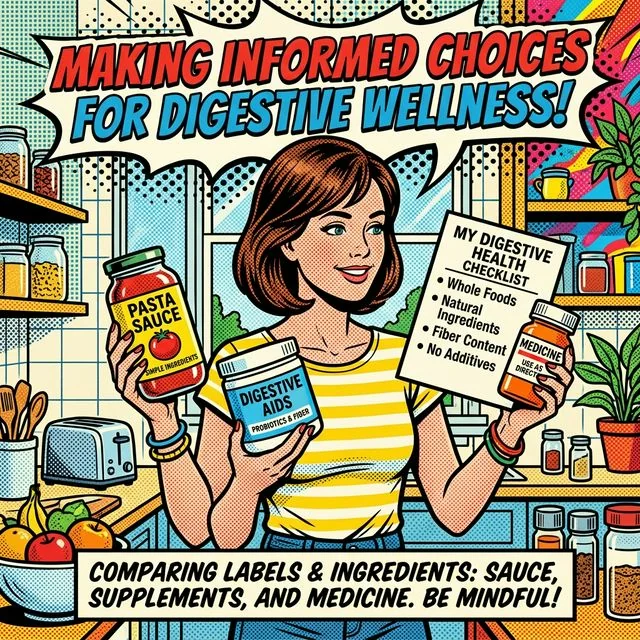
You can do low FODMAP carefully and still flare if the problem is not the meal you noticed, but the sauce, supplement, or medication attached to it. This guide helps you check the highest-yield hidden ingredients first without turning every label into a stress project.
Short answer: hidden FODMAPs are usually not mysterious. They are product ingredients like onion, garlic, inulin, honey, or sugar alcohols hiding in sauces, supplements, powders, gummies, and some medicines.
This page is for you if a flare keeps tracing back to packaged foods, condiments, supplements, or medications rather than simple home meals.
Use a different page first if the bigger clue is meal combinations, stacking, or a whole low-FODMAP trial that never settled down. Those patterns fit FODMAP stacking or Low FODMAP Not Working? better.
If you are frustrated, that makes sense.
This is one of the easiest places to lose confidence in the whole low-FODMAP process. You remove onions. You skip garlic. You do the obvious work. Then symptoms still show up after the pasta sauce, the "gut health" powder, or the chewable medicine you barely registered as food-related at all.
That does not automatically mean low FODMAP is failing. It also does not mean you need to panic about every packaged product or every prescribed medication.
It usually means you need a better filter.
This article is that filter. We will cover what hidden FODMAPs actually are, where they most often hide, which supplement and medication ingredients deserve the closest look, and how to troubleshoot one product at a time. If your main pattern feels more like meal combinations than product labels, start with FODMAP stacking. If the whole diet still feels confusing, use the bigger Low FODMAP not working ladder too.
This page is explaining a product-label problem:
This page is not mainly explaining:
If those patterns are closer, route to FODMAP stacking, When Reintroduction Fails, or Low FODMAP Not Working?.
A hidden FODMAP is not some mysterious toxin. It is simply a high-FODMAP ingredient inside a product that does not look obviously risky at first glance.
That might be:
Monash says label reading can help identify suitable foods, but ingredients alone still do not fully determine FODMAP content because processing and serving size matter too 1 2. That is why the goal is not to become perfect at decoding every label. The goal is to check the most likely product categories first and make faster decisions.
It also helps to separate ingredient stealth from stacking.
If you reacted after a whole-food meal made from simple ingredients, stacking or meal timing may be the better lens. If the reaction followed a jarred sauce, gummy, powdered supplement, restaurant glaze, or liquid medicine, hidden ingredients move higher on the list.
For most readers, sauces and seasonings are the biggest food-side trap.
Monash repeatedly flags pasta sauces, tomato pastes, stocks, dips, wraps, health-food products, and similar processed foods as places where garlic, onion, inulin, fructooligosaccharides, galactooligosaccharides, and polyols can hide 3 4.
The highest-yield sauce ingredients to scan first are:
That is why trouble often shows up in:
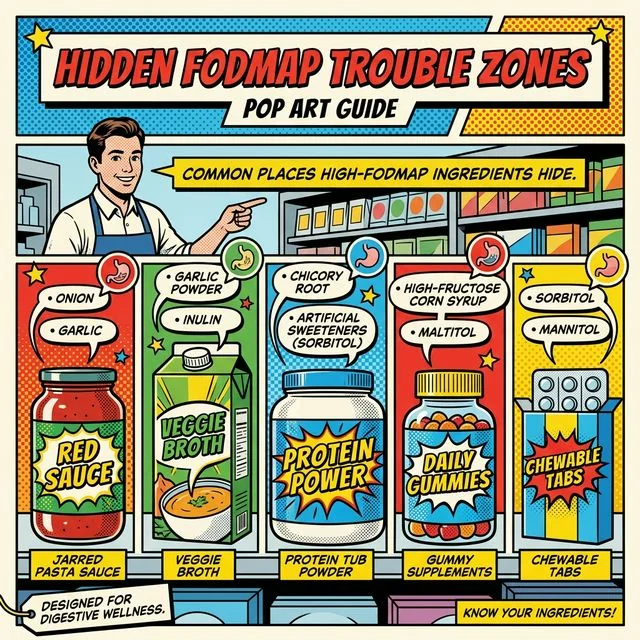
There is one useful U.S. label nuance here. Under 21 CFR 101.22, onion and garlic are not treated as generic "spices" on conventional food labels 5. That is helpful, but it does not make every label easy. The practical move is still to focus on explicit ingredients first and choose simpler products when the rest of the panel still feels noisy.
If grocery labels keep tripping you up, use the label-reading checklist. If the same problem shows up when someone else cooks for you, this overlaps heavily with restaurant sauces.
Supplements are extra confusing because they are marketed as helpful.
"Gut health," "prebiotic," "fiber blend," and "protein support" all sound like signs of a good choice. For an IBS reader doing low FODMAP, they can also be signs that the label deserves a closer look.
Monash says many protein powders are difficult to judge from the label alone and that it is extremely challenging to predict FODMAP content without lab testing 6. In that same guidance, Monash specifically tells readers to watch for polyols, lactose in whey concentrate products, and prebiotic ingredients such as inulin, chicory root, and Jerusalem artichoke 7.
If you want the broader meal-planning version of this problem, use the low-FODMAP vegetarian protein guide for the food-first shortlist of easier protein anchors and the situations where powders are better treated as backups. If protein powder itself is the recurring question, use protein powder and IBS for the dedicated label and food-first troubleshooting path.
So when you are scanning a supplement, pay closest attention to:
This does not mean every supplement is automatically a problem. Monash also notes that some digestive enzyme supplements have been certified under its low-FODMAP program, and certified products are listed in the app 8. So the right lesson is not "avoid everything." The right lesson is "check the filler ingredients instead of trusting the front label."
A 2019 meta-analysis also did not find a significant bloating benefit from prebiotics in IBS 9. That is one reason to be skeptical of the assumption that every prebiotic add-on is automatically helping your symptoms.
If probiotics are part of the picture, the best companion guide here is our article on added prebiotics in probiotic labels. If you are using enzymes, the relevant companion is digestive enzymes.
This is the section where nuance matters most.
First, do not stop a prescribed medication on your own because you suspect a filler ingredient. The point here is safer troubleshooting, not self-discontinuation.
The medication forms most worth checking are:
Why those first? Because some of them do contain polyols or sweeteners that are more obviously relevant to IBS symptoms. DailyMed consumer labels show sorbitol in representative products such as Donnatal elixir and Gas Relief chewable tablets, while a DailyMed PDF for Children's Ibuprofen oral suspension lists high-fructose corn syrup and sorbitol solution among inactive ingredients 10 11 12.
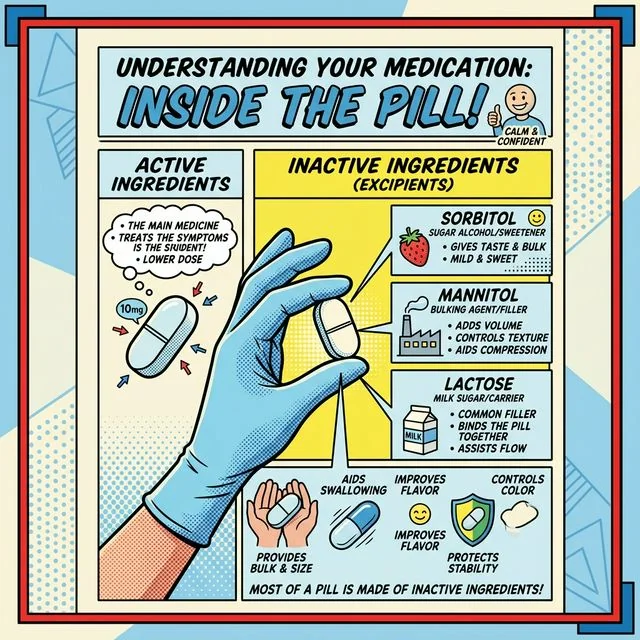
There is also a good reason to take sorbitol-containing liquids seriously. A pharmacy review found sorbitol in 54 of 129 oral liquid products examined and noted that sorbitol-containing medicinal liquids are capable of inducing osmotic diarrhea 13. Separate IBS research also found that sorbitol and mannitol increased overall GI symptoms in people with IBS 14.
What usually matters less than people fear? Trace lactose in tablets.
NHS medicines guidance says lactose used as an excipient in most medicines is usually present in amounts too small to cause problems for most adults 15. So if you are reacting to a standard tablet, lactose is usually not the first thing to blame unless severe intolerance is already clearly part of your pattern.
Use this table as a calmer decision rule:
| Situation | Better Next Step |
|---|---|
| New liquid or chewable medicine around the time symptoms worsened | Check inactive ingredients and ask a pharmacist |
| Essential tablet with tiny lactose excipient | Do not panic; review severity and context first |
| Multiple new supplements and medicines started together | Simplify one variable at a time with clinician input |
The right tools here are DailyMed, your pharmacist, and common sense. If a medicine matters, preserve the treatment relationship first and troubleshoot the formulation safely second.
This is the workflow to use when you want clarity fast:
The first-pass scan looks like this:
| Product Type | Scan These First | Best Backup Check |
|---|---|---|
| Sauces / condiments | onion, garlic, wheat, honey, HFCS, inulin, chicory | Monash app or certified product |
| Supplements / powders | inulin, chicory, FOS, GOS, polyols, whey concentrate, lactose | Monash guidance, certified products, symptom trial |
| Medications | sorbitol, mannitol, xylitol, HFCS, lactose if severe intolerance is relevant | DailyMed, pharmacist, manufacturer info |
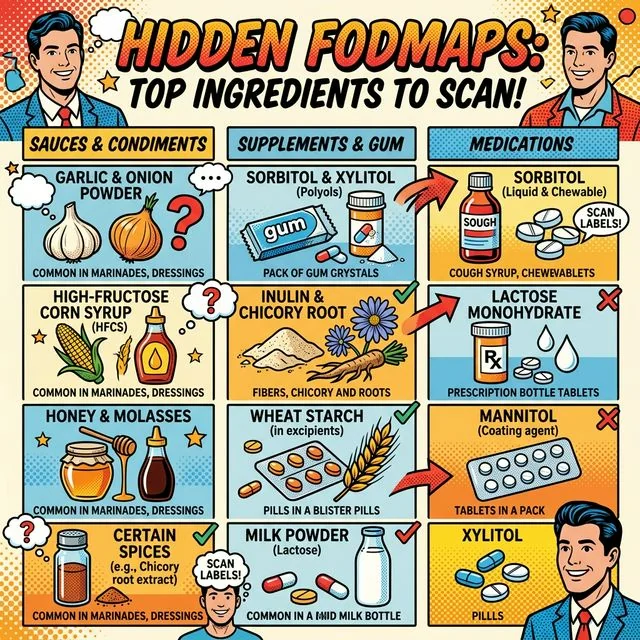
Monash is useful here because it gives you a better fallback than guesswork. Monash-certified products and the app are the cleanest low-guesswork options when a packaged food still feels unclear after label reading 16 17.
[!TIP] Download: Hidden FODMAP Label Scan Checklist Use it when you want to audit one sauce, supplement, or medication without changing everything else on the same day.
If packaged foods are a repeat problem, this also pairs well with our packaged snack guide.
Hidden ingredients are more likely when the pattern keeps pointing back to a product, not when symptoms happen after every kind of meal.
They are more suggestive when:
They are less suggestive when:
| Pattern | More Suggestive of Hidden Ingredients | More Suggestive of Another Issue |
|---|---|---|
| Trigger context | Packaged sauces, supplements, gummies, syrups, restaurant meals | Simple home meals and plain foods |
| Timing | Symptoms started after a new product or flavoring source | Symptoms happen regardless of product changes |
| Better next step | Product swap and ingredient review | Stacking, stress, constipation, or broader troubleshooting |
Use the decision tree below when the line between "bad meal" and "bad product" feels blurry:
If the answer keeps looking more like meal combinations, use meal combinations and stacking. If the answer keeps looking more like stress, routine disruption, or symptom amplification, review stress and gut-brain triggers.
The point of this article is not to make you suspicious of every label forever.
It is to help you spend less time guessing and more time testing the most likely causes first.
If you want the short version, start here:
If urgency is the real problem, this guide on how to reduce urgency without over-restricting can help you decide what to change next.
That final point matters most.
Sometimes the right answer is a cleaner sauce. Sometimes it is dropping the prebiotic powder. Sometimes it is asking a pharmacist about inactive ingredients. And sometimes it is realizing the real issue is not a hidden ingredient at all, but the bigger low-FODMAP picture.
If symptoms are still confusing after the obvious product audit, move to reintroduction and personalization or the broader low FODMAP troubleshooting guide.
If the label looks clean but symptoms track to rich meals, sugar-free products, caffeine, or timing, use fat, sugar alcohols, and post-meal symptoms to sort the meal-format problem.
If the confusing product is a semi-prepared meal, meal kit, delivery bowl, or sauce packet, use meal delivery kits and low-FODMAP labels to decide whether to choose, modify, save for later, or skip it.
If the confusing product is a dairy-free or lactose-free swap, use dairy, lactose, and plant milks to separate lactose, fortification, protein, added fibers, and serving size.
Fewer mystery flares. Less label fatigue. Better decisions.
This page can help you decide whether one sauce, supplement, packaged product, or medicine form deserves a focused ingredient check before you blame a whole meal or the whole low-FODMAP diet.
It cannot tell you to stop a prescribed medicine, diagnose an intolerance, or prove that a clean-looking label is safe for your body. If a medication, ongoing diarrhea, severe pain, bleeding, dehydration, or unexplained weight loss is part of the picture, use a pharmacist or clinician instead of another solo product test.
Product-category route Use the gut health product decision guide if the bigger question is whether you need a book, tracker, comfort tool, OTC medicine, targeted enzyme, supplement, or no new product at all.
Current packaged-sauce example Inspect the current Fody pasta-sauce details only after the label scan, keeping your own tolerance and reintroduction data in charge.
Up: broader troubleshooting Return to Low FODMAP Not Working? Next Steps & Alternative Diagnoses if hidden ingredients are only one item on a longer troubleshooting list.
Across: meal-combination pattern Use FODMAP Stacking Explained if the symptoms follow mixed meals or close snacking more than products and labels.
Across: cultural food fit Use Cultural Foods on Low FODMAP Without Losing Tradition if the hidden-ingredient problem is happening inside sauces, spice blends, staples, or family meals you do not want to replace wholesale.
Constraint route: budget Use Low FODMAP on a Budget if expensive packaged substitutes are creating as much stress as the hidden-ingredient labels.
Xam Riche is a gut health solopreneur and founder of YourFitNature, dedicated to helping people navigate digestive wellness through evidence-based information and personal experience. After years of struggling with IBS and bloating, Xam discovered the transformative power of the low FODMAP diet and now shares practical, science-backed guidance to help others find relief. While not a medical professional, Xam combines extensive research with lived experience to create accessible, empowering resources for the gut health community. Learn more about our mission
As an affiliate, we may earn from qualifying purchases.