 By • Published on April 7, 2026 • 13 min read • 3,602 views
This article is for informational and educational purposes only and does not constitute medical advice. Always consult with a registered dietitian, gastroenterologist, or other qualified medical professional before making significant dietary changes.
A guided path from low-FODMAP basics through elimination, reintroduction, failed challenges, and symptom return.
You're reading: When Reintroduction Fails: What to Do Next
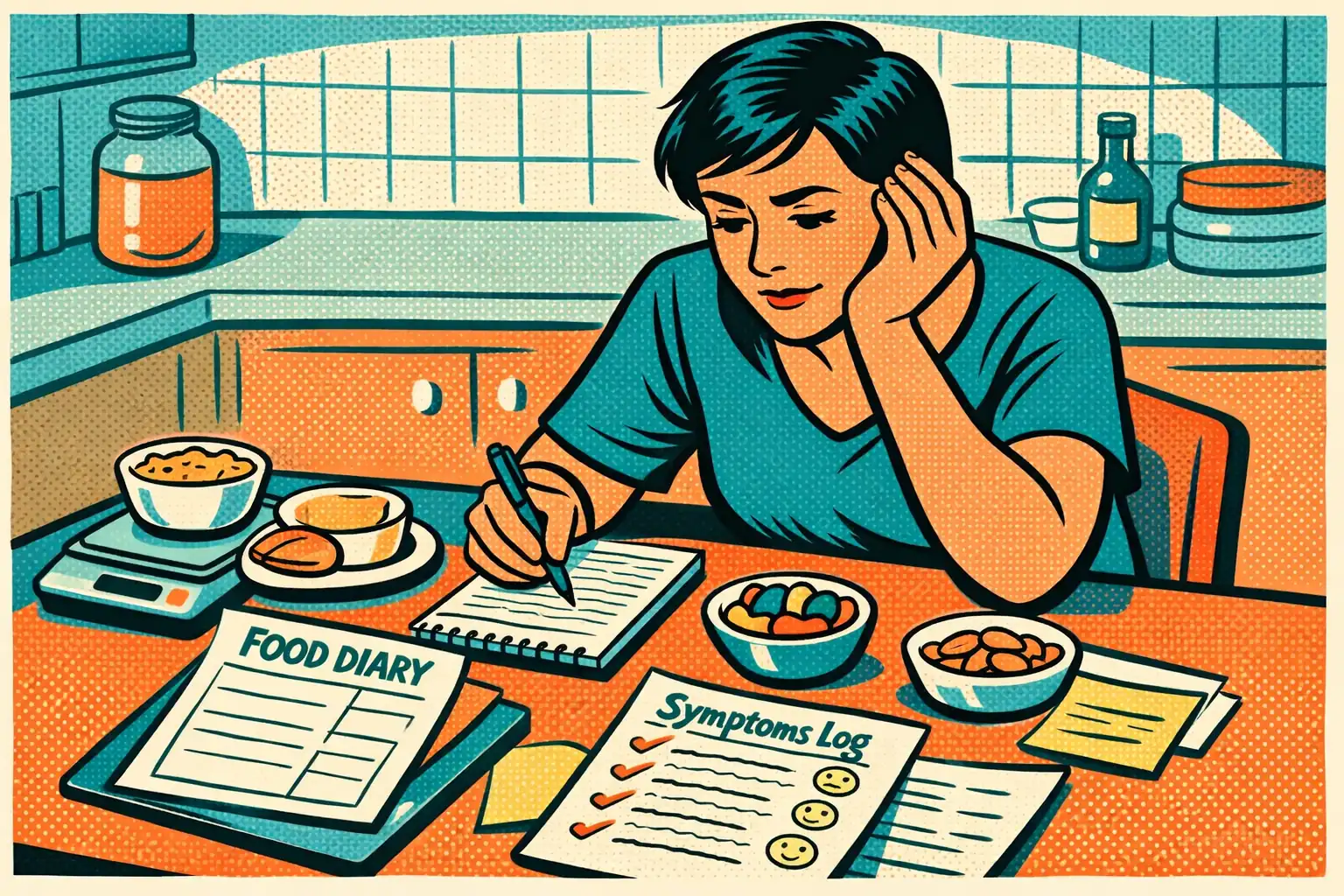
You got through elimination, tested a food, and symptoms came back. That feels like failure in the moment. Usually it is not failure. It is a signal that needs a cleaner read.
Short answer: a bad reintroduction challenge does not automatically mean the whole FODMAP group is out forever. It usually means you need to reset the baseline, review the challenge setup, and decide whether the result was clear or noisy.
This page is for you if your main question is what to do after a challenge food brought symptoms back during Step 2.
Use a different page first if the problem is that the whole low-FODMAP trial never really worked. That fits Low FODMAP Not Working? better. If the issue looks more like meal combinations than a formal challenge, use FODMAP stacking.
You leave Phase 1 expecting relief to keep building.
Instead, one challenge food brings back the pressure, the noise, or the fear that everything is about to unravel.
That moment is where many people start making expensive mistakes:
Here is the truth: a bad challenge does not automatically mean a failed reintroduction.
Sometimes it means you found a meaningful trigger. Sometimes it means the dose was too aggressive. Sometimes it means the baseline was noisy, the food was a messy test choice, or the week was never stable enough to read in the first place.
If you need the full protocol first, start with the low FODMAP reintroduction guide. This article is the narrower troubleshooting companion for the moment when Step 2 goes badly.
This page is explaining a failed or confusing Step 2 challenge:
This page is not mainly explaining:
If that sounds closer, route to Low FODMAP Not Working?, Hidden FODMAPs, or SIBO vs IBS vs Food Intolerance.
Start here. Step 2 only works when the background conditions are calm enough to read.
Monash says reintroduction should begin after a 2 to 6 week low-FODMAP trial that improved symptoms, and that each challenge should start only when symptoms are well controlled while the rest of the diet stays low FODMAP in the background 1.
That means a “bad result” can come from more than one place.
A usable result usually looks like a fairly clear pattern:
An unclear result usually looks like a noisy week:
A bigger concern starts showing up when:
If you need the full system again, revisit the 3 phases of the low FODMAP diet. If your baseline never improved enough to make Step 2 readable, move to low FODMAP not working rather than forcing more random tests.
Bottom line: do not label the whole process a failure until you have separated real trigger data from week-level noise.
Monash advises waiting until symptoms are well controlled before beginning each challenge 2.
If you started testing while symptoms were still shifting day to day, the gut was already too noisy to give you a clean answer.
Monash recommends challenging each FODMAP separately, one challenge at a time, at roughly the same time each day, and over 3 days 3.
That is why restaurant meals, mixed packaged foods, or vague portion sizes can break the usefulness of the test before you even interpret it.
This gets worse if the rest of the day also contained accidental stacking or hidden FODMAPs.
Monash specifically recommends tracking other IBS-related symptoms, including stress, during reintroduction 4.
That matters because the exact same food can feel different when:
If that feels familiar, read how stress can distort symptoms before you assume the challenge food explained everything.
Monash’s reintroduction update notes that some foods once used in reintroduction are no longer ideal challenge foods based on newer testing, and it also notes that some foods can still provoke GI symptoms for reasons beyond their FODMAP content alone 5.
That is one reason a challenge can feel bad without proving that the whole FODMAP category is permanently off-limits.
Bottom line: a bad challenge is often a setup problem, not just a biology problem.
First, stop. Then simplify.
Monash says that if symptoms become unpleasant after day 1 or day 2, you can stop the challenge and return to the low-FODMAP baseline rather than forcing the rest of the challenge 6.
Use this sequence:
That last step matters more than most people think.
If you forget the context, you lose the interpretation. If you log what changed, even a bad test can still teach you something.
| Situation | What It Usually Means | Next Move |
|---|---|---|
| Symptoms started and felt unpleasant | likely meaningful enough to stop | stop, reset, log details |
| Symptoms were mild and not disruptive | possibly still usable | interpret as partial tolerance or keep the result for later review |
| Too many variables changed | unclear result | rebuild baseline and retry |
Download the printable Reintroduction Reset Worksheet to review what happened before you tighten your diet again.
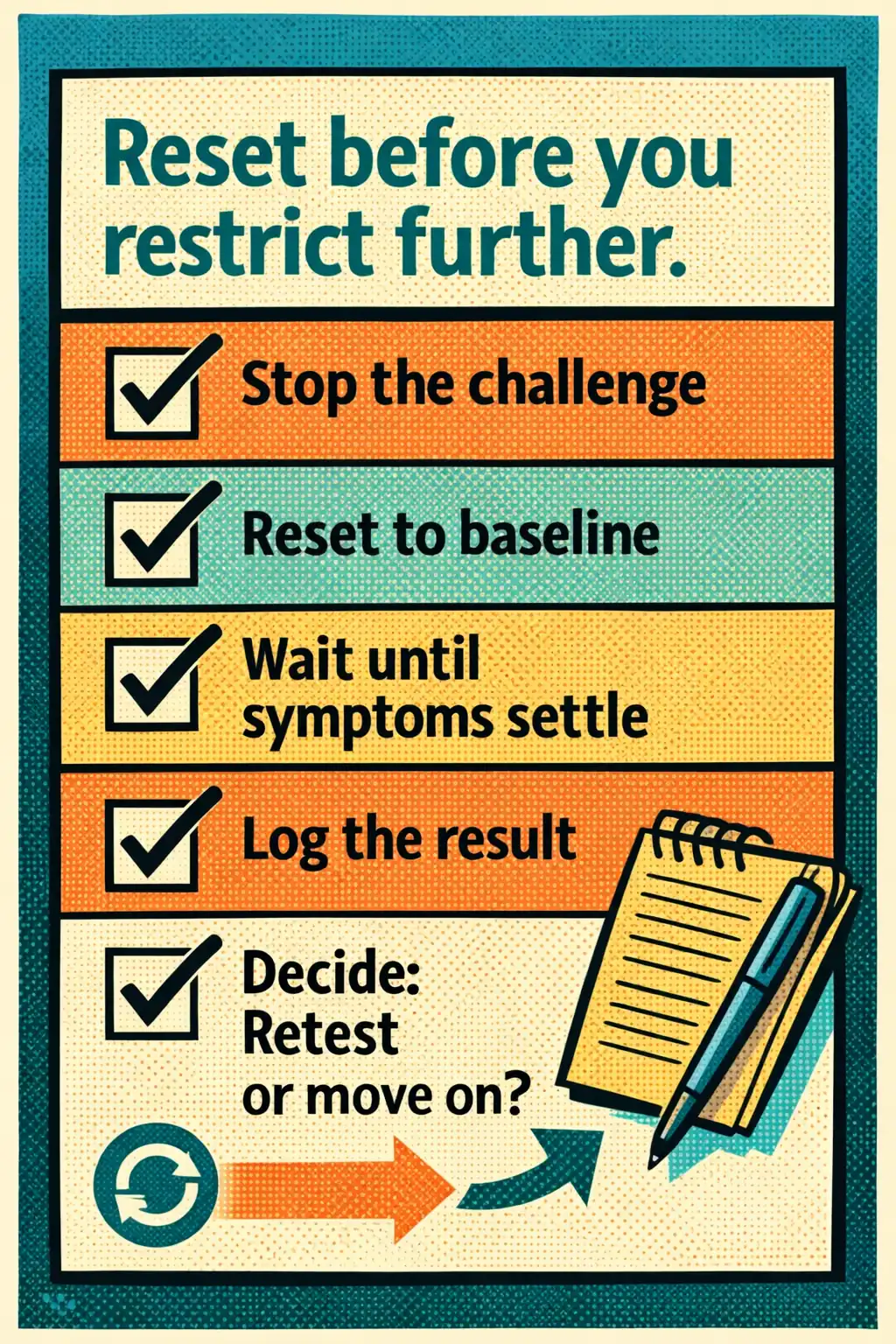
Bottom line: you do not need more willpower here. You need a calmer reset. If you already have some usable challenge data but your real-life Step 3 eating still feels noisy, use low-FODMAP personalization mistakes for the broader execution-error route.
Monash’s 2026 interpretation guide separates no symptoms, mild-to-moderate symptoms, and severe symptoms because those outcomes do not mean the same thing 7.
Use that logic instead of all-or-nothing thinking:
| Result Type | What It Usually Means | Next Move |
|---|---|---|
| No symptoms | likely tolerated | move it into normal rotation |
| Mild to moderate symptoms | threshold issue or manageable sensitivity | keep smaller serves and retest later if useful |
| Severe symptoms | meaningful trigger for now | stop, reset, keep lower serves where appropriate, revisit later only if it matters |
| Unclear result | too many confounders | rebuild baseline and repeat more cleanly |
Monash also notes that a little wind or bloating can still be compatible with a passed challenge if symptoms are minimal and do not disrupt daily life 8.
That matters because many people overcall the result. One uncomfortable moment does not always mean “failed.”
It also does not always define the entire FODMAP category. Monash says some people tolerate fructans in some food types but not others 9.
Bottom line: read the pattern, not just the emotion of the flare.
This is where the next decision matters more than the first bad result.
Retest the same food later if:
Try a different representative food if:
Move on for now if:
| Scenario | Best Next Step |
|---|---|
| Week was noisy | retest the same food later |
| Food itself was messy or mixed | switch to a cleaner representative food |
| Reaction was severe and clear | move on for now and retest only later if useful |
| Everything keeps failing | broader troubleshooting |
Monash’s reintroduction update also reminds readers that older trials were not wasted, but tolerance and food composition can both change over time 10.
That is why “later” should mean strategic retesting, not permanent avoidance.
This is the point where you stop asking only food questions.
If every challenge seems to go badly, the lesson may be that this is no longer just a Step 2 problem.
It can mean:
If the baseline never really improved, go straight to low FODMAP not working.
If the pattern now feels less like one food problem and more like differential confusion, use the side-by-side guide to SIBO vs IBS vs food intolerance.
If the symptom picture is clearly subtype-led, move next to IBS-C and low FODMAP or IBS-D and low FODMAP rather than retrying the same random test structure.
NICE also says that further dietary management, including low-FODMAP-style exclusion diets, should be guided by a healthcare professional with expertise in dietary management when symptoms persist 11.
Bottom line: repeated failure is not proof that you need stricter restriction. Sometimes it is proof that you need a different frame.
If your motivation for restriction has drifted into vague “inflammation” or whole-body fear, reset your hierarchy. Start with symptom fundamentals, then use a systems explainer like the gut-kidney axis when you want a calmer mechanism-to-meaning frame.
If you want the next 7 to 10 days in one sequence, use this:
That is enough to turn a discouraging week into better data.
You do not need to perfect the entire process in one pass. You need to make the next test more readable than the last one.
If symptoms came back during reintroduction, do not rush to the most dramatic conclusion.
Start here instead:
The good news is that a bad challenge can still be useful.
It can tell you that the food matters. It can tell you that the week was noisy. It can tell you that the next move is not another food test but broader troubleshooting.
If the reset gives you a readable pattern again, the next step may be diet diversity after low FODMAP, not another round of shrinking the diet.
If you need the full protocol again, go back to the low FODMAP reintroduction guide. If your pattern now looks bigger than reintroduction alone, move into low FODMAP not working.
And if you want a calmer reset before doing anything else, start with the Reintroduction Reset Worksheet.
Xam Riche is a gut health solopreneur and founder of YourFitNature, dedicated to helping people navigate digestive wellness through evidence-based information and personal experience. After years of struggling with IBS and bloating, Xam discovered the transformative power of the low FODMAP diet and now shares practical, science-backed guidance to help others find relief. While not a medical professional, Xam combines extensive research with lived experience to create accessible, empowering resources for the gut health community. Learn more about our mission
As an affiliate, we may earn from qualifying purchases.
Choose a focused guide for what you are noticing or deciding next.