 By • Published on May 12, 2026 • 9 min read • 4,611 views
This article is for informational and educational purposes only and does not constitute medical advice. Always consult with a qualified healthcare professional before using symptom information to make diagnosis or treatment decisions.
Low-FODMAP personalization can look compliant on paper and still feel chaotic in real life.
That is usually not because the whole process failed. It is because personalization is where structure becomes harder to fake. You are no longer just following a short safe-food list. You are trying to use actual challenge data inside real meals, real workweeks, real stress, changing bowel patterns, and the normal temptation to either liberalize too fast or clamp down again.
This article exists for that stage: when you have moved beyond the first reset, you probably have at least some useful reintroduction data, and yet the plan still feels noisy enough that you cannot tell whether the food, the portion, or the whole week is what went wrong.
If you still need the protocol itself, start with the low-FODMAP reintroduction guide. If one specific challenge week went badly, use when reintroduction fails. If your next goal is variety rebuilding after the signal is calmer, use diet diversity after low FODMAP. This page sits in the middle: the personalization phase is underway, but the execution is still messy.

Personalization is the reason the whole low-FODMAP process exists.
Monash frames the diet as a three-step process: restriction, reintroduction, and personalization 1. The re-challenge review from the Monash group adds an important detail: phase two and the move into personalization are meant to reduce the level of restriction required while improving dietary variety and nutritional adequacy 2.
That means personalization is not:
It is the stage where you ask better questions:
If you improved on low FODMAP and then got lost here, that does not mean you missed the point. It means you are now doing the hardest part of the plan: turning clean challenge logic into real-life eating.
Most messy personalization patterns are not mystery diagnoses. They are signal problems.
Use this table first:
| Mistake | Why it confuses the signal | Better move |
|---|---|---|
| Treating one bad meal as a permanent verdict | One meal can include dose, timing, stress, or stacking confounders | Reset, then look for repetition before making a long-term rule |
| Forgetting stacking and serving-size drift | Several tolerated foods in one sitting can act differently than one tested food alone | Review the whole meal and the rest of the day |
| Changing too many variables at once | Food, dose, schedule, milk base, snacks, and travel can blur the result | Change one thing at a time |
| Ignoring bowel-pattern changes | Constipation, diarrhea, reflux, or fullness can change how the same food feels | Match the reaction to the symptom pattern before blaming the food |
| Testing during stress, travel, or poor sleep | The whole week can get louder than the food signal | Use calmer weeks for interpretation whenever possible |
| Going back to full restriction too fast | Fear replaces usable data and the diet shrinks again | Use a short reset, not indefinite retreat |
Monash's diary-function guidance is useful here because it does not only track the challenge food. It also encourages logging symptoms and stress so you can see whether the week itself was part of the problem 3.
Stacking deserves special mention because many readers accidentally turn a partly successful personalization plan into a noisy one by assuming several tolerated foods will behave the same way in one mixed meal. Monash explains that stacking is mainly a per-sitting issue and that not everyone needs to fear it equally, because the app's cutoffs are conservative for many mixed meals 4. So the lesson is not "micromanage every bite." The lesson is "if a compliant-looking meal still backfires, review the total meal load before banning the food."
Another common mistake is pass-fail thinking. Monash's newer reintroduction interpretation guidance supports graded personalization, where mild-to-moderate symptoms may still leave room for green and amber servings inside the personalized diet 5. That is a big shift. It means a food does not have to be perfect to be usable.
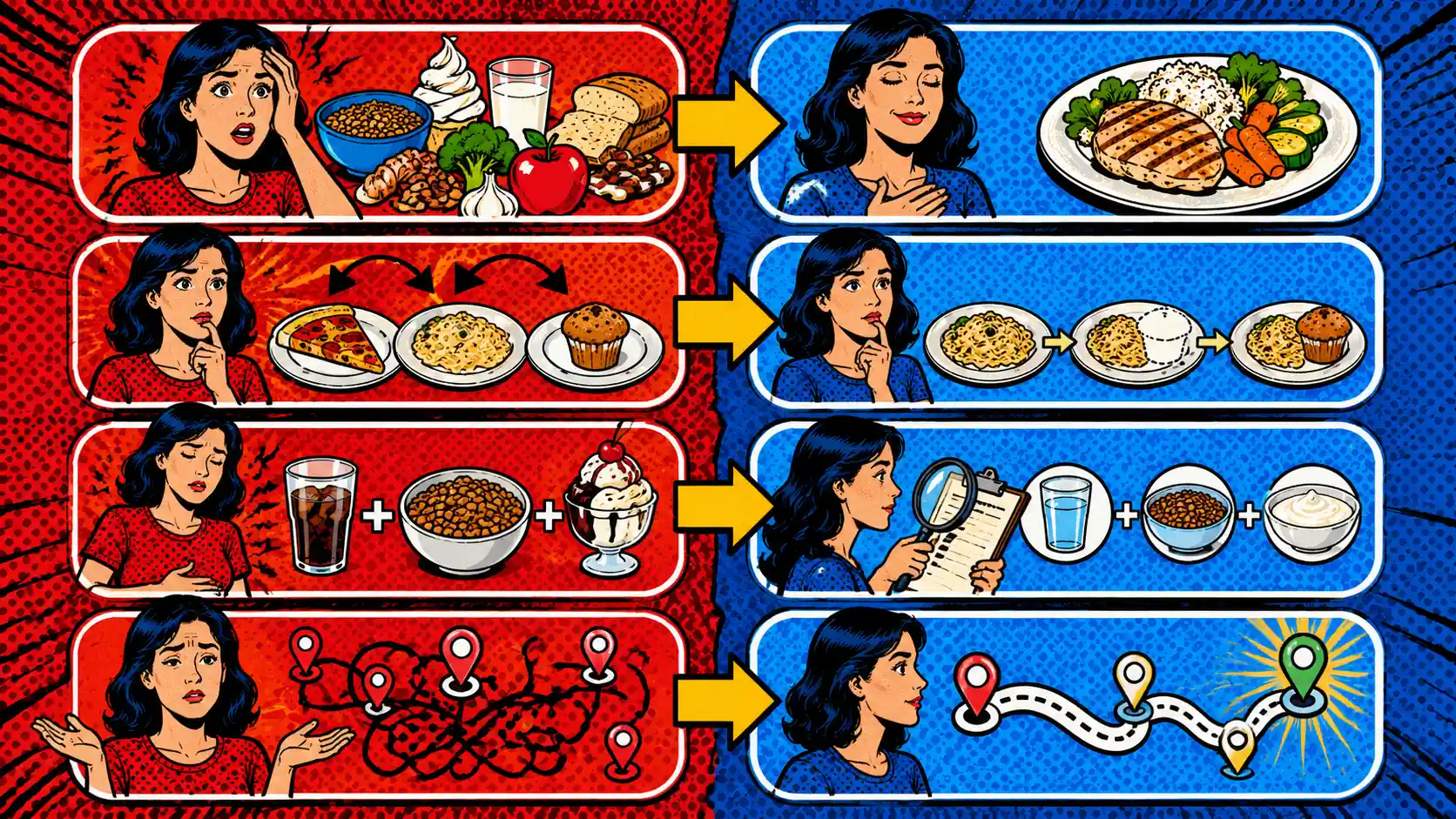
If the plan feels messy, do less on purpose.
That does not mean you failed. It means you are rebuilding a readable background pattern.
Monash says reintroduction works best when symptoms are well controlled, the background diet stays low FODMAP, and one challenge happens at a time over a 3-day period 6. The same logic helps in personalization: a cleaner background pattern creates a better answer.
Use this reset:
This is where bowel pattern matters. A food can feel different when constipation is building pressure, when diarrhea has lowered your confidence in portion size, or when upper-GI symptoms such as fullness or reflux are dominating the day. The point is not to create a giant tracking project. The point is to stop calling every symptom a new permanent trigger.
If the signal mainly gets noisy in restaurants rather than at home, route to low FODMAP eating out before calling the whole personalization phase broken.
If the signal mainly gets noisy at family dinner because onion, garlic, sauces, and household add-ons keep changing at once, use low-FODMAP family meals without separate cooking before turning one messy shared meal into a permanent food rule.
If the signal mainly gets noisy during airports, hotel breakfasts, road trips, or disrupted meal timing, use the low-FODMAP travel guide instead of treating the whole personalized plan as unreliable.
NIDDK's IBS diet guidance also supports this slower interpretation style because diet changes often need individualized adjustment over weeks rather than one dramatic meal experiment 7.
Download: Personalization Mistake Audit and Personalization Reset Week Plan
Sometimes the label on the problem is wrong.
It may not be a personalization mistake if:
Use these route checks:
That route-back logic matters because over-restriction often starts when a reader applies the wrong fix to the wrong problem.
| If this is the main question | Best next read |
|---|---|
| I still need the phase-2 protocol itself | Low-FODMAP reintroduction guide |
| One challenge went badly and I need to interpret it | When reintroduction fails |
| My mixed meals still look compliant but flare anyway | FODMAP stacking explained |
| My baseline never became calm enough to personalize | Low FODMAP not working |
| The plan is readable at home but restaurant meals keep making it noisy | Low FODMAP eating out |
| The plan is readable at home but travel keeps changing meals, timing, or backup food | Low-FODMAP travel guide |
| Symptoms improved for a while and then came back | IBS relapse plan after symptoms return |
| Low-FODMAP Step 3 was working but now feels noisy again | Symptoms return after low FODMAP |
| Access, fatigue, sensory load, caregiver support, or food availability keeps changing the plan | Accessibility, disability, IBS, and low-FODMAP planning |
| Ramadan shifts meal timing, hydration, sleep, caffeine, or medication questions | Ramadan fasting, meal timing, and IBS symptoms |
| Personalization is turning into food fear or a smaller safe-food list | Low FODMAP with an eating disorder history |
| Sensory food limits, transitions, or bathroom access are shaping the plan | Neurodivergent IBS routines |
| Cultural foods or family tradition are being mistaken for the problem | Cultural foods and low FODMAP without losing tradition |
| You need a simple tracker before making another permanent food rule | IBS symptom tracker template |
| The signal is clearer and I want more variety | Diet diversity after low FODMAP |
Personalization is supposed to make the diet more livable, not more chaotic and not more fearful.
If the plan feels messy, the answer is usually not to panic and ban five more foods forever. The better move is to reset the background pattern, test one change at a time, and review the whole week before you turn one reaction into a rule.
Measured freedom is still the goal. You just get there faster when the signal is clean enough to trust.
Xam Riche is a gut health solopreneur and founder of YourFitNature, dedicated to helping people navigate digestive wellness through evidence-based information and personal experience. After years of struggling with IBS and bloating, Xam discovered the transformative power of the low FODMAP diet and now shares practical, science-backed guidance to help others find relief. While not a medical professional, Xam combines extensive research with lived experience to create accessible, empowering resources for the gut health community. Learn more about our mission
As an affiliate, we may earn from qualifying purchases.