 By • Published on April 16, 2026 • 9 min read • 2,526 views
This article is for informational and educational purposes only and does not constitute medical advice. Always consult with a qualified healthcare professional for diagnosis, treatment, medication decisions, and lab interpretation.
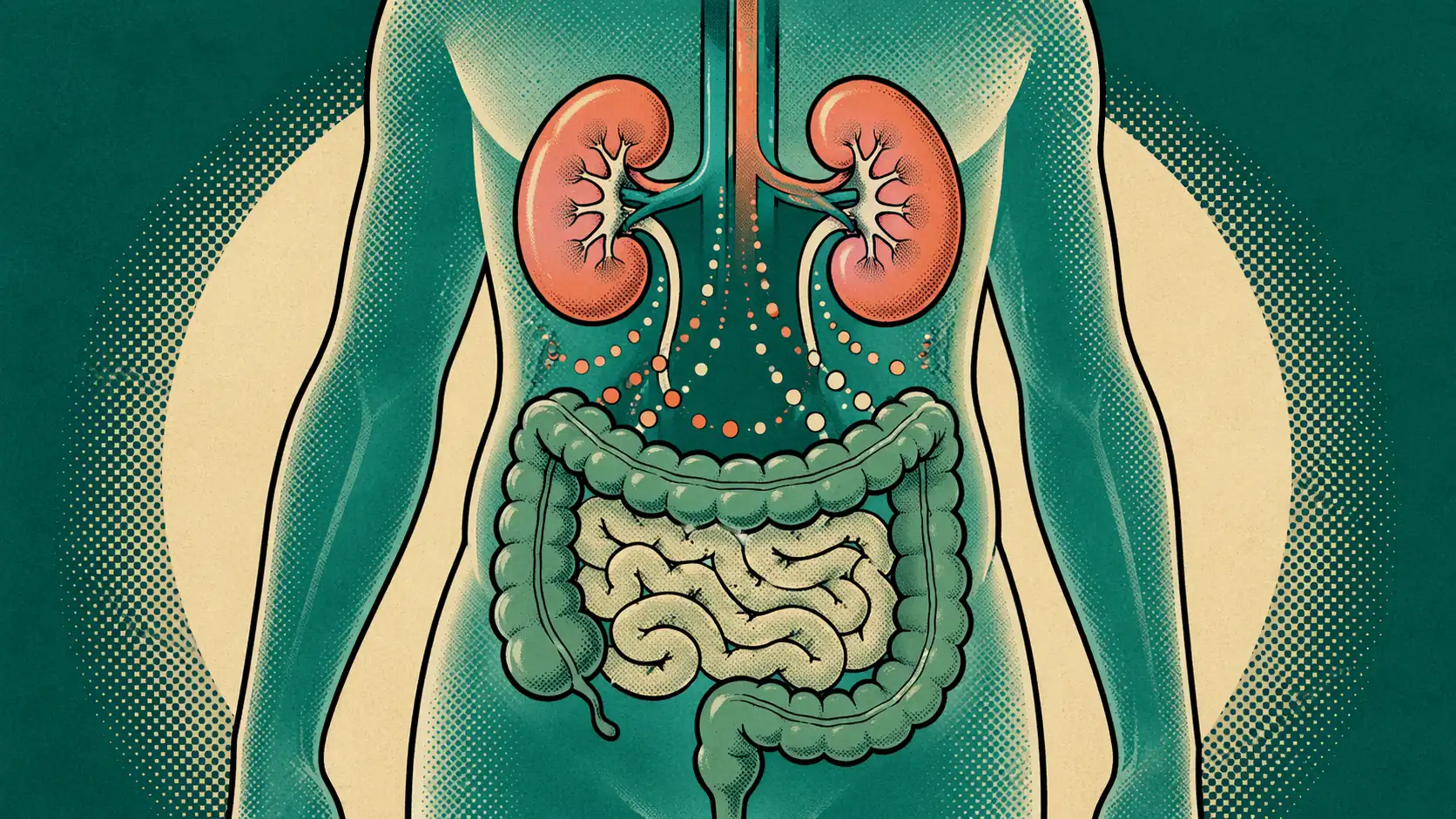
The gut-kidney axis is not a trendy “gut health” buzzword. It is a real research framework describing how diet and gut microbes can shape circulating metabolites and immune signals, and how reduced kidney clearance can also reshape the gut environment. The useful takeaway is not a miracle supplement. It is a clearer hierarchy: better fundamentals first, clinician partnership when needed, and cautious optimism about emerging microbiome research.
Short answer: the gut-kidney axis describes how gut microbes, gut barrier changes, and metabolites such as uremic toxins may affect kidney-related outcomes, but it is still a framework for reading evidence, not a shortcut to therapy.
This page is for you if you keep seeing kidney-health claims tied to the microbiome and want a cleaner explanation of what the research is actually saying.
Use a different page first if you want the shelf opener or practical symptom guidance first. Start with gut-heart-axis or how to reduce bloating.
This page explains a gut-to-kidney mechanism shelf:
This page is not mainly explaining:
If you’ve mostly heard “gut health” discussed in the context of bloating or IBS, the gut-kidney axis can feel surprising.
Here’s the truth: your gut does not replace nephrology. But gut microbes do help process food into metabolites, and some of those signals may matter more when kidney clearance is reduced 1.
If you want the broader organ-axis context, start with the gut-heart axis. This article is the kidney-focused spoke.
In plain English, the gut-kidney axis is the loop between:
It’s also bidirectional. In chronic kidney disease (CKD), higher urea and metabolic changes can shift the gut environment and microbiome behavior, which can then feed back into metabolite and inflammation patterns 2 3.
“Uremic toxins” can sound scary. In practice, it usually refers to compounds that can build up when kidney clearance is reduced.
Two that come up often in CKD research are indoxyl sulfate and p-cresyl sulfate, which are linked to gut microbial metabolism and are frequently discussed as kidney-relevant metabolites 4 5.
Bottom line: these signals help explain why the gut is discussed in kidney research. They do not mean everyone has the same “toxin problem,” or that one intervention will fix CKD.
The gut barrier is part of your immune interface.
When it’s more disrupted, more microbial products can leak through and stimulate inflammatory signaling. In CKD, this topic comes up as one plausible pathway connecting gut changes to systemic effects 6.
If “leaky gut” content has made you anxious, keep the hierarchy simple: barrier research is a reason to prioritize fundamentals (food quality, sleep, constipation management), not a self-diagnosis label.
Gut microbes don’t just “live in you.” They help turn food into compounds that circulate through your body.
Two commonly discussed examples:
Across many studies, CKD cohorts tend to show gut microbiome shifts (often reduced diversity), plus altered relative-abundance patterns that vary by diet, medications, stage of CKD, and study methods 9 10.
This is one reason the gut-kidney axis is treated as a legitimate framework.
It’s also why many claims online go too far: cohort patterns are not the same as proven causality in every person.
The safest reading of gut-kidney research is not "try every microbiome product." It is "use the mechanism to ask better questions."
Gut-kidney claims should not make you:
That last point matters. CKD nutrition is not a single diet template. NIDDK notes that people with CKD may need individualized guidance around sodium, potassium, phosphorus, protein, and fluids depending on kidney function and treatment stage 11. So even when a food looks microbiome-friendly, the better question is whether it fits your current kidney plan.
If you do not have CKD, this section is not meant to make normal foods feel dangerous. It is meant to keep the hierarchy clean: kidney red flags and lab changes come before food experiments; microbiome curiosity comes after safety is covered.
"Eat more plant foods" can be reasonable gut advice and still be too vague for someone with kidney restrictions. Beans, lentils, bran, nuts, seeds, dried fruit, certain whole grains, salt substitutes, and some packaged "gut health" products can raise practical questions about potassium, phosphorus, sodium, protein, or fiber tolerance.
Use a food-first approach, but make it kidney-aware:
| Situation | Better next move |
|---|---|
| Your diet became very narrow after symptoms, labs, or internet rules | Use gentle variety before probiotics as a low-pressure way to rebuild food range without treating supplements as the first move. |
| You finished low-FODMAP elimination and are afraid to expand | Use diet diversity after low FODMAP to separate symptom testing from long-term variety. |
| You want prebiotic fiber but have CKD restrictions or bloating | Use health benefits of prebiotic fiber for the mechanism, then check fit with your clinician or renal dietitian before large changes. |
The practical goal is not maximum fiber at any cost. It is the broadest, best-tolerated pattern that still respects your kidney care plan.
If you do not have CKD, the gut-kidney axis mostly points you back to fundamentals.
If you do have CKD (or CKD risk factors), the safest approach is to use this information to support better questions and better habits, not self-treatment.

Start here:
Use the checklist below as a “decision helper,” not a diagnosis tool:
| If your situation is... | Read this next | Why |
|---|---|---|
| Kidney warning signs, abnormal labs, swelling, blood in urine, or a possible kidney infection are the main concern | Kidney Red Flags and Next Steps Checklist | Safety and clinician routing come before microbiome interpretation. |
| You need the broader organ-axis shelf opener | Gut-heart axis | It gives the systems-science frame before you compare organ-specific spokes. |
| You want the next organ-system comparison | Gut-liver axis | It keeps microbiome-organ claims in a mechanism-first, non-hype frame. |
| Your real problem is daily bloating or food reactions | How to reduce bloating | Symptom-first sorting is more useful than a kidney-axis page when kidney risk is not the main issue. |
| You want food-first microbiome support but your diet has become narrow | Gentle variety before probiotics | It routes you back to food range before product stacking. |
| You want the prebiotic fiber mechanism | Health benefits of prebiotic fiber | It explains fiber and microbiome logic while still leaving room for tolerance and kidney-specific restrictions. |
The gut-kidney axis is a useful research lens, not a self-treatment plan. It helps explain why microbes, uremic-toxin pathways, barrier signaling, and food patterns show up in CKD-adjacent research. It does not prove that a supplement, cleanse, or aggressive fiber plan is right for you.
Use the mechanism to improve the order of decisions: address kidney red flags and labs first, keep clinician-guided CKD nutrition in charge when restrictions apply, and use food-first microbiome support only when it fits your actual tolerance and care plan.
Xam Riche is a gut health solopreneur and founder of YourFitNature, dedicated to helping people navigate digestive wellness through evidence-based information and personal experience. After years of struggling with IBS and bloating, Xam discovered the transformative power of the low FODMAP diet and now shares practical, science-backed guidance to help others find relief. While not a medical professional, Xam combines extensive research with lived experience to create accessible, empowering resources for the gut health community. Learn more about our mission
As an affiliate, we may earn from qualifying purchases.