 By • Published on April 22, 2026 • 14 min read • 4,104 views
This article is for informational and educational purposes only and does not constitute medical advice. Always consult with a registered dietitian, gastroenterologist, or other qualified healthcare professional before making major diet changes or starting a new supplement.
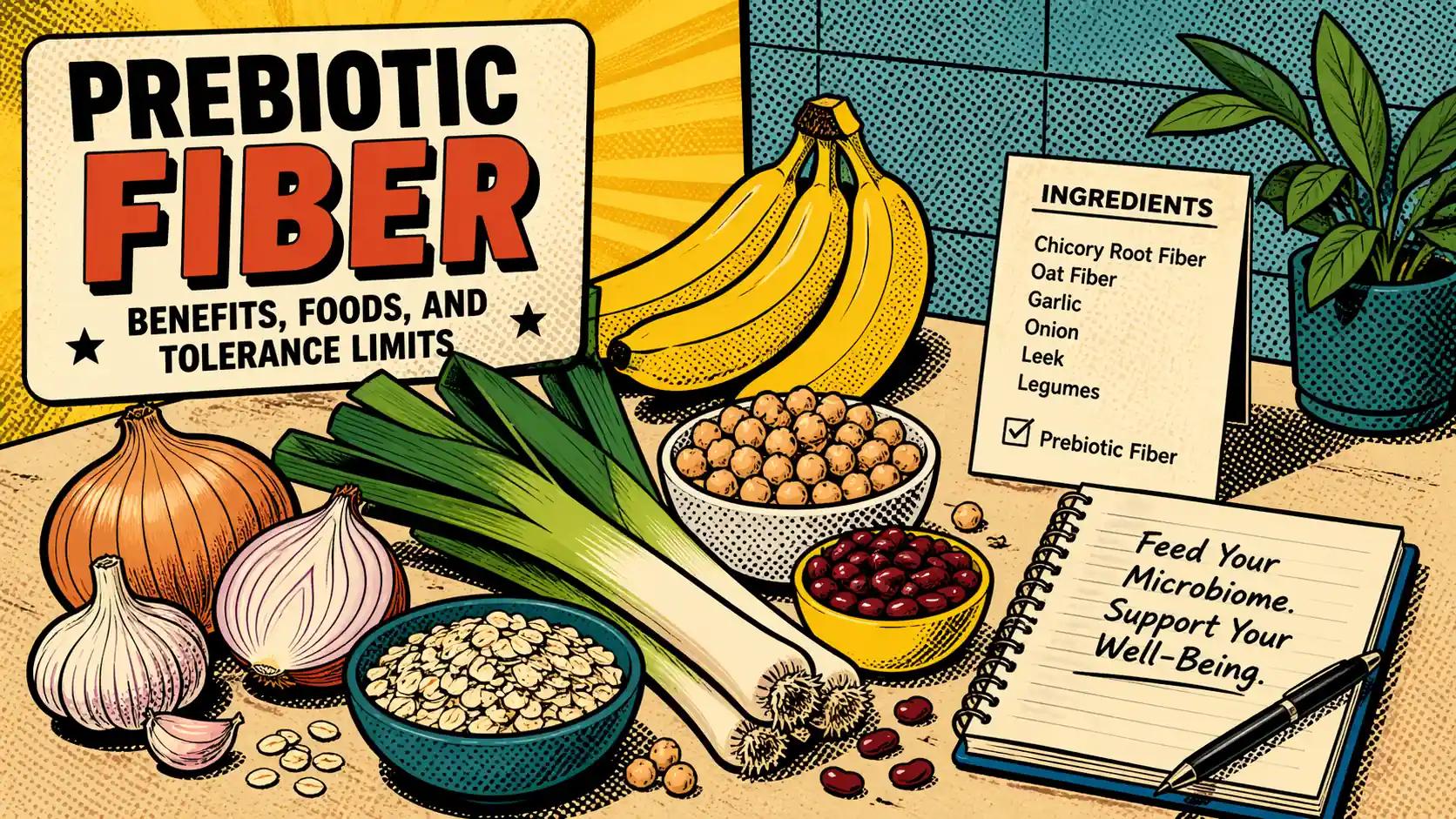
Prebiotic fiber sounds like one of those terms that should make everything clearer. In practice, it often does the opposite. One label says gut support. Another says microbiome reset. A third says the product feeds your good bacteria. Here is the truth: the concept is real, but the marketing is usually way ahead of the decision you actually need to make.
Short answer: prebiotic fiber is a real microbiome category, but it is not the same thing as "more fiber is always better." The most evidence-backed part of the story is selective microbial use and fermentation. The most important real-world caveat is that some prebiotic-heavy foods or products can worsen gas and bloating in sensitive guts.
This page is for you if you want to understand what prebiotic fiber is before you buy another gut-health product or turn one mechanism into a universal solution.
Use a different page first if your main question is constipation-specific supplement choice, strain-specific probiotics, or a broader symptom map. Those fit prebiotics, probiotics, and synbiotics for constipation, probiotics for IBS, or why healthy foods still bloat you better. If you still need the simplest category split on probiotic vs prebiotic, use that comparator first and come back here for the substrate decision.
If you have read that prebiotics feed the "good" bacteria in your gut, the logic probably sounds simple.
More prebiotic fiber should mean a happier microbiome.
Sometimes that is directionally true. Sometimes it is the exact thing that makes your gut louder.
This article is the bridge between microbiome theory and a usable next step. If you want the broader food-to-mechanism shelf, use our explainer on polyphenols and the gut microbiome. If you want the practical decision layer, stay here. If your main question is what changed in the gut after antibiotics and whether fiber belongs in recovery at all, use our antibiotic-induced gut dysbiosis guide.
The cleanest modern definition comes from the 2017 ISAPP consensus statement: a prebiotic is a substrate that is selectively utilized by host microorganisms conferring a health benefit 1.
That matters for one reason: the term is narrower than most product labels make it sound.
Not every ingredient added to a bar, powder, or capsule automatically deserves the stronger prebiotic claim. And not every high-fiber food behaves the same way just because fiber is involved.
This is also why readers keep getting stuck between two oversimplifications:
Neither version is accurate.
The good news is that the middle ground is more useful anyway. Prebiotic fiber is best understood as a specific microbiome-support concept with real mechanistic logic, uneven clinical evidence, and important tolerance limits.
That puts it in a different lane from generic fiber advice. It also puts it in a different lane from probiotic marketing.
If you want the food-to-microbiome mechanism that sits above this article in the content graph, start with polyphenols and the gut microbiome.
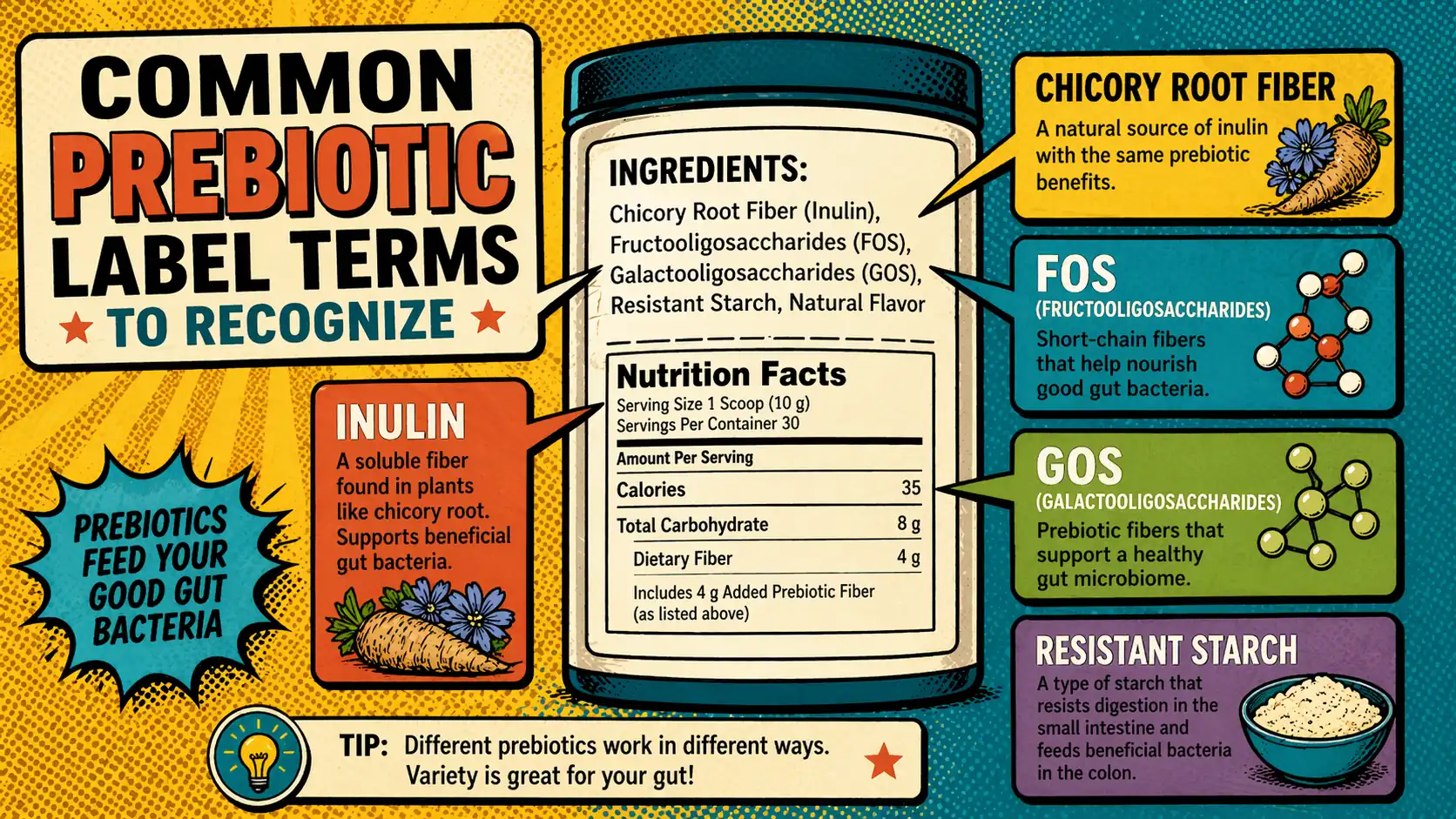
The prebiotic conversation usually circles a few familiar names:
Those ingredients show up in two very different contexts.
First, they can appear inside real foods such as onions, garlic, leeks, asparagus, legumes, oats, and other plant foods discussed in patient-facing prebiotic resources 2. If you want the narrower child utility that turns those examples into a practical source-group list, use our guide to food-first prebiotic fiber sources.
Second, they can show up as concentrated add-ins on product labels:
That difference matters more than most articles admit.
A whole-food exposure and a concentrated powder do not always feel the same in the gut, even if the ingredient logic overlaps. This is especially relevant for readers who already know that label-heavy "gut-friendly" products make them feel worse.
Monash University's FODMAP materials matter here too, because fructans and galacto-oligosaccharides sit inside the same wider symptom-management conversation for IBS-prone readers 3. Their certification material also explicitly flags added FODMAP ingredients such as inulin and fructo-oligosaccharides 4.
That does not mean prebiotic fiber is fake.
It means the label should slow you down.
If hidden add-ins are a recurring problem in your life, use our guide to hidden FODMAP products. And if you need the wider food-trigger map first, use high-FODMAP foods to avoid for bloating.
The old listicle version of this topic usually gives you eight or ten "benefits" with the same level of certainty.
That is not how the evidence reads.
The stronger version is to rank the claims.
This is the core of the definition and the safest starting point. Prebiotic fiber matters because selected microbes can use it and because that use may lead to relevant downstream effects 5.
This is also why words like bifidogenic keep showing up in the literature. Certain ingredients appear to favor specific microbial patterns more than generic fiber talk would suggest. That is conceptually useful. It is still not the same claim as "this will definitely improve your symptoms."
Short-chain fatty acids, or SCFAs, are one of the main reasons prebiotic fiber keeps reappearing in microbiome science. When microbes ferment relevant substrates, they may produce compounds such as acetate, propionate, and butyrate.
That does not mean every prebiotic meal or supplement automatically increases SCFAs in a clinically meaningful way for every person. A systematic review of resistant starch trials found wide variation in both tolerability and SCFA production across human studies 6.
Still, SCFAs are a legitimate mechanism bridge. They help explain why microbiome-supportive nutrition keeps showing up in the same conversation as immune balance, barrier function, and organ-axis research.
That is one reason this topic links naturally to the gut-heart axis, the gut-lung axis, and even the still-draft gut-kidney shelf, where metabolites and inflammatory tone keep re-entering the story.
This is where readers need nuance most.
Getting enough fiber is still part of mainstream constipation care, and NIDDK explicitly says fiber should be added gradually rather than dumped into the gut all at once 7.
Some modern intervention work also suggests that selected prebiotic interventions may improve bowel habit in functional constipation 8.
But this does not justify turning prebiotic fiber into a universal constipation answer. The broader IBS and chronic idiopathic constipation meta-analysis found that the prebiotic evidence base was still sparse and far less definitive than marketing language would lead you to believe 9.
So the fair summary is:
If constipation is your main problem, the narrower follow-up page is prebiotics, probiotics, and synbiotics for constipation.
Recent systematic-review work on prebiotic fibers, probiotics, and synbiotics suggests these interventions may influence gut permeability, immunity, microbial composition, and SCFA-related pathways, but the findings remain heterogeneous and highly dependent on the intervention, population, and outcomes studied 10.
That is the key sentence product pages usually skip.
Interesting does not mean settled.
If you keep seeing newer labels built around inactivated microbes rather than fermentable substrates, use this postbiotics explainer to separate the category before you assume it belongs in your next experiment.
Promising does not mean proven for everyone.

This is the part many articles soften too much.
Bloating and gas are not rare little footnotes in the prebiotic story. They are often the whole reason readers become skeptical in the first place.
That skepticism is understandable.
If you add a highly fermentable ingredient to an already reactive gut, the first thing you may notice is not better microbial ecology. It may be more fullness, more noise, and more regret.
That is one reason food-first tolerance can matter so much. A whole-food pattern with modest exposure may feel very different from a concentrated blend in a bar, smoothie powder, or probiotic-plus-prebiotic formula.
It is also why readers with IBS-style or FODMAP-sensitive patterns should be especially careful around inulin, chicory root fiber, and FOS-heavy products.
If that sounds familiar, you are not broken. You are noticing an actual tolerance boundary.
If you want the narrower mechanism explainer for why the same fermentable input can create both microbiome-relevant outputs and a louder gut, use fiber fermentation and gas tradeoffs.
This is where the current site ecosystem matters:
The broader point is simple:
A technically prebiotic ingredient can still be the wrong move for your current symptom pattern.
That is not anti-prebiotic. It is just more clinically honest.
This is where category confusion wastes the most money.
Prebiotics feed selected microbes. Probiotics are live microbes. Synbiotics combine both.
That is the simple version. The practical version is better:
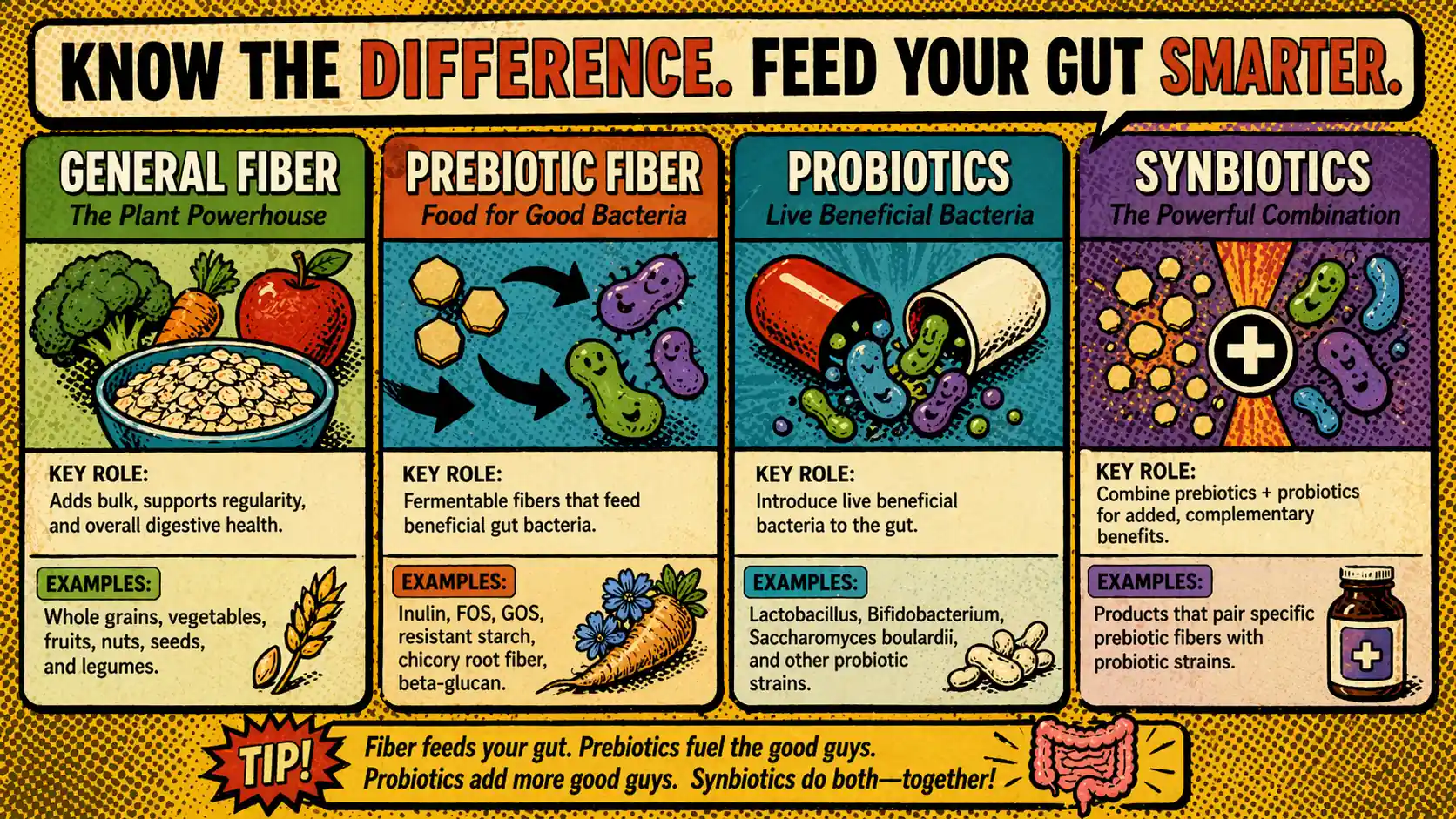
| Category | What it is | Typical examples | Main role | Common caution |
|---|---|---|---|---|
| General fiber | broad group of nondigestible carbohydrates and related compounds | oats, psyllium, vegetables, legumes | stool bulk and broader digestive support | not all fiber is automatically prebiotic |
| Prebiotic fiber | selectively utilized substrate with a health benefit | inulin, FOS, GOS, some resistant starches | microbiome-targeted fermentation support | can worsen gas or bloating in sensitive readers |
| Probiotic | live microorganisms | strain-specific capsules or fermented products | add specific live microbes | evidence is strain-specific |
| Synbiotic | probiotic plus prebiotic | combo formulas with strains plus inulin or FOS | combine both support levers | the added prebiotic may be the part that backfires |
The important mistake to avoid is assuming these labels are interchangeable.
If your main question is constipation category choice, the deeper comparison is already covered in prebiotics, probiotics, and synbiotics for constipation. If your question is strain-level probiotic evidence for IBS, stay with probiotics for IBS.
This article is the parent bridge above both of those.
The cleaner question is not "Are prebiotics good?"
It is "Is prebiotic fiber a good fit for my next step?"
Good fit signals look like this:
If the real question is less about one prebiotic ingredient and more about why different plant fibers may matter across the week, use fiber diversity and microbiome resilience. If the real question is which fiber behavior is more likely to fit constipation, bloating, or IBS-style sensitivity, use types of fiber by symptom fit. If the real issue is that every "eat more fiber" attempt turns into a sudden bar, powder, cereal, or giant-salad experiment, use fiber intake pattern mistakes before escalating the dose.
Caution signals look like this:
Here is the simplest version of the routing logic:
[!TIP] Download: Prebiotic Fiber Decision Guide Use this quick reference if you want the decision tree in a printable one-page format before you buy another product.
Routine bloating does not always need drama.
But there are times when you should stop trying to solve everything through one ingredient category.
Use broader medical review if you have:
NHS is clear that bloating can overlap with constipation, food intolerance, celiac disease, IBS, and other digestive issues 11. So if the story feels medically sticky, let it become a broader evaluation rather than a label-reading competition.
[!TIP] Download: Prebiotic Ingredient Label Checklist Keep this nearby when you compare inulin, chicory root fiber, FOS, GOS, and other 'gut support' label language.
Prebiotic fiber is worth understanding. It is just not worth idealizing.
Here is the bottom line:
If you are still deciding what that next page should be, use the routing block below instead of guessing.
Xam Riche is a gut health solopreneur and founder of YourFitNature, dedicated to helping people navigate digestive wellness through evidence-based information and personal experience. After years of struggling with IBS and bloating, Xam discovered the transformative power of the low FODMAP diet and now shares practical, science-backed guidance to help others find relief. While not a medical professional, Xam combines extensive research with lived experience to create accessible, empowering resources for the gut health community. Learn more about our mission
As an affiliate, we may earn from qualifying purchases.
Choose a focused guide for what you are noticing or deciding next.