 By • Published on April 13, 2026 • 13 min read • 1,720 views
This article is for informational and educational purposes only and does not constitute medical advice. Always consult with a registered dietitian, gastroenterologist, or other qualified medical professional before changing your treatment plan or starting a new supplement.
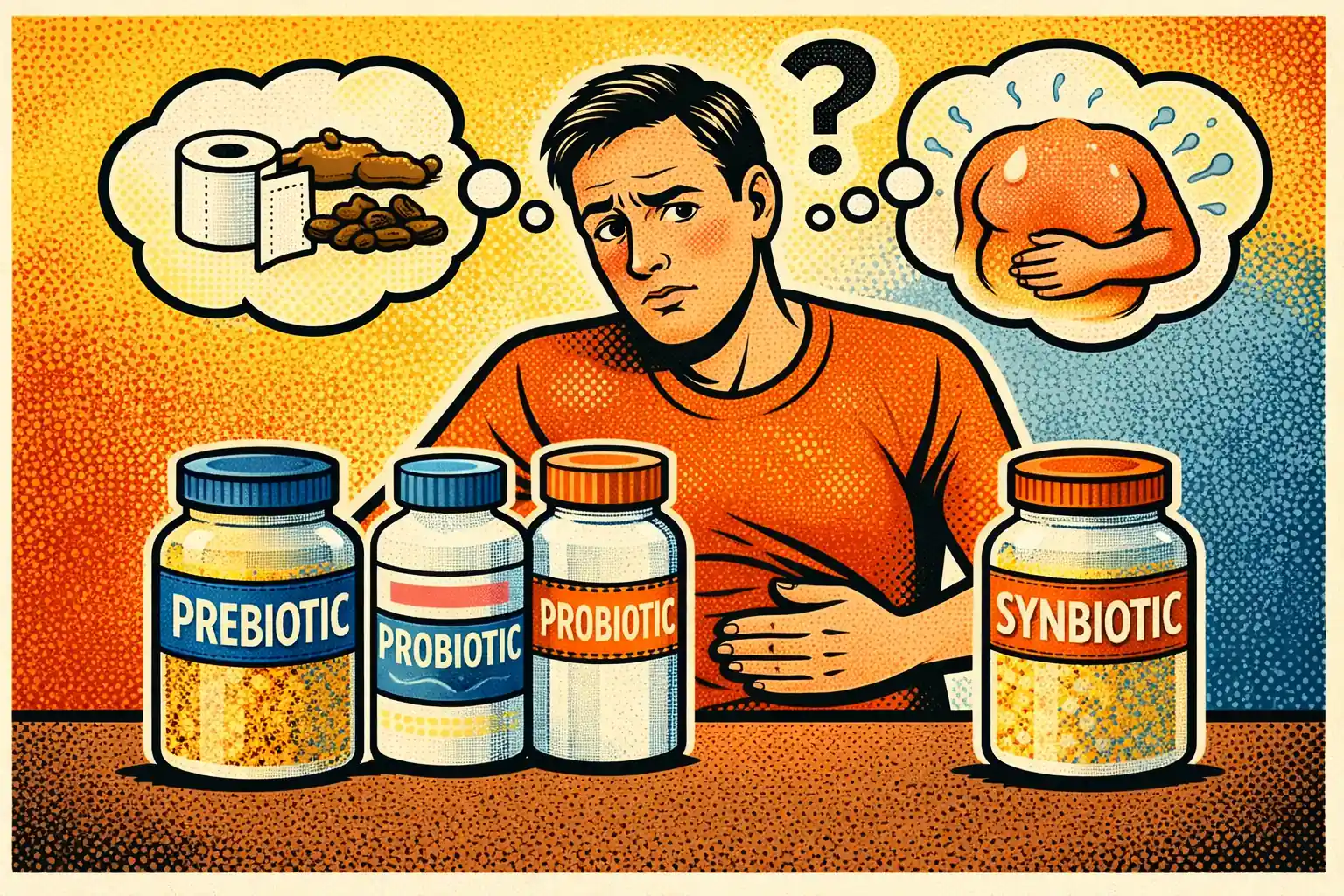
You do not need another supplement promise. You need a clearer answer to one question: if constipation is still the problem, does it make more sense to try fiber, a probiotic, or one of those 'prebiotic + probiotic' blends? The good news is that the answer is usually simpler than the marketing makes it sound.
Short answer: prebiotics, probiotics, and synbiotics are not interchangeable. The right category depends on whether the goal is fiber-like support, a strain-specific probiotic trial, or a mixed product that will not make bloating worse.
This page is for you if you are comparing supplement categories and want a cleaner way to decide what kind of product, if any, fits constipation better.
Use a different page first if you still need the symptom-first constipation map or the food-first microbiome version. Those fit constipation and bloating or polyphenol foods for gut health better. If your real question is which tolerated foods count as prebiotic-source options before you trial another product, use food-first prebiotic fiber sources.
If you have stood in front of a supplement shelf or scrolled through a product page that promises "complete microbiome support," you already know how messy this category gets.
Every label sounds smarter than the last one.
One says prebiotic. One says probiotic. One says synbiotic and tries to look like the obvious upgrade.
If you want the broader concept before narrowing into constipation, start with what prebiotic fiber is and when it helps.
Here is the truth: if you are dealing with constipation, more complicated does not automatically mean more effective.
Before you expect a microbiome supplement to solve everything, it still makes sense to fix the basics of constipation care such as fluids, fiber strategy, movement, bowel routine, and whether PEG or other clinician-guided treatment belongs in the conversation 1 2. If you need that broader reset first, start with our guide to constipation and bloating.
This article is the narrower follow-up. We will sort what prebiotics, probiotics, and synbiotics actually are, where the evidence for constipation is promising or weak, and how to test one without making your gut louder.
For a broader category map beyond constipation, use Synbiotics, Probiotics, and Prebiotics before narrowing into bowel-frequency decisions.
This page is explaining an intervention-category decision:
This page is not mainly explaining:
If that sounds closer, route to constipation and bloating, probiotics for IBS strains, or polyphenols and the gut microbiome science.
Constipation rarely improves because one capsule finally enters the chat.
More often, the bigger picture still matters:
That hierarchy matters because the 2023 AGA / ACG guideline clearly supports fiber supplementation and PEG in adults with chronic idiopathic constipation 3. Synbiotics are not sitting in the same evidence tier.
That does not make them useless.
It just means they belong in the conversation as an adjunct or a careful experiment, not as the first move that replaces everything else.
If your bigger symptom pattern is constipation plus abdominal pressure, distension, and stool backup, our main constipation and bloating guide is still the best starting point. This piece assumes you are asking a narrower question after that:
Is there a smarter microbiome-support tool to try next?
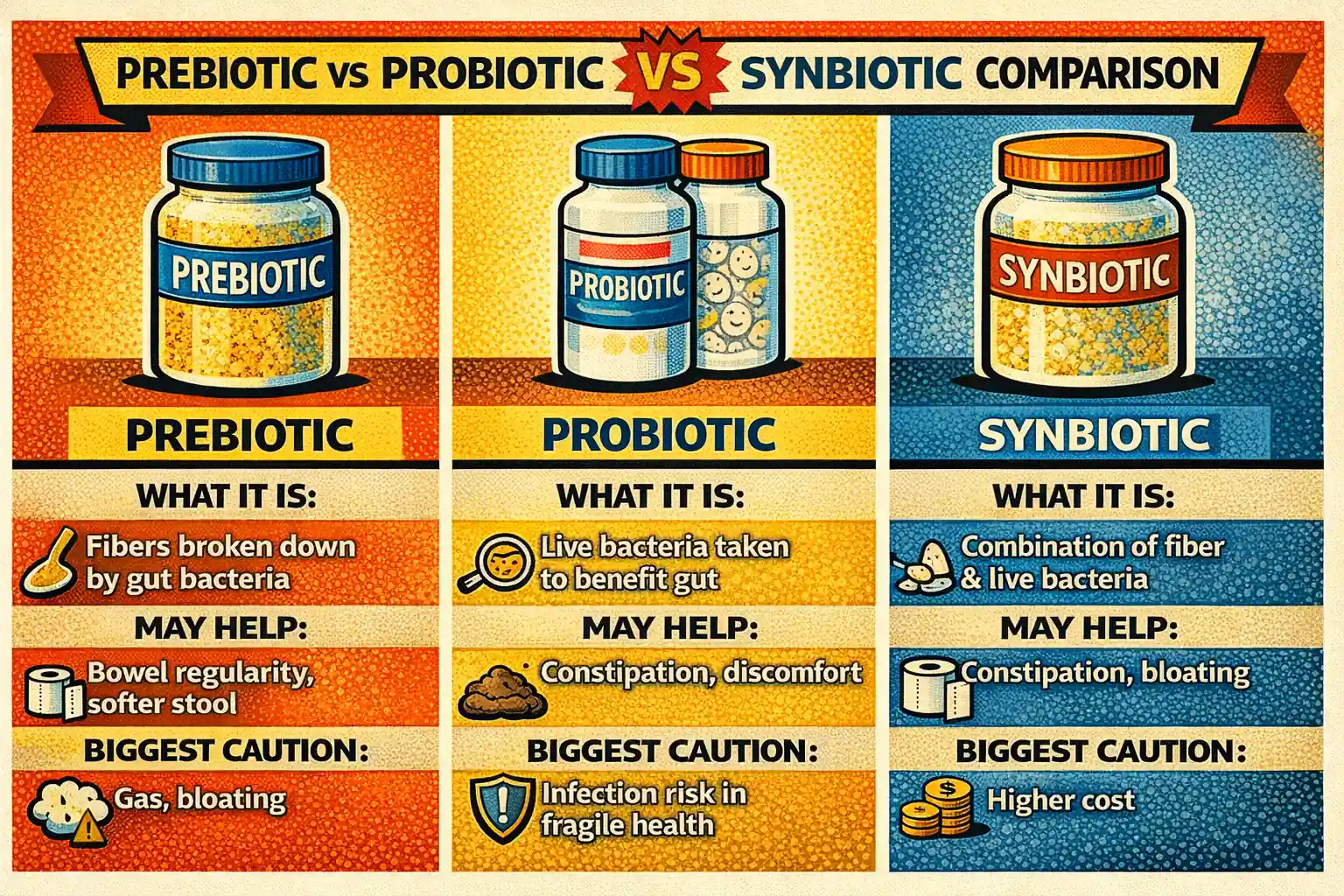
This is the distinction most supplement pages blur on purpose.
That sounds simple enough. But the practical difference is what matters.
| Category | What it is | Why people reach for it | Biggest caution |
|---|---|---|---|
| Prebiotic | a selectively fermented ingredient | to support stool frequency or microbiome activity | may worsen gas or fullness |
| Probiotic | live microbial strains | to support transit, stool form, or broader gut regulation | results are strain-specific |
| Synbiotic | a probiotic plus a prebiotic | to combine both support levers in one product | evidence is still formula-specific |
The most important mistake to avoid is assuming that a synbiotic is just a "better probiotic."
Sometimes it may be a better fit.
Sometimes the added prebiotic is exactly the thing that makes the product feel worse.
That is especially relevant if you have constipation plus bloating, or if your pattern already looks partly like IBS-C and low FODMAP, where added inulin or FOS can be rough on a sensitive gut.
The evidence is interesting. It is not clean enough to justify supplement hype.
Prebiotic ingredients such as fructooligosaccharides, often shortened to FOS, may increase bowel movement frequency and soften stool in some human trials. But mild bloating is a known tradeoff, and the current evidence is still too mixed to treat them as a universal answer 4.
That means a prebiotic may be useful for some readers. It does not mean every constipated person should start dumping extra fermentable fiber into an already bloated gut.
The probiotic category has the clearest pooled signal here, but it still comes with heavy variation between studies. A 2024 meta-analysis found statistically significant improvement across adult chronic idiopathic constipation trials while also reporting major heterogeneity between products, populations, and study designs 5.
That is a strong argument for caution, not cynicism. The category may help. You just cannot assume that one positive trial turns every shelf product into a good idea.
Synbiotics are the most interesting category for this specific article because they try to combine a probiotic with a supportive prebiotic ingredient. Recent pilot and product-level studies suggest that this approach may improve chronic functional constipation in some adults 6 7.
But this is where supplement marketing runs ahead of the evidence.
The strongest fair summary is:
Bottom line: promising is not the same as proven for everyone.
Here is the plain-language version of why synbiotics even exist.
Prebiotics may help by feeding microbes that produce fermentation byproducts such as short-chain fatty acids. Probiotics may help by altering microbial composition, supporting transit, or changing the local gut environment. Together, a synbiotic formula tries to combine those two support levers in one product, although much of the mechanism literature still leans more preclinical than clinically settled 8.
In theory, that could mean:
In real life, it depends on the exact formula.
This is the part many articles skip. "Synbiotic" is not one ingredient. It is a category label covering many possible pairings. If the strains are weak, or the added prebiotic is poorly tolerated, the whole combo can still miss the mark.
If you want the broader food-based microbiome layer rather than another capsule-first strategy, our guide to polyphenol foods for gut health is a useful companion. And if you want the deeper mechanism story behind microbiome claims, read polyphenols and the gut microbiome.
For a whole-body example of why microbiome signaling may matter beyond bowel habits, see our explainer on the gut-lung axis.
This is the part that usually matters most to readers.
Why can one person say a synbiotic changed everything while another person says it made the bloating unbearable?
Because several variables change the outcome at once:
A 2023 randomized placebo-controlled trial on hard stools is especially useful here because it reported symptom improvement with selected formulas while also acknowledging a real clinical problem: higher-fiber or prebiotic-heavy interventions can aggravate bloating and flatulence 9.
That is not a reason to avoid every prebiotic.
It is a reason to stop pretending that "feeds good bacteria" always feels good immediately.
If you already know that inulin, FOS, or fiber-heavy products make your gut much louder, treat that information seriously. And if your bigger pattern still looks like constipation plus food-trigger sensitivity, revisit IBS-C and low FODMAP before deciding the problem is just that you have not found the right supplement yet.
Not every constipated reader is a good candidate for a synbiotic.
A more reasonable fit looks like this:
A less ideal fit looks like this:
If you are mostly trying to figure out which strains matter for constipation plus IBS overlap, use our guide to probiotic strains. That page is better for strain-shopping. This page is better for deciding whether the prebiotic-plus-probiotic category even belongs in your next step. If you need the adjacent comparison on which fiber behavior fits your symptoms before you even choose a product category, use types of fiber by symptom fit.
And if food restriction has already become the whole strategy while symptoms keep hanging around, read what to do when low FODMAP is not working.
Here is the cleaner way to run a trial.
[!TIP] Download: Synbiotic Trial Checklist for Constipation Use it before buying another combo product so you can tell whether the trial is structured or just hopeful.
If you want a one-page version of the category decision itself, use the Prebiotic-Probiotic-Synbiotic Comparison Sheet as the faster companion.
Some readers really do need to stop troubleshooting supplements and move the conversation toward care.
That is especially true if you have:
This is also where it helps to separate "my stool pattern improved a little" from "my whole gut problem is solved."
That distinction matters because IBS-C readers may see a small change in stool consistency without seeing the same improvement in pain, bloating, or quality of life. Constipation-only evidence does not automatically translate into global IBS symptom relief 10.
Bottom line: if the situation keeps feeling medically sticky, move toward evaluation instead of trying to win by stacking better labels.
Synbiotics for constipation are worth understanding. They are just not worth idealizing.
Here is the cleanest way to think about them:
Start here if you want the calmest next move:
If you need the symptom-first version, go back to constipation and bloating. If you need the strain-focused version, use probiotic strains. And if the bigger issue is that diet changes are still not solving the whole picture, read what to do when low FODMAP is not working.
Xam Riche is a gut health solopreneur and founder of YourFitNature, dedicated to helping people navigate digestive wellness through evidence-based information and personal experience. After years of struggling with IBS and bloating, Xam discovered the transformative power of the low FODMAP diet and now shares practical, science-backed guidance to help others find relief. While not a medical professional, Xam combines extensive research with lived experience to create accessible, empowering resources for the gut health community. Learn more about our mission
As an affiliate, we may earn from qualifying purchases.