 By • Published on April 29, 2026 • 14 min read • 3,868 views
This article is for informational and educational purposes only and does not constitute medical advice. Always consult with a registered dietitian, gastroenterologist, or other qualified healthcare professional before making major fiber changes, especially if IBS, severe constipation, or persistent bloating symptoms are active.
A commerce-safe path for deciding when enzymes, peppermint oil, fiber, supplement audits, hidden-product checks, or symptom trackers fit.
You're reading: Types of Fiber Explained by Symptom Fit
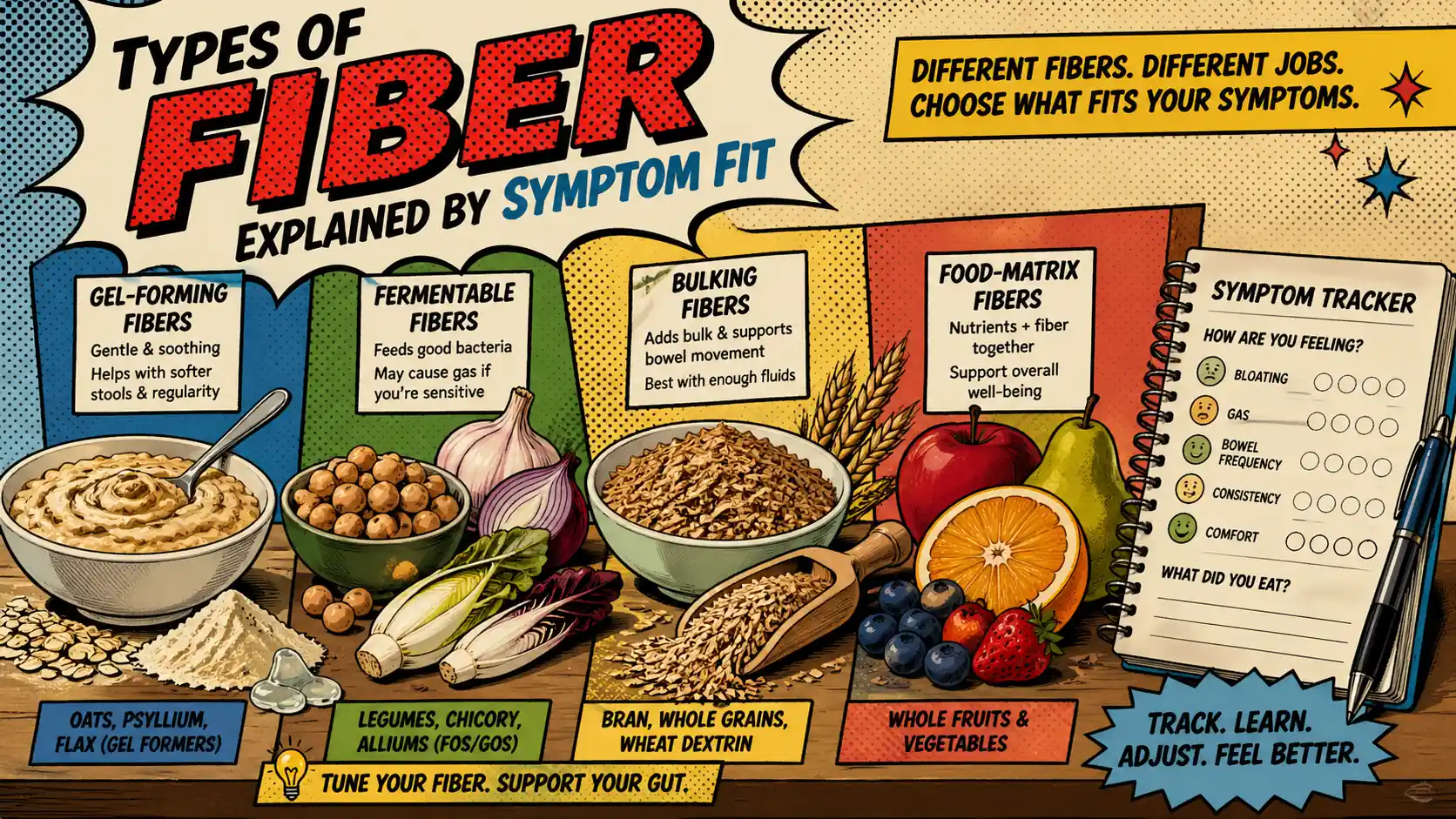
Fiber advice sounds simple until you actually try to use it. One person swears by psyllium. Another says prebiotic fiber changed everything. Then you try a bran-heavy cereal, a gut-health powder, or a chicory-root product and end up more bloated than before. At that point, the problem is no longer 'should I eat fiber?' It is 'which kind of fiber is least likely to backfire for my symptoms?'
Short answer: the best fiber choice depends on what the fiber actually does. Water-holding, gel formation, fermentation speed, bulking, and food matrix can all change the experience, which is why different fibers can fit constipation, bloating, or IBS-style sensitivity very differently 1 2.
This page is for you if you already know fiber matters but still need a calmer way to choose between fiber patterns.
Use a different page first if your main question is what prebiotic fiber means as a category, which foods count as food-first prebiotic fiber sources, or why fiber fermentation and gas tradeoffs can feel so different in real life. This article is the decision layer that sits between those shelves.
One of the most common reasons fiber advice fails is that it treats every fiber as one interchangeable intervention.
That is not how real guts experience fiber.
Some fibers pull water and help stool move more smoothly. Some thicken into a gel. Some ferment quickly and create more gas pressure. Some arrive embedded in whole foods that change how microbes can access them. Some are concentrated add-ins that look small on a label but feel loud in practice 3 4.
NIDDK guidance for IBS also helps here because it makes two practical points that readers often miss:
Those two facts are not contradictory 5. They are exactly why symptom fit matters.
Monash takes this a step further by arguing that the older soluble-versus-insoluble split is often too blunt for IBS-style decisions. The more useful question is how the fiber behaves: does it bulk, form a gel, ferment rapidly, or do several of those things at once 6.
That is the frame this article will use.
The goal here is not to build a perfect textbook taxonomy.
It is to compare the fiber buckets readers actually run into.
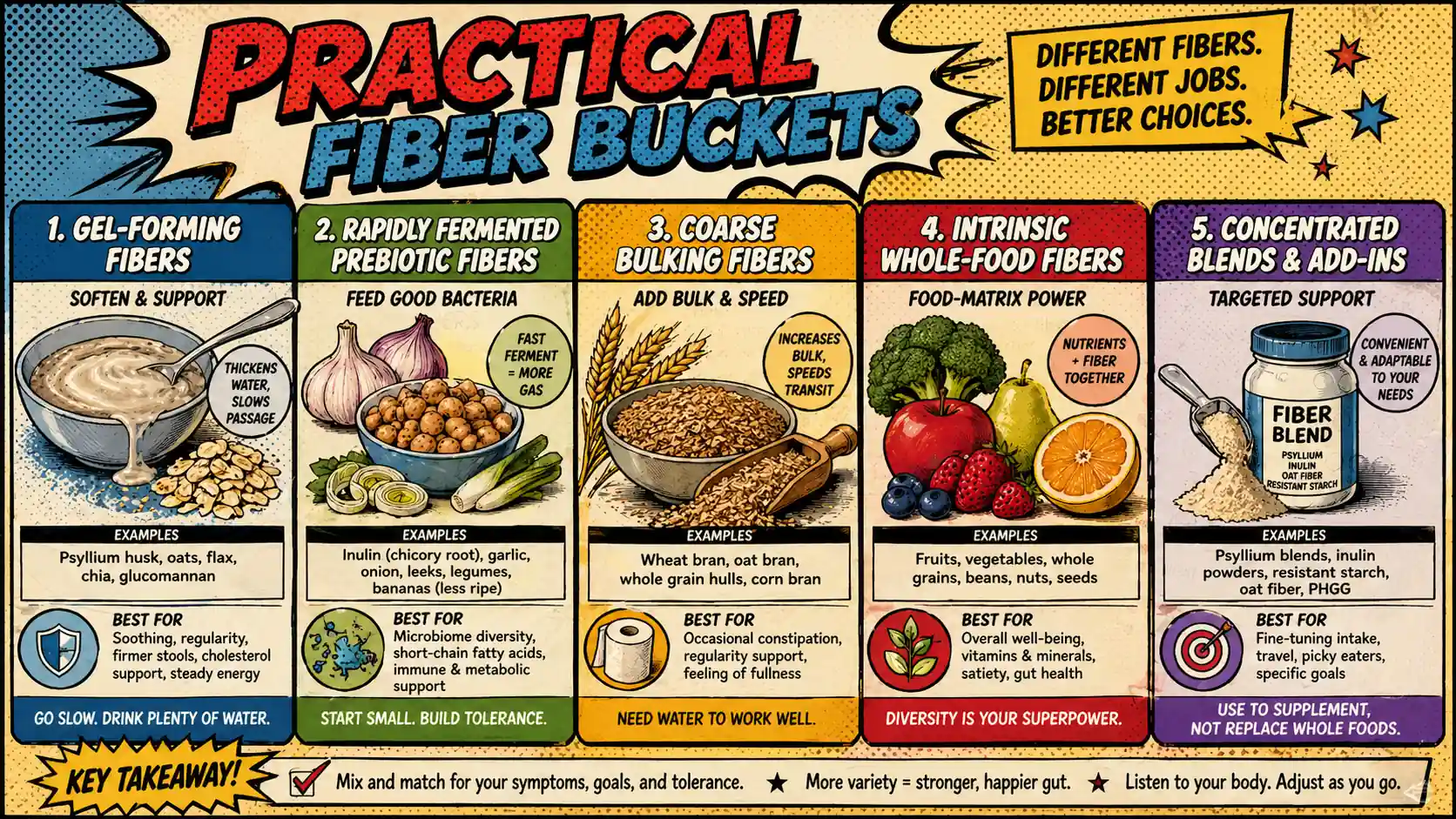
These are the fibers readers often describe as gentler or steadier when the main issue is stool support rather than aggressive fermentation.
This bucket includes fibers such as psyllium and some oat-based or beta-glucan-rich patterns. In practical terms, the appeal is not that they are magical. It is that they can support stool form and water handling without always creating the same gas burden as more rapidly fermented inputs 7 8.
This bucket includes ingredients such as inulin, fructooligosaccharides, and related fermentable add-ins that often show up in powders, bars, and combo products.
These fibers belong to the broader prebiotic fiber conversation because they may support selected microbes through fermentation. But that does not mean they are automatically the best tactical move for a bloating-prone gut. Monash explicitly notes that more rapidly fermented fibers, including oligosaccharides, may exacerbate symptoms via gas production 9.
This is the bucket readers often meet through bran-heavy cereals, rougher high-fiber pushes, or foods chosen mainly because the label says "whole grain" or "high fiber."
Sometimes these choices help. Sometimes they simply overwhelm a gut that is already reactive, constipated, or distended. That is why "more rough fiber" should not automatically be treated as the next upgrade when bloating is loud.
This bucket matters because the same fiber chemistry can behave differently when it stays embedded in a plant-food structure instead of arriving as an isolated or refined ingredient.
The intrinsic-fiber review is useful here because it argues that plant cell matrices can change microbial access and fermentation timing. The practical translation is simple: a whole-food fiber exposure and a concentrated add-in do not always land the same way in real life 10.
If you want the broader bridge on why varied fiber inputs matter across the week, use fiber diversity and microbiome resilience after this article.
This is where readers get trapped most often.
A label may combine several fibers, a probiotic, or a vague "gut health" positioning and make the product sound smarter than a simpler food-first plan. But one blended formula can be harder to interpret if symptoms get worse, especially when you do not know whether the problem came from the dose, the fermentation speed, or the combination itself.
That is one reason this comparator stays symptom-first rather than product-first.
One reason readers get stuck is that category words sound more precise than they really are.
Take the word soluble.
It sounds like it should tell you exactly how a fiber will behave. In practice, it does not. Two soluble fibers can still differ in fermentation speed, gas load, gel formation, and how readable the trial feels in a symptom-sensitive gut 11.
The same problem shows up with labels such as:
Those phrases can point in a useful direction, but they do not tell you enough on their own. A whole-grain cereal may still feel too rough in one situation. A prebiotic-heavy bar may still be too loud in another. A food-first pattern may still backfire if the portions, combinations, and timing all overwhelm the same reactive gut.
For the broader food-pattern version of that problem, use the guide to whole-grain and plant-food tolerance.
That is why the best next move is rarely "buy the product with the smartest fiber language."
It is usually:
The better question is not "is fiber good?"
It is "which fiber pattern fits the current problem?"
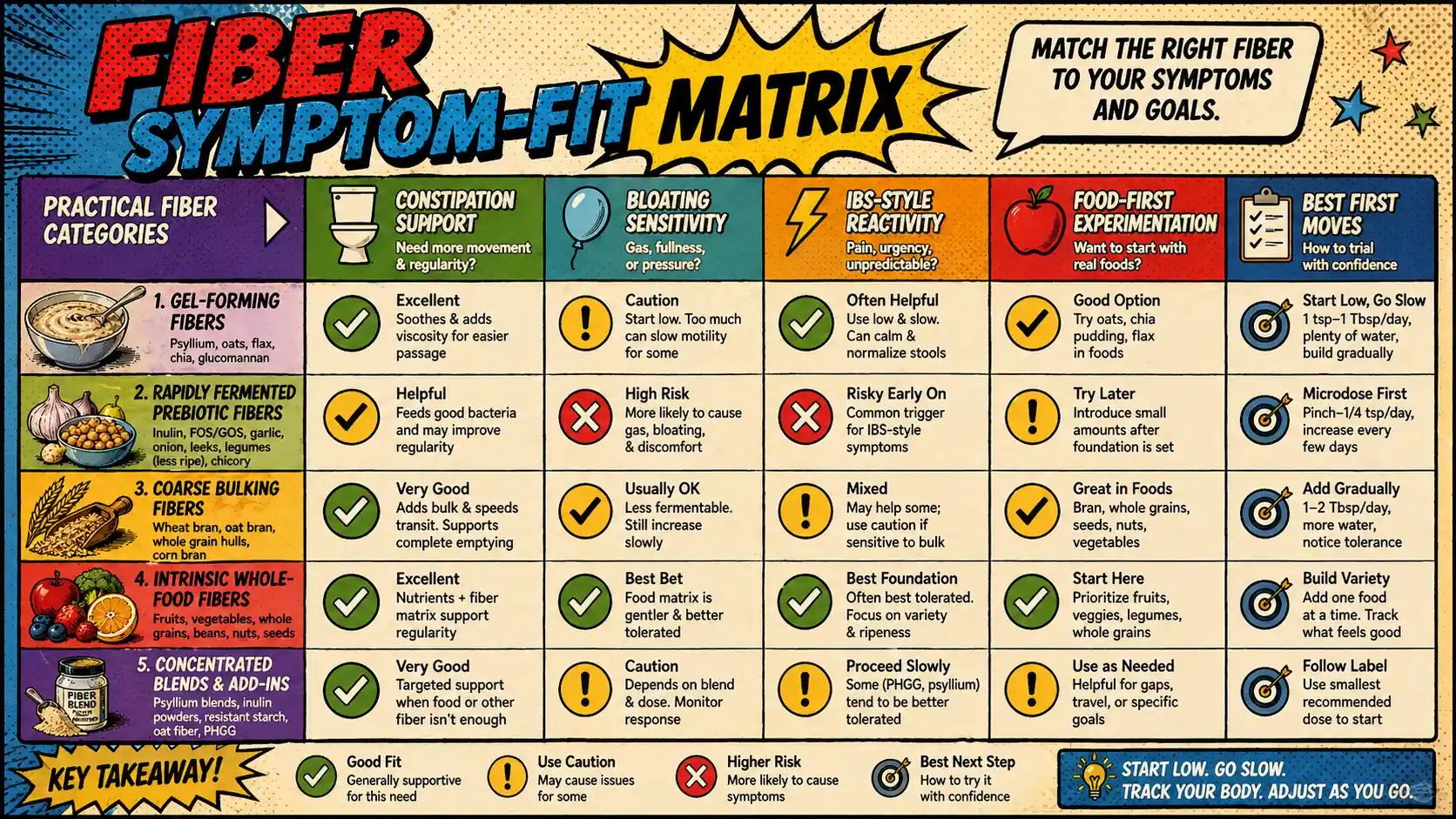
| Fiber pattern | More likely to fit | More likely to backfire |
|---|---|---|
| Viscous or gel-forming | constipation support, gentler trialing, stool-form work | when readers expect instant results from a tiny dose |
| Rapidly fermented prebiotic-style | microbiome-curious readers with decent tolerance | active bloating, IBS-style reactivity, FODMAP sensitivity |
| Coarse bulking push | some low-fiber constipation patterns | distension, rough high-fiber escalation, already-sensitive guts |
| Intrinsic whole-food matrix | food-first experimentation, steadier comparison | when the reader still stacks portions too fast or too many triggers at once |
| Concentrated blends | structured experiments with careful tracking | readers who keep switching products or cannot tell what changed |
Start by remembering that constipation support is not just a fiber-label issue. NIDDK still emphasizes enough fiber, enough fluid, and gradual change 12.
That often means a calmer, water-aware, easier-to-read fiber pattern can make more sense than an aggressive rough-fiber push.
If your real decision is whether a microbiome product belongs in the plan at all, use prebiotics, probiotics, and synbiotics for constipation next. That page is better for category choice. This one is better for choosing the fiber behavior first.
This is where many readers get hurt by good intentions.
Rapidly fermented fibers may have microbiome logic behind them, but symptom fit still comes first. Monash's IBS guidance and the psyllium-versus-inulin data both point in the same direction: some fibers are more likely to feel louder because of fermentation rate and gas load 13 14.
If that sounds like your pattern, route sooner to why healthy foods still bloat you or the broader low-FODMAP troubleshooting shelf rather than assuming you just need a higher dose.
This is where intrinsic whole-food fibers can be useful as a way to slow the experiment down.
Food-first does not mean every healthy plant food will feel calm. It means the trial is often easier to interpret than a dense blend with multiple added ingredients. If you want the practical source-group page, move next to food-first prebiotic fiber sources.
That is the exact reader job this comparator is trying to serve.
The practical answer is usually:
If you want the broader explanation of why different substrates matter to the ecosystem over time, use fiber diversity and microbiome resilience.
The wrong fiber type can create the illusion that fiber itself failed.
Often the mismatch is more specific than that.
For example:
If you need the dedicated sibling explainer for the gas side of this story, use fiber fermentation and gas tradeoffs. That page explains the mechanism more fully. This page is about choosing a better-fit starting point.
The whole-food matrix distinction matters here too.
The intrinsic-fiber literature suggests that fibers embedded in plant-food structures can behave differently from isolated forms because access and fermentation timing are not identical 15 16.
That does not mean every whole food is automatically gentler.
It means the food matrix can change the experiment enough that readers should not treat a refined add-in and a normal meal as interchangeable exposures.
If you already know high-FODMAP combinations, bars, or chicory-heavy products make your gut louder, take that pattern seriously before chasing another smart label.
The goal is not perfection.
It is clarity.
Before comparing another label, check whether the problem is one of the common fiber intake mistakes: too much too fast, one repeated source, a supplement-first habit, or several fermentable changes stacked together.
If the category is already clear and the remaining question is a specific IBS-C powder, use choosing between Metamucil psyllium and Benefiber wheat dextrin for the evidence and label check.
[!TIP] Download: Fiber Choice by Symptom Pattern Quick Guide Use this when you want the faster comparison without rereading the whole article.
[!TIP] Download: Calmer Fiber Trial Checklist Use this if you need a simpler trial structure before testing another food, powder, or fiber-heavy product.
Fiber mismatch is common.
That does not mean every ongoing symptom problem should be solved by personal trial and error.
Get broader medical review if you have:
Those patterns deserve evaluation, not a louder fiber experiment 17 18.
If the main problem is not which fiber exists but how to increase it without triggering bloating, use Fiber Without Bloating as the step-up plan.
Here is the truth: the right fiber choice depends less on generic wellness advice and more on whether that fiber matches the current symptom pattern.
Bottom line:
The good news is that this usually makes the next step simpler, not more complicated: match the fiber behavior to the problem you are actually solving.
Xam Riche is a gut health solopreneur and founder of YourFitNature, dedicated to helping people navigate digestive wellness through evidence-based information and personal experience. After years of struggling with IBS and bloating, Xam discovered the transformative power of the low FODMAP diet and now shares practical, science-backed guidance to help others find relief. While not a medical professional, Xam combines extensive research with lived experience to create accessible, empowering resources for the gut health community. Learn more about our mission
As an affiliate, we may earn from qualifying purchases.
Choose a focused guide for what you are noticing or deciding next.