 By • Published on May 5, 2026 • 15 min read • 4,800 views
This article is for informational and educational purposes only and does not constitute medical advice. Always consult with a registered dietitian, gastroenterologist, or other qualified healthcare professional before making major diet changes, especially if IBS, celiac disease, inflammatory bowel disease, severe bloating, unexplained weight loss, or persistent symptoms are part of the picture.
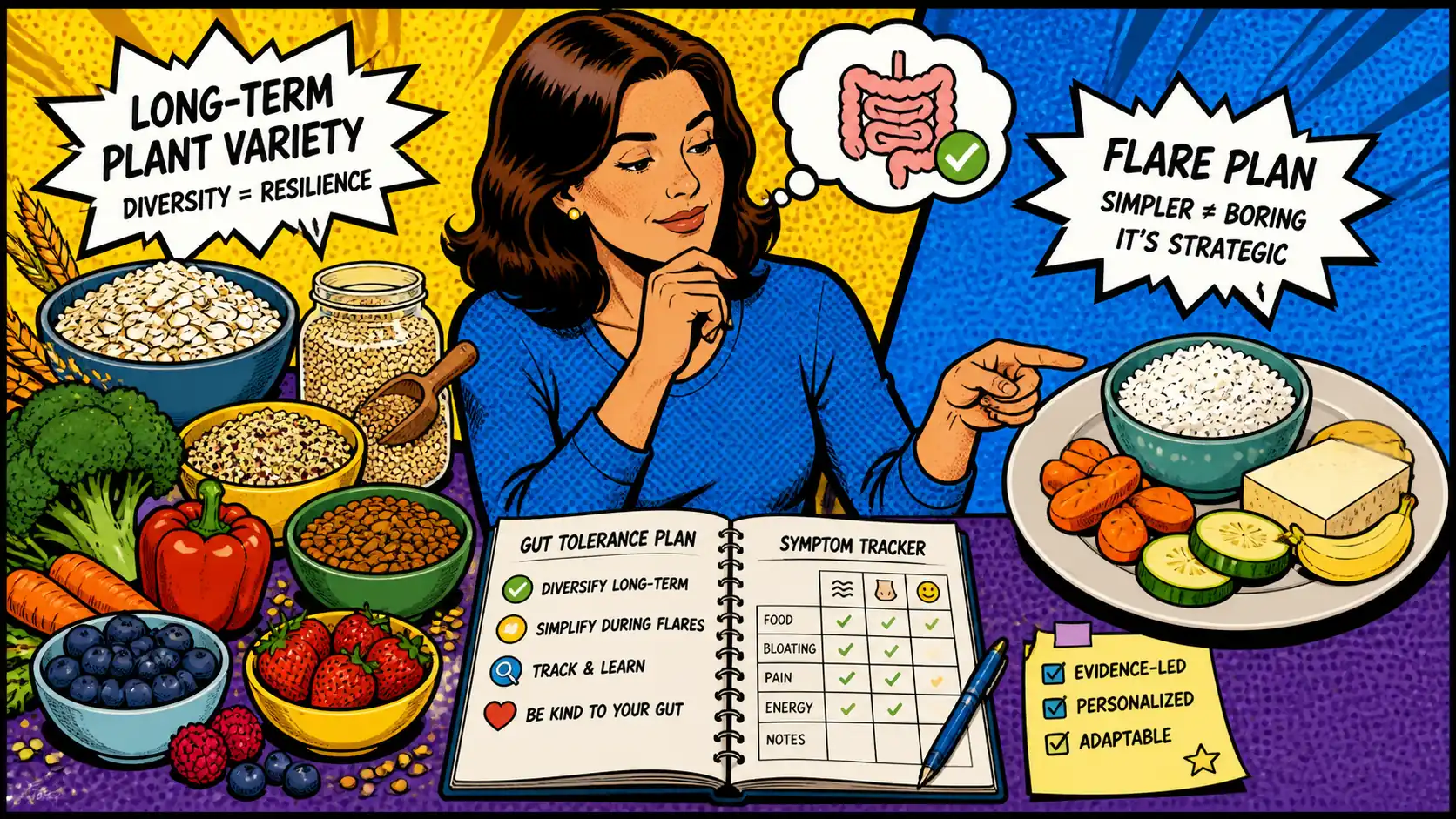
You added oats, whole-grain bread, beans, salads, seeds, berries, and more plant foods because that sounded like the responsible gut-health move. Then your abdomen felt tighter, your stool changed, or your IBS flare got louder. That does not mean the advice was fake. It means nutrition value and symptom tolerance are different questions.
Short answer: whole grains and plant foods can support long-term health and microbiome resilience, but they can still feel rough during symptom flares because of fermentable carbohydrates, fiber load, bran-heavy texture, resistant starch, serving size, FODMAP stacking, constipation, or IBS sensitivity.
This page is for you if you are trying to eat more whole grains and plant foods but keep running into bloating, gas, urgency, constipation, abdominal pressure, or "why does healthy eating hurt?" confusion.
Use a different page first if your main question is broader healthy-food bloating, a formal low-FODMAP phase, or a specific fermented-food reaction. Those fit why healthy foods still make you bloated, low-FODMAP foods, or fermented foods and gut health better.
Your flare plate and your long-term plate may not look identical.
That is the whole bridge.
The 2025-2030 Dietary Guidelines for Americans describe current federal nutrition advice as a pattern built around whole, nutrient-dense foods, including vegetables, fruits, healthy fats, and whole grains 1. That broad advice makes sense for many people.
But broad nutrition advice is not the same as flare management.
During a gut flare, your digestive system may be responding to dose, texture, fermentation, fluid shifts, constipation, speed of eating, or visceral sensitivity. A food can be good for the long game and still be too noisy in the current amount or meal combination.
So the goal is not:
Should I love whole grains or fear them?
The goal is:
Which plant foods fit this gut, this week, in this serving size?
That question keeps you out of two common traps: forcing more "healthy" food when your symptoms are active, or permanently demonizing whole categories that may still belong in your diet later.
Whole grains are not just refined grains with better branding.
Monash describes whole grains as grains left intact after processing, retaining the bran, endosperm, and germ. That structure usually means more fiber and micronutrients than refined grains 2.
Plant foods also matter because they bring more than one nutrient at a time:
That is why the site's broader microbiome shelf keeps returning to fiber diversity and microbiome resilience, polyphenol foods for gut health, and fiber fermentation, gas, and bloating.
The problem is that the same features that make plant foods biologically interesting can also make them symptom-loud.
Fiber can support bowel regularity in one person and create pressure in another. A grain bowl can be nourishing on a stable week and too much during a flare. Beans can be part of a long-term plant-forward pattern and still be a terrible first test after several rough days.
That is not contradiction. That is context.
NIDDK explains that some carbohydrates are not fully digested in the stomach and small intestine. When they reach the large intestine, bacteria break them down and gas can form 3.
That same NIDDK page lists foods that may increase gas symptoms in some people, including certain fruits, cruciferous vegetables, legumes, dairy products, whole grains such as whole wheat, high-fructose drinks, sugar alcohols, too much fiber, and high-fat foods.
That list is not a list of bad foods. It is a list of foods that can create digestive load.
If you have IBS, that load may matter more because symptoms can reflect both what is produced in the gut and how sensitive the gut is to stretch, pressure, and movement. The British Society of Gastroenterology guideline frames IBS as a disorder of gut-brain interaction, which is one reason the same meal can feel different in a sensitive gut than it does in a quiet one 4.
That is why a plant-heavy meal can feel unfair. The meal may be nutritionally reasonable and still cross your current symptom threshold.
"More fiber" is not specific enough.
NICE recommends reviewing fiber intake in people with IBS and adjusting it while monitoring symptoms. It also says people with IBS should be discouraged from eating insoluble fiber such as bran, and that if fiber is increased it should be soluble fiber such as ispaghula or foods high in soluble fiber, such as oats 5.
That matters because the gut may respond differently to:
If a sudden "healthier breakfast" meant bran cereal, seeded toast, chia, fruit, and coffee all at once, you have not tested whole grains. You have tested a large mixed fiber load.
For the more detailed fiber map, use types of fiber by symptom fit.
Serving size is one of the easiest details to miss.
Monash explains that FODMAP tolerance often follows a dose-response pattern. Its serving-size article gives a concrete example: a typical two-slice serving of wholemeal wheat bread may rate differently than a one-slice serving 6.
That is the difference between:
This is also where FODMAP stacking matters. A small serving of one food may be fine. Several borderline foods in the same meal may not be.
Wheat confusion can make this topic more restrictive than it needs to be.
Monash explains that during the restrictive phase of a low-FODMAP diet, wheat, rye, and barley are reduced because they contain fructans. It also states that this does not mean everyone following low FODMAP needs a strict wheat-free or gluten-free diet 7.
That distinction matters.
Gluten is medically crucial for people with celiac disease, and celiac disease should not be self-managed casually. But if your question is IBS-style bloating after wheat-containing foods, the issue may be fructans, serving size, food format, or meal context rather than gluten itself.
Do not diagnose yourself from one sandwich. Do not ignore celiac testing if a clinician recommends it. And do not assume "gluten-free" automatically means gentle for IBS.
The same plant-heavy meal can feel different depending on whether you are constipated, loose, sleep-deprived, stressed, rushed, or already distended.
Constipation can make gas feel trapped. Diarrhea or urgency can make large raw meals feel risky. Stress can lower your comfort threshold. A fizzy drink can add swallowed air to an already large fiber meal.
This is why your answer may change from week to week.
You are not trying to find a perfect universal rule. You are trying to find the first lever that makes this week's symptoms easier to read.
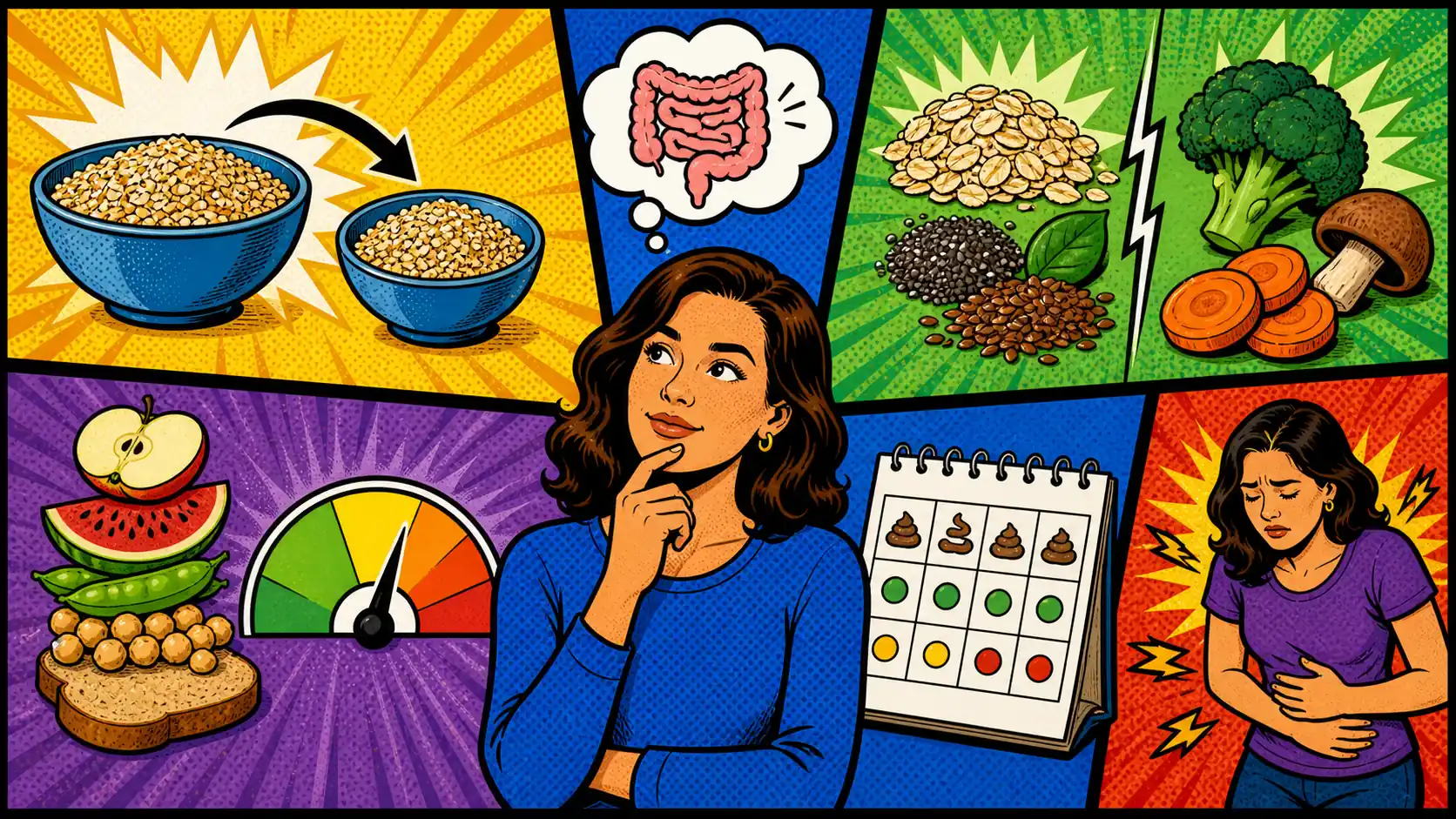
Use patterns, not halos.
| Meal pattern | What may be noisy | Gentler first move |
|---|---|---|
| Bran cereal or a dense whole-wheat bowl | coarse fiber, fructans, serving size | smaller serving, oats, or a repeatable breakfast |
| Bean and grain bowl with onion or garlic | FODMAP stacking | remove one driver and retest |
| Giant raw salad | volume, texture, fermentable load | cooked vegetables and a smaller portion |
| Smoothie with seeds, fruit, and powder | fast fiber dose and additives | simplify ingredients |
| Reheated grain bowl during a flare | resistant starch and total load | fresh small serving or lower-noise starch |
The point is not to ban every food in the left column.
The point is to stop treating a complex meal as a single verdict on your body. If a bean, barley, kale, onion, avocado, and kombucha lunch backfires, you do not know which part mattered. You only know that the stack was too noisy.
That is where the Whole-Grain Tolerance Checklist helps. It gives you a quick way to check serving size, grain type, fiber style, FODMAP load, and meal context before cutting out whole grains.
During a flare, the goal is lower noise.
That usually means simple, familiar, smaller, and cooked before it means perfectly diverse.
Possible flare-week moves include:
This is not anti-plant eating.
It is a sequencing strategy. A flare plate should help you hear the signal. Your long-term plate can widen again once the signal is clearer.
NICE's IBS advice is useful here because it starts with basic meal rhythm: regular meals, time to eat, fluids, reduced fizzy drinks, and a review of fiber intake when symptoms worsen 8.
That is not glamorous. It is often the right first move.
There is no universal "gentlest" grain or plant food. The useful starting point is the food that gives you the cleanest signal.
For many readers, that means choosing a food that is:
Oats are often a practical first test because NICE specifically names oats as a soluble-fiber food that may be helpful for wind and bloating in IBS guidance 9. Rice, quinoa, corn, buckwheat, millet, and potatoes may also be easier to read for some people than dense wheat bowls, bran cereals, or mixed-grain products, depending on the serving and the rest of the meal.
That does not mean those foods are automatically safe for everyone. It means they can be easier starting points because they let you test dose and context without stacking too many variables.
Plant foods work the same way.
Cooked carrots, zucchini, potatoes, rice, oats, or a small serving of berries may be easier to interpret than a large raw salad with beans, onion, garlic, seeds, avocado, and a fizzy drink. The second meal may be more diverse. The first meal may be more useful during a flare because it answers one question at a time.
If you are actively following low FODMAP, use the Monash app or a GI dietitian for exact serving sizes. Monash notes that several grain-based foods can be low FODMAP at full or half serves, but the answer changes by food and portion 10.
The biggest mistake is changing too many things at once.
You might switch breakfast from toast and eggs to oats, chia, flax, berries, yogurt, protein powder, and coffee. If symptoms flare, you cannot tell whether the problem was oats, seeds, dairy, caffeine, portion size, or the total fiber jump.
The second mistake is testing during the wrong moment. If you are already constipated, sleep-deprived, stressed, or bloated before the meal, your tolerance threshold may be lower than usual. That does not make the food a forever trigger. It means the test happened on a loud day.
The third mistake is treating a flare strategy like a nutrition identity. Simplifying plant foods for a few days is a tool. It is not proof that your body cannot handle plant foods, and it is not a reason to keep narrowing the diet without a plan.
After symptoms calm down, rebuild like you are testing a signal, not proving a point.
If the test creates gas and distension, review FODMAP load and portion. If it creates stool urgency, review dose, fat, caffeine, and bowel sensitivity. If it creates pressure that improves after a bowel movement, review constipation first. If symptoms are broad and unpredictable, the problem may not be one grain at all.
Use the Plant-Food Flare Reset Tracker for a short window if every plant food feels suspicious. The goal is to find the smallest useful change, not to shrink your diet indefinitely.
Low FODMAP can be useful. It is also easy to misuse.
If whole grains, legumes, fruits, onions, garlic, and mixed plant-heavy meals keep triggering symptoms, a structured low-FODMAP process may help clarify which fermentable carbohydrates matter. But low FODMAP is not supposed to be a forever low-plant diet. It has restriction, reintroduction, and personalization phases.
NICE says that if IBS symptoms persist while following general lifestyle and dietary advice, further dietary management such as low FODMAP should be given by a healthcare professional with expertise in dietary management 11.
That matters if you are already cutting more and more foods.
Use low FODMAP as a structured tool, not a fear-based food list. Start with low-FODMAP foods if you need a practical entry point, then move to the 3 phases of low FODMAP before treating restriction as the endpoint.
Also seek medical review promptly if symptoms include blood in stool, unexplained weight loss, persistent vomiting, fever, severe or worsening pain, trouble swallowing, or inability to pass stool or gas.
If you are ready to rebuild plant variety but bloating keeps derailing the test, use Fiber Without Bloating to choose one step-up change at a time.
| If your real question is... | Read this next |
|---|---|
| "Healthy foods keep making me bloated" | Why You Still Feel Bloated After Eating Healthy Foods |
| "Which fiber type fits my symptom pattern?" | Types of Fiber by Symptom Fit |
| "I want broader plant-forward eating without constant flares" | Plant-Based Eating and Gut Symptoms |
| "I need a slower step-up plan for fiber" | Fiber Without Bloating |
| "Beans or galacto-oligosaccharides are the specific trigger and I need to inspect an enzyme format" | Current Beano product details |
| "I need low-FODMAP structure instead of guessing" | Low-FODMAP Foods to Eat for Bloating Relief |
Whole grains and plant foods are not the enemy.
They are also not automatically gentle.
The more useful truth is this:
If you are bloated after many healthy foods, step sideways to why healthy foods still make you bloated. If fiber type seems like the main clue, use types of fiber by symptom fit. If your long game is broader plant-forward eating, read plant-based eating and gut symptoms. If your next question is microbial resilience, read fiber diversity and microbiome resilience. If the real concern is keeping cultural staples and tradition visible while you adapt symptoms, use cultural foods and low FODMAP without losing tradition.
Your gut is not arguing with the idea of health. It is responding to the food, amount, timing, and context in front of it. Start there.
Medical note: This article is educational and is not a diagnosis or treatment plan. Work with a qualified clinician or dietitian if symptoms are persistent, severe, unexplained, or causing broad food restriction.
Xam Riche is a gut health solopreneur and founder of YourFitNature, dedicated to helping people navigate digestive wellness through evidence-based information and personal experience. After years of struggling with IBS and bloating, Xam discovered the transformative power of the low FODMAP diet and now shares practical, science-backed guidance to help others find relief. While not a medical professional, Xam combines extensive research with lived experience to create accessible, empowering resources for the gut health community. Learn more about our mission
As an affiliate, we may earn from qualifying purchases.