 By • Published on May 4, 2026 • 13 min read • 1,520 views
This article is for informational and educational purposes only and does not constitute medical advice. Always consult with a registered dietitian, gastroenterologist, allergist, or other qualified healthcare professional before making major diet changes, especially if IBS, severe bloating, histamine-type reactions, immune compromise, pregnancy, or a medical condition is part of the picture.
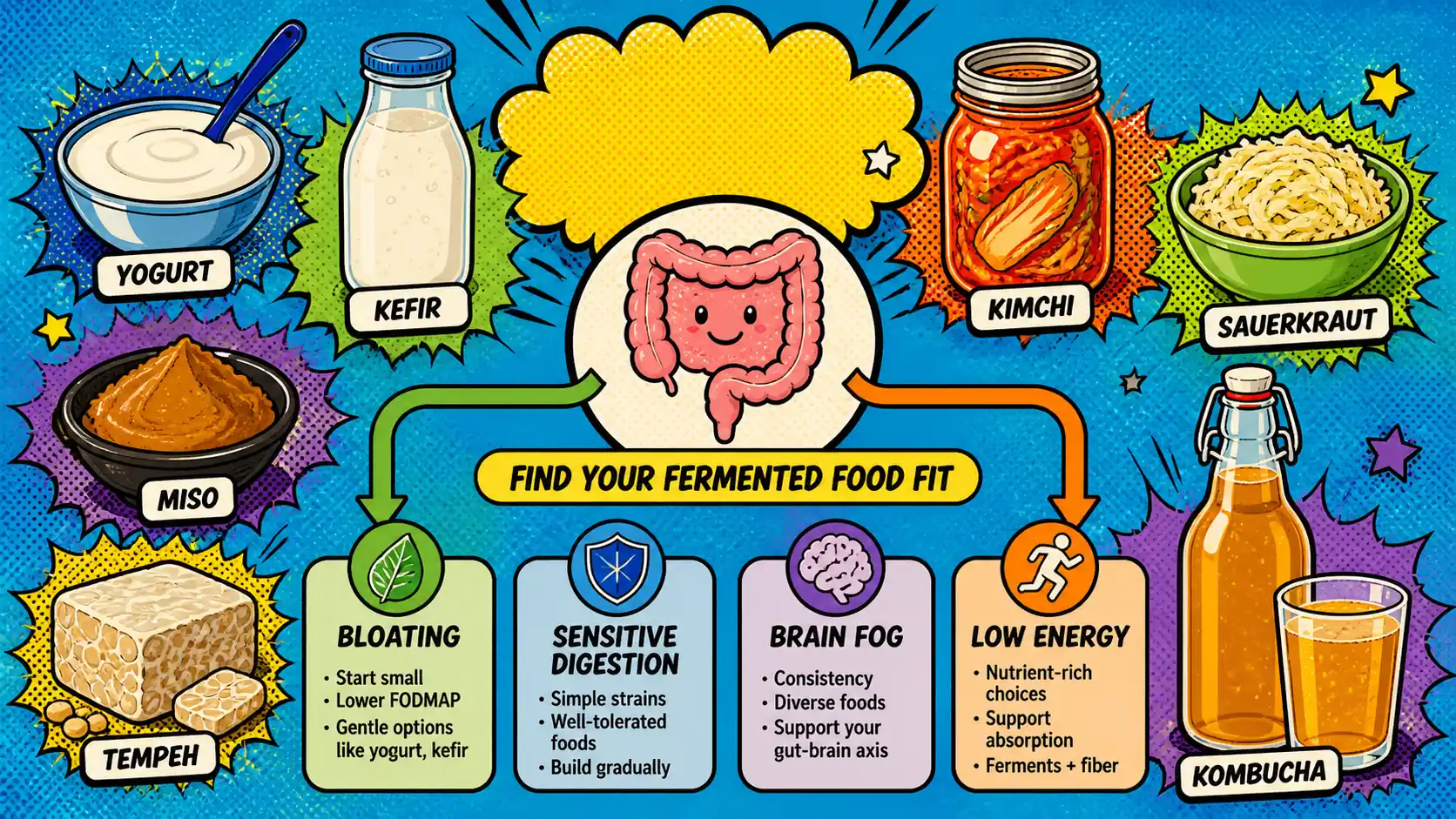
Fermented foods have a strange reputation. One article calls them the shortcut to a better microbiome. Another person tries kimchi, sauerkraut, kefir, or kombucha and ends up bloated, loose, refluxy, flushed, or wired at night. Both experiences can be real. The mistake is treating "fermented" as if it means "automatically good for every gut."
Short answer: fermented foods can be part of a gut-supportive food pattern, but they are not automatically probiotics, not always gentle, and not a treatment shortcut. The right question is not "are fermented foods good?" It is: which fermented food, at what dose, for which gut pattern, and with what claim attached?
This page is for you if you want to use fermented foods for gut health without falling into microbiome hype or ignoring the fact that some fermented foods can make symptoms louder.
Use a different page first if your main question is a strain-specific probiotic product, an inactivated microbial product, or a broader bloating pattern. Those fit probiotics for IBS strains, postbiotics and what they are not, or why healthy foods still cause bloating better.
ISAPP defines fermented foods as foods made through desired microbial growth and enzymatic conversions of food components 1. That sounds simple, but it matters because fermentation is a food process, not a guarantee of a specific health outcome.
A fermented food can contain:
That is why fermented foods belong in gut-health conversations. They can expose the digestive tract to microbes and fermentation products, and some human studies suggest that fermented-food patterns can shift the microbiome 2.
But that same definition also protects you from overclaiming.
Fermented is not automatically probiotic. Fermented is not automatically low FODMAP. Fermented is not automatically easier to digest. Fermented is not automatically better than the non-fermented food.
It is one category of food processing that may help some people and bother others.
If the specific problem is kombucha, kefir, water kefir, drinking vinegar, or a fruit-fermented beverage, use the drink-specific guide to fermented drinks and gut symptoms before assuming every fermented food is the issue.
That is the whole article in one sentence.
The strongest reason to keep fermented foods in the gut-health conversation is not internet tradition. It is that they can change the microbial and chemical exposure coming through the diet.
In a small 10-week trial from Stanford, 36 healthy adults were assigned either a high-fiber diet or a high-fermented-food diet. The fermented-food group increased foods such as yogurt, kefir, fermented cottage cheese, kimchi, vegetable brine drinks, kombucha, and other fermented vegetables. Researchers reported increased microbiome diversity and lower levels of several inflammatory proteins in that group 3.
That is interesting evidence.
It is not permission to say fermented foods cure gut problems.
The trial was small, short, and done in healthy adults. It does not prove that kimchi treats IBS, that kombucha fixes bloating, or that every reader should increase fermented foods aggressively.
The more useful takeaway is narrower:
fermented-food patterns can be biologically active enough to matter, but the response depends on the food, the person, and the symptom context.
Mechanism reviews make the same point in a broader way. Fermented foods can affect gastrointestinal health through microbial exposure, microbial products, changes in the food matrix, and interactions with host and resident microbes 4. That is a good reason to include them in a food-pattern toolkit.
It is not a reason to turn every jar, bottle, or capsule into a gut-health promise.
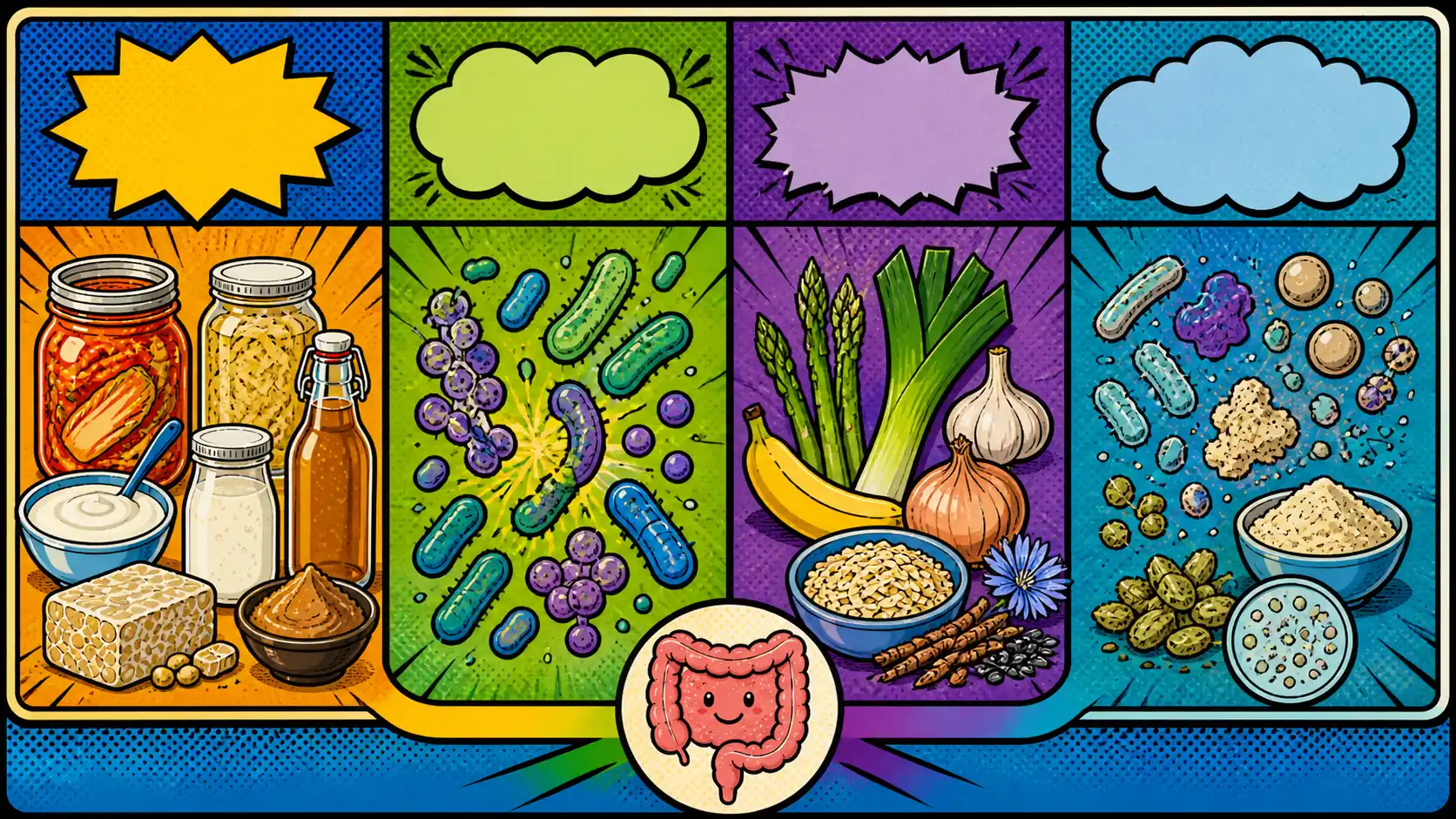
This is where most confusion starts.
The word "fermented" sounds close to several other gut-health terms, so labels and articles often blur them together. That makes the topic feel more powerful than it really is.
Here is the cleaner map.
| Category | What it means | What to ask next |
|---|---|---|
| Fermented food | Food made through desired microbial growth and enzymatic conversion | Which food and serving fit my symptoms? |
| Probiotic | Live microorganism that confers a health benefit when given in adequate amounts | Which strain, dose, and outcome were studied? |
| Prebiotic | Substrate selectively used by host microorganisms | Which ingredient and dose fit my tolerance? |
| Postbiotic | Inanimate microorganisms and/or components with demonstrated host benefit | Which preparation was studied? |
ISAPP's definitions keep these terms separate for a reason 5. If a yogurt, kimchi, or kombucha contains live cultures, that still does not automatically make it a probiotic in the technical sense. A probiotic claim needs defined live microorganisms and evidence of benefit.
That distinction matters if you have IBS and are looking for symptom evidence.
If your real question is "which live strain has IBS data?" use probiotics for IBS strains. If your real question is "how do these microbiome categories differ?" use synbiotics, probiotics, prebiotics, postbiotics, and SCFAs. If a product is built around inactivated microbes rather than live cultures, use postbiotics and what they are not.
Category clarity saves you from paying for vibes.
A food can be microbiome-relevant and still be symptom-loud.
That is especially true if you already deal with IBS-like symptoms, reflux, food intolerance, histamine-type reactions, constipation, or bloating after "healthy" meals.
Fermentation does not automatically erase the original food's FODMAP problem. Monash explains that fermented foods vary, and some have low-FODMAP serving sizes while others can still be problematic depending on the food and portion 6.
That matters for foods such as sauerkraut, kimchi, fermented cabbage products, fermented vegetables with garlic or onion, and some drinks or grain products.
If your symptoms are gas, distension, pain, and bloating, the issue may be less "fermented food is bad" and more "this serving created too much fermentable load for this gut." For the mechanism side of that problem, use fiber fermentation, gas, and bloating.
Some people notice a different pattern: flushing, headache, itching, loose stool, reflux, palpitations, sleep disruption, or a wired feeling after aged or fermented foods.
That does not prove histamine intolerance. It does mean the pattern is worth tracking.
Histamine intolerance is complex, but food-derived histamine and related biogenic amines can contribute to gastrointestinal and body-wide symptoms in susceptible people 7. Reviews of biogenic amines in fermented foods also describe histamine-related adverse effects and note that fermented foods can vary widely in amine content 8. Fermented and aged foods are common suspects in that conversation.
Do not self-diagnose from one kombucha reaction. But do not ignore repeated multi-system reactions just because the food has a gut-health reputation.
Not every reaction is about microbes.
Kombucha may be carbonated, acidic, sweetened, caffeinated, and may contain trace alcohol depending on production. Kimchi may contain garlic, onion, chili, and a high flavor load. Sauerkraut may be acidic and salty. Miso can be sodium dense. Yogurt and kefir can raise dairy or lactose questions depending on the product.
Those details are not side issues. They are often the reason a "healthy" food does not fit the person eating it.
If the broader pattern is that many healthy foods backfire, step sideways to why healthy foods still make you bloated.
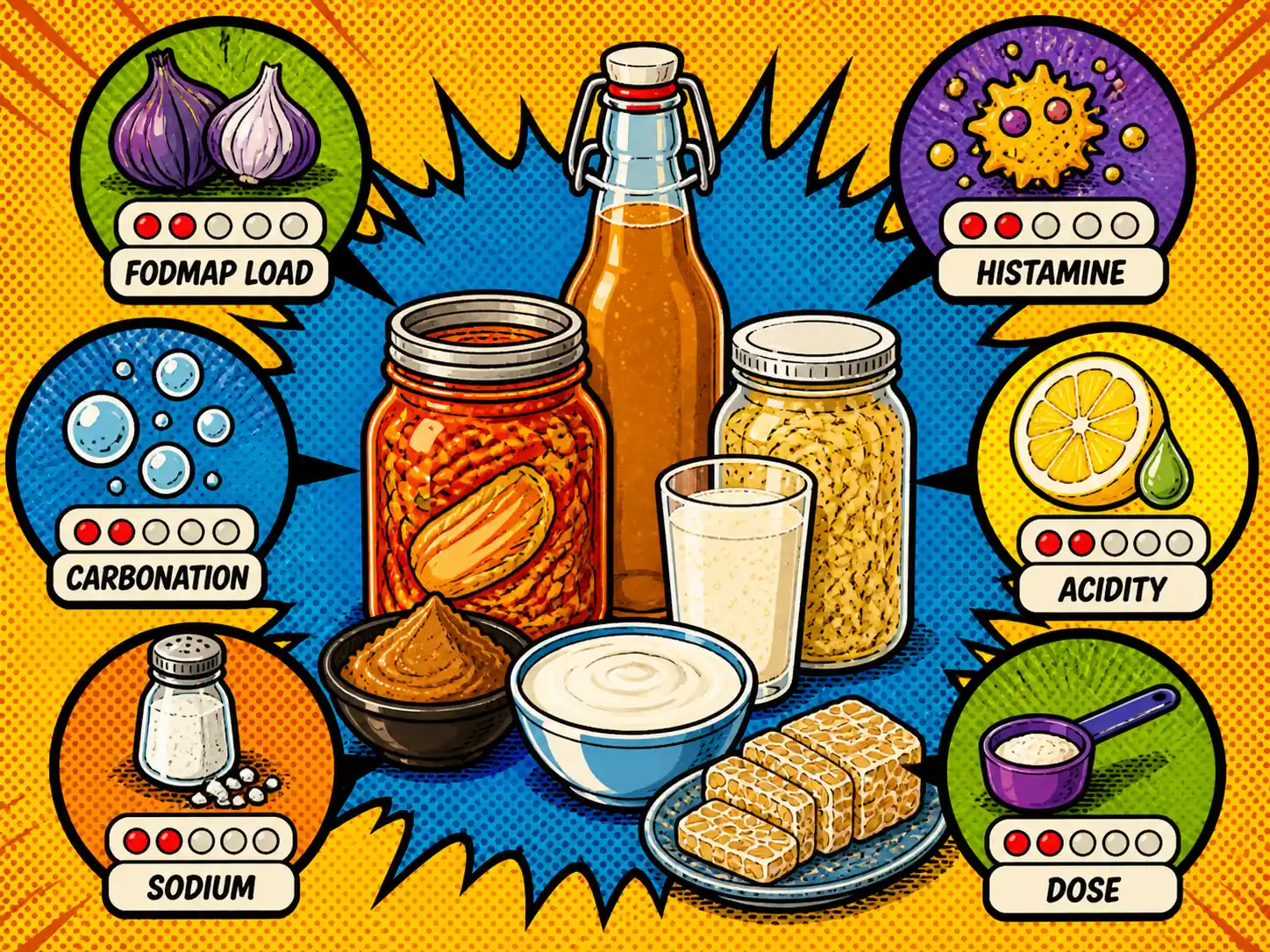
There is no universal best fermented food for gut health. The practical answer depends on the food matrix and the reader's tolerance pattern.
These are common starting points because they are familiar and can contain live cultures. They may also be easier for some people than large servings of fermented vegetables.
But dairy tolerance still matters. Some people react to lactose, milk proteins, fat content, sweeteners, or added fibers. If a yogurt is marketed as probiotic, the label still needs strain and evidence clarity before you treat it like a clinical probiotic.
These can be useful food-pattern additions for some readers. They can also be too loud for others because of cabbage, portion size, garlic, onion, chili, acid, sodium, histamine concerns, or active IBS sensitivity.
The better move is not "never eat kimchi" or "eat it every day."
The better move is to test a small portion in a simple meal and see whether your body treats it like food or like a flare trigger.
These fermented soy foods may fit readers who tolerate soy and want savory plant-food variety. Miso is often used in small amounts, which can make dose easier to control, but sodium matters. Tempeh is a whole-food protein option, but portion size and soy tolerance still matter.
If your bigger goal is plant-food variety rather than fermentation specifically, pair this with fiber diversity and microbiome resilience.
Kombucha is the fermented food where marketing often outruns tolerance.
It can be refreshing. It can also be carbonated, acidic, sweet, caffeinated, and symptom-loud. If bloating, reflux, or loose stool is your main issue, kombucha is not automatically the gentle starter just because it sits in the gut-health aisle.
Fermentation can change bread. That does not mean every sourdough is low FODMAP or symptom-friendly. Flour type, fermentation time, serving size, and the rest of the meal all matter.
If you are actively using low FODMAP as a symptom strategy, use low-FODMAP foods to eat for bloating relief as the practical filter rather than assuming the word sourdough settles it.
If fermented foods are not automatically good or bad, the next step is a better test.
Start with the gut you have this week, not the microbiome you wish you had.

Do not add kefir, kimchi, kombucha, and miso in the same week and then try to interpret the result. Choose one food.
Small matters because dose changes the signal. A teaspoon of sauerkraut in a meal is not the same exposure as a large bowl of fermented cabbage. A few sips of kombucha are not the same as a full bottle.
If you test kimchi with beans, onions, garlic, sparkling water, and a huge salad, you have not tested kimchi. You have tested a noisy stack.
Track:
One tolerated serving is useful. Three similar tolerated servings are more useful. Escalating too quickly is how gut-health experiments become unreadable.
[!TIP] Download: Fermented Food Fit Checklist and Fermented Food Category Map before you turn "fermented" into a bigger diet rule.
Sometimes the best gut-health move is not adding another category.
Pause fermented-food experiments and widen the review if you have:
Those patterns deserve medical review rather than another jar in the fridge.
Also pause if the experiment is making your diet smaller and more anxious. The goal is not to prove you can tolerate every trending food. The goal is to build a food pattern that supports your gut without making daily eating harder.
If fermented foods sound beneficial but repeatedly cause bloating, reflux, diarrhea, flushing, hives, or headache, use histamine, fermented foods, and gut symptoms as the tolerance-first route before forcing more ferments.
Fermented foods deserve a place in gut-health conversations. They can add microbial exposure, change food matrices, and may support microbiome diversity in some contexts.
But the more useful truth is less glamorous:
If you want the category map, go to synbiotics, probiotics, prebiotics, postbiotics, and SCFAs. If you want live-microbe IBS evidence, use probiotics for IBS strains. If you want the fermentation gas tradeoff, use fiber fermentation, gas, and bloating. If the bigger pattern is that good-for-you foods keep backfiring, use why healthy foods still make you bloated. If your question is less about fermentation and more about oats, wheat, beans, grain bowls, and plant-food variety during flares, use whole grains, plant foods, and gut tolerance. If the broader question is how plant-based eating fits IBS, bloating, fullness, plant proteins, and plant fats, use plant-based eating and gut symptoms.
Fermented foods are not a badge of gut-health purity. They are foods. Useful ones, for the right person, in the right amount, with the right expectations.
Xam Riche is a gut health solopreneur and founder of YourFitNature, dedicated to helping people navigate digestive wellness through evidence-based information and personal experience. After years of struggling with IBS and bloating, Xam discovered the transformative power of the low FODMAP diet and now shares practical, science-backed guidance to help others find relief. While not a medical professional, Xam combines extensive research with lived experience to create accessible, empowering resources for the gut health community. Learn more about our mission
As an affiliate, we may earn from qualifying purchases.