 By • Published on April 23, 2026 • 13 min read • 3,364 views
This article is for informational and educational purposes only and does not constitute medical advice. Always consult with a qualified healthcare professional before using microbiome or supplement content to make treatment decisions.
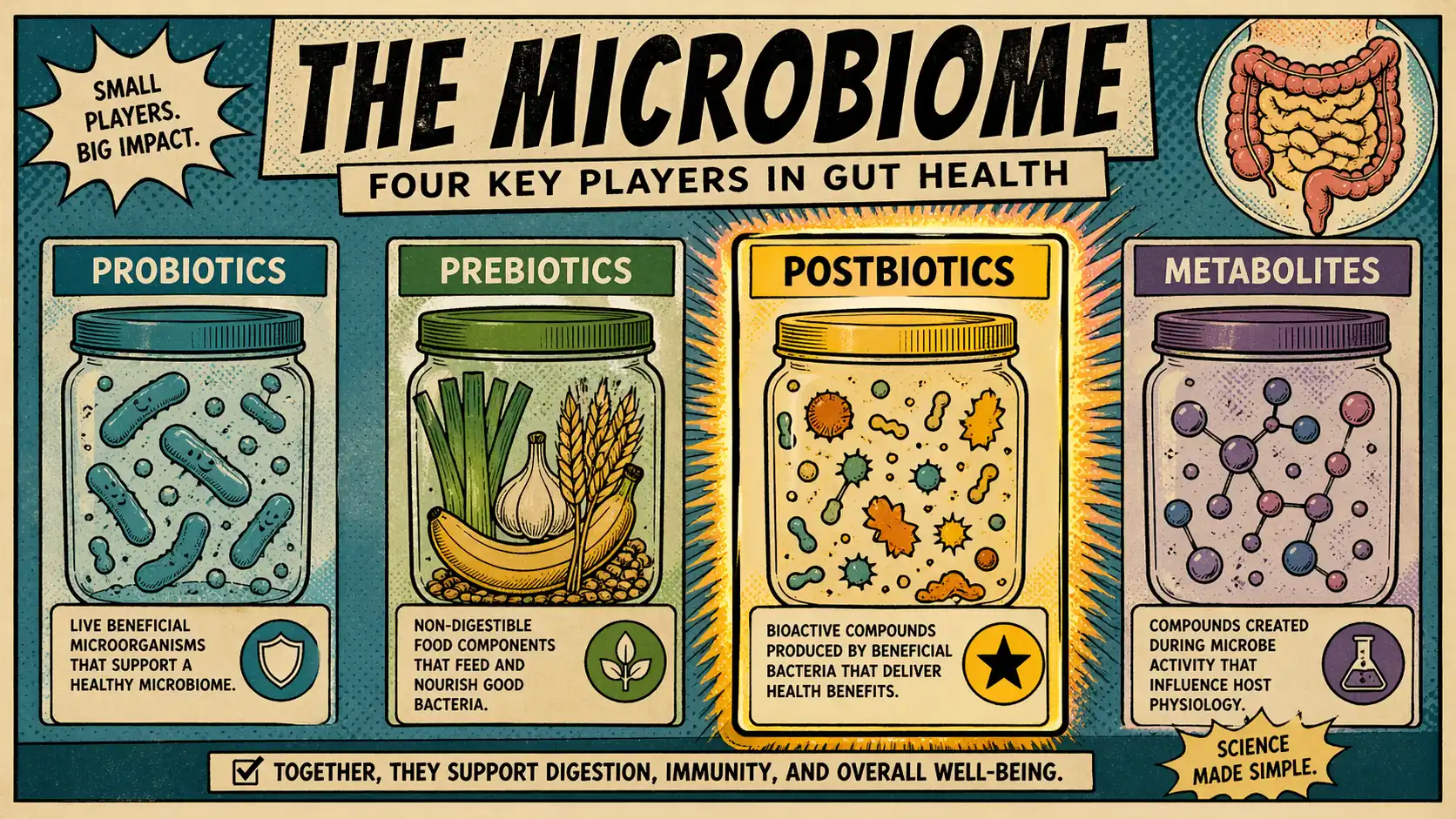
Postbiotics sound like one of those microbiome terms that should make the next step easier. Then the labels start talking. One says next-generation gut health. Another says safer than probiotics. A third quietly blurs together dead microbes, fermented foods, and butyrate as if they all belong in one neat bucket. Here is the truth: postbiotics are a real category, but the term is narrower than the marketing and much more useful when you define it correctly.
Short answer: postbiotics are preparations of inanimate microorganisms and/or their components that confer a health benefit on the host 1. That means the term does not automatically apply to every fermented food, every non-living microbe product, or every purified microbial metabolite. The most credible postbiotic benefits are product-specific, not category-wide.
This page is for you if you keep seeing "postbiotic" on labels or in microbiome content and want to know what the term actually means before you turn it into a shortcut for every gut-health decision.
Use a different page first if your main question is fermentable substrate, metabolite interpretation, or strain-specific probiotic selection. Those fit prebiotic fiber and what it may help, short-chain fatty acids and gut microbiota, or probiotics for IBS strains better.
If you are mainly feeling worse after experimenting with products that sound healthy, use why healthy foods still bloat you before you add another microbiome category to the pile.
The cleanest starting point is the 2021 ISAPP consensus statement. It defines a postbiotic as a preparation of inanimate microorganisms and/or their components that confers a health benefit on the host 2.
That definition matters because it quietly fixes most of the confusion.
Postbiotics are not just "microbe-related things that sound good for you." They are not just dead probiotics. They are not just the leftovers of fermentation. And they do not inherit every claimed benefit that marketing assigns to the microbiome.
ISAPP's plain-language explainer makes the sequence easier to follow:
That last point is the part labels often skip.
A category name is not evidence.
A preparation can sound sophisticated and still fail the more important question: what exactly was studied, in whom, and for what outcome?
The good news is that this narrower definition makes the term more helpful, not less. Instead of treating postbiotics as a vague wellness upgrade, you can use the word as a filter against hype.
This is the most useful section in the whole article because most confusion starts here.
Readers often blur together postbiotics and microbial metabolites, especially when butyrate or other short-chain fatty acids start appearing in the same conversation.
But that shortcut breaks the category.
ISAPP explicitly says that purified microbial metabolites are not postbiotics on their own. They have their own names and should be discussed as metabolites rather than relabeled as postbiotics 4 5.
That is why this distinction matters:
If you want the metabolite layer itself, use our SCFA explainer.
Fermented foods belong in a related but separate conversation.
They can contain live microorganisms, fermentation products, altered food matrices, or all three. That does not automatically mean they qualify as postbiotics under the ISAPP definition 6.
This matters because a lot of consumer content quietly jumps from "this food is fermented" to "therefore it is probiotic, prebiotic, and postbiotic." That is category drift, not clarity.
If your real question is the food side rather than the inactivated-microbe category, use fermented foods and gut health to separate microbiome promise from FODMAP, histamine, and tolerance caveats.
The term also should not be used as a catch-all label for anything containing non-living microorganisms.
The preparation, inactivation method, characterization, dose, and documented host benefit still matter 7.
That is where the sharper question becomes:
what exactly is in the product, and what does the human evidence actually show?
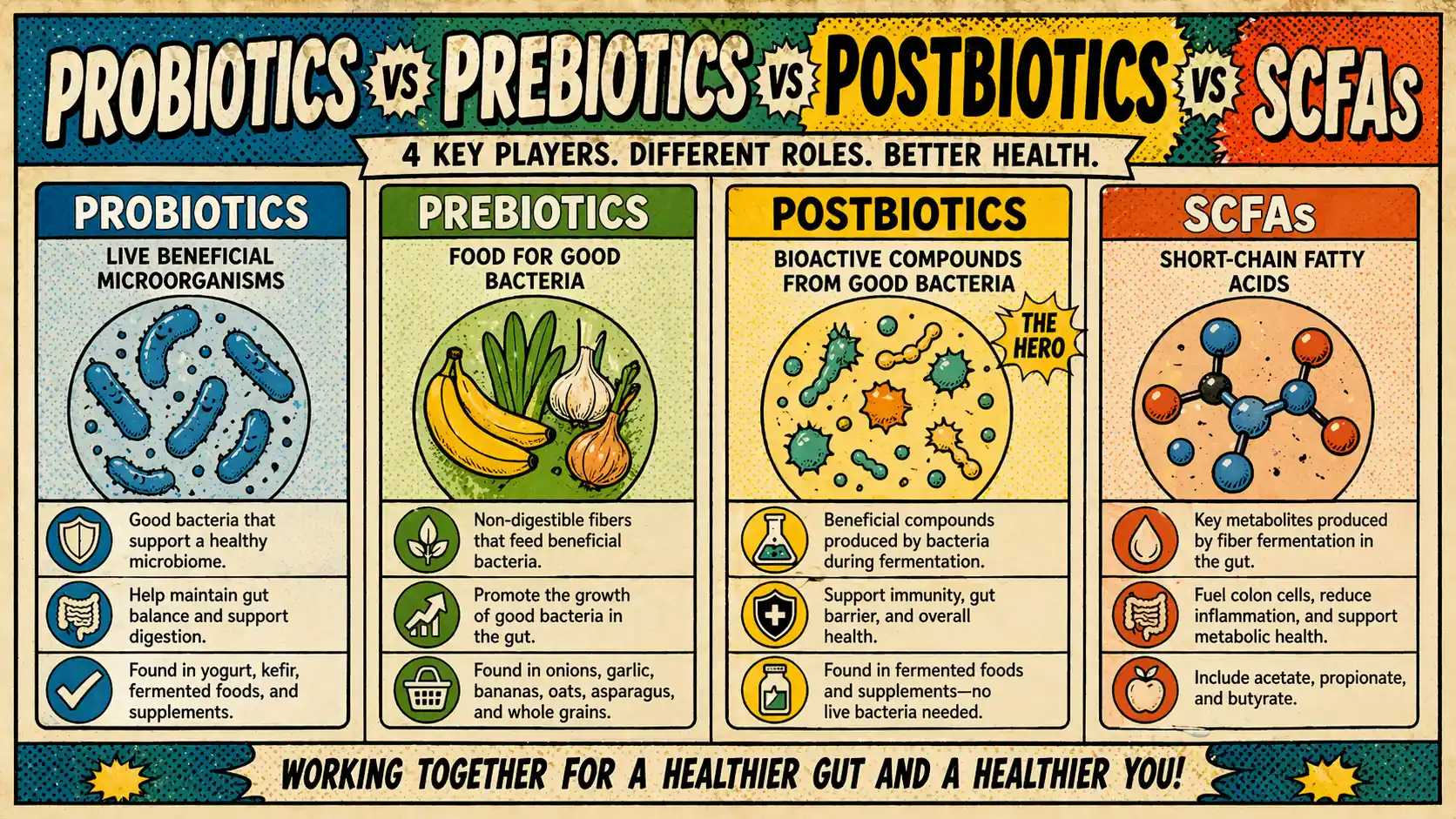
| Category | Plain-language definition | What the reader should ask next |
|---|---|---|
| Probiotics | Live microbes | Which strain and condition were studied? |
| Prebiotics | Substrates selectively used by microbes | Which ingredient and tolerance pattern fit? |
| Postbiotics | Preparations of inanimate microbes and/or their components | Which preparation was studied and for what benefit? |
| SCFAs | Microbial metabolites such as acetate, propionate, and butyrate | What mechanism does this explain, and what does it not settle? |
The safest way to talk about benefits of postbiotics is to stop thinking in category slogans and start thinking in specific preparations studied for specific outcomes.
The clearest examples for this site live in gut-facing human research.
One useful example is the randomized, placebo-controlled IBS trial involving a heat-inactivated Bifidobacterium bifidum MIMBb75 preparation 830056-X>). That does not prove that all postbiotics help IBS. It proves that one named preparation has meaningful IBS-relevant data.
That distinction is everything.
If you are comparing live-microbe options instead of inactivated preparations, move to probiotic strains with IBS-specific evidence. If your question is more constipation-focused, the better next page is prebiotics, probiotics, and synbiotics for constipation.
This is another area where selective evidence exists, but the category can get oversold fast.
A pediatric systematic review found only limited evidence to recommend specific postbiotics for some infectious-disease settings, including acute diarrhea and prevention of selected common infections 9.
That is promising in a narrow, specific way.
It is not the same as saying "postbiotics boost the immune system" in some broad consumer-friendly sense.
Early-life and infant-formula applications also help show why the category keeps getting attention. But they are another good example of why safety and efficacy have to be separated cleanly.
A 2023 systematic review and meta-analysis concluded that adding postbiotics to infant formula appeared safe, but did not show clear overall efficacy 10.
Bottom line: tolerated does not automatically mean strongly effective.
The broader literature and regulatory discussions include skin and other non-gut applications too 11. That range helps explain why the category keeps surfacing across wellness content, but it should stay a secondary note for this site's editorial system.
For gut-health readers, the main value is still understanding the category correctly before borrowing claims from another shelf.
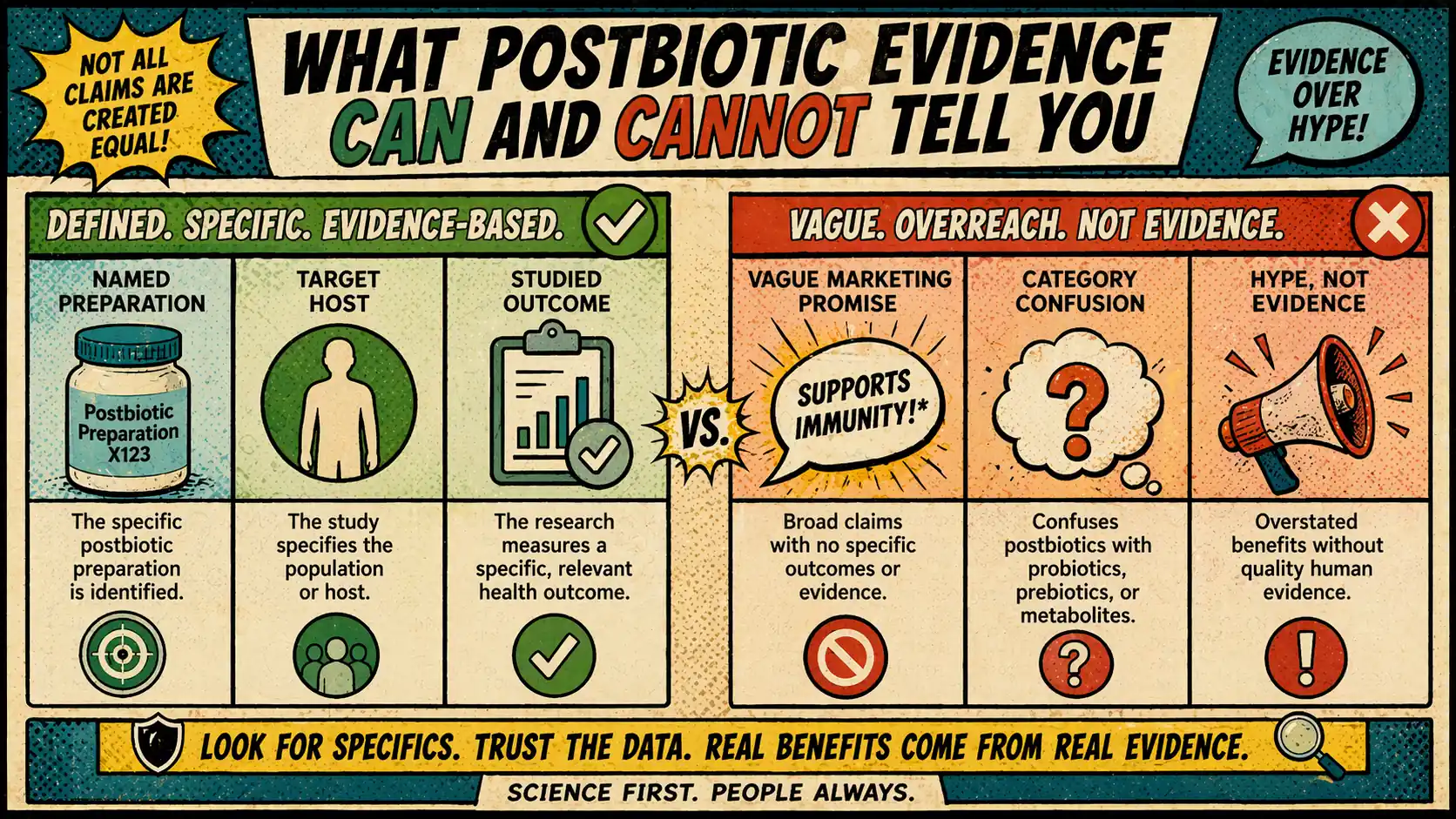
The phrase sounds harmless. In practice, it can flatten too much.
One strain. One preparation. One inactivation process. One dose. One target host. One studied outcome.
That is how the evidence usually works.
The 2024 ISAPP FAQ paper is clear that, as with the other biotics, a health benefit should be demonstrated in a well-designed intervention trial at the appropriate dose in the target host 12.
That means category-level language quickly outruns the data.
The field is full of plausible mechanisms. Some preparations may affect barrier-related biology, immune signaling, or microbiome-facing pathways. Those mechanisms matter. They still do not let you skip the evidence question.
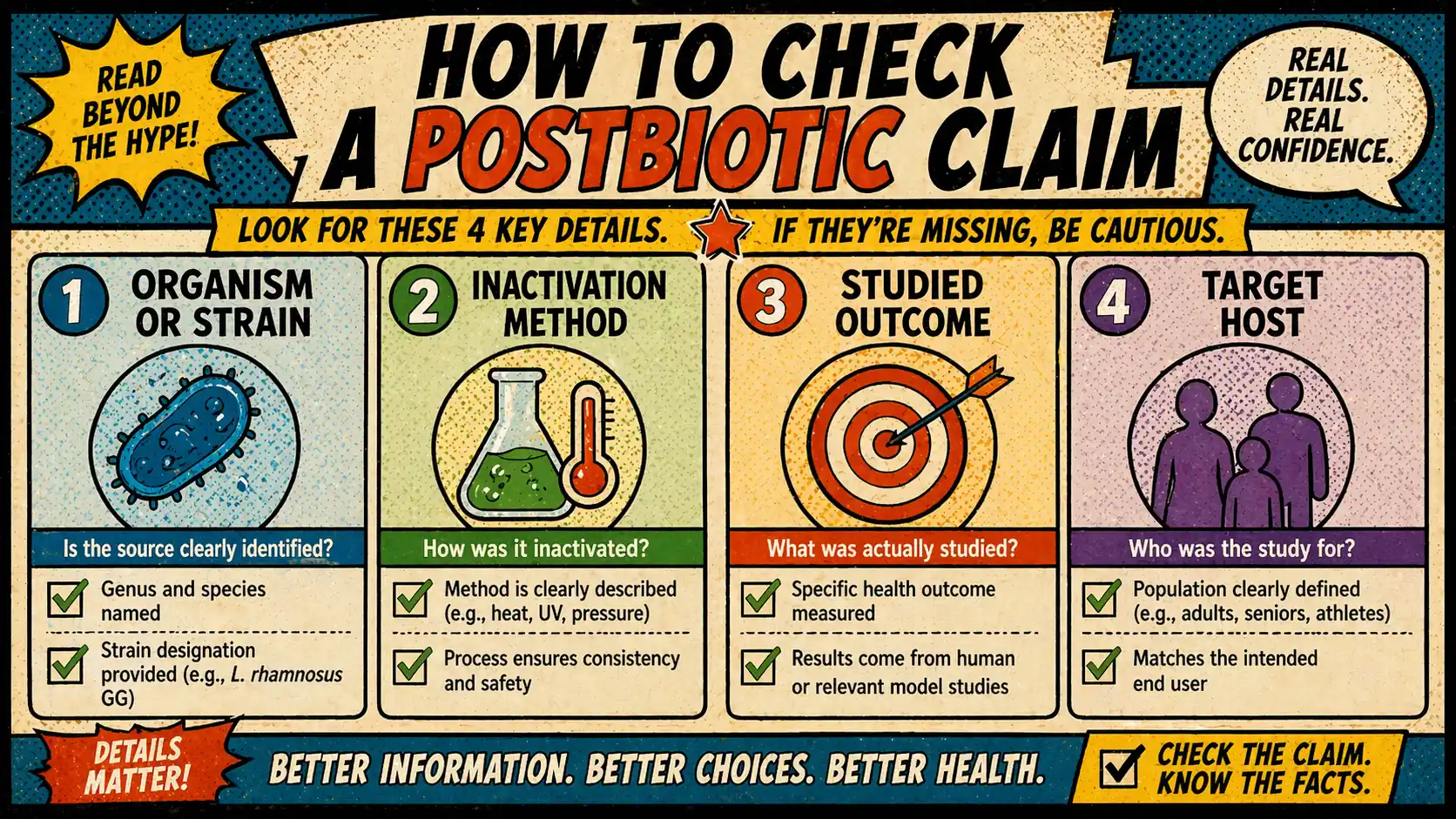
That is why the smartest way to read a postbiotic claim is:
This is one of the most repeated selling points around postbiotics.
There is a reasonable kernel inside it. In some settings, inanimate microbial preparations may be attractive because they can offer stability advantages or avoid some of the concerns that come with administering live microbes 13.
But that should not be turned into a blanket promise.
Safety still depends on the exact preparation, the intended user, and the use context. If a label collapses nuance into "better and safer than probiotics," that is not a science signal. It is a marketing signal.
This is where the article should make the rest of the microbiome shelf easier to navigate.
If your main question is whether a specific live strain helps IBS, bloating, or bowel-habit support, you need the probiotic shelf. Start with probiotic strains with IBS-specific evidence.
If your main question is whether inulin, FOS, GOS, resistant starch, or other fermentable inputs fit your current gut pattern, you need the substrate shelf. Start with prebiotic fiber and what it may help. If you need the simpler first pass on probiotic vs prebiotic before adding postbiotics to the map, use that comparator first.
If your main question is what acetate, propionate, and butyrate mean, you need the metabolite shelf. Start with short-chain fatty acids and gut microbiota.
If your main question is whether a product's postbiotic label means something specific and credible, stay here.
This category line also matters upstream in the broader mechanism shelf. If you want the food-to-microbiome science that sits above these intervention choices, use the broader microbiome mechanism shelf.
The fastest way to turn this article into a real decision is to ask better questions.
If your question is still mostly "what even is this category?" stay in the comparison sections above.
If your question is "which live microbes help IBS?" route to probiotics for IBS.
If your question is "should I use fermentable substrate support at all?" route to prebiotic fiber and what it may help.
If your question is "why do gut-health products keep sounding right while my symptoms keep sounding wrong?" route to why healthy foods still bloat you.
If your question is "which microbiome shelf should I open next?" use the map below.
Download the printable version: Postbiotic Category Checklist and Postbiotic Route-by-Question Guide for a faster label check the next time a product page tries to collapse four microbiome categories into one promise.
Sometimes the wrong move is not buying the wrong product.
Sometimes it is staying in microbiome terminology when the real issue is a symptom pattern that needs broader sorting.
Persistent bloating, pain, vomiting, bleeding, unintentional weight loss, or inability to pass stool or gas deserve broader evaluation rather than another category explainer 14 15.
If your gut-health reading keeps getting more technical while your symptom map keeps getting less clear, that is the signal to step back.
Postbiotics are a legitimate category. That matters.
But the more useful truth is narrower: the term works best when it protects you from category confusion instead of giving you another vague promise to chase.
Start here:
If you need mechanism clarity, go to short-chain fatty acids and gut microbiota. If you need substrate clarity, go to prebiotic fiber and what it may help. If you need live-microbe evidence, go to probiotics for IBS strains.
This article is for informational purposes only and is not intended as medical advice. Please consult a qualified healthcare provider for diagnosis and treatment of any health condition.
Xam Riche is a gut health solopreneur and founder of YourFitNature, dedicated to helping people navigate digestive wellness through evidence-based information and personal experience. After years of struggling with IBS and bloating, Xam discovered the transformative power of the low FODMAP diet and now shares practical, science-backed guidance to help others find relief. While not a medical professional, Xam combines extensive research with lived experience to create accessible, empowering resources for the gut health community. Learn more about our mission
As an affiliate, we may earn from qualifying purchases.