 By • Published on April 23, 2026 • 15 min read • 1,134 views
This article is for informational and educational purposes only and does not constitute medical advice. Always consult with a qualified healthcare professional before using microbiome or nutrition content to make diagnosis or treatment decisions.
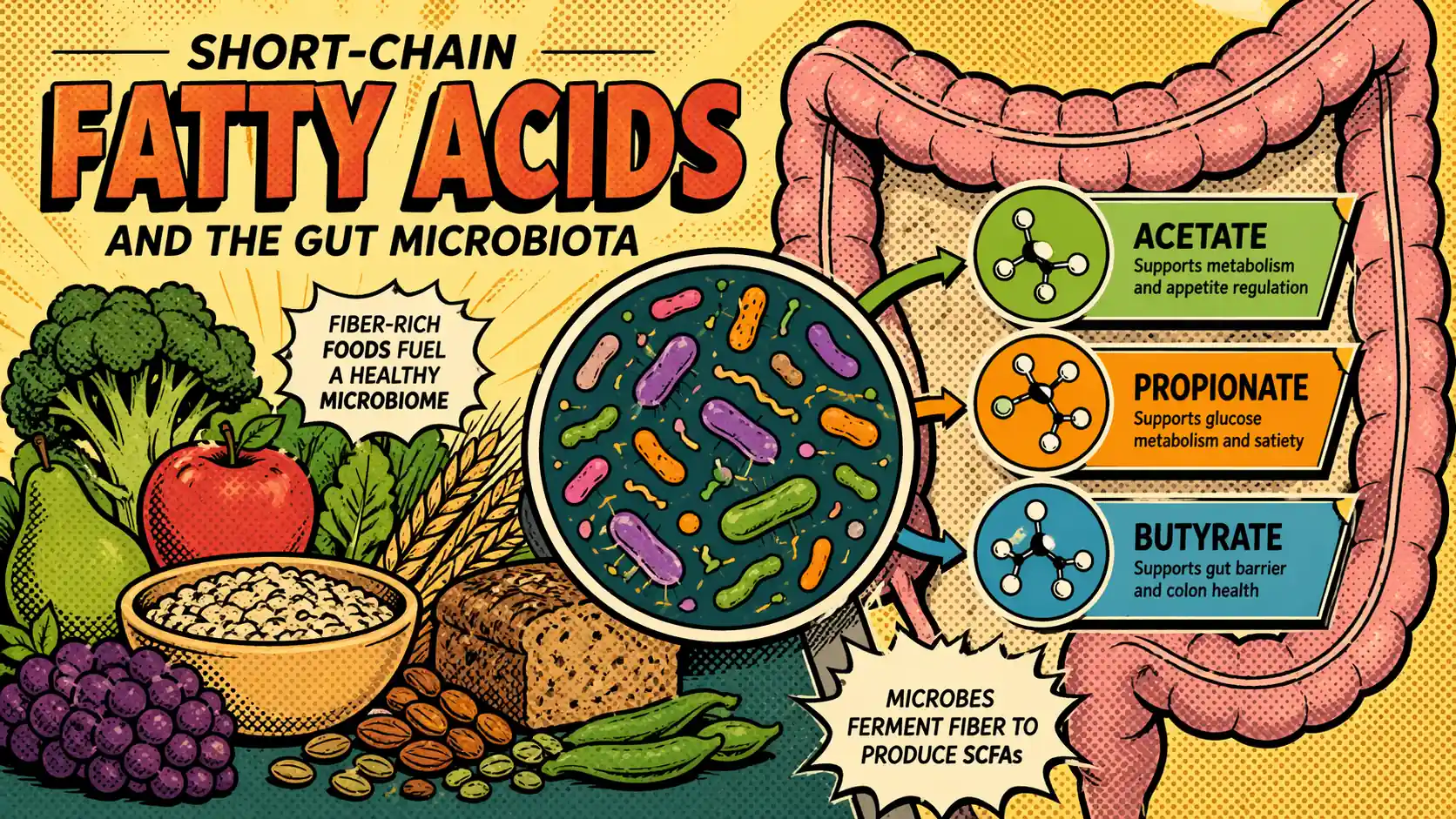
Short-chain fatty acids sound like one of those microbiome phrases that should make everything clearer. Then the articles start. One says butyrate protects the gut barrier. Another says SCFAs explain immune balance. A third says you need more prebiotics right now. Here is the truth: SCFAs are a real and useful bridge concept, but they still need interpretation before they become a next step.
Short answer: short-chain fatty acids, or SCFAs, are compounds gut microbes make when they ferment certain substrates, especially dietary fiber 1. The main ones people discuss are acetate, propionate, and butyrate. They matter because they help explain why microbiome-supportive foods and microbial ecology can have host-facing effects. They do not automatically tell you which product to buy, which test to trust, or why your symptoms are doing what they are doing.
This page is for you if you keep seeing SCFA language inside prebiotic, fiber, polyphenol, or organ-axis content and want to know what it actually means before you turn one mechanism into a universal answer.
Use a different page first if your real question is ingredient-level decision-making, food-first microbiome support, or a symptom-first bloating pattern. Those fit prebiotic fiber and what it may help, polyphenol foods for gut health, or why healthy foods still bloat you better.
If you read that prebiotic fiber or resistant starch can help because it raises SCFAs, the logic can feel simple.
More fermentable substrate should mean more beneficial metabolites.
Sometimes that is directionally useful. Sometimes it hides the harder question: useful for whom, in what context, and at what symptom cost?
This article is the mechanism bridge between upstream inputs and downstream claims. If you want the metabolite layer, stay here.
Short-chain fatty acids are small organic compounds produced when gut microbes ferment substrates that make it to the colon, especially dietary fiber and other microbiota-accessible carbohydrates 2 3.
The three main SCFAs people talk about are:
That list matters because many articles make the phrase sound abstract, when it is really pointing to a downstream chemistry story.
SCFAs are not foods. They are not a supplement category by themselves. They are not proof that one microbiome intervention is automatically working.
They are metabolites.
That makes them useful because they sit at a meaningful crossroads:
This is also why readers keep seeing butyrate everywhere. Butyrate deserves attention, especially for local colonocyte and barrier discussions 4. But a butyrate-only version of the story is too narrow. Acetate and propionate belong in the same picture, and the article is less useful if it quietly drops them.
The good news is that the fuller picture is more actionable anyway. It lets you read microbiome claims with more precision instead of treating one metabolite like a magic stamp of approval.
SCFAs come from fermentation.
That sounds technical, but the plain-language version is simple: some food components are not fully digested by your own enzymes, so they continue into the colon where microbes can use them. One outcome of that microbial activity is SCFA production 5.
The upstream inputs often discussed in this context include:
If you want the ingredient-side explanation before this metabolite layer, use prebiotic fiber and what it may help. If you want the broader food-to-microbiome shelf above this article, use polyphenols and the gut microbiome.
The important correction is this: one food does not act alone.
Microbes interact with each other. Some species break down one substrate into a compound that another species then uses. That is one reason cross-feeding keeps appearing in SCFA discussions. An ISME Journal paper even showed that while different substrates can shift microbiota composition, the resulting SCFA output may still show functional redundancy 6.
If you want the upstream bridge on why a wider range of fibers may create broader microbial opportunities before this metabolite layer even begins, use fiber diversity and microbiome resilience.
That matters because it stops the article from slipping into a fake certainty model:
Real guts are messier than that.
The same prebiotic ingredient, fiber-rich meal, or polyphenol-heavy pattern can produce different responses depending on:
If you want the mechanism-first bridge for why fermentation can help and hurt, use that article before you turn SCFA language into a symptom assumption.
Bottom line: SCFA production is a microbiome story, not just a single-food story.
The easiest way to make this useful is to describe the three main SCFAs without pretending each one settles a treatment decision.
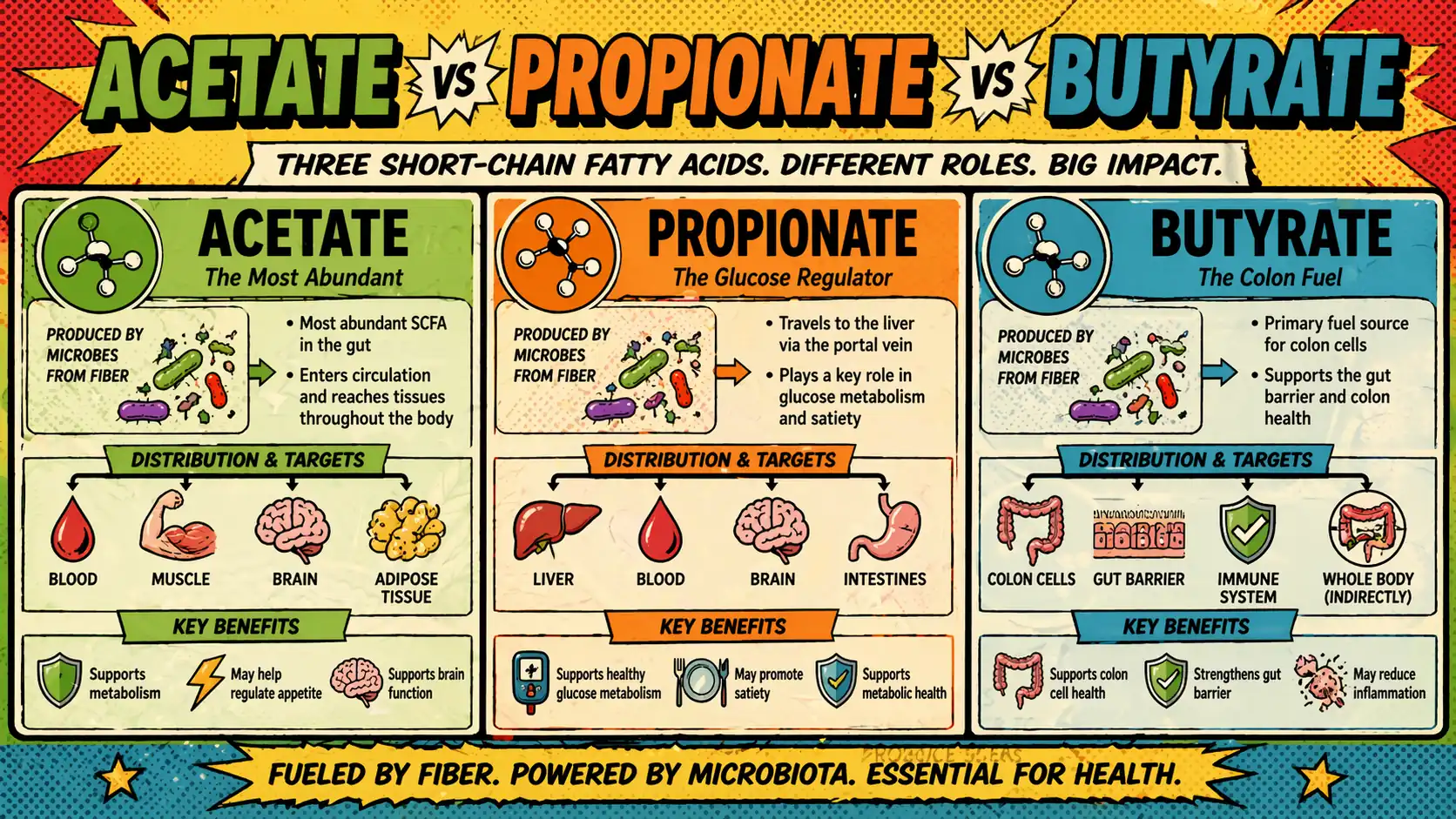
Acetate is often the most abundant SCFA discussed in circulation and broader host metabolism. That is one reason it shows up in systemic reviews and not only in colon-specific discussions 7 8.
Plain-language translation:
Propionate is often discussed in relation to liver-facing and metabolic pathways, which is why it keeps appearing in broader host-metabolism summaries 9.
That makes it interesting. It does not make it a shortcut.
The more disciplined reading is that propionate helps show how gut metabolites can matter beyond digestion, not that a reader should start treating one propionate pathway as a personal diagnosis.
Butyrate gets the most attention for understandable reasons. It is repeatedly highlighted for local gut-facing roles such as colonocyte fuel and barrier relevance 10 11.
This is why butyrate appears across the current site ecosystem:
But here is the part worth repeating:
butyrate is a useful explanation. It is not a guaranteed outcome.
Readers sometimes run into branched-chain fatty acids and assume they are the same discussion. They are related to microbial metabolism, but they are not the same thing as the main SCFA trio that dominates gut-health content 12.
That distinction is enough for this article. The goal is clarity, not another detour.
The old marketing version of SCFA content tends to flatten everything into one glossy sentence:
SCFAs are good. Therefore more SCFAs are better. Therefore the product is helpful.
That is not how the evidence reads.
The stronger version is to rank the claims.
This is the safest and strongest part of the story. SCFAs matter because they are major microbial fermentation products and because they help explain host-microbe signaling 13 14.
This is what the article should defend most confidently.
The evidence is also meaningful for broader pathways involving barrier integrity, immune signaling, and host physiology, especially in reviews that connect diet, the microbiome, and immunity 15 16.
That is important. It is also where many consumer articles lose discipline.
Interesting does not mean automatic.
Promising does not mean proven for every person, every intervention, or every organ-system claim.
This is where readers most need a brake pedal.
Stool SCFA language sounds practical because it feels measurable. But the article should not imply that fecal SCFA values map neatly onto:
The literature is more complicated than that 17 18.
That makes SCFAs a better framework than a shortcut.
If you want the food and ingredient translation behind this mechanism, return to prebiotic fiber and what it may help. If you want to keep following the systems-science shelf, the gut-heart axis and gut-lung axis show how the same metabolite logic gets discussed in whole-body frameworks.

This is the part that keeps the article useful instead of merely interesting.
A fermentable substrate may be microbiome-relevant and still feel awful in a bloating-prone gut.
That is why the same article can legitimately say both of these things:
Monash's low FODMAP framework matters here because fermentable substrates can be conceptually interesting and still symptom-heavy in the wrong context 19.
If that is your pattern, the better next page is usually not a stool test or a new supplement. It is something like why healthy foods still bloat you or constipation and bloating, where pattern-fit leads the decision.
This part is worth saying plainly.
SCFAs do not tell you whether:
That is why the site needs multiple shelves. SCFAs explain one layer. They do not replace the others.
This category line matters because it keeps future content cleaner.
ISAPP's postbiotic definition refers to preparations of inanimate microorganisms and their components that confer a health benefit on the host, and it explicitly notes that purified microbial metabolites are not themselves postbiotics 20.
So if a reader has blurred together:
the correction is not complicated:
That distinction protects the whole bridge lane from turning into one vague bucket of microbiome marketing.
If you want the dedicated category explainer behind that distinction, read what postbiotics are and where their benefits may fit.
The most useful question is not "Are SCFAs good?"
It is "What does this mechanism change about my next step?"
Good-fit next steps look like this:
Caution-first next steps look like this:
Here is the simplest routing version:
That routing turns the topic back into something practical:
[!TIP] Download: SCFA Interpretation Guide Use this one-page guide when a microbiome headline sounds persuasive but you are not sure what the mechanism actually justifies.
Microbiome mechanisms can be clarifying.
They can also become a trap if they encourage you to over-interpret everything through one concept.
If your story includes persistent or worsening bloating, severe pain, vomiting, bleeding, weight loss, or inability to pass stool or gas, do not keep trying to solve it through metabolite language alone. NHS and NIDDK both frame those patterns as signals to widen the evaluation rather than keep guessing 21 22.
That is one reason this page keeps routing instead of pretending to settle everything in place.
[!TIP] Download: SCFA Route-by-Situation Checklist Use this printable routing sheet if you want to choose the right next shelf before chasing another microbiome claim.
SCFAs are worth understanding. They are just not worth idealizing.
Bottom line:
If you are still deciding what that next page should be, use the routing block below instead of guessing.
Xam Riche is a gut health solopreneur and founder of YourFitNature, dedicated to helping people navigate digestive wellness through evidence-based information and personal experience. After years of struggling with IBS and bloating, Xam discovered the transformative power of the low FODMAP diet and now shares practical, science-backed guidance to help others find relief. While not a medical professional, Xam combines extensive research with lived experience to create accessible, empowering resources for the gut health community. Learn more about our mission
As an affiliate, we may earn from qualifying purchases.