 By • Published on May 15, 2026 • 9 min read • 3,535 views
This article is for informational and educational purposes only and does not constitute medical advice. Always consult with a qualified healthcare professional before using symptom information to make diagnosis, testing, or treatment decisions.
If watery diarrhea keeps winning despite the usual IBS-D cleanup, the next move may not be another food rule. It may be a narrower question.
IBS-D and bile-acid diarrhea can look similar from the outside: loose stool, urgency, post-meal bathroom runs, and a sense that your gut is moving too fast. That overlap is exactly why people get stuck. If every flare is treated as "just IBS-D," a pattern that deserves a different clinician conversation can stay buried under more restriction, more tracking, and more frustration.
This page is a comparison map. It does not diagnose bile-acid diarrhea from one symptom or one rich meal. It helps you decide when the pattern is specific enough to ask whether bile acids belong in the conversation at all.
Do not use a comparison article to talk yourself out of medical review.
NIDDK says diarrhea can become dangerous when it causes dehydration or signals a more serious problem, and it advises prompt medical attention for black or bloody stool, severe pain, frequent vomiting, dehydration symptoms, high fever, or adult diarrhea lasting more than 2 days 1.
Get medical guidance promptly if diarrhea or urgency comes with:
If the immediate issue is safety, use the IBS flare plan or IBS vs colorectal warning signs before you keep sorting at home.
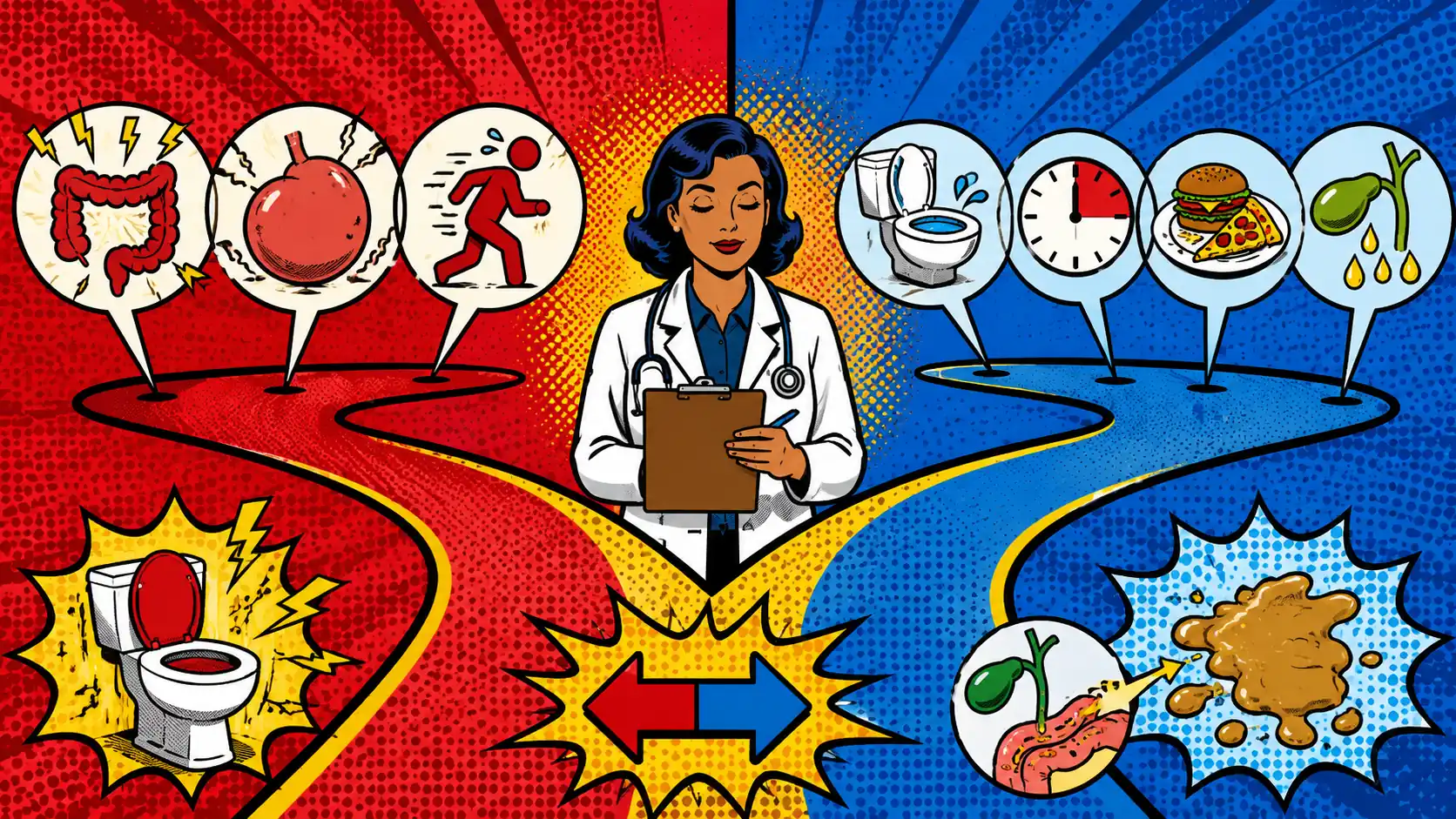
IBS-D is a broad syndrome label. Bile-acid diarrhea is a narrower mechanism-based question.
AGA's chronic-diarrhea guidance specifically suggests testing for bile-acid diarrhea in adults with chronic diarrhea 2. That recommendation exists because some readers with IBS-D-like symptoms have a pattern that deserves more than another generic diarrhea plan.
The practical distinction is not "IBS-D means mild" and "bile-acid diarrhea means severe." It is this:
| Question | IBS-D lane | Bile-acid diarrhea lane |
|---|---|---|
| What is the frame? | A broader disorder of gut-brain interaction with diarrhea-predominant symptoms | A narrower diarrhea mechanism involving too much bile acid reaching the colon |
| What often brings people in? | Loose stool, urgency, pain, bloating, food-trigger confusion | Chronic watery diarrhea, urgency, looser stool consistency, sometimes a strong post-meal pattern |
| Does one meal prove it? | No | Also no |
| What changes the next step? | Symptom mix, red flags, and response to IBS-D management | Chronic watery pattern plus the right clinical history or persistence despite routine cleanup |
| What is the useful question? | "Which IBS-D route fits my dominant problem?" | "Should bile-acid diarrhea be evaluated instead of assumed away?" |
A recent review describes bile-acid diarrhea as an under-recognized condition that commonly presents with increased stool frequency, urgency, and looser stool consistency 3. That sounds familiar to many IBS-D readers. The overlap is real; the point is to ask better questions inside it.
Watery is a clue, not a verdict.
The bile-acid conversation becomes more worth raising when several of these are true at once:
That is the moment to widen the lens, not to self-diagnose. If the broader issue is still just "which IBS-D treatment lane fits?", start with IBS-D medications and diarrhea options. If low FODMAP never made the pattern coherent, use when low FODMAP does not work for the wider troubleshooting frame.
Testing depends on where you live, what your clinician has access to, and the rest of the history.
The 2023 review discusses diagnostic approaches including SeHCAT in some settings and newer strategies using fasting serum C4 plus stool bile-acid measures 4. AGA's guidance keeps the higher-level principle simpler: in chronic diarrhea, bile-acid diarrhea is a reasonable thing to test for 5.
That means the appointment question is usually not:
"Can I prove this from one meal?"
It is closer to:
"Given my chronic watery diarrhea pattern, should bile-acid diarrhea be part of the evaluation, and which testing route is actually available here?"
If you still need the broader test map first, use IBS tests, celiac, SIBO, calprotectin, and colonoscopy so bile acids sit beside the other questions rather than replacing them.
Bile-acid binders belong in a clinician conversation, not a home experiment.
ACG does not recommend bile-acid sequestrants as routine treatment for global IBS-D symptoms because the evidence is weak for that broad use 6. That does not mean they are irrelevant in diagnosed bile-acid diarrhea. A 2024 meta-analysis of randomized trials found bile-acid sequestrants improved several diarrhea outcomes in people with bile-acid diarrhea, while also increasing abdominal cramping in the pooled evidence 7.
The clean interpretation is:
That distinction keeps the page honest. It also keeps you from shrinking your food world when the next useful move is a medical conversation instead.
The evidence on this page supports a clinician-guided question, not a home diagnosis. AGA guidance makes bile-acid diarrhea a reasonable testing question in chronic diarrhea, review evidence describes common watery-diarrhea and urgency patterns, ACG cautions against using bile-acid sequestrants as routine global IBS-D treatment, and treatment trials apply to people with bile-acid diarrhea rather than every reader with IBS-D-like symptoms.
That means the evidence can support asking, "Should bile-acid diarrhea be part of my workup?" It cannot decide that you have bile-acid diarrhea, choose a test, start a binder, or explain away blood, fever, dehydration, nighttime diarrhea, weight loss, or severe pain. The action translation is to track the watery pattern and ask about available testing or supervised treatment only with a clinician.
Bring the pattern, not a self-diagnosis.
For 1 to 2 weeks, track:
If dehydration is part of the picture, keep hydration, electrolytes, and gut symptoms nearby. If the pattern is most obvious immediately after meals, urgency after meals can help you separate setup problems from a wider diarrhea lane.
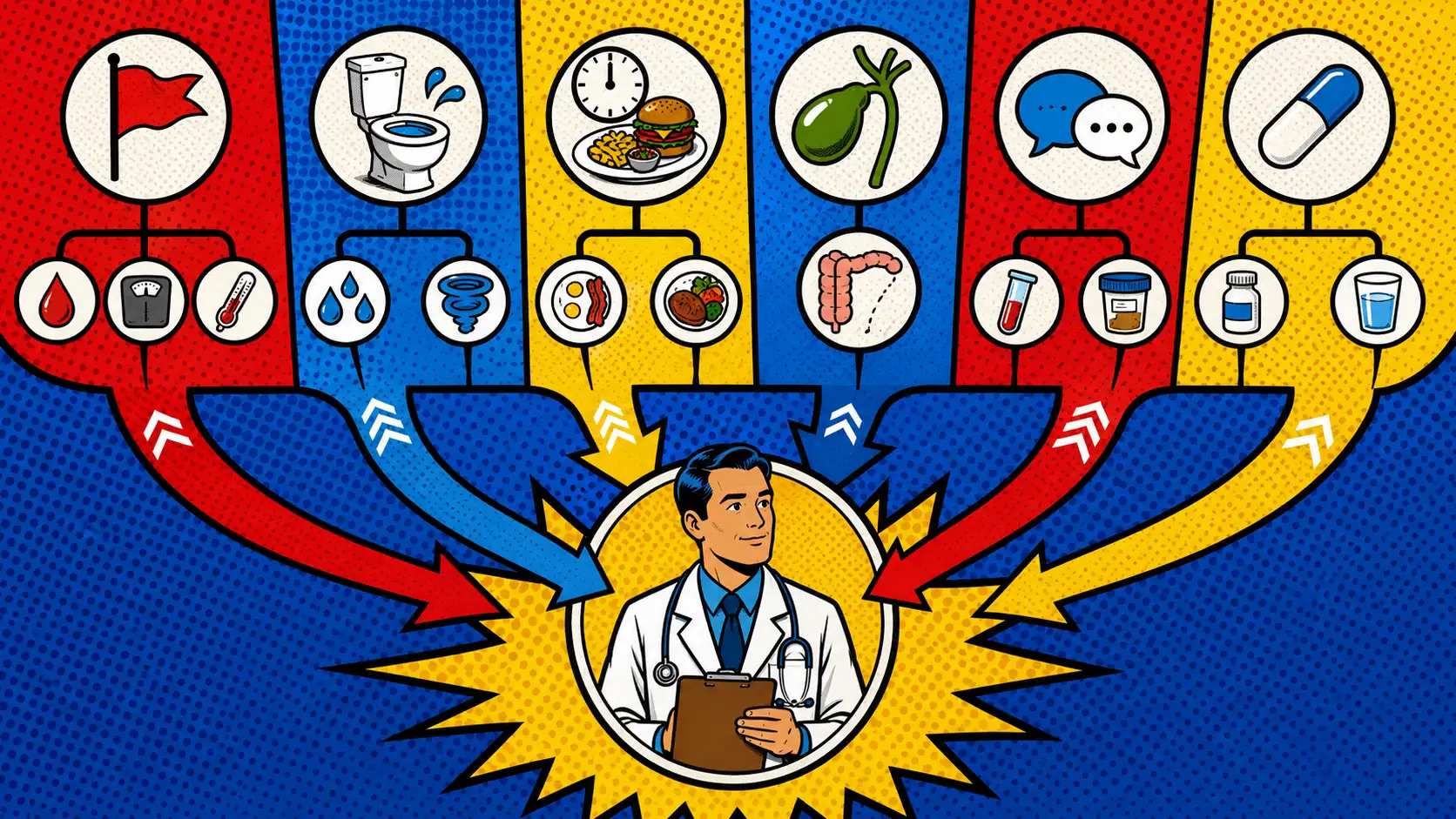
Free Download: Bile-Acid Diarrhea Conversation Guide Bring the symptom pattern, history, and appointment questions together in one printable page.
Use this wording to keep the appointment focused:
"My main pattern is chronic watery diarrhea with urgency. It happens [number] times per day/week, is worse after [meals/fatty meals/mornings/unknown], and has continued despite [low-FODMAP cleanup, caffeine change, IBS-D steps, or no structured trial yet]. Given this pattern, should bile-acid diarrhea be considered, and what testing or supervised treatment options are available here?"
Also ask:
Get prompt medical help for watery diarrhea with blood or black stool, fever, severe or worsening pain, repeated vomiting, dehydration, fainting, weight loss, nighttime diarrhea, recent antibiotics, immune suppression, pregnancy, older age, or symptoms that feel clearly different from your baseline. Professional support is also the right move when diarrhea is persistent enough that you are planning medication changes, stopping medicines, or repeatedly narrowing your diet.
| If your main question is... | Read next |
|---|---|
| "Which IBS-D medication conversation fits overall?" | IBS-D medications and diarrhea options |
| "My gallbladder history might change the diarrhea question." | Gallbladder diarrhea vs IBS-D |
| "My meals trigger urgent bathroom runs, but I am not sure why." | Urgency after meals |
| "Low FODMAP helped a little, but watery diarrhea is still not readable." | When low FODMAP does not work |
| "I need the broader testing map before I focus on bile acids." | IBS tests, celiac, SIBO, calprotectin, and colonoscopy |
| "I want the diet-adjustment version of the IBS-D lane." | IBS-D and low FODMAP |
Bile-acid diarrhea and IBS-D can resemble each other closely enough to create a lot of confusion. The useful question is not whether one symptom proves one label. It is whether chronic watery diarrhea, urgency, persistence despite routine cleanup, and the rest of your history make bile acids worth discussing instead of assuming the whole problem is generic IBS-D.
If the pattern is broad and still clearly IBS-D, use the IBS-D options route. If it is persistently watery, hard to explain, or no longer responding to another round of restriction, widen the conversation. Sometimes the most practical next step is not a smaller diet. It is a better question.
Xam Riche is a gut health solopreneur and founder of YourFitNature, dedicated to helping people navigate digestive wellness through evidence-based information and personal experience. After years of struggling with IBS and bloating, Xam discovered the transformative power of the low FODMAP diet and now shares practical, science-backed guidance to help others find relief. While not a medical professional, Xam combines extensive research with lived experience to create accessible, empowering resources for the gut health community. Learn more about our mission
As an affiliate, we may earn from qualifying purchases.