 By • Published on May 6, 2026 • 14 min read • 2,002 views
This article is educational and is not cancer screening, diagnosis, treatment, or supplement advice. If you have colorectal cancer, possible warning signs, a new diagnosis, chemotherapy, surgery, immune suppression, or infection risk, use your oncology or gastroenterology team as the decision-maker.

Microbiome headlines can sound hopeful very quickly. A bacterium is linked with colorectal cancer. A probiotic protocol is studied around surgery. A stool marker looks promising. The problem starts when those ideas get pulled out of their evidence lane and turned into cancer-care advice.
Short answer: gut microbiome and probiotic research may help explain colorectal cancer mechanisms, biomarkers, treatment response, or selected supportive-care questions. It does not replace colorectal cancer screening, symptom evaluation, diagnosis, staging, surgery, chemotherapy, radiation therapy, targeted therapy, immunotherapy, or oncology-team guidance 1.
This article is for readers who have seen microbiome or probiotic claims around colorectal cancer and want to know what those claims do not mean.
If you have blood in stool, a persistent bowel habit change, abdominal pain that does not go away, unexplained weight loss, anemia, or rapidly worsening lower-GI symptoms, start with medical evaluation. For a symptom-sorting page, use IBS vs colorectal warning signs. This page is not a substitute for that.
The safest way to read colorectal cancer microbiome claims is to ask what job the claim is doing.
| Claim you may see | What it may mean | What it does not mean | Safer next question |
|---|---|---|---|
| "The microbiome is linked with colorectal cancer" | Researchers have found associations, mechanisms, or patterns worth studying | A consumer can change one microbe and prevent or treat cancer | Is this association, animal mechanism, or human clinical evidence? |
| "Some bacteria may be biomarkers" | Microbial markers may help future screening or risk models | A microbiome test replaces validated screening or colonoscopy | Has this been validated for clinical use in the setting I care about? |
| "Probiotics may reduce postoperative complications" | Selected perioperative protocols may affect infections or gut recovery | Probiotics treat the tumor or replace surgery, antibiotics, or oncology care | Which product, dose, timing, population, and outcome were studied? |
| "Diet changes the microbiome" | Food patterns can influence microbial ecology and long-term risk factors | Diet alone becomes colorectal cancer treatment | Is this prevention context, treatment context, or general health context? |
| "FMT or next-generation microbial therapy is being studied" | Microbial therapies are active research areas | FMT is a routine CRC treatment | Is this an approved indication, a clinical trial, or a speculation? |
That table is the entire article in miniature: the science can be real while the personal decision remains much narrower.
Colorectal cancer care starts with the right question.
Screening asks whether someone without symptoms should be tested based on age and risk. In the United States, USPSTF recommends colorectal cancer screening for adults ages 45 to 49 and adults ages 50 to 75, with individualized decisions for some older adults 2.
Symptom evaluation is different. CDC notes that colorectal polyps or colorectal cancer may not cause symptoms early, and that possible symptoms can include a change in bowel habits, blood in or on stool, diarrhea, constipation, a feeling that the bowel does not empty, abdominal pain or cramps that do not go away, and unexplained weight loss 3.
Treatment is a third question. After diagnosis, staging helps determine the plan. NCI describes standard colon cancer treatment categories that include:
Probiotics, microbiome tests, fermented foods, and microbiome supplements do not sit in that list as standard cancer treatment 4.
That does not make microbiome research worthless. It keeps the claim in the right lane.
The old source drafts behind this article were right about one thing: the gut microbiome is a serious colorectal cancer research topic.
Researchers study microbial patterns because they may help explain:
If you want the broader mechanism shelf, use polyphenols and the gut microbiome or short-chain fatty acids and the gut microbiota.
The problem is translation speed. A microbial pattern in a study does not automatically become a consumer action.
For example, if a bacterium is more common in colorectal cancer tissue or stool samples, that might support biomarker research. It does not prove that the bacterium caused the cancer in a way a probiotic can correct. It also does not mean a home microbiome report can tell you whether you have colorectal cancer.
This is the evidence-literacy boundary:
Skipping that ladder is how careful science turns into unsafe certainty.
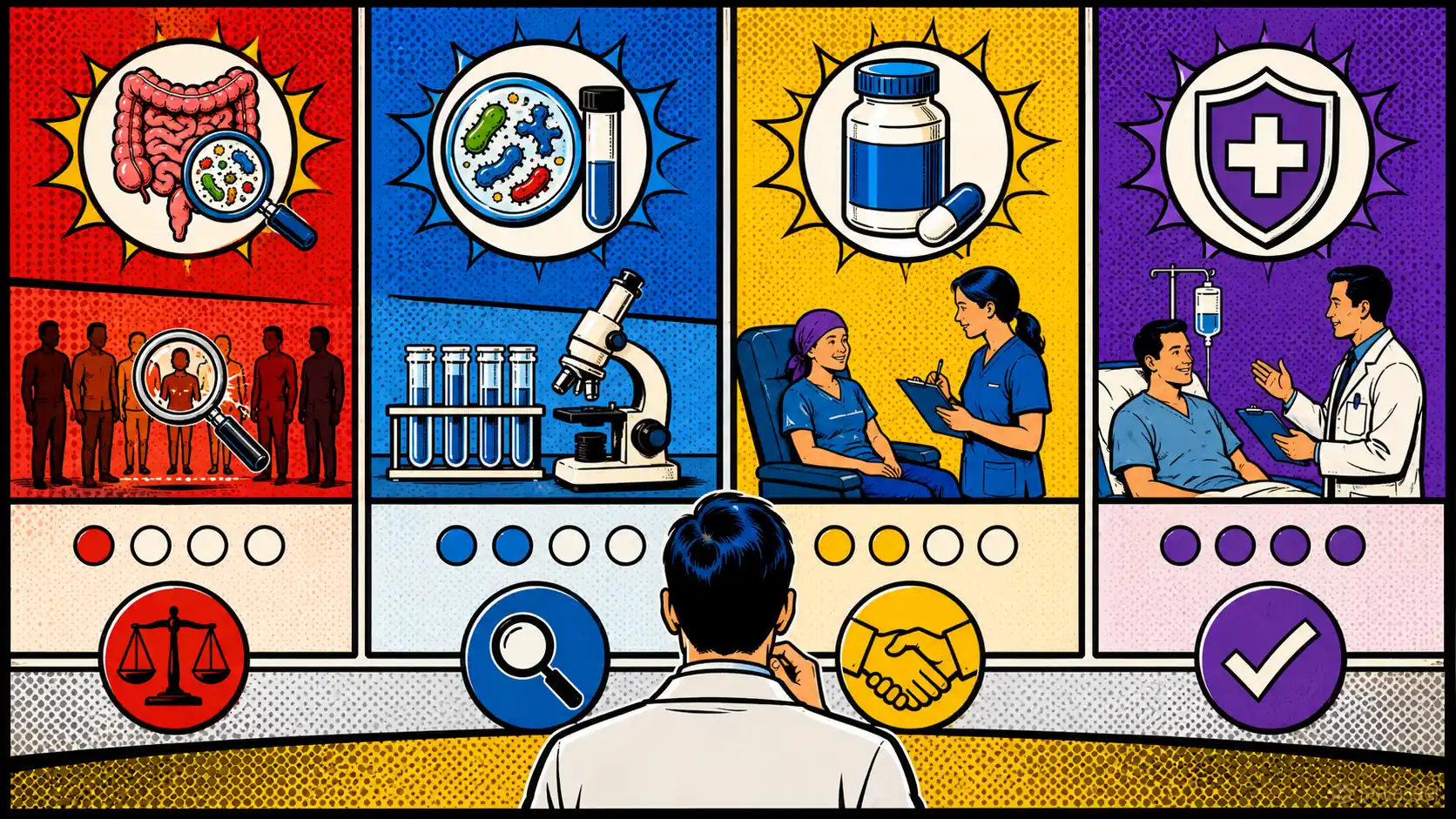
Probiotic and synbiotic studies around colorectal cancer are usually not asking, "Can this treat the cancer?"
They are more often asking narrower questions around supportive care, especially in surgical settings. Systematic reviews of randomized trials in colorectal cancer surgery have reported possible reductions in some postoperative complications with selected perioperative probiotic or synbiotic protocols 5 6.
That is worth studying. It is also easy to overread.
Those findings do not mean:
The better wording is:
Selected probiotic or synbiotic protocols have been studied as supportive-care tools around colorectal cancer surgery. That is not the same as treating the tumor.
This is similar to the logic in how probiotic selection is evolving: strain, formulation, timing, population, and outcome matter. A probiotic claim that sounds specific in one setting should not be stretched into every other setting.
If the confusing part is category language, step sideways to synbiotics, probiotics, and prebiotics or probiotic vs prebiotic. Cancer-care context raises the safety bar even higher.
This page is not anti-probiotic. It is anti-overreach.
Here is the boundary:
| What the evidence lane may support | What it does not support |
|---|---|
| Some probiotic or synbiotic protocols have been studied around colorectal surgery outcomes. | A retail probiotic treats colorectal cancer. |
| Probiotic effects can be strain-, formulation-, dose-, timing-, and outcome-specific. | Any product labeled "probiotic" matches the studied intervention. |
| A care team may consider supportive-care questions in selected contexts. | A supplement decision should bypass oncology, surgery, or gastroenterology guidance. |
| Probiotic category education can help you ask better questions. | Probiotics replace screening, diagnosis, staging, surgery, chemotherapy, immunotherapy, or surveillance. |
If you are simply trying to understand category language, use probiotic vs prebiotic. If you are trying to judge a product claim, use how probiotic selection is evolving. If your gut is reactive and you are not in an active cancer-care decision, the food-first route may be gentle variety before probiotics.
But if colorectal cancer screening, symptoms, surgery, chemotherapy, immunotherapy, infection risk, or immune suppression is part of the picture, the decision belongs with a clinician.
Many healthy people tolerate common probiotics with only minor side effects such as gas. That does not make live microbial supplements automatically low-risk in every medical context.
NIH's Office of Dietary Supplements notes that probiotics are unlikely to cause harm in healthy people, but severe infections such as bacteremia and fungemia have been reported, mostly in people who were severely ill or immunocompromised 7.
That matters in colorectal cancer care because some patients may have:
The practical rule is not "probiotics are always dangerous." That would be too broad.
The practical rule is:
Do not start live microbial supplements during colorectal cancer care without the oncology, surgery, or gastroenterology team.
This includes probiotic capsules, high-dose synbiotic products, live microbial concentrates, and any product being used because a headline made it sound cancer-relevant.
Microbiome claims should never replace routine colorectal cancer screening.
They should also never replace evaluation of warning signs. CDC lists possible symptoms such as blood in stool, bowel habit changes, persistent abdominal pain, and unexplained weight loss, and says people with these symptoms should talk to a doctor 8.
They should never replace diagnosis and staging. Treatment planning depends on where the cancer is, whether it has spread, molecular features in some cases, overall health, goals of care, and standard treatment options 9.
They should never replace oncology treatment decisions. If immunotherapy, targeted therapy, chemotherapy, radiation, surgery, surveillance, or clinical trial enrollment is on the table, that decision belongs with the care team.
And they should never turn a serious symptom into a supplement-shopping task.
If the real question is post-antibiotic recovery after treatment, use antibiotic-induced gut dysbiosis as a context page. If the real question is product-specific probiotic evidence, use how probiotic selection is evolving. If the real question is colorectal warning signs, this is not the page to stay on.
Many readers land here with a question that is not really a cancer-care microbiome question. Route by the actual job.
| Real question | Better next step |
|---|---|
| "Could these bowel symptoms be more than IBS?" | Use IBS vs colorectal warning signs and seek medical review when red flags are present. |
| "Should I get screened?" | Follow validated screening guidance with your clinician; do not substitute a microbiome test. |
| "What is the microbiota-gut-brain axis?" | Use microbiota-gut-brain axis explained. |
| "What is the difference between probiotics and prebiotics?" | Use probiotic vs prebiotic. |
| "How do I choose a probiotic without hype?" | Use how probiotic selection is evolving. |
| "My gut is too reactive for another supplement experiment." | Use gentle variety before probiotics. |
This keeps the cancer-care boundary intact. A microbiome mechanism page can educate. A probiotic category page can improve label literacy. A food-first page can lower experimentation pressure. None of those replace symptom evaluation or oncology guidance.
Use this before trusting any microbiome or probiotic colorectal cancer claim.
What decision is this claim trying to influence?
Screening, diagnosis, treatment, surgical recovery, chemotherapy side
effects, diet, and general microbiome curiosity are different jobs.
What kind of evidence is it?
Human clinical trial, systematic review, guideline, observational
association, animal model, lab mechanism, and marketing page should not carry
the same weight.
Does the product or test match the study?
A probiotic effect is not automatically transferable across strains, blends,
doses, timing, or patient groups.
Could safety be different in my situation?
Immune suppression, neutropenia, central lines, surgery, severe illness,
infection risk, and active cancer treatment all change the conversation.
What would my clinician do differently with this information?
If the answer is unclear, the claim may be interesting but not actionable.
Download: Microbiome Claim Boundary Checklist
Use this before turning a colorectal cancer microbiome claim into a health decision.
Download: Oncology Probiotic Question Sheet
Bring this to your oncology, surgery, or gastroenterology team before using a live microbial product during cancer care.
The microbiome may matter in colorectal cancer. Probiotic and synbiotic trials around surgery may matter too.
The mistake is making those claims do a job they have not earned.
Use the boundary this way:
If symptoms or screening are the issue, go to IBS vs colorectal warning signs or your clinician. If probiotic label logic is the issue, go to how probiotic selection is evolving. If category confusion is the issue, go to synbiotics, probiotics, and prebiotics.
| Situation | Best next read | Why |
|---|---|---|
| Blood in stool, persistent bowel change, anemia, weight loss, or abdominal pain is the real concern | IBS vs colorectal warning signs | Symptoms and screening logic come before microbiome interpretation. |
| You want the broad microbiome mechanism map | Microbiota-gut-brain axis explained | It explains signaling lanes without turning them into cancer-care advice. |
| You need the simplest category split | Probiotic vs prebiotic | It separates live microbes from substrates before any product decision. |
| You are evaluating a product claim | How probiotic selection is evolving | It keeps strain, dose, formulation, population, and outcome in view. |
| You are holding a stool, FIT, infection, breath-test, or consumer microbiome report | Stool and microbiome tests for IBS | It separates medical testing, screening context, and consumer interpretation before claim-jumping. |
| You are considering live probiotics, enzymes, or supplements during cancer care or around medication changes | Doctor visit prep for IBS next steps | Use it as a question-organizing tool, then bring the decision back to oncology, surgery, gastroenterology, or the prescribing clinician. |
| You are stacking gut-health products outside a cancer-care decision | Supplement stack audit for IBS | It keeps product experimentation separate from screening, diagnosis, and treatment decisions. |
| A microbiome claim is being stretched into back-pain, spine, or musculoskeletal advice | Gut-spine claims explainer | It gives a safer example of how mechanism talk can outrun evidence. |
| You want microbiome support but your gut is still reactive | Gentle variety before probiotics | It offers a food-first bridge without supplement escalation. |
The safest reading is not anti-microbiome. It is pro-boundary.
Microbiome and probiotic research can help explain possible supportive-care questions in colorectal cancer, but it cannot replace screening, diagnosis, staging, oncology treatment, medication review, or red-flag evaluation. If a claim changes what you would swallow, stop, delay, screen for, or ask a clinician about, it belongs in a medical conversation before it becomes a product decision.
Xam Riche is a gut health solopreneur and founder of YourFitNature, dedicated to helping people navigate digestive wellness through evidence-based information and personal experience. After years of struggling with IBS and bloating, Xam discovered the transformative power of the low FODMAP diet and now shares practical, science-backed guidance to help others find relief. While not a medical professional, Xam combines extensive research with lived experience to create accessible, empowering resources for the gut health community. Learn more about our mission
As an affiliate, we may earn from qualifying purchases.