 By • Published on May 6, 2026 • 9 min read • 3,625 views
This article is for informational and educational purposes only and does not constitute medical advice. Always consult with a qualified healthcare professional before using symptom information to make diagnosis or treatment decisions.
The gut-spine axis sounds like the kind of missing link that could explain everything at once: gut bacteria, inflammation, back pain, disc changes, IBS, stress, and maybe even why one flare seems to follow another. That makes the idea attractive. It also makes it easy to overuse.
Short answer: gut-spine research is plausible, but it is not yet a practical diagnosis or treatment map for back pain. Use it to ask better questions, not to skip back-pain evaluation, buy a microbiome test, or assume a probiotic can fix a spine problem.
This page is for you if you have seen claims about gut bacteria and back pain and want to know what they actually mean.
Use a different page first if your back pain is new, severe, progressive, linked with injury, paired with weakness, numbness, fever, unexplained weight loss, cancer history, or bowel/bladder dysfunction. Those patterns belong with a clinician before any gut-health experiment.
Health note: this article explains evidence level and routing. It does not diagnose back pain, diagnose IBS, recommend treatment for spine disease, or replace care from a physician, physical therapist, gastroenterologist, neurologist, dietitian, or other qualified clinician.
The gut is not sealed off from the rest of the body. Gut microbes can influence immune signaling, barrier function, metabolites, endocrine activity, and the nervous system. That is why the microbiota-gut-brain axis is a real research field rather than a wellness slogan.
The spine is also not a simple stack of bones. Back pain can involve muscles, discs, joints, nerves, inflammation, metabolic health, movement history, sleep, stress, injury, and pain processing. A broad research question follows: could microbiome-related immune or metabolic signals matter to some spine or pain states?
That question is reasonable. A review on the "gut-disc axis" discusses possible links between microbiome dysbiosis, inflammation, metabolites, intervertebral disc degeneration, and low back pain 1. But a mechanism map is not a treatment map. Plausibility does not tell you whether your back pain is gut-driven, whether a stool test is useful, or whether a probiotic will help.
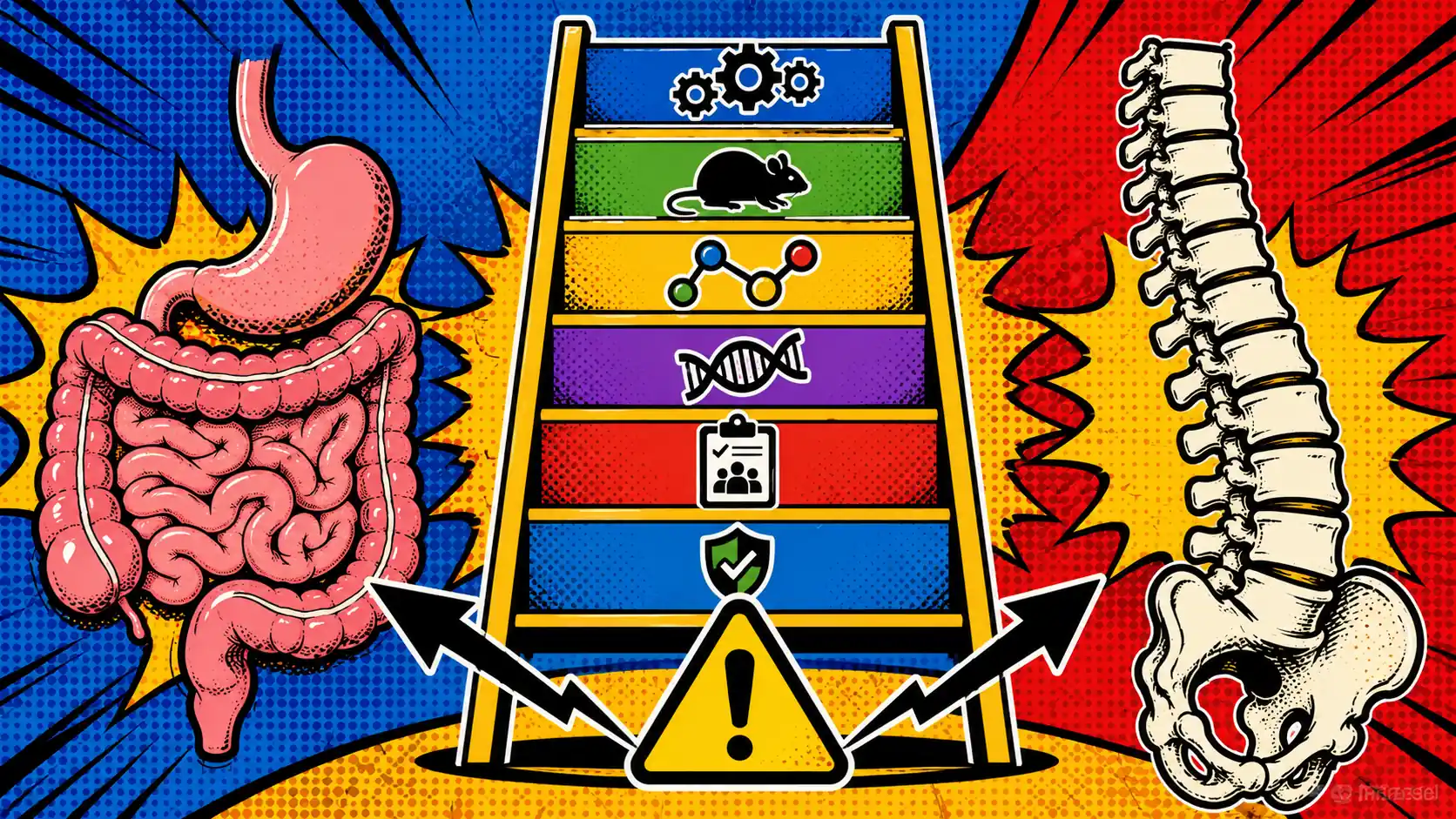
The old version of this topic leaned on the excitement of discovery: specific bacteria, obesity-related inflammation, spinal degeneration theories, and the possibility that gut health might someday shape pain care. Those are research questions worth following. They are not enough to create a self-treatment plan.
Some newer studies use Mendelian randomization to explore whether gut microbes or microbial metabolites may have genetically supported associations with low back pain, sciatica, or intervertebral disc degeneration 2 3. That can help researchers choose better targets. It still does not answer the reader's practical questions:
Until those questions are answered, "gut-spine axis" should be treated as an evidence-check prompt, not a care plan.
The useful question is not whether every back symptom starts in the gut. It is whether the person has a back-pain problem, a gut-symptom problem, or an overlap pattern that needs both sides sorted.
NIDDK describes IBS as repeated abdominal pain with bowel movement changes, with no visible signs of digestive tract damage on routine evaluation 4. The Rome Foundation describes disorders of gut-brain interaction as chronic or recurrent GI symptoms without structural disease that readily explains the symptoms 5.
That means lower back pain by itself is not an IBS diagnosis. But back discomfort that repeatedly travels with abdominal pain, bloating, constipation, diarrhea, urgency, or food tolerance problems may be a reason to sort the gut pattern more carefully.
Start with SIBO vs IBS vs food intolerance if you are unsure what the bowel pattern is. Use constipation and bloating if pressure, incomplete evacuation, or slow stools dominate. If pain remains loud even after basic gut triggers are clearer, the more useful route may be visceral hypersensitivity and gut-brain pain amplification.
Back pain should not be squeezed into a gut explanation when the pattern points somewhere else. Low back pain guidance emphasizes history, physical examination, neurological deficits, and red flags such as malignancy, fracture, or infection before deciding on imaging or next treatment steps 6.
Do not route back pain through diet, probiotics, stool testing, or microbiome theory first when any of these are present:
Those clues do not prove something dangerous is happening. They do mean the first step is medical assessment, not gut-spine speculation.
Use the gut-spine idea as a filter for better questions.
| Pattern | Better next question | Useful route |
|---|---|---|
| Back pain without bowel symptoms | Is this mechanical, neurological, inflammatory, infection-related, or another medical pattern? | Clinician, physical therapy, or back-pain evaluation |
| Back pain plus abdominal pain and bowel changes | Is this IBS, SIBO, food intolerance, constipation, diarrhea, or another gut condition? | SIBO vs IBS vs food intolerance |
| Back discomfort rises with bloating or pressure | Is stool burden, gas, fermentation, or constipation part of the pattern? | Constipation and bloating |
| Pain feels amplified across several body systems | Is pain sensitivity or gut-brain amplification part of the picture? | Chronic visceral pain and gut-brain amplification |
| A product claims to fix back pain through the gut | What evidence level supports this claim? | Evidence checklist before buying or changing treatment |
| Gut symptoms persist after a structured diet attempt | Was low FODMAP the right tool, or is another diagnosis more likely? | When low FODMAP does not work |
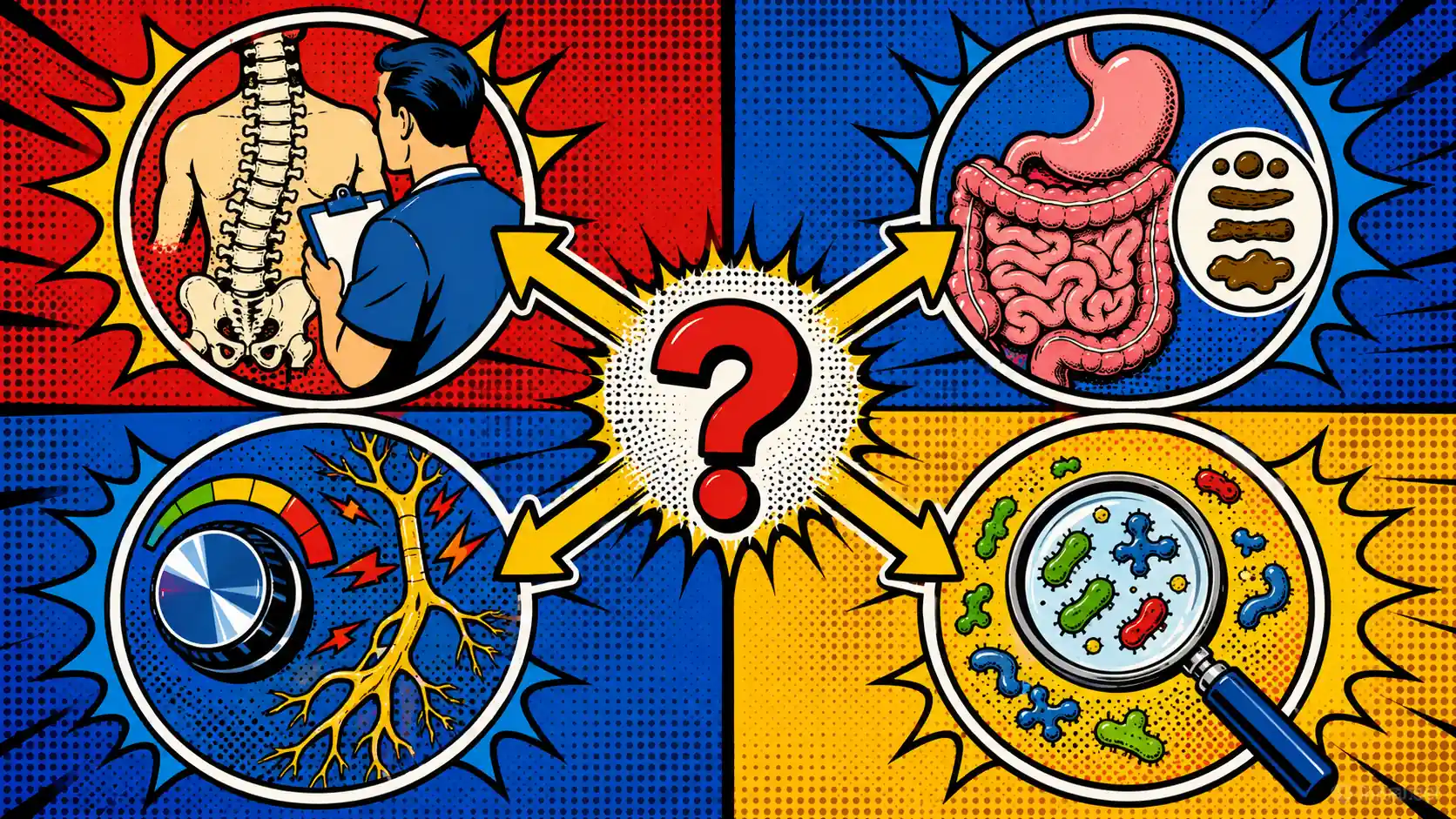
Tracking helps when symptoms feel tangled. It also protects you from forcing a single theory onto everything.
For two to four weeks, note:
Then look for repeatable context. Does back discomfort mainly rise after lifting or long sitting? That points away from a gut-first route. Does it appear during constipation, bloating, or abdominal pain flares? That makes gut sorting more useful. Does pain stay loud after the gut pattern is better controlled? That may belong with gut-brain pain amplification rather than more food restriction.
Download the Gut and Back Symptom Overlap Tracker if you need a one-page way to separate back-pain context from gut clues.
Microbiome claims often jump from "gut bacteria are associated with pain" to "this product fixes the cause." That jump is the problem.
Before acting, ask:
NIDDK notes that diet changes can be part of IBS care, including approaches such as FODMAP reduction and careful reintroduction when symptoms improve 7. That supports diet as a gut-symptom tool. It does not turn diet into a proven back-pain treatment.
Download the Gut-Spine Claims Evidence Checklist before treating a microbiome headline, probiotic ad, or stool-test result like practical back-pain advice.
The gut-spine axis is a research idea worth watching. It is not a shortcut around back-pain evaluation, and it is not a reason to treat probiotics, stool tests, or gut-healing plans as spine therapy.
The practical value is routing. If the back-pain pattern is new, neurological, traumatic, severe, progressive, or paired with red flags, start with medical assessment. If the bowel pattern is the loudest clue, route through IBS, food tolerance, constipation, bloating, or gut-brain pain support. If the claim is mainly a microbiome product promise, slow down and rank the evidence before acting.
That is the useful version of the gut-spine conversation: not "your back pain is really your microbiome," but "which symptom system needs the next careful question?"
Xam Riche is a gut health solopreneur and founder of YourFitNature, dedicated to helping people navigate digestive wellness through evidence-based information and personal experience. After years of struggling with IBS and bloating, Xam discovered the transformative power of the low FODMAP diet and now shares practical, science-backed guidance to help others find relief. While not a medical professional, Xam combines extensive research with lived experience to create accessible, empowering resources for the gut health community. Learn more about our mission
As an affiliate, we may earn from qualifying purchases.