 By • Published on April 25, 2026 • 13 min read • 5,011 views
This article is for informational and educational purposes only and does not constitute medical advice. Always consult with a qualified healthcare professional before using symptom information to make diagnosis or treatment decisions.
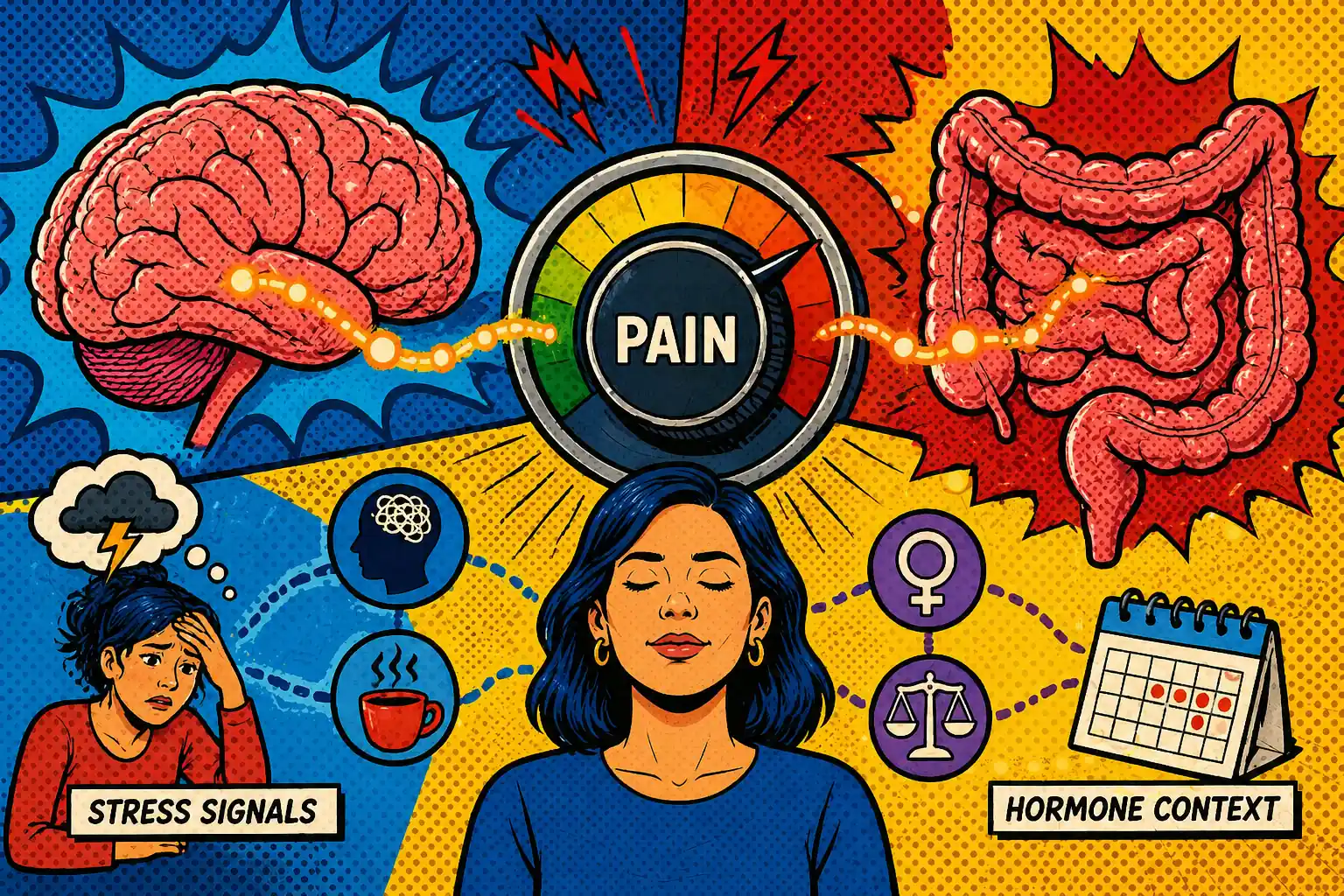
Some gut pain behaves less like a simple injury alarm and more like a volume dial that will not turn down. Stress, anticipation, poor sleep, hormone context, and past flares can all change how loudly the gut is heard by the nervous system. That pain is real. The question is which part of the loop needs care.
Short answer: stress and sex-related biology can shape chronic visceral pain in IBS and other disorders of gut-brain interaction, but they do not prove that symptoms are psychological or hormonal "only." They help explain why pain can become amplified, persistent, and more sensitive to context.
This page is for you if gut pain keeps feeling louder than the visible gut event, especially when stress, sleep, anticipation, menstrual-cycle timing, or flare fear changes the intensity.
Use a different page first if you mainly need practical stress tools, brain-imaging science, or a broad treatment overview. Start with stress and bloating through the gut-brain axis, what brain imaging reveals about IBS pain, or IBS treatment options.
Use this selector before turning every gut-brain question into a pain question.
| If the loudest issue is... | Best next read | Why |
|---|---|---|
| Fear, anticipation, low mood, or the symptom loop is taking over daily life | IBS, anxiety, and depression | It owns the mood-loop and care-lane conversation without saying symptoms are imaginary. |
| Urgency, diarrhea, fast transit, or serotonin-targeted IBS-D options | Serotonin and IBS-D | It keeps urgency-heavy patterns in the IBS-D mechanism and treatment lane. |
| How gut contents become serotonin, motility, urgency, and pain signals | Enterochromaffin cells, serotonin, and gut pain signaling | It explains the upstream cell-level bridge without turning it into a self-treatment plan. |
| Pain volume, stress sensitivity, sex or hormone context, or persistent visceral pain | This page | It owns the pain amplification and pain-threshold lane. |
| The pattern is mixed, persistent, medication-adjacent, or hard to summarize | Doctor visit prep for IBS next steps | It turns mechanism reading into a cleaner clinician handoff. |
This page takes a narrower job. It is not trying to summarize every gut-brain pain finding in one place.
This page is a visceral hypersensitivity bridge.
It connects:
The reader question is not "What are five surprising facts?" It is:
Why does my gut pain feel amplified, and what should I do when food restriction is no longer the right next step?
Visceral pain comes from internal organs. In the gut, it can feel crampy, deep, diffuse, hard to pinpoint, or strangely connected to nausea, urgency, bloating, or fear of another flare.
In IBS and other disorders of gut-brain interaction, pain can be real even when routine tests do not show visible damage. That is because gut sensation depends on a live communication system between:
The 2023 review frames chronic visceral pain, stress, and sex-related biology as interacting pieces inside disorders of gut-brain interaction, not as a single-cause story 1.
Visceral hypersensitivity means the nervous system responds too strongly to gut signals. A normal stretch, gas movement, bowel contraction, or post-meal signal may register as painful, urgent, or threatening.
That is why two people can have similar gas or stool patterns but very different pain experiences. It also explains why the same person can tolerate a meal on one day and feel overwhelmed by a similar meal on another day.
This is the deeper mechanism behind advice that can otherwise sound vague. If someone says "stress affects IBS" without explaining visceral hypersensitivity, it can sound like dismissal. The more accurate statement is: stress can change the gain on gut-signal processing.
If you want the cell-level bridge between gut sensory signaling, serotonin release, and why the same upstream lane can feed either urgency or amplified pain, read enterochromaffin cells, serotonin, and gut pain signaling.
Pain amplification is not one personality type, one hormone story, or one stress story. It can look different because several levers can raise the pain volume at the same time.
| If this is the visible pattern | What may be changing the pain volume |
|---|---|
| The same meal hurts on one week but not another | Stress load, sleep loss, flare memory, or bowel pattern may be changing sensitivity. |
| Pain rises before travel, work, or social plans | Anticipation and threat scanning may be making gut signals feel more urgent. |
| Pain changes around cycle timing, postpartum changes, perimenopause, or hormonal therapy | Hormone context may be one useful clue, not the whole diagnosis. |
| Pain stays high after diarrhea or constipation improves | The remaining problem may be visceral hypersensitivity or central pain modulation. |
| Pain travels with migraine, pelvic pain, bladder symptoms, or widespread sensitivity | The dominant issue may be overlapping pain processing, not one isolated gut trigger. |
That is why this page stays narrow. It does not say stress or sex hormones explain every case. It says pain can become context-sensitive, and the next step should match the pattern that is actually loudest.
Stress affects the body through several systems at once:
The point is not that stress creates every IBS symptom from nothing. The point is that stress can make an already sensitive gut more reactive. It can also make the brain more likely to tag gut sensations as urgent or dangerous.
That matters for chronic visceral pain because pain can outlive the original trigger. A stressful season, infection, flare, trauma history, or long run of unpredictable symptoms may leave the system easier to activate later.
If your main problem is practical stress-sensitive bloating, use stress and bloating. If you want the research-facing neuroscience layer, use stress and IBS brain imaging.
Sex differences show up in IBS and related gut-brain disorders. Women are often overrepresented in many chronic visceral pain conditions, and symptoms can change across menstrual-cycle phases, pregnancy, menopause, hormonal therapy, or other endocrine contexts.
That does not mean every woman's gut pain is "just hormones." It also does not mean men are outside the gut-brain stress-pain loop.
The better model is layered:
The review literature is careful here: sex, stress, pain, and lifespan effects interact, but the mechanisms remain complex and not fully settled 2.
For readers, the practical takeaway is simple. If pain changes with cycle timing, hormonal medication, perimenopause, postpartum changes, or chronic stress, that pattern is worth bringing to a clinician. It is data, not proof of one cause.
Download the Visceral Pain Amplification Tracker if you want a simple way to compare pain intensity with stress, sleep, bowel pattern, and hormone-context clues.
This article sits between two neighboring mechanism pages.
Visceral hypersensitivity in IBS is the plain-language pain-volume explainer. Use it when the main question is why normal digestion, gas, stool movement, or stretching can feel painful.
Serotonin and IBS-D is the urgency and bowel-speed bridge. Use it when diarrhea, fast transit, urgency, or 5-HT3 medication questions are more important than pain alone.
Enterochromaffin cells, serotonin, and gut pain signaling is the upstream signaling page. Use it when you need the mechanism layer that connects gut contents, sensory cells, serotonin release, motility, urgency, and pain signaling without turning serotonin into a self-treatment target.
This page has a different job. It explains why stress physiology, sex-related biology, sleep disruption, symptom fear, and life-stage context can change the same pain system. In other words:
Food-trigger work is useful when food is the main lever. It becomes less useful when the dominant problem is pain amplification.
Signs that the next step may be gut-brain or pain-focused care:
This is where therapies that target the nervous system can make sense. NIDDK lists mental health therapies among IBS treatments, including cognitive behavioral therapy, gut-directed hypnotherapy, and relaxation training 3. NCCIH also notes that gut-directed hypnotherapy has evidence for IBS symptoms, with guideline support that is conditional and based on low to very low quality evidence 4.
That evidence is not a magic-cure claim. It is a routing clue. If the pain volume is the problem, treatments aimed at pain processing deserve a seat at the table.
Download the Gut-Brain Pain Next-Step Guide if you need a one-page route between safety evaluation, gut-brain therapy, IBS treatment, and serotonin/IBS-D support.
There is one hard boundary: new or concerning pain should not be casually explained away as stress, hormones, or visceral hypersensitivity.
Get medical help promptly when pain comes with:
That safety boundary protects the gut-brain model from becoming a dumping ground for symptoms that need evaluation.
If exams, pelvic symptoms, urgency, or prior care experiences make the pain conversation feel unsafe, IBS and trauma-informed care adds consent, choice, and pacing without making trauma the presumed cause.
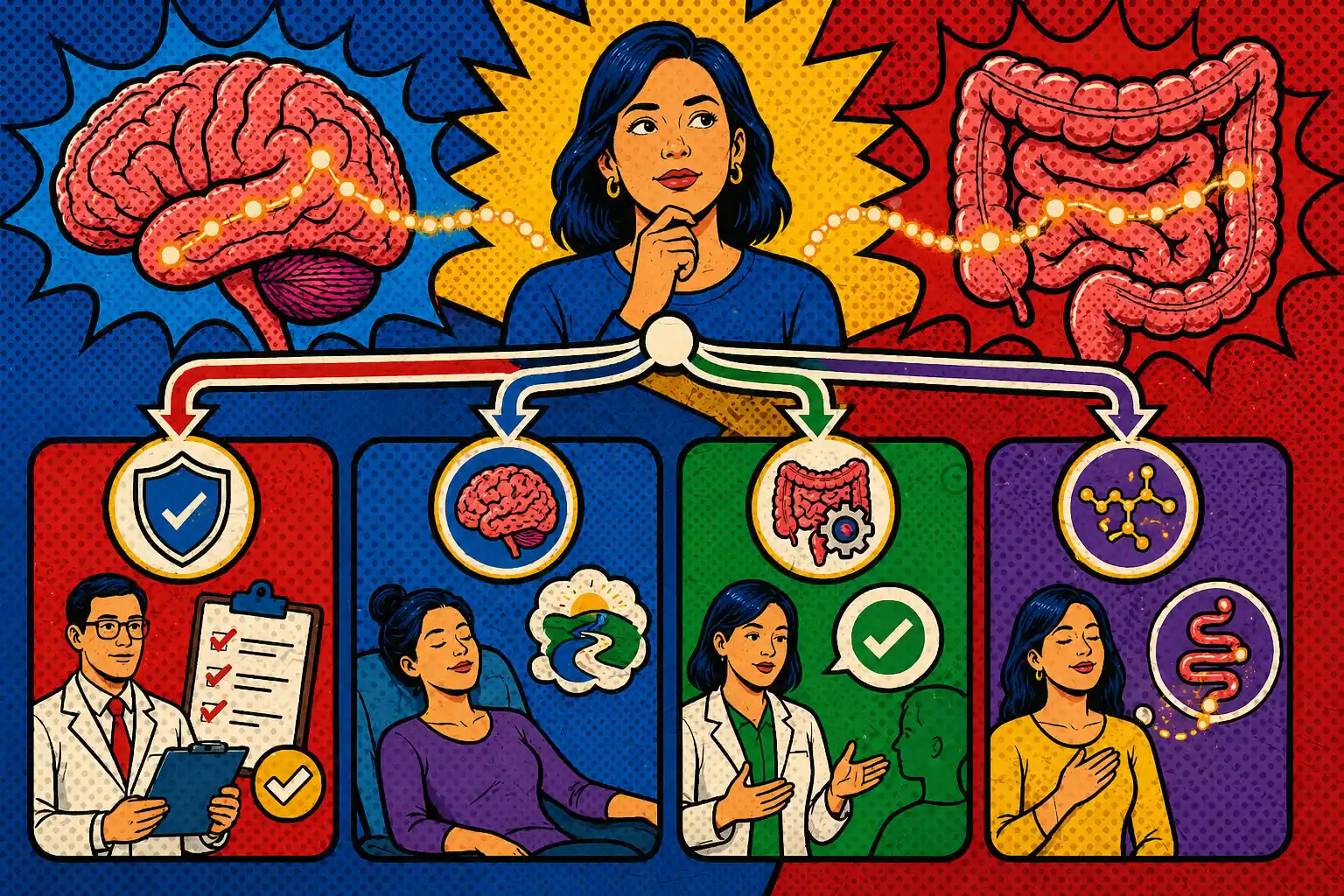
| Symptom pattern | Best next read | Why |
|---|---|---|
| Normal digestion feels painful | Visceral hypersensitivity in IBS | It explains the core pain-volume problem before adding stress or hormone context. |
| Urgency, diarrhea, or fast bathroom runs dominate | Serotonin and IBS-D | It routes urgency-heavy symptoms into gut serotonin and IBS-D treatment questions. |
| You want the cell-level signaling bridge | Enterochromaffin cells, serotonin, and gut pain signaling | It connects gut sensory cells, serotonin, motility, urgency, and pain signaling. |
| Anxiety, low mood, or symptom fear is now part of the loop | IBS, anxiety, and depression | It widens care without implying the pain is imaginary. |
| Migraine and IBS seem to travel together | Migraine and IBS overlap | It translates gut-brain comorbidity without turning migraine into a gut-only problem. |
| Stress-sensitive bloating is the practical issue | Stress and bloating through the gut-brain axis | It gives the everyday gut-brain loop before deeper pain routing. |
| You need the research layer on IBS pain | What brain imaging reveals about IBS pain | It explains pain, threat, salience, and body-signal networks. |
| Sex pain, pelvic pain, urinary symptoms, or cycle-timed bowel symptoms need a wider lens | IBS, endometriosis, or pelvic pain | It separates pelvic and gynecologic clues from a gut-brain pain-volume explanation. |
| Symptoms change around cycle timing | Menstrual cycle and IBS symptoms | It now separates cycle-phase patterns, constipation versus diarrhea, pain amplification, and pelvic-boundary clues before assuming the flare is IBS alone. |
| Symptoms are changing during perimenopause or menopause | Menopause, perimenopause, and IBS symptoms | It keeps midlife bowel changes, pelvic clues, sleep-stress overlap, and medication shifts on one route map. |
| The pattern is mixed, persistent, medication-adjacent, or difficult to summarize | Doctor visit prep for IBS next steps | It turns the pain timeline, symptom context, medicines, and questions into a cleaner clinician handoff. |
| Pain persists despite basics | IBS treatment options | It covers neuromodulators, IBS-D options, and clinician-guided escalation. |
Stress, sex-related biology, and chronic visceral pain interact in ways that can make IBS symptoms feel amplified, persistent, and context-sensitive. That does not make the pain fake. It means the nervous system, gut, immune signals, stress physiology, and hormone context may all be part of the pattern.
The next step is not endless restriction. It is better routing.
Use food tools when food is the main driver. Use the serotonin IBS-D bridge when urgency and bowel speed dominate. Use gut-directed hypnotherapy, IBS treatment options, or clinician-guided pain support when the bigger problem is the pain volume dial.
Xam Riche is a gut health solopreneur and founder of YourFitNature, dedicated to helping people navigate digestive wellness through evidence-based information and personal experience. After years of struggling with IBS and bloating, Xam discovered the transformative power of the low FODMAP diet and now shares practical, science-backed guidance to help others find relief. While not a medical professional, Xam combines extensive research with lived experience to create accessible, empowering resources for the gut health community. Learn more about our mission
As an affiliate, we may earn from qualifying purchases.