 By • Published on May 5, 2026 • 11 min read • 3,381 views
This article is for informational and educational purposes only and does not constitute medical advice. Always consult with a qualified healthcare professional before using symptom information to make diagnosis or treatment decisions.
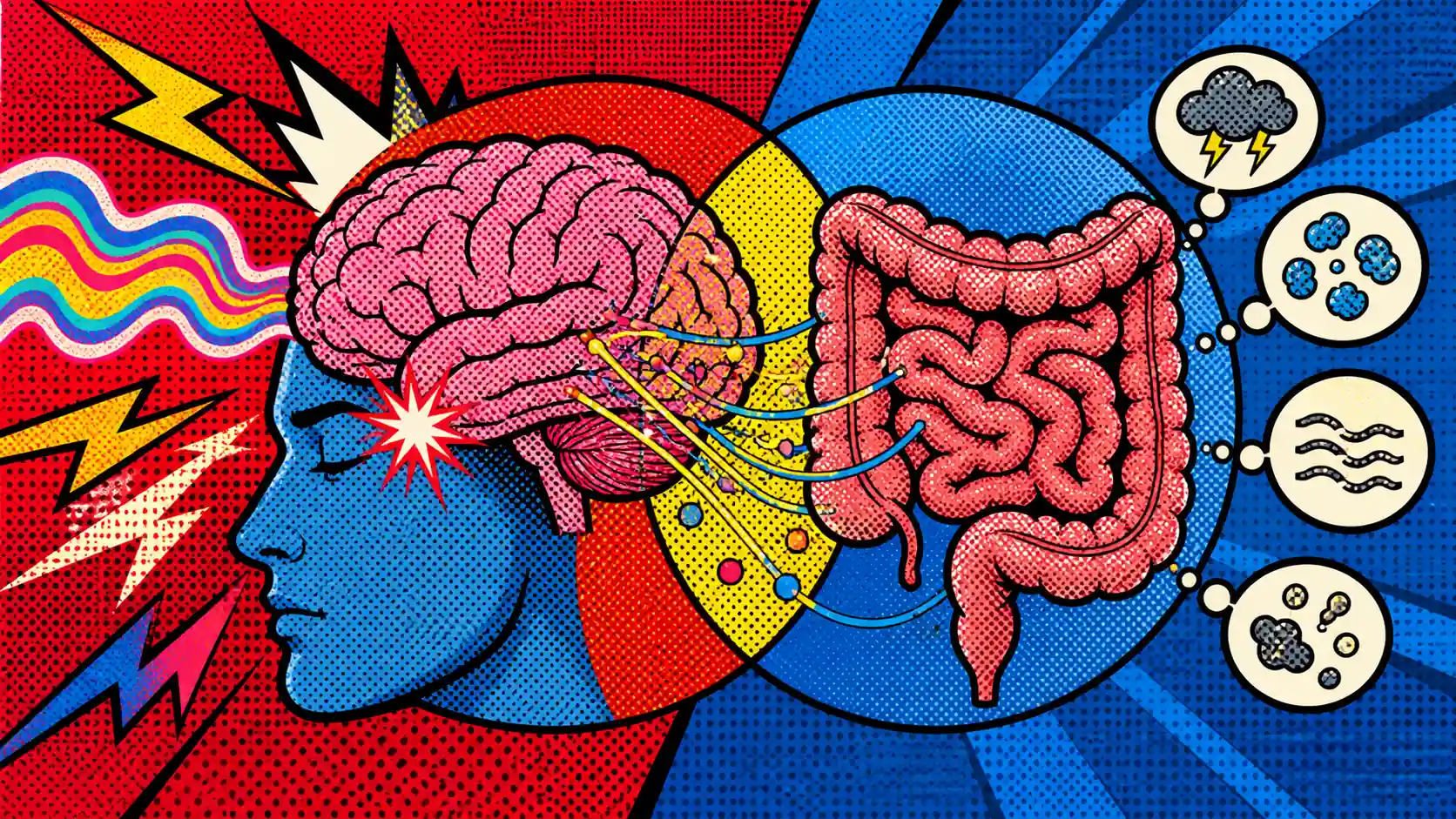
Migraine and IBS can feel like two separate calendars running your life. One tracks head pain, light sensitivity, nausea, and lost time. The other tracks cramping, bloating, urgency, constipation, or food-trigger fear. Then you start noticing they often flare around the same conditions: poor sleep, stress, skipped meals, hormonal context, travel, or a body that already feels on high alert.
Short answer: migraine and IBS overlap often enough to take seriously, but the overlap does not prove that one condition simply causes the other. It is better understood as a gut-brain comorbidity clue: two sensitive signaling systems may be sharing stress, sleep, nausea, pain-processing, immune, or microbiome-related context.
This page is for you if you have both migraine and IBS-like symptoms and need a practical map, not another list of miracle triggers.
Use a different page first if you still are not sure the bowel pattern is IBS, or if migraine is new, severe, changing, or disabling. Start with SIBO vs IBS vs food intolerance for gut sorting, and use clinician-guided migraine care when the headache pattern is the main safety question.
Health note: this article explains overlap and routing. It does not diagnose migraine, diagnose IBS, or replace care from a gastroenterologist, neurologist, dietitian, therapist, or primary-care clinician.
The most useful starting point is simple: migraine is a neurological disorder, and IBS is a disorder of gut-brain interaction. They are not the same illness. They can still travel together.
NINDS describes migraine as a neurological disorder that can involve attacks of head pain, nausea, light or sound sensitivity, and other symptoms; diagnosis depends on medical history and physical or neurological exam 1. IBS sits in a different clinical lane. It involves recurrent abdominal pain with bowel habit change after other concerning causes are considered, and it is commonly discussed as a disorder of gut-brain interaction.
That distinction matters because it protects you from two bad interpretations:
Neither frame is good enough.
A 2023 systematic review and meta-analysis found that IBS and migraine or headache co-occur more often than expected. The pooled estimates included higher odds of migraine or headache in IBS, higher odds of IBS in migraineurs, and an increased cohort risk estimate for IBS among migraine sufferers 2. That does not prove one condition causes the other. It does make the overlap worth translating.
The best question is not "Did my gut cause my migraine?" The better question is:
Which shared system is keeping both symptom patterns easier to trigger?
That is where the microbiota-gut-brain axis, pain amplification, sleep, stress, nausea, and food-trigger context become useful.
Migraine and IBS both involve real body signals. Gut-brain language should never be used to dismiss either one.
In IBS, the gut can become more sensitive to normal digestion, gas movement, stretch, stool changes, stress, and anticipation. That is one reason the same meal can feel manageable on one day and impossible on another. In migraine, the nervous system can become sensitive to light, sound, smell, sleep loss, stress, food timing, hormonal context, and other triggers.
The overlap is not that the gut and head are identical. It is that both conditions can involve sensitive signaling systems.
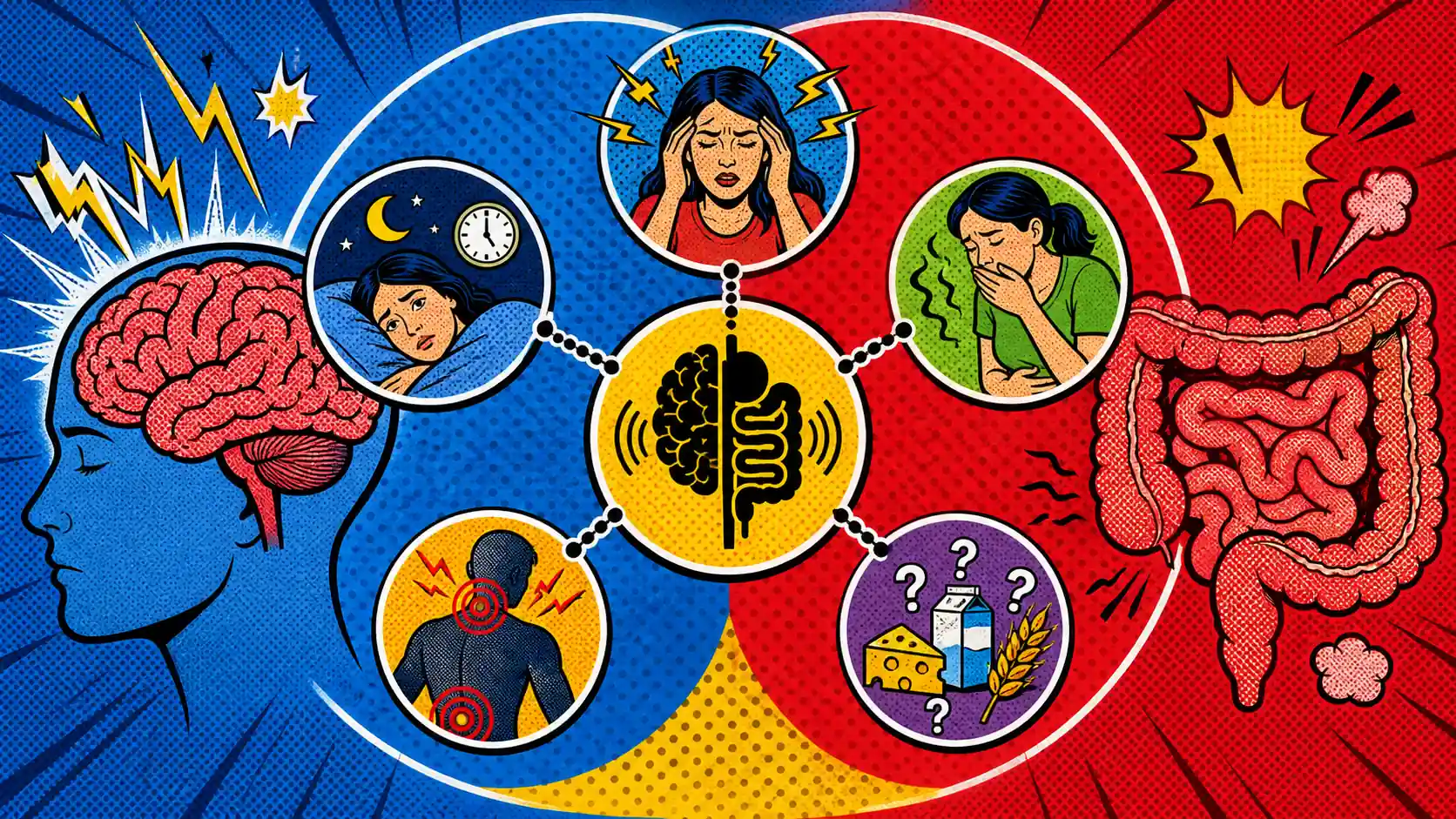
When IBS pain feels louder than the visible gut event, the mechanism may involve visceral hypersensitivity, stress-system activation, gut motility changes, and central pain processing. The deeper explainer is here: stress, sex, and chronic visceral pain.
Migraine has its own nervous-system biology. It is not explained away by abdominal symptoms. But if both systems flare around poor sleep, stress, or sensory overload, your next step may be to reduce the shared load instead of chasing one perfect trigger.
Stress does not mean symptoms are fake. It can change motility, attention, sleep, muscle tension, food timing, and pain processing. That is why a stress-sensitive IBS flare can overlap with a migraine-prone week without one being the sole cause of the other.
If bloating and gut symptoms rise with stress, the practical parent page is stress and bloating through the gut-brain axis. If the issue is that symptoms now create fear, avoidance, low mood, or panic, use the IBS, anxiety, and depression bridge as well.
NIDDK lists mental health therapies such as cognitive behavioral therapy, gut-directed hypnotherapy, and relaxation training among IBS treatment options 3. That does not mean IBS is psychological. It means the gut-brain loop is a valid treatment target.
If IBS symptoms remain amplified even after basic diet and bowel-pattern work, gut-directed hypnotherapy may be a more logical gut-centered next step than another restrictive diet reset.
The older version of this topic leaned heavily into gut microbiota findings in migraine and IBS. That research is interesting. It is also easy to overuse.
Recent migraine microbiome reviews describe plausible pathways through immune activation, barrier function, oxidative stress, neuroinflammatory signaling, and the broader microbiome-gut-brain axis 4. Other studies have found differences in gut microbiota profiles in migraine populations, including a metagenomic study of elderly women with migraine 5. Causal-inference work has also explored whether gut microbiota might contribute to migraine risk, while calling for more verification and mechanism research 6.
That is enough to justify curiosity. It is not enough to justify certainty.
Microbiome findings are usually:
So the practical message is restrained:
The microbiome may be part of the migraine-IBS overlap story, but it is not a consumer shortcut.
If you are trying to understand the mechanism map, use microbiota-gut-brain axis explained. If your real question is whether a product category fits IBS symptoms, compare probiotic vs prebiotic and then use the probiotics for IBS strains guide. Do not turn one microbiome study into a private treatment plan.
Food-trigger lists are tempting because they give the overlap a simple shape. The problem is that migraine triggers and IBS triggers are not always the same kind of trigger.
IBS food tolerance often involves:
Migraine triggers may involve:
Some foods or routines can sit in both columns. For example, alcohol may worsen reflux, gut motility, sleep, and migraine risk in the same person. A skipped meal may trigger migraine while also setting up later IBS symptoms through a larger, faster, higher-fat meal. Caffeine changes may affect headache patterns, stool speed, reflux, and anxiety.
That is why the tracker matters more than a generic list.
Ask:
If food-trigger sorting is the main problem, start with SIBO vs IBS vs food intolerance. If upper gut nausea, early fullness, or post-meal pressure is the dominant pattern, the better next route may be functional dyspepsia rather than a lower-GI IBS plan.
Low FODMAP can help some IBS patterns, but it should not be framed as migraine treatment. Use IBS-D and low FODMAP or IBS-C and low FODMAP when bowel subtype and diet strategy are the actual question.
The goal is not to find one master explanation. The goal is to choose the next route with less guessing.
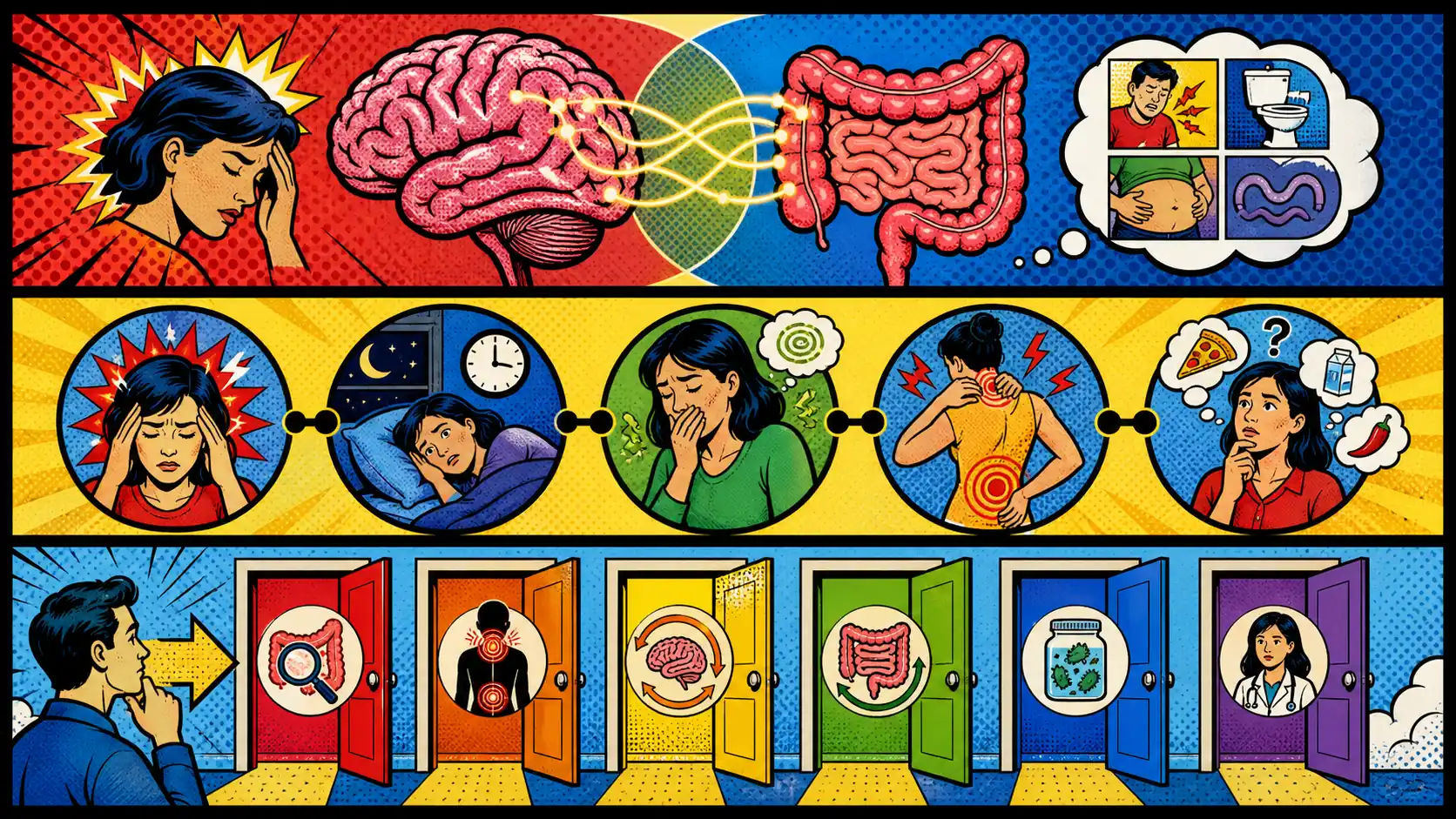
| If this pattern dominates | Better next route |
|---|---|
| You are not sure the bowel symptoms are IBS | SIBO vs IBS vs food intolerance |
| Abdominal pain feels amplified or context-sensitive | Stress, sex, and chronic visceral pain |
| Stress and bloating rise together | Stress and bloating through the gut-brain axis |
| Anxiety, low mood, or symptom fear now feed the loop | IBS, anxiety, and depression |
| Diarrhea, urgency, or fast transit dominates | Serotonin and IBS-D and IBS-D low FODMAP |
| Constipation and bloating dominate | IBS-C and low FODMAP |
| Probiotic claims are pulling your attention | Probiotics for IBS strains |
| Migraine is worsening, changing, or disabling | Clinician-guided migraine care |
This route-by-pattern approach keeps the article from becoming a vague gut-brain story. It also keeps migraine care where it belongs. If headache frequency, aura symptoms, medication use, disability, or neurological symptoms are the main issue, a gut article is not the right first-line plan.
If another adjacent claim is pulling you toward back pain, spine health, or a "gut-spine axis" explanation, use the gut-spine claims explainer to separate early microbiome research from practical gut-symptom routing.
Download the Migraine and IBS Overlap Tracker if you need a one-page way to compare sleep, stress, meals, nausea, bowel pattern, and migraine timing.
Download the Migraine and IBS Next-Step Router if you need help choosing the next gut-centered or clinician-guided route.
Overlap does not remove safety boundaries.
Get prompt medical care for headache symptoms such as:
Get medical evaluation for gut symptoms such as:
Also widen care if food fear, panic, depression, or symptom avoidance is now shrinking your life. That is not a sign of failure. It is a sign that the treatment frame needs to include more than diet and trigger tracking.
Migraine and IBS can overlap in a way that is medically and emotionally meaningful. The overlap may involve gut-brain signaling, pain sensitivity, stress, sleep, nausea, immune context, and microbiome research clues. But it is not a simple proof that one condition caused the other.
Use the overlap as a routing clue.
If the gut diagnosis is unclear, sort that first. If pain feels amplified, route toward visceral hypersensitivity and gut-brain care. If stress, mood, or sleep are turning both symptom systems up, treat those as real biological context. If bowel subtype dominates, use the IBS-C or IBS-D shelf. If migraine is changing or disabling, keep migraine care separate and clinician-guided.
That is the clean bridge: take the overlap seriously without letting it become a microbiome myth, a food-trigger spiral, or a migraine article wearing a gut label. For the broader treatment shelf, use IBS treatment options after the dominant pattern is clear.
Xam Riche is a gut health solopreneur and founder of YourFitNature, dedicated to helping people navigate digestive wellness through evidence-based information and personal experience. After years of struggling with IBS and bloating, Xam discovered the transformative power of the low FODMAP diet and now shares practical, science-backed guidance to help others find relief. While not a medical professional, Xam combines extensive research with lived experience to create accessible, empowering resources for the gut health community. Learn more about our mission
As an affiliate, we may earn from qualifying purchases.