 By • Published on April 25, 2026 • 13 min read • 2,515 views
This article is for informational and educational purposes only and does not constitute medical advice. Always consult with a qualified healthcare professional before using symptom information to make diagnosis or treatment decisions.
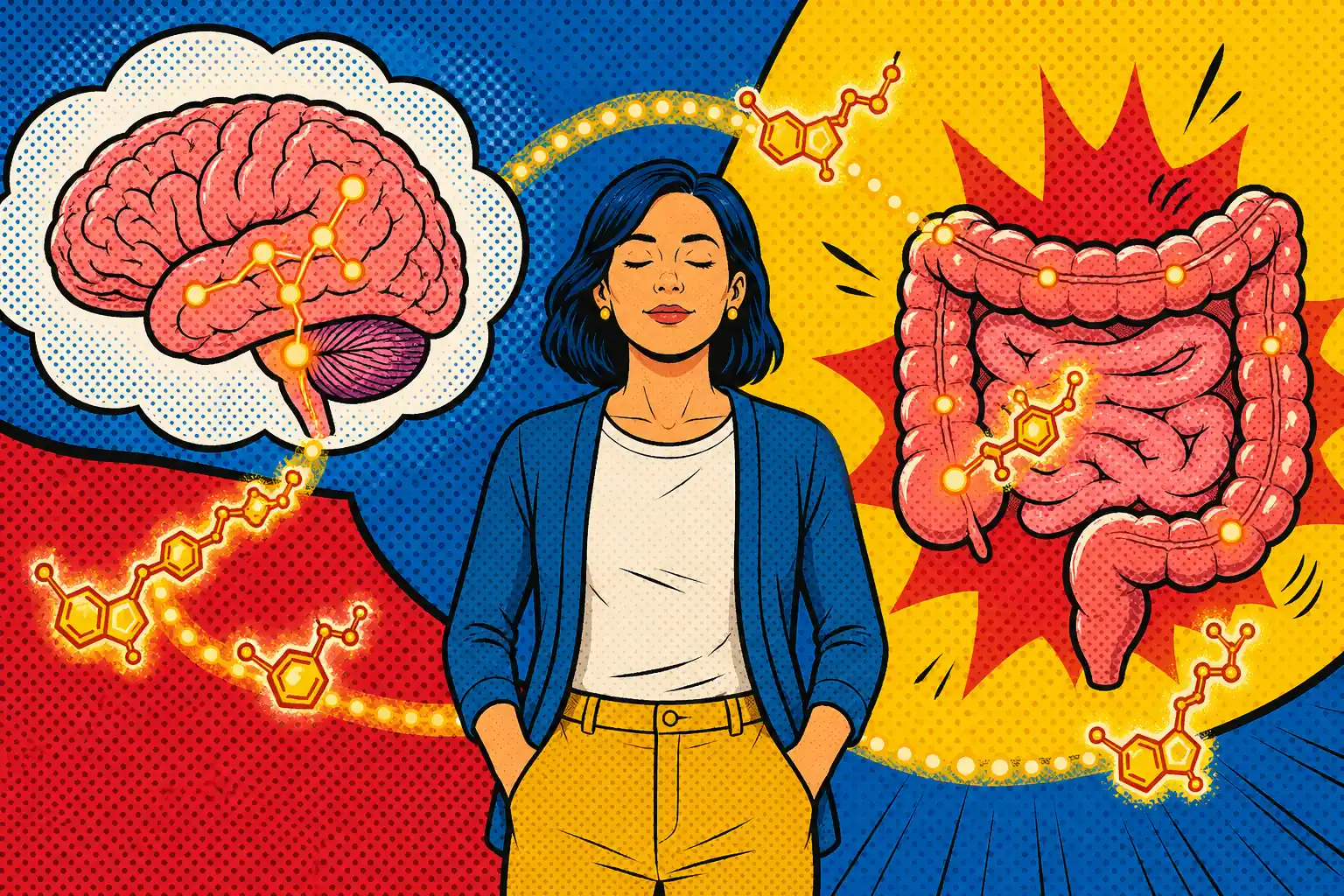
IBS-D can feel like the gut has no brakes. Food may matter, stress may matter, and the microbiome may matter, but urgency also has a signaling story. One part of that story is serotonin in the gut: a chemical messenger that helps regulate movement, secretion, and sensation.
Short answer: serotonin is not just a mood chemical. In the gut, it helps control motility, secretion, and pain signaling. That is why some IBS-D medicines target serotonin receptors, especially 5-HT3 receptors, but those medicines are only one clinician-guided lane inside a broader IBS-D plan.
This page is for you if IBS-D urgency, loose stools, or fast-transit flares remain confusing after the basic diet and stress explanations.
Use a different page first if you need practical food-trigger work, broad treatment escalation, or mental-health overlap. Start with IBS-D and low FODMAP, IBS treatment options, or IBS, anxiety, and depression.
Use this selector before turning serotonin into the explanation for every IBS-D flare.
| If the loudest issue is... | Best next read | Why |
|---|---|---|
| Fear, anticipation, low mood, or the symptom loop is taking over daily life | IBS, anxiety, and depression | It owns the mood-loop and care-lane conversation without saying symptoms are imaginary. |
| Urgency, diarrhea, fast transit, or serotonin-targeted IBS-D options | This page | It owns the serotonin and IBS-D urgency lane. |
| How gut contents become serotonin, motility, urgency, and pain signals | Enterochromaffin cells, serotonin, and gut pain signaling | It explains the upstream cell-level bridge without turning it into a consumer treatment map. |
| Pain volume, stress sensitivity, sex or hormone context, or persistent visceral pain | Stress, sex, and chronic visceral pain | It routes pain amplification into the pain-threshold anchor. |
| The pattern is mixed, persistent, medication-adjacent, or hard to summarize | Doctor visit prep for IBS next steps | It turns mechanism reading into a cleaner clinician handoff. |
This page takes a narrower job: it is an IBS-D mechanism bridge. It covers one lane in the larger IBS-D picture rather than trying to act as a broad IBS-D treatment guide.
It explains:
Serotonin is one mechanism, not the whole story. The point is not to pick a medicine for you. The point is to help you ask a more precise next-question:
Is my IBS-D mainly a food-trigger problem, a fast-transit urgency problem, a pain-amplification problem, or a mixed pattern?
Serotonin is often described as a brain chemical, but the gut uses serotonin as a local messenger too. In IBS-D, that matters because bowel speed, intestinal fluid handling, urgency, and pain are all partly controlled by gut-brain and enteric nervous system signaling.
That is why the American College of Gastroenterology guideline discusses serotonin-receptor medicines in IBS-D treatment, especially 5-HT3 antagonists such as alosetron and ondansetron 1.
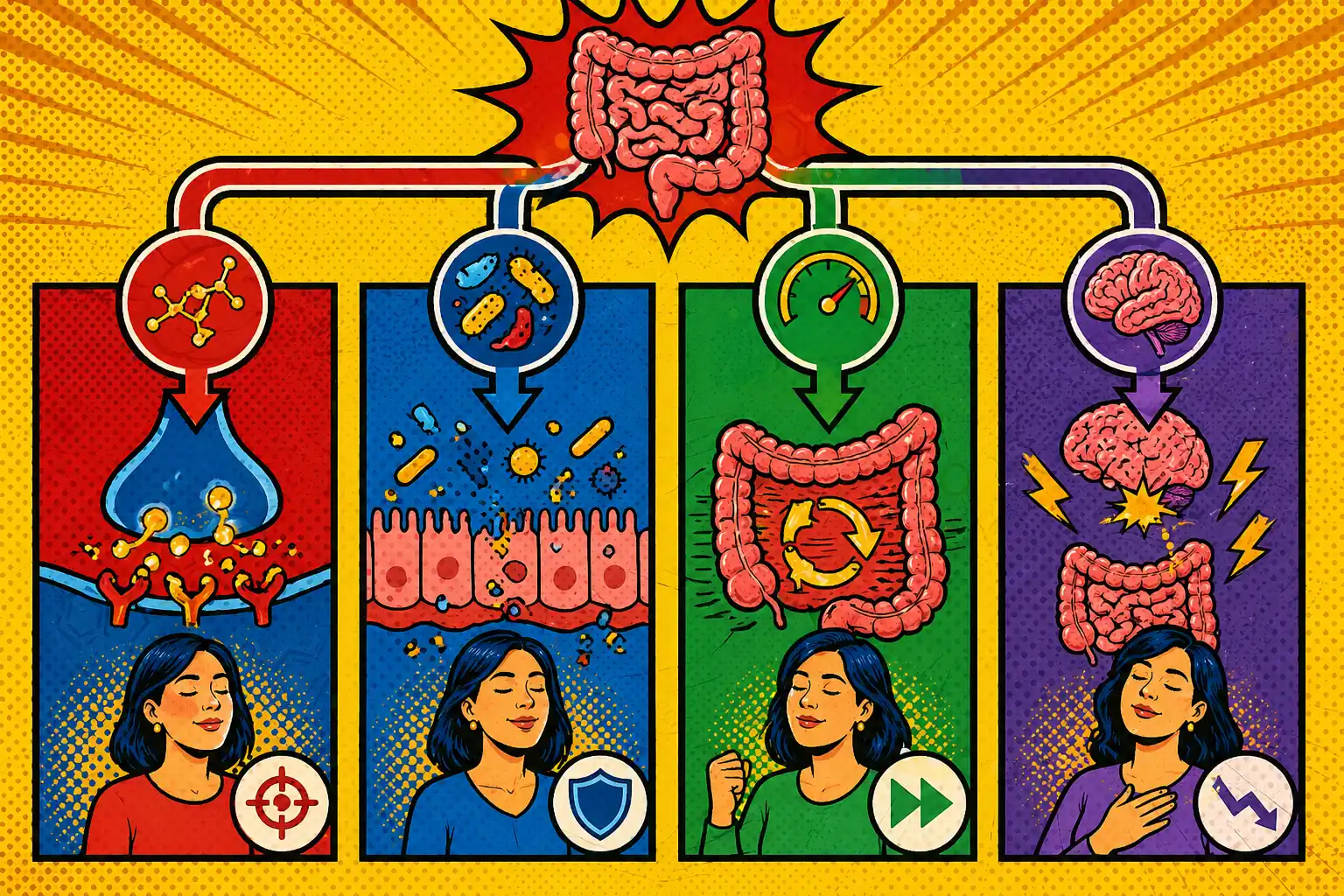
Think of serotonin signaling as one control surface on the IBS-D dashboard:
That does not mean every IBS-D flare is a serotonin problem. It means serotonin can be one reason a purely dietary explanation feels incomplete.
Serotonin is useful here because it explains a mechanism. It is not useful as a do-it-yourself target.
In practice, that means this article should not lead to:
The safer interpretation is narrower: gut serotonin signaling can help explain why urgency, loose stool, fast transit, and pain sometimes need more than a food-trigger list. If that pattern fits, the next step is a better clinical question, not a serotonin hack.
For the upstream mechanism, use enterochromaffin cells, serotonin, and gut pain signaling. That page explains how gut sensory cells can translate contents and stretch into serotonin-related motility and pain signals without turning the pathway into a consumer treatment target.
5-HT3 antagonists block one serotonin receptor pathway. In IBS-D, that can help slow the gut and reduce urgency-heavy symptoms for some people. The important phrase is for some people.
The main drugs that come up in this conversation are:
This is not a page about collecting IBS-D drug names. Its job is to explain why this drug class exists and when it may be worth discussing.
A serotonin-receptor conversation is most logical when the problem sounds like fast-transit IBS-D:
That is different from a pattern where bloating is the loudest symptom, where gut-brain fear and vigilance dominate, or where watery diarrhea may need a broader medical evaluation.
If diet is still messy, start with the practical IBS-D low-FODMAP guide. If the overall treatment ladder is the question, use IBS treatment options. If symptom fear, anxiety, and low mood are now feeding the loop, use the IBS mental-health bridge.
Serotonin is one lane. IBS-D treatment has other lanes.
NIDDK lists several medicines doctors may recommend for IBS with diarrhea, including loperamide, rifaximin, eluxadoline, and alosetron 5.
The AGA pharmacologic guideline also suggests rifaximin, alosetron, eluxadoline, and loperamide for IBS-D, with important implementation cautions, including eluxadoline contraindications in people without a gallbladder or those who drink more than three alcoholic drinks per day 6.
Here is the cleaner way to compare them:
| Treatment lane | Main target | Better-fit pattern | Key caution |
|---|---|---|---|
| Loperamide | Bowel speed | Rescue support for diarrhea-heavy days | May help stool frequency more than global IBS pain or bloating |
| 5-HT3 antagonists | Serotonin-linked urgency and transit | Fast-transit IBS-D with urgency | Constipation and drug-specific serious safety issues |
| Rifaximin | Microbial signaling | IBS-D with bloating as a major burden | Antibiotic stewardship and recurrence planning matter |
| Eluxadoline | Gut opioid signaling | IBS-D with diarrhea plus pain | Avoid in patients without a gallbladder or with pancreatitis risk |
| Neuromodulators | Pain processing | Pain-predominant or gut-brain-amplified IBS | Dose, side effects, and mental-health context need supervision |
Low FODMAP can be useful for IBS-D, but it mainly reduces fermentable carbohydrate triggers. It does not directly block every serotonin receptor, change every pain-processing pathway, or rule out every non-FODMAP driver of diarrhea.
That is why a reasonable IBS-D plan often has layers:
If the low-FODMAP plan keeps getting smaller but the urgency is not improving, that is a routing signal. It may be time to stop asking food to solve the whole problem.
Download the IBS-D Serotonin and Urgency Discussion Guide if you want a one-page way to prepare a clinician conversation about urgency, 5-HT3 options, and other IBS-D treatment lanes.
Not every urgent bathroom run after eating belongs in a serotonin article. Sometimes the first useful question is much more practical: what was the setup?
Use urgency after meals when the pattern seems tied to:
Use fat, sugar alcohols, and post-meal symptoms when the same "safe" food behaves differently because the meal is richer, sweeter, larger, later, or built around products with polyols or added fibers.
Use low-FODMAP personalization mistakes when the issue is not serotonin at all, but a noisy personalization phase: stacking, serving-size drift, too many changes at once, or a week that was too chaotic to interpret.
The serotonin route fits better after that practical sorting has happened and the remaining pattern still looks like IBS-D urgency, loose stool, fast transit, or a clinician-guided medication question.
IBS-D urgency can create a fear loop:
That is why serotonin belongs in the same neighborhood as stress, pain amplification, and visceral hypersensitivity. It is not because symptoms are imaginary. It is because gut movement and gut sensation are regulated by a living nervous system.
If you want the missing cell-level bridge between gut contents, serotonin release, and the split between urgency and pain amplification, read enterochromaffin cells, serotonin, and gut pain signaling.
If you want the broader bridge on how hunger, fullness, reward pull, and gut signals fit together before narrowing into urgency-heavy IBS-D, read gut-brain signaling and appetite.
If you specifically want the broader microbiome-facing mechanism map behind that same gut-brain conversation before you stay with serotonin, read microbiota-gut-brain axis explained.
If pain and threat sensitivity are now larger than stool looseness itself, the next read is the visceral pain bridge: stress, sex, and chronic visceral pain.
Download the IBS-D Mechanism Routing Checklist if you need help deciding whether the next route is food cleanup, urgency-focused IBS-D care, pain-amplification support, or medical evaluation.
Use the route by the dominant pattern, not by the word serotonin.
| Dominant pattern | Best next read | Why |
|---|---|---|
| The IBS-D diet layer is still messy | IBS-D and low FODMAP | It helps reduce urgency triggers without turning the diet into over-restriction. |
| After-meal urgency is the clearest pattern | Urgency after meals | It sorts caffeine, fat load, sugar alcohols, meal timing, IBS-D, and red flags before mechanism speculation. |
| "Safe" meals still trigger urgency or fullness | Fat, sugar alcohols, and post-meal symptoms | It checks meal context and product triggers before blaming serotonin. |
| Low-FODMAP personalization feels chaotic | Low-FODMAP personalization mistakes | It separates stacking and execution noise from a true mechanism problem. |
| You want the gut serotonin mechanism layer | Enterochromaffin cells, serotonin, and gut pain signaling | It explains how gut sensory cells connect contents, motility, urgency, and pain. |
| You need the broader IBS-D medication sorter | IBS-D medications and diarrhea options | It compares hydration, loperamide, rifaximin, bile-acid clues, serotonin options, and clinical red flags. |
| The pattern is mixed, persistent, medication-adjacent, or hard to explain in one sentence | Doctor visit prep for IBS next steps | It turns urgency timing, stool pattern, medicines, supplements, and questions into a cleaner clinician handoff. |
| Pain feels amplified even when bowel speed is not the only issue | Stress, sex, and chronic visceral pain | It routes pain-volume problems into gut-brain care. |
| Diarrhea is watery, persistent, nocturnal, bloody, feverish, dehydrating, or clearly changing | IBS treatment options or medical evaluation | The next step is clinical sorting, not more food restriction or serotonin self-experimentation. |
Serotonin gives IBS-D a more precise mechanism story. It helps explain why some people have urgency, fast transit, and diarrhea that are not fully solved by cutting another food.
But serotonin is not the whole IBS-D story. The useful move is pattern matching: food-trigger work when diet is messy, IBS-D medication discussion when urgency is dominant, and gut-brain or pain treatment when the volume dial stays high.
Use this page as the mechanism bridge. Use IBS-D and low FODMAP for food execution, IBS-D medications and diarrhea options for the clinical IBS-D sorter, IBS treatment for the broader treatment landscape, and visceral pain support when pain amplification is the deeper problem.
Xam Riche is a gut health solopreneur and founder of YourFitNature, dedicated to helping people navigate digestive wellness through evidence-based information and personal experience. After years of struggling with IBS and bloating, Xam discovered the transformative power of the low FODMAP diet and now shares practical, science-backed guidance to help others find relief. While not a medical professional, Xam combines extensive research with lived experience to create accessible, empowering resources for the gut health community. Learn more about our mission
As an affiliate, we may earn from qualifying purchases.