 By • Published on April 1, 2026 • 10 min read • 4,567 views
This article is for informational and educational purposes only and does not constitute medical advice. Always consult with a registered dietitian, gastroenterologist, or other qualified medical professional before making significant dietary changes or starting treatment.
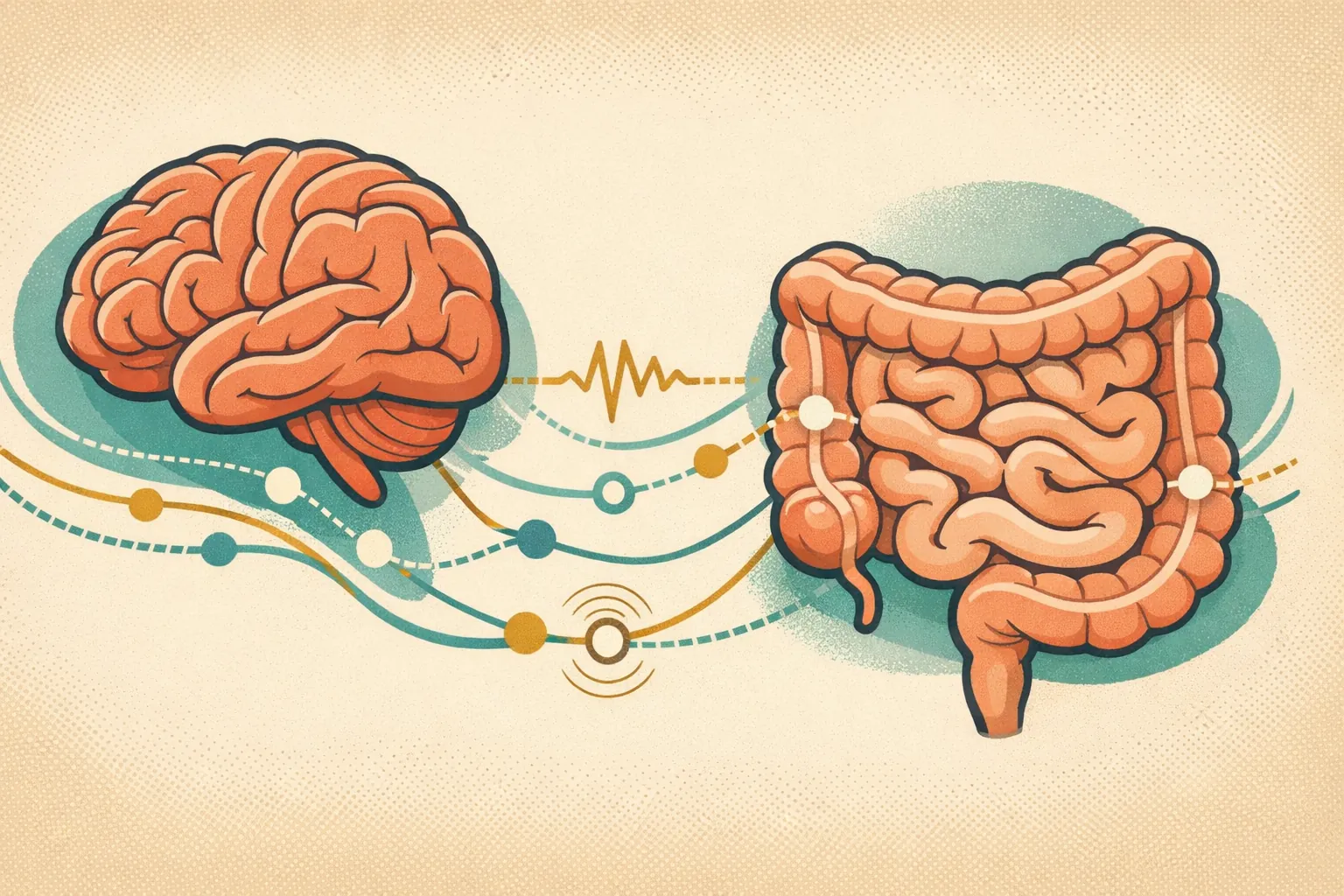
IBS is not "just stress," and it is not "all in your head." Brain imaging studies cannot diagnose IBS on their own, but they do show repeatable differences in how pain, threat, attention, and body signals are processed. That helps explain why the same meal can feel manageable one day and brutal the next, especially when stress, anticipation, or symptom fear enter the picture.
Short answer: IBS brain-imaging research helps explain why stress, anticipation, and pain amplification can make symptoms feel louder, but it does not mean IBS is imaginary or purely psychological.
This page is for you if you want the deeper science behind the gut-brain axis after the practical stress-and-bloating page already makes intuitive sense.
Use a different page first if you need the practical gut-brain guide or a broader treatment option first. Start with stress-bloating-through-gut-brain-axis or gut-directed-hypnotherapy-for-ibs.
This page explains a science-facing gut-brain sibling:
This page is not mainly explaining:
If you live with IBS, vague advice about stress can sound insulting.
You know the symptoms are physical. The pain is real. The bloating is real. The urgency, constipation, nausea, or post-meal dread are not imaginary. That is exactly why the newer brain-gut research matters: it gives a biological explanation for why IBS symptoms can feel disproportionately intense, unpredictable, and tightly linked to stress or anticipation without reducing the condition to a mindset problem 1 2.
If you want the practical day-to-day version of this topic, start with our guide to the gut-brain axis and stress-sensitive bloating. This article is the clinical science companion: what researchers think is happening, what brain scans can actually show, and how that should influence treatment decisions.
IBS is now widely framed as a disorder of gut-brain interaction rather than a condition explained by food alone or by visible bowel damage 3 4.
Across systematic reviews and meta-analyses, the same broad pattern keeps appearing: IBS patients as a group show differences in brain regions involved in interpreting body signals, tagging them as threatening, and regulating the emotional response to pain 5 6.
Here are the regions and networks that show up most often:
That does not mean a doctor should order a brain scan to diagnose IBS. These findings are strongest at the group level in research settings. They help explain the condition; they are not yet standard front-line diagnostics for ordinary clinic visits 11.
One of the most useful neuroscience insights is that IBS symptoms can intensify before the bowel event itself.
In other words, the body can start reacting during anticipation, not just after a meal or during a flare. A classic fMRI study found that women with IBS showed altered anticipatory responses in the insula, anterior cingulate region, amygdala, and brainstem before expected visceral pain, supporting the idea that threat expectation can shape the pain experience itself 12.
This helps explain patterns like:
That does not mean anticipation is the only driver. It means the gut-brain alarm system may already be activated before digestion has a chance to proceed normally. A more recent systematic review found that emotional stress responsivity in IBS is altered, but not in one simple universal way across all patients or all stressors 13. That nuance matters. Some readers are strongly stress-sensitive. Others are more diet-dominant, motility-dominant, or diagnosis-uncertain.
Psychosocial factors belong in the IBS conversation, but they need to be handled carefully.
Higher rates of anxiety and depression are consistently reported in IBS compared with healthy controls across constipation-predominant, diarrhea-predominant, and mixed subtypes 14. That supports two practical conclusions:
What it does not prove is that every IBS symptom starts from stress or that food, motility, inflammation, and microbiome factors no longer matter.
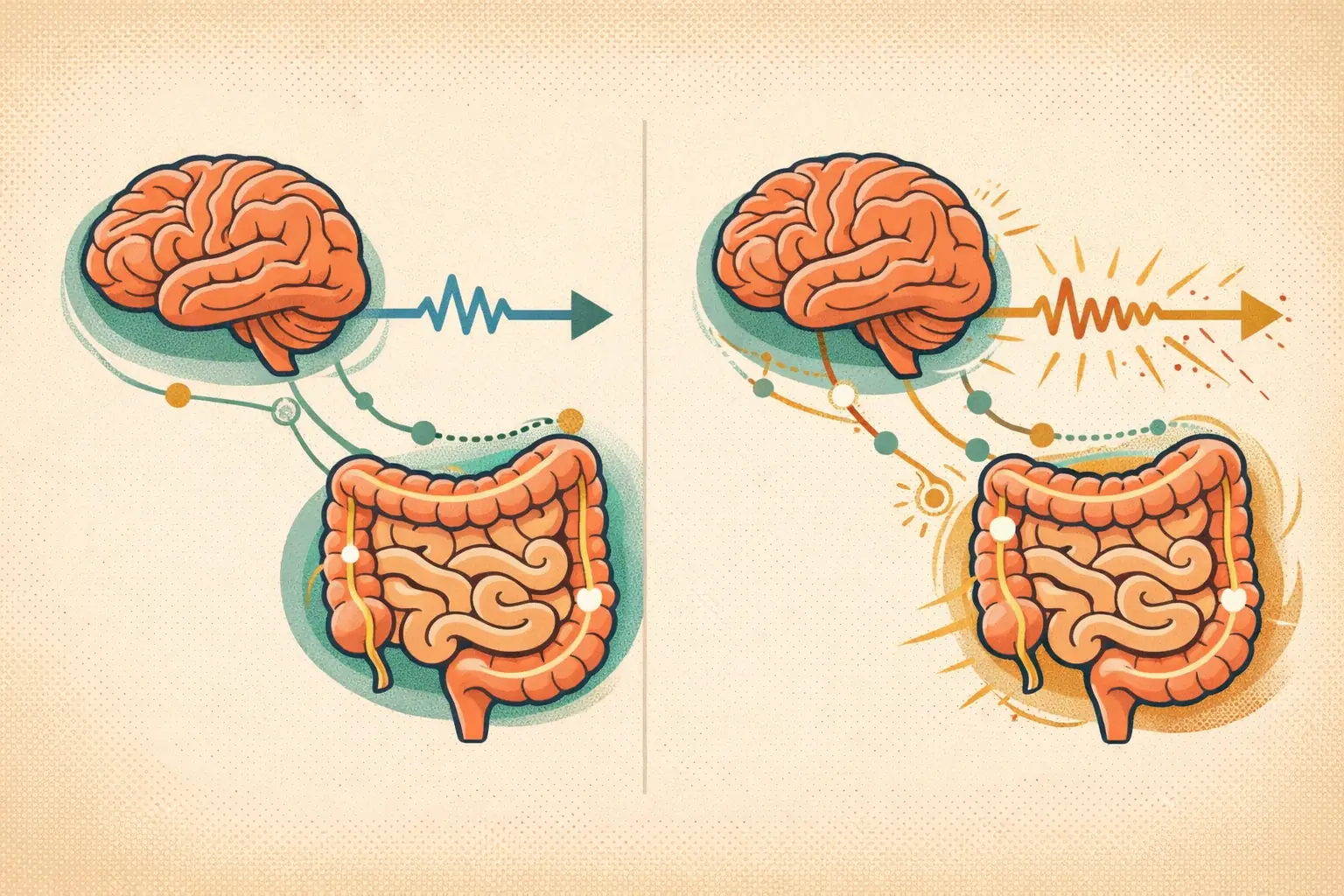
The better way to think about psychosocial load is this: it can act like a gain knob on top of an already sensitive system. If your gut is already prone to pain amplification, altered motility, or symptom vigilance, chronic stress, trauma history, disrupted routines, or panic about symptoms can make that signal hit harder and last longer.
If that sounds familiar, pair this page with our practical article on stress and bloating through the gut-brain axis. If your main issue is still diagnostic uncertainty rather than confirmed IBS, use our guide to SIBO vs IBS vs food intolerance before overfitting everything to brain-gut theory.
The treatment takeaway is not "get a brain scan." The treatment takeaway is that IBS care often works better when it matches the dominant driver of your symptom pattern.
The 2021 ACG guideline suggests gut-directed psychotherapy for global IBS symptoms 15. NCCIH uses similarly cautious language, noting that there is some evidence that gut-directed hypnotherapy can improve symptoms and quality of life 16.
That recommendation makes more sense when you look at the neuroscience. Therapy is not being used because IBS is imaginary. It is being used because symptom processing, vigilance, fear learning, and pain modulation are part of the disorder.
There is also direct evidence that symptom improvement with CBT can track with measurable biological change. Older work linked cognitive therapy with reduced limbic activity and better gastrointestinal symptoms 17. More recent work connected CBT response with both brain-signature and microbiome changes in IBS 18.
If this is the part of the plan you want to understand better, read our evidence review on gut-directed hypnotherapy for IBS.
Brain-gut science should widen your treatment options, not replace obvious diet and subtype logic.
If constipation is your clearest pattern, go straight to IBS-C and low FODMAP. If urgency and diarrhea dominate, read IBS-D and low FODMAP. If you already cleaned up the basics and still feel stuck, use what to do when low FODMAP doesn't work.
For readers with severe pain, major quality-of-life loss, or repeated failure of diet-only approaches, the next step may be medical rather than purely behavioral. That is where neuromodulators and broader treatment pathways matter. Our guide to IBS treatment breakthroughs covers that side of the decision tree.
If the pain feels especially stress-sensitive, hormone-context-sensitive, or persistent after stool pattern improves, the more specific next layer is stress, sex, and chronic visceral pain.
| Finding | Plain-English meaning | Best next step |
|---|---|---|
| Greater salience and threat processing | gut sensations may feel urgent and intrusive | brain-gut therapy, stress-targeted care, symptom-loop work |
| Anticipation-related amplification | symptoms can rise before the trigger event itself | prepare for predictable flares, reduce vigilance, use therapy tools |
| Higher anxiety and depression burden in IBS | mood load can worsen symptom burden | broaden treatment beyond diet alone |
| Mixed drivers across patients | not every IBS case is the same | route by subtype, severity, and dominant trigger pattern |
This page is most useful if:
It is less useful as a starting point if:
Free Resource: IBS Symptom Amplification Checklist
Download the IBS Symptom Amplification Checklist if you want a one-page way to judge whether stress, anticipation, and pain amplification are driving more of your pattern than food alone.
The neuroscience of IBS does not tell you that symptoms are imaginary. It tells you that pain, vigilance, stress, and body-signal interpretation are part of the illness in many patients.
That is useful because it changes the next-step conversation. Instead of asking whether IBS is "real" or "psychological," you can ask a better question: Which part of my brain-gut loop needs the most help right now?
For practical stress tools, read stress-bloating-through-gut-brain-axis. For therapy evidence, go to gut-directed hypnotherapy for IBS. For subtype-specific care, use IBS-C and low FODMAP or IBS-D and low FODMAP. And if pain remains persistent despite the basics, review IBS treatment breakthroughs.
If the flare pattern may involve sleep, movement, hydration, cycle timing, medications, or urgency as well as stress, use the non-food IBS triggers decision guide to compare trigger lanes before cutting more foods.
Xam Riche is a gut health solopreneur and founder of YourFitNature, dedicated to helping people navigate digestive wellness through evidence-based information and personal experience. After years of struggling with IBS and bloating, Xam discovered the transformative power of the low FODMAP diet and now shares practical, science-backed guidance to help others find relief. While not a medical professional, Xam combines extensive research with lived experience to create accessible, empowering resources for the gut health community. Learn more about our mission
As an affiliate, we may earn from qualifying purchases.