 By • Published on May 20, 2026 • 10 min read • 4,465 views
This article is for informational and educational purposes only and does not constitute medical advice. Always consult with a qualified healthcare professional for diagnosis, testing, and treatment decisions.
Eating after an IBS-D diarrhea flare can feel like stepping onto thin ice. You may be hungry, tired, and ready for normal food, but every bite feels like it could restart the bathroom loop.
That fear makes sense. It also creates a trap: one diarrhea flare can turn into days or weeks of eating only the few foods that feel safest. The goal after a flare is not to prove you can live on bland food. It is to move in a clear sequence: safety signs, fluids, familiar simple foods, a rebuilt plate, and then normal variety.
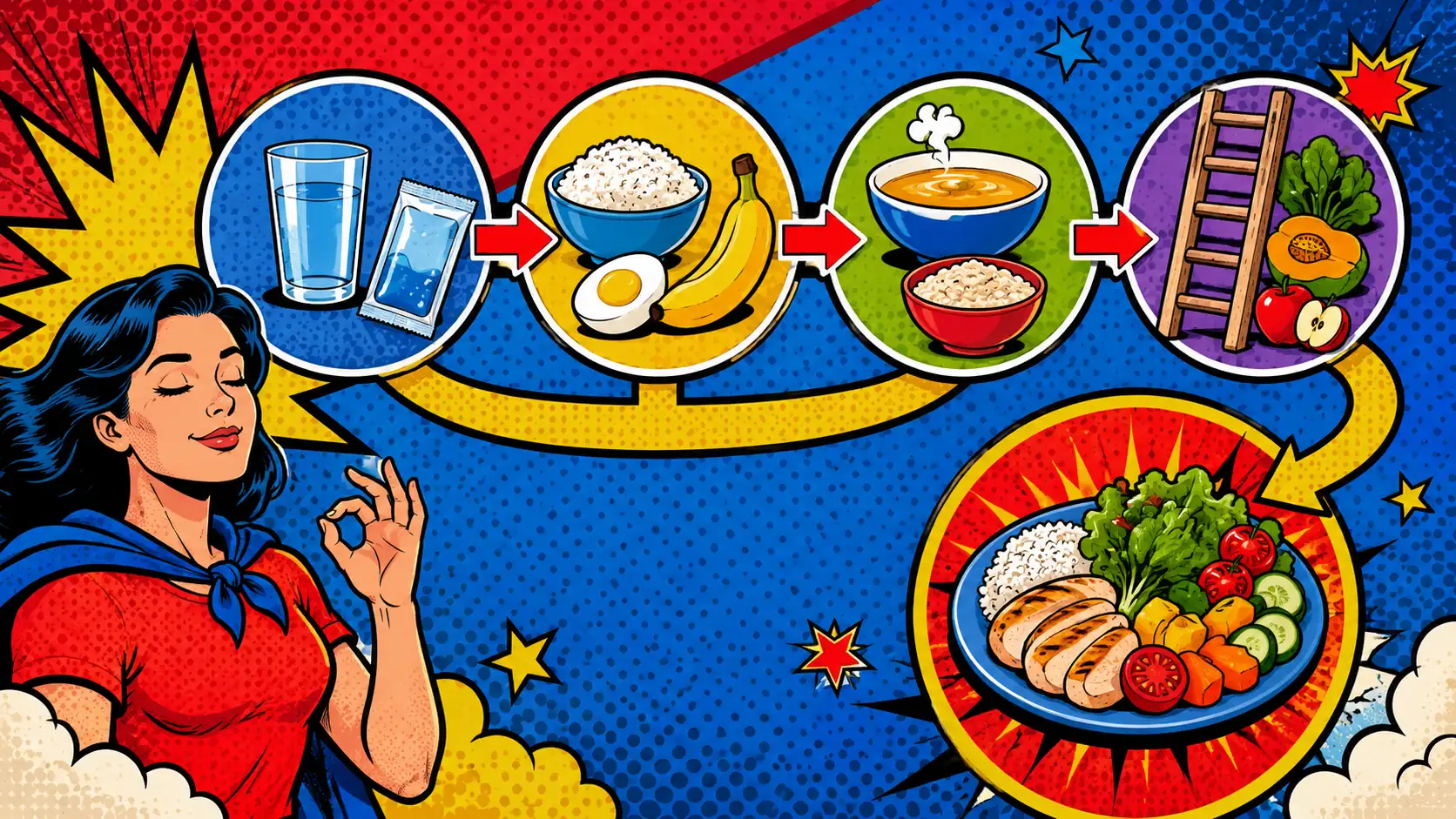
Use this as the food bridge after the same-day IBS flare plan and the hydration-focused oral rehydration for diarrhea and IBS flares guide. If diarrhea is frequent, persistent, or needs treatment sorting, keep IBS-D medications and diarrhea options nearby too.
Food strategy should not delay care when the pattern is unsafe.
Get medical guidance promptly if diarrhea comes with blood or black stool, fever, severe or worsening pain, repeated vomiting, fainting, confusion, dehydration signs, nighttime diarrhea, unexplained weight loss, or symptoms that are clearly different from your usual IBS pattern. NIDDK lists dehydration, blood or pus in stool, black stool, fever, severe pain, and higher-risk situations among diarrhea warning contexts 1. NIDDK also notes that doctors may need to treat severe dehydration in a hospital 2.
If those signs are present, the next move is care, not a better breakfast.
If the pattern is familiar, improving, and not paired with warning signs, then food can become part of recovery.
After a diarrhea-heavy day, the first question is not "Which food will fix my gut?" It is "Am I keeping up with fluid and salt loss?"
For mild loose stool, normal fluids and familiar meals may be enough. For frequent watery diarrhea, diarrhea plus vomiting, heat or sweating, dark urine, dizziness, very low urination, or dry mouth, hydration deserves priority. CDC clinician guidance says severe diarrhea should be managed with oral rehydration solutions to prevent dehydration 3.
That does not mean ORS is an IBS treatment. It is a fluid-and-salt replacement tool. Use packaged oral rehydration solution according to product directions or medical advice, especially if you are older, medically complex, pregnant, immunocompromised, or unsure whether the diarrhea is routine IBS.
If your main question is ORS fit, use oral rehydration for diarrhea and IBS flares before you worry about the perfect recovery meal.
The first meals back should lower noise. They do not need to become your new identity.
Start with foods that are familiar, simple, and previously tolerated. Depending on your pattern, that might look like:
The key phrase is already tolerated. A food that works for one person with IBS-D may not work for another. A "safe food" list can become misleading when it ignores lactose tolerance, FODMAP dose, fat load, caffeine, sweeteners, stress, infection, medication changes, and the size of the meal.
Keep portions modest at first. Eat slowly enough to notice whether appetite, nausea, urgency, and cramping are settling. If you have been skipping food all day, avoid making the first meal back very large, very fatty, very spicy, or loaded with sugar alcohols.
Bland foods can be useful for a short bridge. They are not a complete maintenance plan.
NIDDK says that when appetite returns, people can most often go back to eating their normal diet even if diarrhea has not completely stopped 4. That matters because many IBS readers do the opposite: they wait for a perfect stool day before eating normally again. The diet shrinks, anxiety rises, and the next normal meal feels like a test.
Use this sequence instead:
This is a bridge, not a countdown. Some people move through it in a day. Some need longer because diarrhea was heavier, appetite is still low, travel or illness is involved, or treatment questions are unresolved. The point is to keep moving toward a fuller diet when the pattern allows it.
When your appetite is returning and bathroom trips are slowing, shift from snack survival to a small plate.
A useful first plate has:
That could be rice with egg and broth. It could be potatoes with chicken and a small tolerated vegetable. It could be oats with banana and lactose-free yogurt if that combination is already normal for you.
Do not use the first rebuilding meal to test everything at once. Avoid changing the grain, protein, fiber, caffeine, supplement, meal size, and timing all in the same window. If symptoms return, you will not know which variable mattered.
If urgency mainly happens after meals, the issue may be meal size, caffeine, fat, sugar alcohols, timing, or a gastrocolic-reflex pattern rather than the recovery food itself. Use urgency after meals for that route.
After diarrhea, many people become afraid of fiber. The better move is not "fiber forever bad." It is "which fiber, how much, and when?"
Fiber affects stool formation, transit, and the gut microbiota, but different fiber types behave differently and tolerance varies by bowel pattern 5. If stool is still loose, large jumps in roughage, bran, raw salads, beans, or added prebiotic fibers may be too noisy. If constipation swings in after diarrhea, avoiding fiber too long can create a different problem.
Use a small, readable step:
If low FODMAP is part of your care, do not turn a flare into a fresh indefinite elimination. Monash describes low FODMAP as a three-step process: restriction, reintroduction, and personalization 6. If you already completed reintroduction and are afraid to expand again, use diet diversity after low FODMAP to rebuild variety without losing symptom signal.
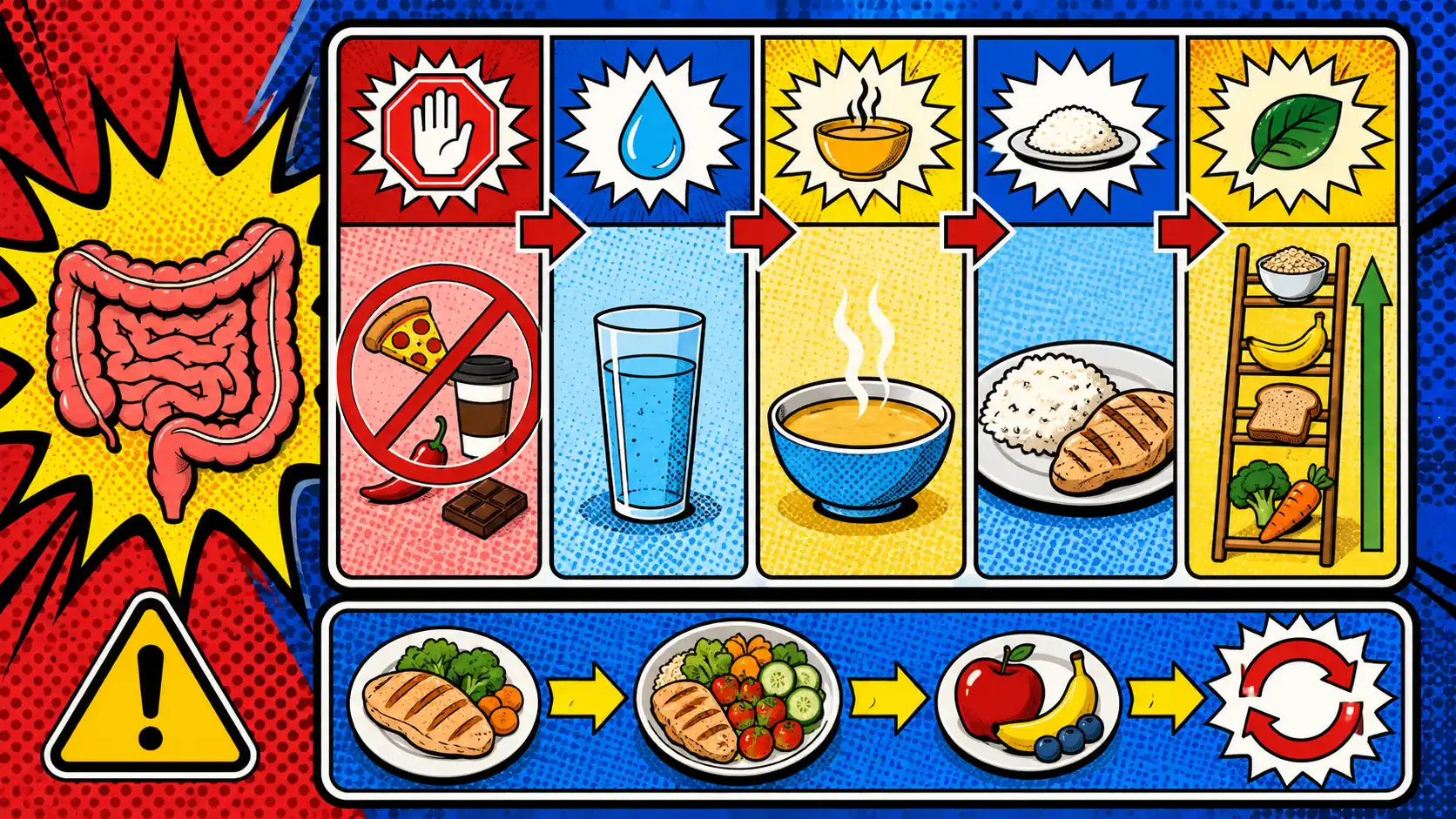
Download: After-Diarrhea Flare Food Step Card for a one-page route from stop signs and hydration back toward a normal plate.
Sometimes the problem is not "what should I eat after diarrhea?" Sometimes the pattern is telling you to leave the food-recovery lane.
Use a different route if:
| Pattern | Better next route |
|---|---|
| Diarrhea is frequent enough that dehydration is a concern | Oral rehydration for diarrhea and IBS flares |
| Watery diarrhea keeps coming back or treatment questions are rising | IBS-D medications and diarrhea options |
| Urgency is mainly after meals | Urgency after meals |
| The whole day is a noisy multi-symptom flare | IBS flare plan |
| Symptoms return after low-FODMAP personalization | Symptoms return after low FODMAP |
| Testing questions are now the main concern | IBS tests, celiac, SIBO, calprotectin, and colonoscopy |
| Symptoms are persistent, different, severe, or medically tangled | Doctor visit prep for IBS next steps |
ACG and BSG guideline literature both frame IBS management as a symptom- and subtype-aware process rather than one universal rule for every reader 7 8. That is the right mindset after a diarrhea flare too. Food is one lane. Hydration, medication review, testing, sleep, stress, cycle timing, travel, infection, and meal rhythm may all belong in the bigger map.
| If this is your main question | Read this next |
|---|---|
| "Do I need ORS or just normal fluids?" | Oral rehydration for diarrhea and IBS flares |
| "What do I do during a loud IBS day?" | IBS flare plan |
| "My diarrhea needs treatment sorting." | IBS-D medications and diarrhea options |
| "I rush to the bathroom after eating." | Urgency after meals |
| "I am scared to expand food after low FODMAP." | Diet diversity after low FODMAP |
| "Fiber always feels risky." | Types of fiber by symptom fit |
| "I want long-term variety, not just tolerated meals." | Fiber diversity and microbiome resilience |
If appetite is still low after the diarrhea day settles, use IBS safe foods when appetite is low to choose a small, familiar next meal without turning recovery into a universal safe-food list.
After a diarrhea flare, the goal is not to eat perfectly. The goal is to move in the right order.
Check stop signs first. Replace fluids before obsessing over food if diarrhea was frequent or severe. Use familiar simple foods for the first meals back. Then rebuild a small plate and add one variable at a time as the pattern settles.
Do not let one flare become an indefinite restriction plan. A useful recovery diet should lead back toward normal eating, clearer signals, and enough variety to live with.
Xam Riche is a gut health solopreneur and founder of YourFitNature, dedicated to helping people navigate digestive wellness through evidence-based information and personal experience. After years of struggling with IBS and bloating, Xam discovered the transformative power of the low FODMAP diet and now shares practical, science-backed guidance to help others find relief. While not a medical professional, Xam combines extensive research with lived experience to create accessible, empowering resources for the gut health community. Learn more about our mission
As an affiliate, we may earn from qualifying purchases.