 By • Published on March 26, 2026 • 12 min read • 1,731 views
This article is for informational and educational purposes only and does not constitute medical advice. If you are concerned about fertility, low sperm quality, or hormone-related symptoms, consult a qualified clinician for proper evaluation before relying on supplements alone.

Probiotic supplements are often marketed as support for testosterone, gut health, performance, and fertility all at once. That is exactly why this topic needs a narrower lens. This article does not ask whether probiotics are vaguely "good for men." It asks a much more useful question: what evidence actually exists for sperm-related outcomes such as motility, concentration, morphology, oxidative stress, and DNA fragmentation, and where do the claims still run ahead of the science?
Short answer: probiotics may support selected sperm-related markers in some male fertility contexts, but the evidence is narrower and less universal than marketing suggests. Testosterone claims are especially weak.
This page is for you if you want an evidence-first review of probiotic claims around sperm motility, semen quality, oxidative stress, and adjunctive fertility support.
Use a different page first if your real question is digestive symptom relief, broader microbiome mechanisms, or supplement-label troubleshooting. Start with probiotics-for-ibs-strains-guide, polyphenols-gut-microbiome-science, or hidden-fodmaps-products.
This page is explaining a peripheral evidence review:
This page is not mainly saying:
If your next step is closer to symptom-led strain selection or broader microbiome education, route instead to probiotics-for-ibs-strains-guide or polyphenols-gut-microbiome-science.
The old framing of this page treated probiotics as a broad men's-health topic. That sounds expansive, but it is too vague to help anyone make a sound decision.
For fertility discussions, the real outcomes that matter are more specific:
That is a much better question than "What are the probiotic benefits for men?" because it forces the article to stay close to what was actually measured in studies.
It also matters because fertility concerns should not be treated like ordinary supplement shopping. Current male-infertility guidance supports structured clinician evaluation rather than endless self-experimenting with over-the-counter products 1.
So this article is best understood as an evidence review for men who are asking:
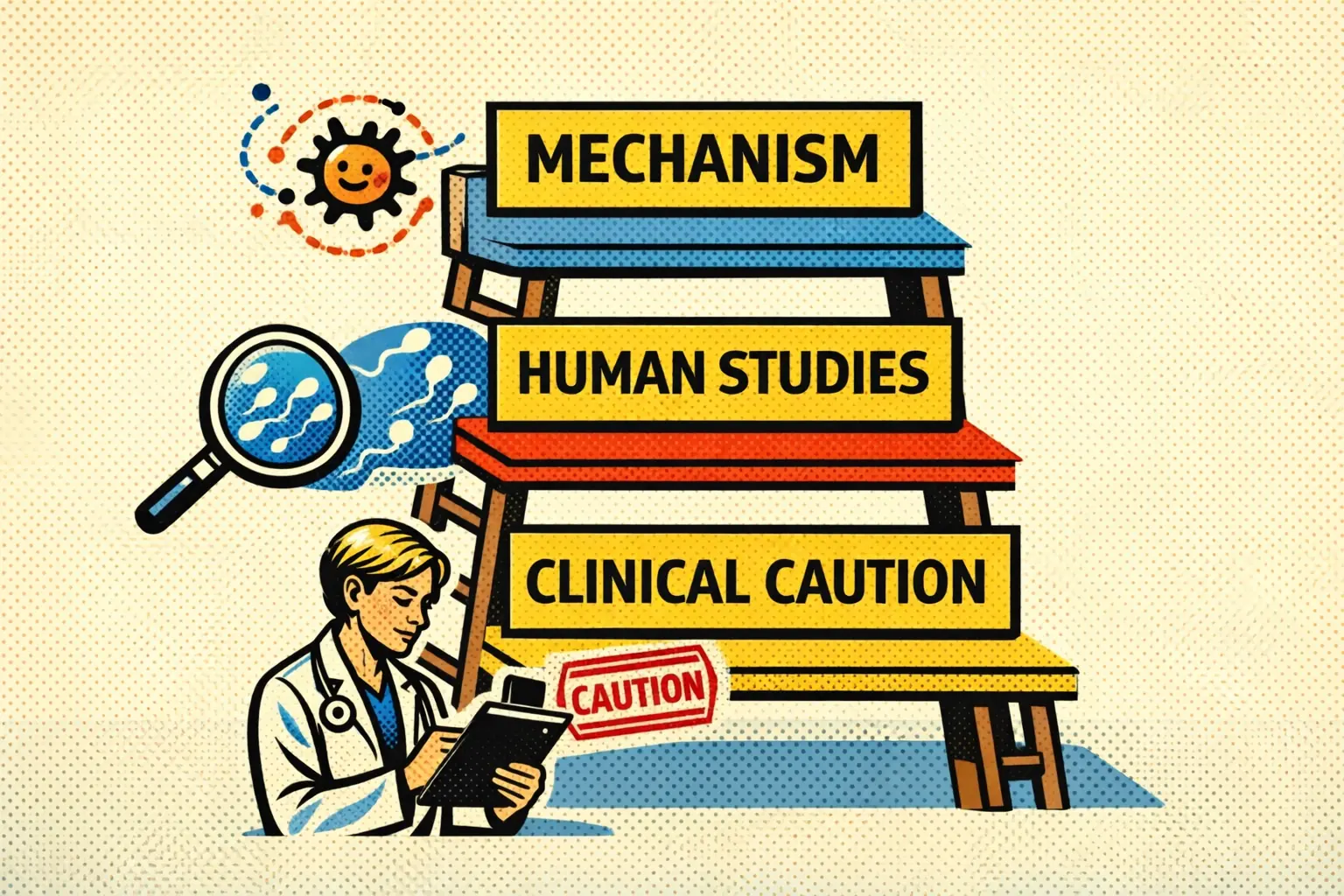
Researchers are interested in probiotics here for a reason. Male fertility is not only a hormone story. It is also shaped by inflammation, oxidative stress, metabolic status, and the broader signaling environment of the body.
Oxidative stress is particularly relevant because it is strongly associated with poorer sperm quality and male infertility 2. That helps explain why microbiome-related strategies even enter the conversation. If gut dysbiosis contributes to inflammatory load or oxidative stress, then changing the microbiome could plausibly affect downstream sperm-related markers.
That mechanism is still only part of the picture. Review-level literature proposes that probiotics may influence male reproductive health through changes in inflammatory signaling, oxidative balance, and host-microbiome interactions 3. That is a plausible pathway, not a guarantee of clinical benefit.
This is also where strain specificity still matters. Not all probiotics do the same job, just as not all studies ask the same question. A strain or combination studied for IBS, sports recovery, or general digestive comfort cannot automatically be treated as fertility evidence.
If you want more context on how inflammation and signaling patterns can change gut function more broadly, our guide to stress and gut signaling helps explain why microbiome effects are rarely isolated from the rest of the system.
This is where the topic gets both more interesting and more limited.
Some studies and reviews do report improvements in sperm-related markers after probiotic or synbiotic interventions. But those results usually come from very specific groups, such as infertile men, men after varicocelectomy, or men using combination protocols rather than probiotic-only treatment.
These are the outcomes most people care about first, and they are also where some of the more promising findings appear.
In a randomized controlled trial after varicocelectomy, the probiotic group showed significantly better sperm concentration and normal morphology at 3 months compared with placebo, while motility improved numerically but was not statistically significant 4. That is a useful human example, but it is still a very specific clinical context. It does not prove the same result for every man buying a probiotic online.
A broader review pattern also suggests that some probiotic-related interventions may help sperm concentration and motility in certain male infertility populations 5. The problem is that the literature is not clean enough yet to turn that into a single go-to strain recommendation for all readers.
This is arguably the most important bridge between the mechanism story and the human-outcomes story.
Some of the more promising fertility results come from combination protocols rather than probiotic-only studies. In a 2025 randomized trial in idiopathic oligoasthenoteratozoospermia, a synbiotic added to an antioxidant supplement improved progressive motility, reduced non-motile sperm, and improved DNA fragmentation outcomes 6.
That is relevant because it shows where the signal may be strongest: not necessarily in a probiotic acting alone, but in how it may contribute to a broader oxidative-stress and sperm-quality support strategy.
Still, this is exactly where caution is needed. A synbiotic-plus-antioxidant study is not the same as a probiotic-only fertility proof. The article needs to keep that distinction visible.
Morphology changes do appear in some human studies, including the varicocelectomy trial above 7. But once you zoom out, the pattern is mixed enough that morphology should be presented as a possible supportive outcome, not a settled promise.
The same goes for broad language like "improves male fertility." The evidence is more defensible when translated into specific semen-quality markers than when collapsed into a one-line fertility claim.
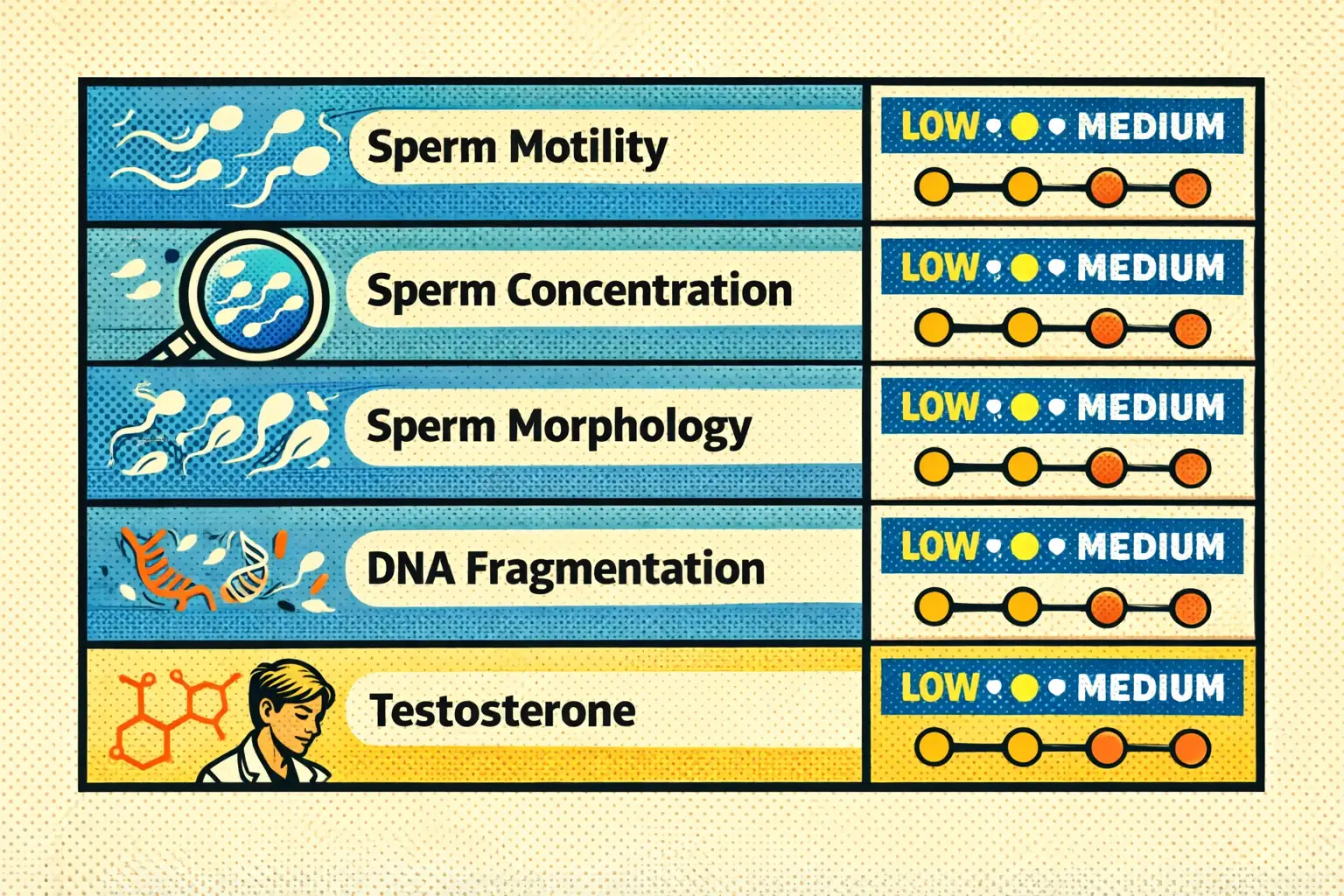
| Outcome | Evidence direction | How to frame it |
|---|---|---|
| Progressive motility | Some promising findings | Promising, but population-specific |
| Sperm concentration | Mixed to somewhat promising | Better as cautious summary than guarantee |
| Morphology | Mixed | Mention without overselling |
| DNA fragmentation | Promising in some combination protocols | Emphasize context and protocol differences |
| Live birth / pregnancy outcomes | Too limited for strong claims | Do not present as established benefit |
This is one of the most common reasons men click probiotic content, and it is also one of the fastest ways to lose credibility if the answer is overstated.
At the moment, testosterone is better handled as a myth-check section than as a benefit section.
In a placebo-controlled study of collegiate male baseball players, probiotic supplementation attenuated TNF-alpha but had no effect on hormonal status, gut permeability, body composition, or performance 8. That does not prove probiotics can never influence hormone-related pathways. It does show that probiotic use should not be marketed as a reliable testosterone strategy on the basis of current human evidence.
So if your main reason for looking into probiotics is "I want to raise testosterone," the honest answer is that the evidence is weak. The more defensible discussion is around sperm-related markers, inflammation, oxidative stress, and adjunctive support in selected male populations.
This is the section most supplement pages hope you skip.
Before taking a "male fertility probiotic" seriously, ask:
This matters because the evidence base is heterogeneous. Some trials focus on infertility populations, some on post-surgical patients, some on combination regimens, and some on men whose primary outcomes were not fertility-related at all.
It also matters because supplement labels can bury awkward details inside formulation choices. If you want help auditing ingredients and filler claims, our supplement label check guide is a useful companion when you are trying to tell evidence-based probiotic positioning from generic supplement marketing.
Download: Male Fertility Probiotic Questions Checklist Use this printable checklist to pressure-test fertility-focused probiotic claims before you buy a product or treat a supplement as a substitute for proper evaluation.
A probiotic may be a reasonable adjunct for men who:
A probiotic is not a good substitute for evaluation if:
That is why the strongest framing for this article is not "here is the best probiotic for every man." It is "here is what the evidence suggests, what it does not prove, and how to think about the topic more intelligently."
If your real priority is unresolved IBS, bloating, or food-trigger symptoms, you will get more direct value from our broader gut-symptom guide and from what to do when symptoms do not improve. This article is not meant to replace those entry points.
The current evidence does not support a sweeping claim that probiotics "fix male fertility." What it does support is a narrower, more cautious conclusion:
If you are considering this seriously, the most practical next step is:
The best use of this article is not to sell you a shortcut. It is to help you see which claims are evidence-based, which ones are still emerging, and where a probiotic might fit into a more grounded fertility-support plan.
Xam Riche is a gut health solopreneur and founder of YourFitNature, dedicated to helping people navigate digestive wellness through evidence-based information and personal experience. After years of struggling with IBS and bloating, Xam discovered the transformative power of the low FODMAP diet and now shares practical, science-backed guidance to help others find relief. While not a medical professional, Xam combines extensive research with lived experience to create accessible, empowering resources for the gut health community. Learn more about our mission
As an affiliate, we may earn from qualifying purchases.