 By • Published on May 15, 2026 • 7 min read • 1,247 views
This article is for informational and educational purposes only and does not constitute medical advice. Seek urgent care for trouble breathing, throat tightness, faintness, swelling, severe allergic symptoms, black or bloody stool, severe abdominal pain, dehydration, or rapidly worsening symptoms.
Fermented foods sit in a strange place for symptom-prone readers. They are often framed as gut-friendly, microbiome-supportive, or “good for digestion.” But the same category can include kombucha, kefir, yogurt, sauerkraut, kimchi, aged cheese, vinegar-heavy foods, wine, and probiotic foods that feel anything but gentle.
If you get bloating, reflux, diarrhea, flushing, hives, headache, or urgency after fermented foods, the answer is not automatically “histamine intolerance.” It is also not automatically “your gut is too damaged for healthy foods.” A food can be microbiome-relevant and still be a poor fit for your current gut state.
This guide sorts the reaction pattern before it turns into another broad restriction project.
Probiotics are live microorganisms intended to provide health benefits, but effects depend on the organism, product, dose, and person 1. Fermented foods are even more variable. Some contain live microbes; some do not. Some are acidic, carbonated, salty, alcoholic, lactose-containing, spicy, or eaten in larger servings than the gut can comfortably handle.
NIH ODS also notes that many commercial probiotic products have not been examined in research studies and that safety data can be limited, especially for people with compromised immune function or serious underlying disease 2. That does not mean probiotic or fermented foods are bad. It means “healthy” is not the same as “automatically tolerated.”
Before you test histamine, FODMAPs, acidity, or probiotics, separate routine discomfort from safety signs.
FDA food allergy guidance lists possible severe allergic-reaction symptoms such as rash or flushed skin, tingling or itching in the mouth, swelling of the face, tongue, or lips, vomiting or diarrhea, cramps, coughing or wheezing, dizziness, throat or vocal-cord swelling, trouble breathing, and loss of consciousness 3.
NIAID food allergy guidance also emphasizes that severe reactions can be life-threatening and require avoidance and treatment of severe symptoms 4.
If the reaction involves breathing trouble, throat tightness, faintness, swelling, widespread hives with other symptoms, repeated vomiting, severe diarrhea, severe abdominal pain, or collapse, do not run a home retest. Stop the food and get medical guidance.
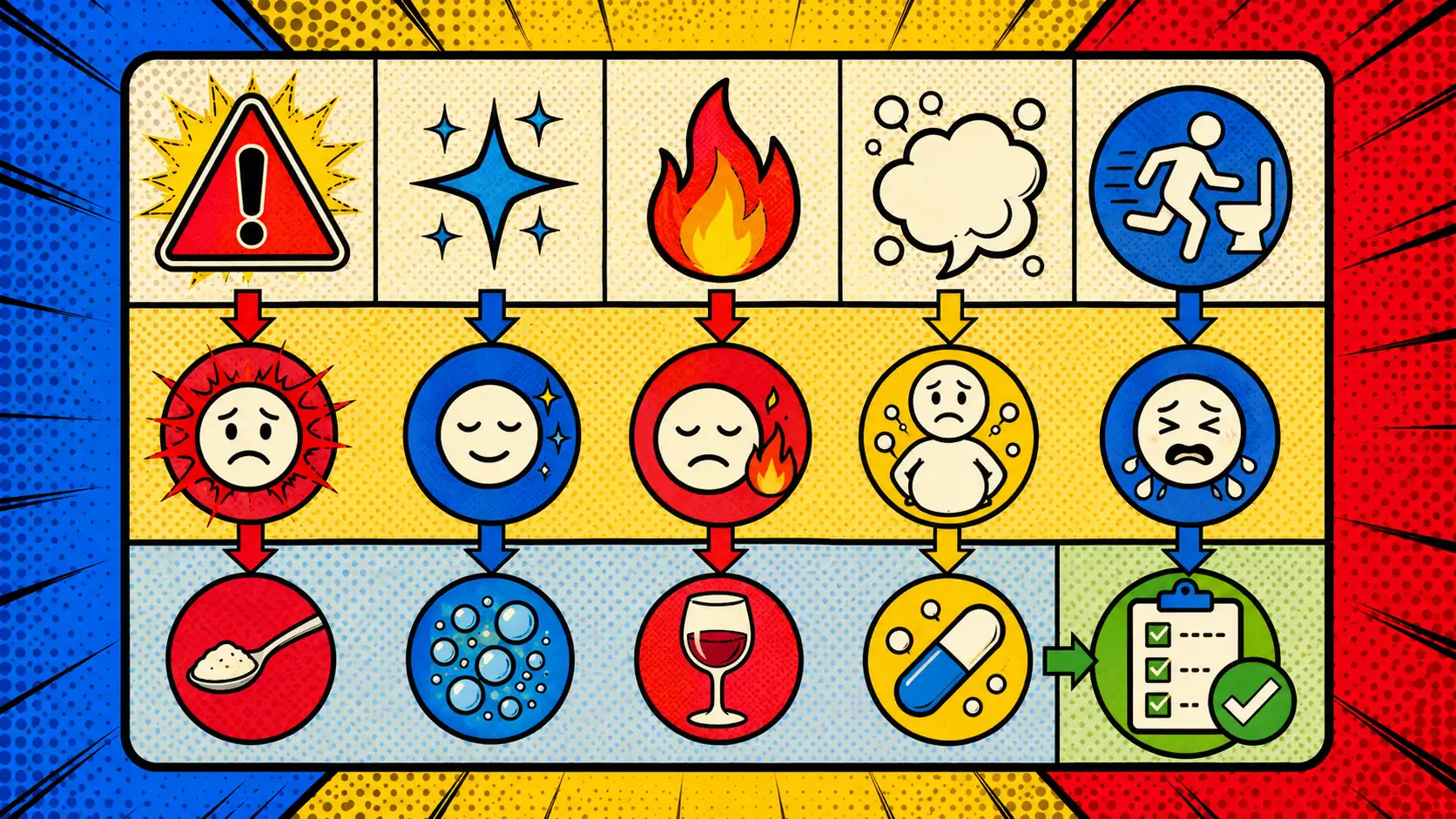
Most fermented-food reactions are easier to understand when you sort by the lead symptom.
| Lead pattern | Possible variables | Better next route |
|---|---|---|
| Bloating, gas, distension | Serving size, FODMAP load, carbonation, constipation, fiber | Use a bloating or fermented-drink sorter |
| Reflux, burning, sour taste | Acidity, carbonation, alcohol, late meal timing, meal size | Route to reflux-like symptoms |
| Diarrhea or urgency | Alcohol, caffeine, sweeteners, dose, IBS-D, bile-acid clues, food poisoning context | Route by stool pattern and safety |
| Flushing, hives, itching, headache, diarrhea | Possible histamine-style clue, allergy, medication interaction, mast-cell concern | Discuss with a clinician if recurrent |
| Multi-system reaction | Food allergy or another urgent reaction pattern | Medical care; do not self-rechallenge |
If kombucha is the trigger, the problem may be carbonation, acidity, caffeine, alcohol traces, fruit sugars, serving size, or histamine-style sensitivity. The fermented drinks and gut symptoms guide is the better sibling route for that pattern.
If the main symptom is reflux, burning, or sour taste, use reflux-like symptoms before building a histamine theory. If the main symptom is “healthy food always bloats me,” use why healthy foods still cause bloating.
Histamine-style symptoms are a clue, not a diagnosis. AAAAI summarizes histamine intolerance as a postulated disorder involving increased sensitivity to dietary histamine, with reported symptoms such as diarrhea, flushing, hives, itching, headache, low blood pressure, arrhythmias, and asthma after histamine-rich foods 5.
That wording matters. The evidence is not clean enough to say, “You reacted to sauerkraut, therefore you have histamine intolerance.” Cleveland Clinic similarly frames histamine intolerance as a proposed condition and notes that other conditions, including inflammatory bowel disease, celiac disease, and mast-cell disorders, may need to be ruled out when the pattern is more complex 6 7.
So keep the question practical:
A low-histamine diet should not be the first reflex for ordinary IBS bloating. If it is considered, it should be short, structured, and ideally supported by a clinician or dietitian so the food list does not keep shrinking without a clear reason.
Do not retest a food after a severe or multi-system reaction unless a clinician specifically guides you. If the reaction was uncomfortable but not dangerous, use a cleaner experiment.
📥 Free Download: Fermented-Food Histamine Symptom Sorter — use it to separate allergy signs, histamine-style clues, reflux, bloating, diarrhea, and dose variables.
For a safe retest:
If the reaction is mainly to fermented foods but not probiotic supplements, the issue may be food matrix, acidity, salt, FODMAPs, alcohol, dose, or histamine-style sensitivity. If the reaction is mainly to probiotic capsules, use the probiotics for IBS strains guide and focus on strain, dose, and indication.
| Situation | Best next read |
|---|---|
| Kombucha or fermented drinks are the main trigger | Fermented drinks and gut symptoms |
| You want the broader benefit lane | Health benefits of fermented plant-based foods |
| Probiotic supplement questions dominate | Probiotics for IBS strains guide |
| Healthy foods keep causing bloating | Why healthy foods still cause bloating |
| Reflux or upper-GI burning dominates | Reflux-like symptoms |
| The pattern is unclear between SIBO, IBS, and intolerance | SIBO vs IBS vs food intolerance |
Fermented foods are optional. They are not a gut-health obligation, and avoiding a food that reliably makes you feel worse is not a moral failure.
The useful move is not “ferments are good” or “histamine explains everything.” It is pattern sorting. Start with safety signs. Separate reflux, bloating, diarrhea, and allergy-like clues. Test one variable at a time if it is safe. And if reactions are severe, multi-system, progressive, or paired with blood, dehydration, weight loss, or major symptom change, get medical care instead of running another food experiment.
This article is for informational purposes only and is not intended as medical advice. Please consult a qualified healthcare provider for diagnosis and treatment of any health condition.
Xam Riche is a gut health solopreneur and founder of YourFitNature, dedicated to helping people navigate digestive wellness through evidence-based information and personal experience. After years of struggling with IBS and bloating, Xam discovered the transformative power of the low FODMAP diet and now shares practical, science-backed guidance to help others find relief. While not a medical professional, Xam combines extensive research with lived experience to create accessible, empowering resources for the gut health community. Learn more about our mission
As an affiliate, we may earn from qualifying purchases.