 By • Published on May 5, 2026 • 11 min read • 1,757 views
This article is for informational and educational purposes only and does not constitute medical advice. Always consult a qualified healthcare professional before using ginger, supplements, or symptom information to make diagnosis or treatment decisions, especially if symptoms are persistent, severe, changing, or medication-related.

Ginger can sound almost too easy: a slice in tea, a capsule from the shelf, a little heat in a meal, and maybe the nausea or heavy-stomach feeling settles down. Sometimes that small tool really can fit. The problem starts when ginger gets treated like a cure-all for every digestive symptom instead of a narrow option that needs the right symptom, form, and safety context.
Short answer: ginger is most plausible as a small tool for nausea and some upper-GI discomfort patterns. It is less useful as a blanket answer for chronic bloating, reflux, IBS, or unexplained fullness. Tea, food ginger, and capsules are not the same exposure, and persistent or alarming symptoms deserve medical review rather than another home experiment.
This guide refreshes two older ginger articles into one practical utility: how to think about ginger for nausea, meal-related fullness, and digestive discomfort without turning it into supplement hype.
If your main issue is early fullness, upper-stomach heaviness, or nausea after small meals, keep functional dyspepsia in view. If burning, sour taste, or lying-down symptoms are louder, compare the pattern with reflux-like symptoms before assuming ginger is gentle for you. If appetite is low and the immediate question is what small meal to try next, use IBS safe foods when appetite is low as the gentle eating route.
Ginger is the underground stem, or rhizome, of Zingiber officinale. It is used as food, spice, tea, and supplement. That range matters because "ginger" can mean a few slices in hot water or a concentrated capsule with a standardized extract. Those are not the same test.
NCCIH summarizes ginger as a traditional herb now promoted for nausea, vomiting, osteoarthritis, menstrual cramps, and other conditions. It also says there have been many human studies, but some are not high quality, and most nausea studies used dietary supplements rather than foods 1.
For digestive readers, that gives ginger three different evidence zones:
| Use case | How strong is the fit? | Practical meaning |
|---|---|---|
| Nausea | Best-supported digestive use, but context-dependent | Worth considering carefully, especially if there are no red flags |
| Mild upper-GI discomfort or unsettled stomach | Plausible but less certain | A small food or tea trial may be reasonable if it does not worsen reflux |
| Chronic bloating, IBS, reflux, or persistent fullness | Weaker or indirect fit | Use symptom-specific routing instead of relying on ginger |
That is the core distinction. Ginger may belong in your toolkit. It should not replace the work of naming the symptom pattern.
The cleanest digestive case for ginger is nausea. Even there, the details matter.
NCCIH notes that research suggests ginger may help nausea and vomiting associated with pregnancy. It also says most studies of ginger for motion sickness have not shown benefit, and it remains uncertain whether ginger helps as an addition to standard treatment for chemotherapy-related or postoperative nausea 2.
That is more useful than a simple yes or no. It tells you ginger is not a universal anti-nausea answer. It may be a fit in some nausea contexts, while other contexts need standard medical treatment, a clearer diagnosis, or a clinician-guided plan.
Older and newer reviews reach a similar practical message: ginger has been studied in randomized trials, but results vary by nausea type, study quality, preparation, dose, and comparator 3 4 5.
So if your question is, "Can ginger ever help nausea?", the answer is yes, possibly. If your question is, "Will ginger tea fix my nausea no matter why it is happening?", the answer is no.
Use ginger as a small fit check only when the nausea is mild, familiar, and not paired with warning signs. Repeated vomiting, dehydration, severe pain, fever, new neurological symptoms, pregnancy uncertainty, medication changes, or cancer treatment nausea should not be handled as a casual tea experiment.
Fullness is where ginger claims often get too loose.
NIDDK describes indigestion, or dyspepsia, as a cluster of symptoms that can include pain, burning, or discomfort in the upper abdomen; feeling full too soon during a meal; uncomfortable fullness after eating; bloating; nausea; or belching 6 7.
That list overlaps with the exact symptoms many readers call "bad digestion." But the overlap does not prove that ginger is the answer.
One small randomized double-blind study in 11 people with functional dyspepsia found that ginger stimulated gastric emptying and antral contractions. That is interesting because delayed or altered stomach handling can be part of some upper-GI symptom stories. But the study was small, short, and not enough to say ginger treats chronic functional dyspepsia 8.
The practical translation is this:
That is why this page routes persistent fullness back to functional dyspepsia and broader hunger, fullness, and gut-brain signaling. Ginger can be a side tool. It is not the whole map.
The older ginger-tea article treated tea as if it could inherit nearly every ginger supplement claim. That is too broad.
Here is the cleaner distinction:
| Form | Best use | Main caution |
|---|---|---|
| Food ginger | Flavor, meal-level support, lowest-intensity trial | Effects are hard to separate from the whole meal |
| Ginger tea | Warm, simple, hydrating, easy to test | Dose is uncertain and not equivalent to studied capsules |
| Ginger capsules or extracts | Closer to many research products | Higher need for medication, pregnancy, and safety review |
Tea can still be useful. Warm fluid, a familiar ritual, and a modest ginger exposure may feel settling for some people. But the honest claim is "this is a readable small experiment," not "this tea equals clinical trial evidence."
Capsules and extracts are different. They may be more study-like, but they also move ginger closer to the dietary supplement world. NCCIH reminds readers that dietary supplements are regulated differently from drugs and are not approved by the FDA before sale in the same way medicines are 9.
So the form question is not cosmetic. It changes both the evidence and the safety conversation.
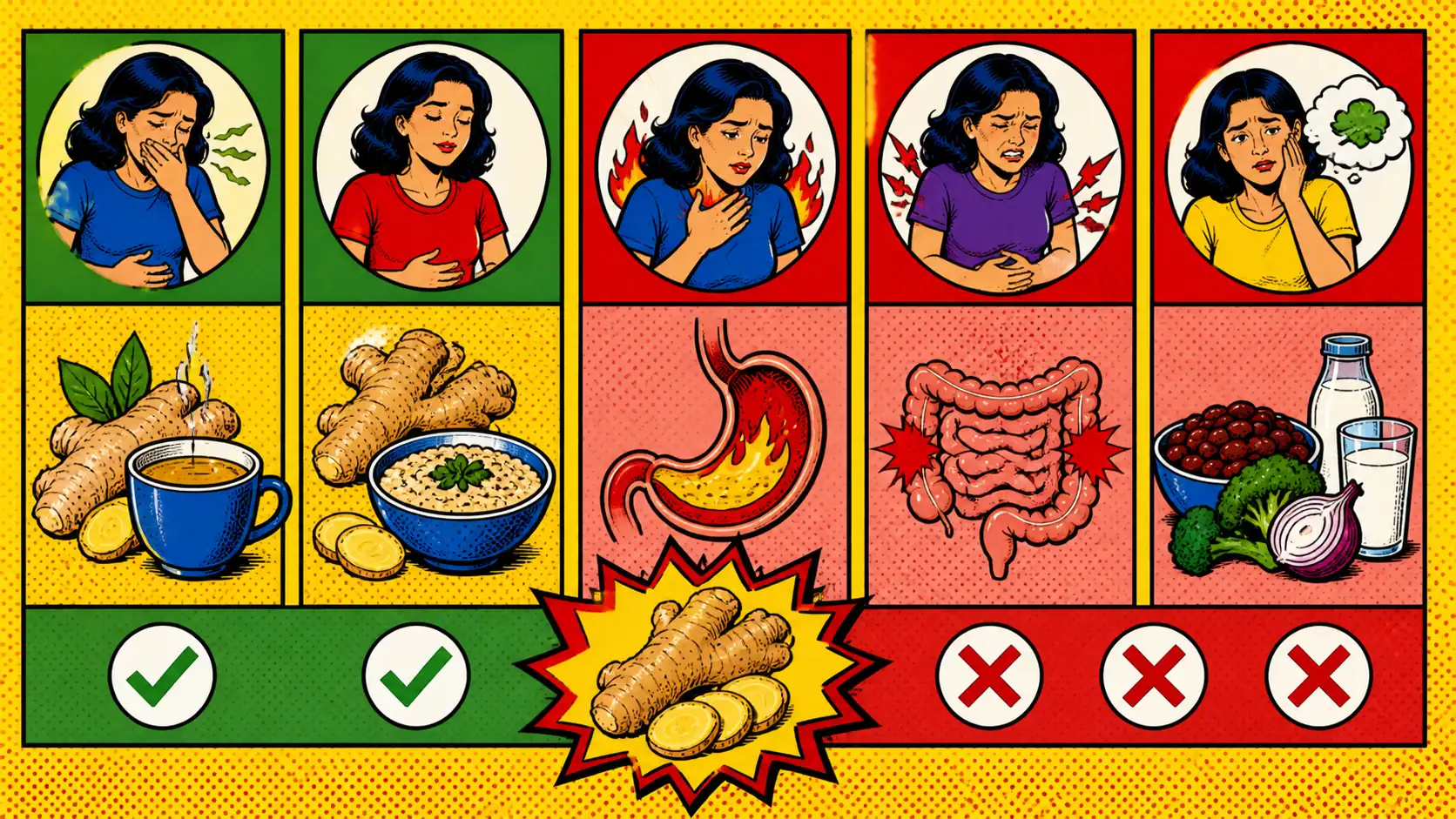
Use this table before you add ginger to every gut symptom:
| Your main pattern | Ginger fit | Better route if this is louder |
|---|---|---|
| Mild nausea, no red flags | Reasonable cautious trial | Medical review if persistent or worsening |
| Early fullness after small meals | Possible comfort tool, not a diagnosis | Functional dyspepsia |
| Burning, sour taste, worse lying down | Be careful; ginger may irritate some | Reflux-like symptoms |
| IBS cramping, pain, and bloating | Not the main IBS tool | Peppermint oil for IBS |
| Gas after beans, dairy, or specific foods | Ginger does not digest the trigger | Digestive enzymes for bloating |
| Broad bloating with unclear cause | Too nonspecific | How to reduce bloating |
This is also how to avoid the classic natural-remedy trap. The question is not "Is ginger healthy?" The better question is:
Does ginger match the symptom I am actually trying to change?
Download: Ginger Fit Checklist
Use this before treating ginger as the automatic next digestive remedy.
If you decide ginger is a reasonable fit, keep the test boring on purpose. Boring tests are easier to interpret.
Start with one form. Do not add ginger tea, a new probiotic, digestive enzymes, a magnesium powder, and three diet changes in the same week. If you do, you may feel better or worse, but you will not know why.
A readable ginger trial looks more like this:
Track the practical details:

Download: Ginger Tea Readable Trial Planner
Use it if you want a short ginger tea test without changing too many variables.
Ginger is familiar as food, but familiar does not mean risk-free in every context.
NCCIH lists possible oral ginger side effects including abdominal discomfort, heartburn, diarrhea, and mouth or throat irritation. It also advises people who take medicine to talk with a health care provider before using ginger or other herbal products, because some herbs and medicines can interact in harmful ways 10.
Be more careful if:
NIDDK's indigestion guidance also gives clear medical-review signals. Seek care right away when indigestion-like symptoms come with chest, jaw, neck, or arm pain; swallowing difficulty; frequent vomiting; bloody vomit; or severe constant abdominal pain 11.
That does not mean every unsettled stomach is dangerous. It means ginger should stay in the small-tool category. It should not be used to delay evaluation when the pattern stops feeling mild, familiar, or self-limited.
Ginger is easiest to use well when you place it beside other tools instead of above them.
If nausea is the loudest symptom, ginger may be worth a cautious trial if the situation is mild and there are no red flags.
If pain, cramping, and IBS-style bloating are louder, the evidence map usually points more toward IBS-specific tools such as peppermint oil for IBS, diet pattern review, and gut-brain strategies.
If the problem is food-trigger gas after dairy, beans, or specific carbohydrates, ginger is probably not the right mechanism. A better next question may be whether a targeted enzyme, food intolerance route, or low-FODMAP troubleshooting step fits the pattern.
If the issue is meal heaviness, early fullness, or upper-abdominal nausea, the important move is to decide whether this is a one-off unsettled stomach or a repeat upper-GI pattern. That is where functional dyspepsia and reflux-like symptom sorting matter more than another generic "digestion booster."
Ginger is useful to think about, but only when the claim stays small enough to be true.
It may help some nausea patterns. It may feel settling as food or tea for mild upper-GI discomfort. It has some mechanistic research around gastric motility, but that does not make it a treatment for chronic fullness or functional dyspepsia. It can also irritate some people, especially when reflux or heartburn is already active.
Use ginger as a readable experiment, not as a diagnosis. Choose one form, track one target symptom, and stop if the pattern gets worse. If the symptom keeps coming back, the next step is not stronger ginger. It is a clearer route.
If the remaining question is whether tea, food ginger, or a capsule fits better, use ginger tea vs ginger supplements before changing the dose or adding another product.
Xam Riche is a gut health solopreneur and founder of YourFitNature, dedicated to helping people navigate digestive wellness through evidence-based information and personal experience. After years of struggling with IBS and bloating, Xam discovered the transformative power of the low FODMAP diet and now shares practical, science-backed guidance to help others find relief. While not a medical professional, Xam combines extensive research with lived experience to create accessible, empowering resources for the gut health community. Learn more about our mission
As an affiliate, we may earn from qualifying purchases.